ITOM for Aviation and Airlines: Mapping Flight Systems

A passenger aircraft sits at the gate, fully fueled, checked by line maintenance, and ready for pushback. Modern sensors stream live engine telemetry and structural metrics to ground monitoring stations. Yet the aircraft cannot move. The flight deck is waiting on an electronic sign-off from dispatch authorization, weight-and-balance verification, or crew assignment systems. If the network interface, identity database, or integration middleware feeding those ground applications fails, the flight remains grounded regardless of the aircraft’s physical readiness.
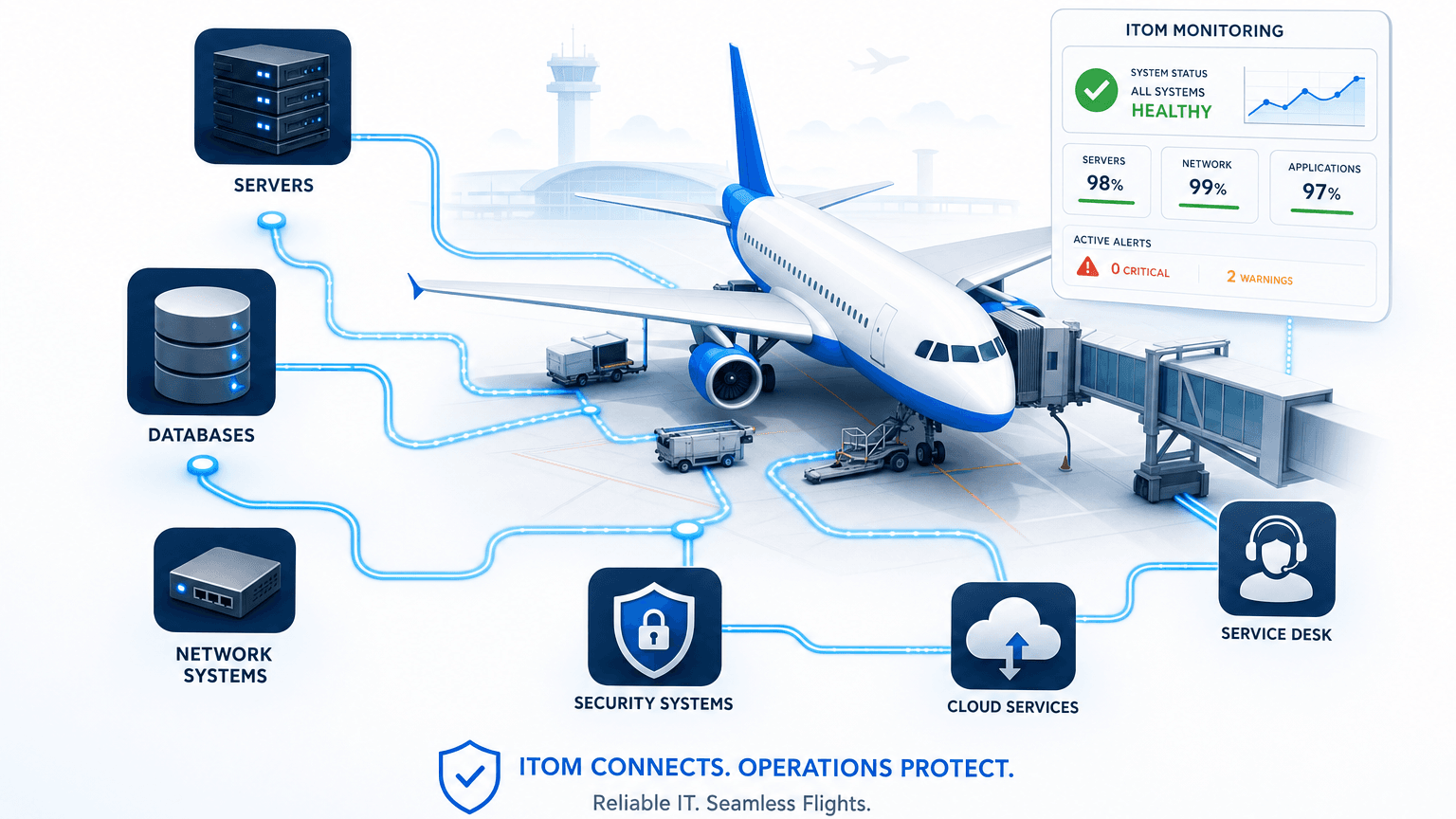
That is what ITOM for aviation and airlines exists to fix. Airline disruptions that make national headlines are rarely passenger booking glitches or web app timeouts. They are infrastructure failures in the ground-based authorization layer that legally certifies a flight to depart. Carriers now face strict Department of Transportation (DOT) refund mandates for controllable delays, which leaves IT leadership with a critical operational gap: mapping the ground-based IT infrastructure that dispatch and crew systems depend on. ITOM for aviation and airlines is the practice of mapping and monitoring that ground-based infrastructure — the servers, identity systems, and middleware — so IT teams know exactly which flight-authorization application goes down when a single component fails.
The outage pattern across commercial aviation
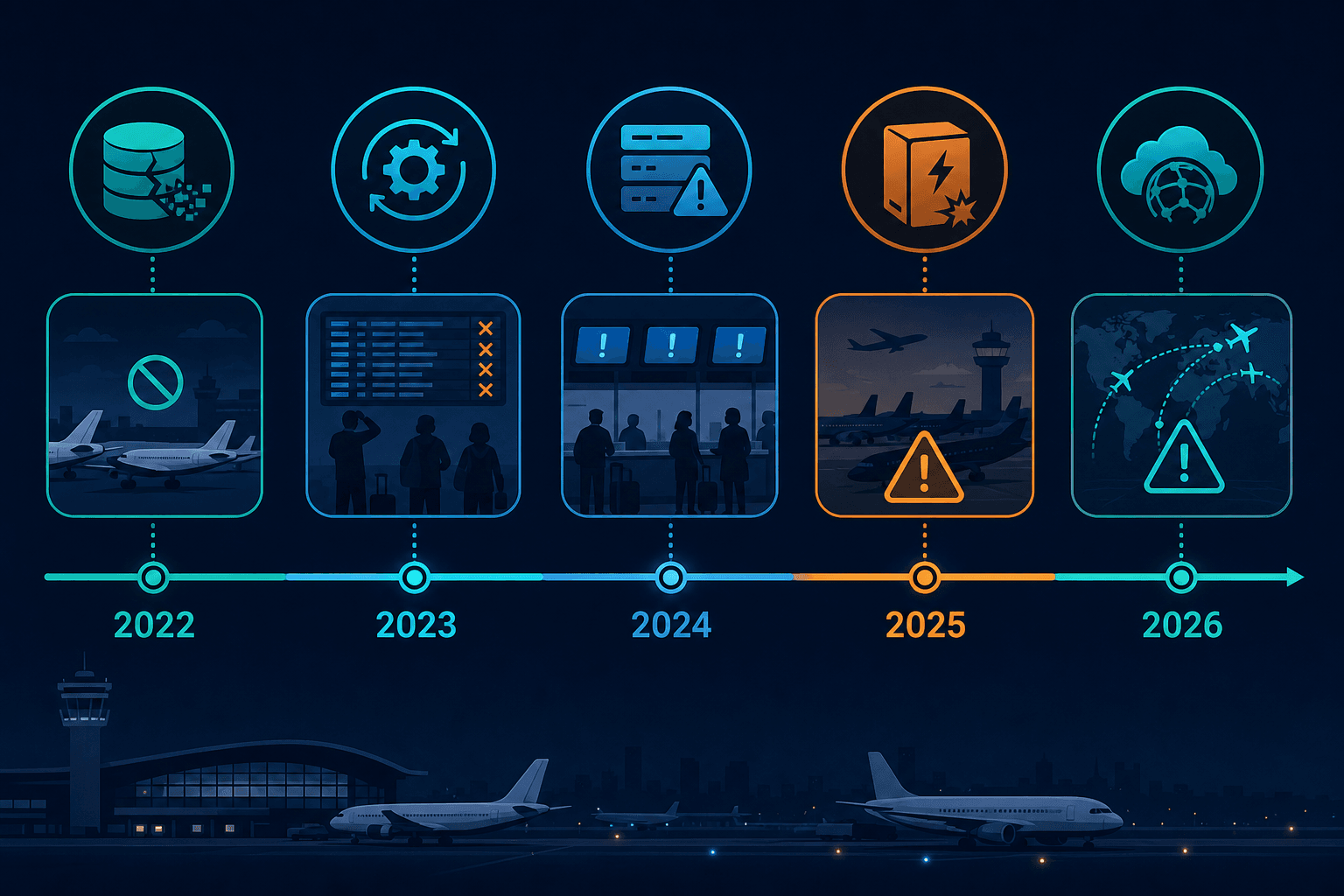
A review of major commercial airline disruptions over recent years reveals a consistent pattern. In December 2022, Southwest Airlines experienced a system-wide operational collapse when its crew-scheduling software could not process location updates for flight crews during severe weather. In January 2023, the Federal Aviation Administration (FAA) issued a nationwide ground stop after a corrupted database file disabled the Notice to Air Missions (NOTAM) system.
In July 2024, a third-party software update triggered widespread outages across global IT environments, causing Delta Air Lines to cancel thousands of flights as crew-tracking applications failed to reconcile flight attendant and pilot availability. Aviation trade press also reported a data-center hardware failure that forced Alaska Airlines into a fleet-wide ground stop in July 2025, an outage affecting United Airlines’ Unimatic weight-and-balance system that delayed more than a thousand flights in August 2025, and an IT infrastructure failure that halted American Airlines departures across domestic hubs in July 2026.
While each incident involved different root causes, hardware components, or software vendors, the operational impact followed an identical structure. The aircraft were functional, but the ground-based coordination systems required to authorize departure were unavailable. According to reporting by CIO Dive, legacy system dependencies and manual recovery steps repeatedly convert localized IT failures into multi-day ground stops.
Why do ground-based IT outages ground entire airline fleets?
Airlines cannot legally operate flights without ground-based authorization sign-offs from crew-tracking, dispatch-release, and weight-and-balance systems. When the underlying server, identity, or network infrastructure supporting these applications fails, aircraft remain at gates regardless of physical airworthiness or passenger booking status.
What authorizes a flight to depart vs. what handles bookings
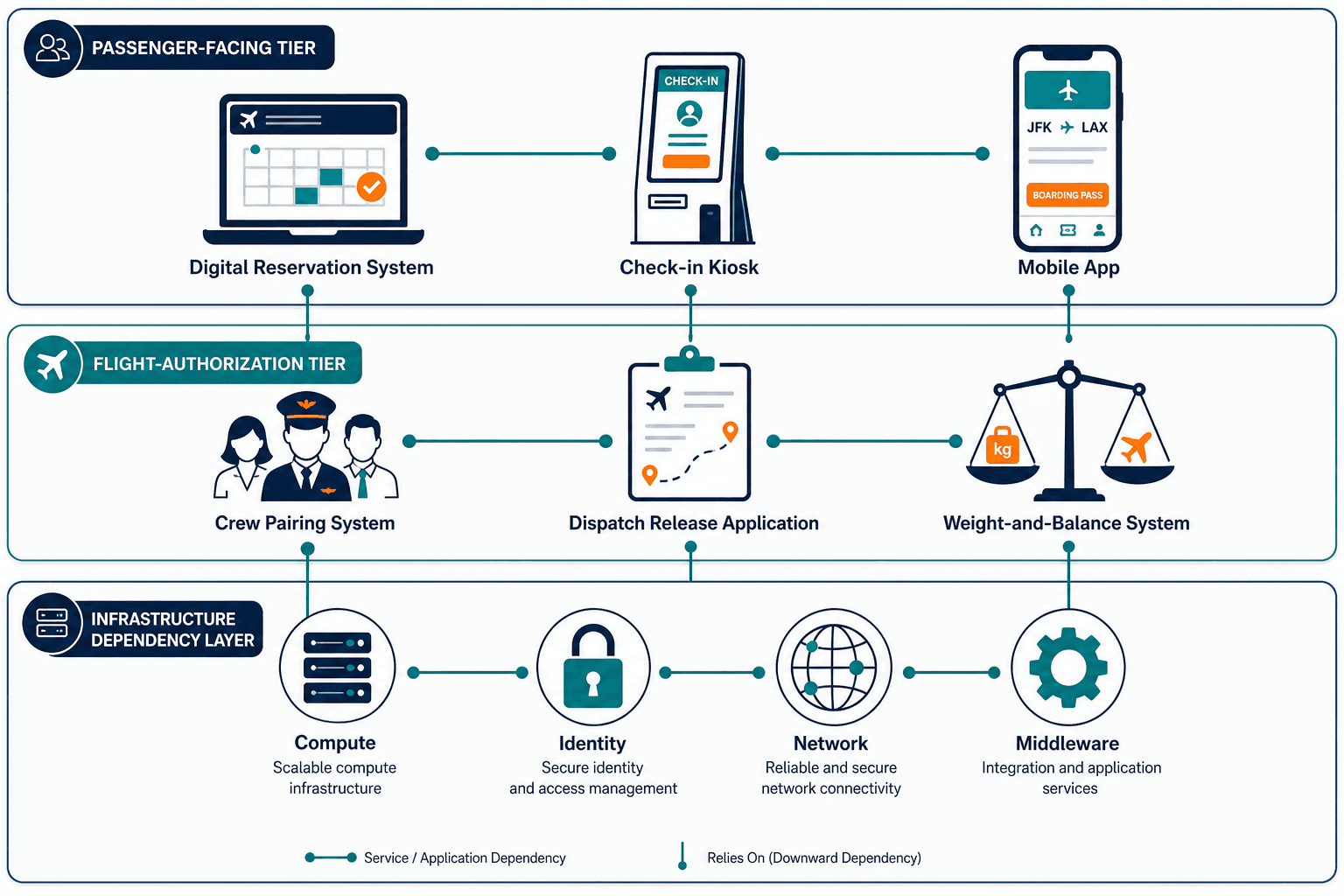
To understand why standard IT monitoring fails to prevent aviation ground stops, IT leaders must distinguish between passenger-facing digital systems and operational flight-authorization systems. Passenger reservations, online check-in, passenger service systems (PSS), and mobile apps form the customer-visible tier. An outage in this layer causes inconvenience, long airport lines, and public relations challenges, but it rarely prevents a fully boarded aircraft from taking off.
By contrast, the operational authorization tier consists of applications that certify flight safety and legal compliance:
- Crew pairing and crew-tracking: Systems that calculate legal duty hours, track physical crew locations, match required pilot qualifications, and issue legally binding crew assignments.
- Dispatch release and weight-and-balance: Applications that calculate fuel burn, payload limits, center of gravity, and weather routing to produce the official flight release.
- Load planning and baggage reconciliation: Systems verifying that cargo weight distribution matches flight deck calculations before baggage doors close.
During United’s Unimatic outage, line captains could view physical fuel gauges and aircraft sensors, yet flights could not push back because dispatch authorization algorithms run on ground servers. Explore how Virima Trusted Runtime Truth provides visibility across infrastructure dependencies supporting these operational applications.
The organizational split: vendor-managed vs. airline-owned infrastructure
A key reason flight-authorization infrastructure remains vulnerable is the organizational division between shared aviation technology and proprietary airline systems. Shared airport technology, including common-use passenger processing systems (CUPPS), departure control nodes, and baggage messaging networks, is frequently operated by specialized aviation IT providers such as SITA. These vendor-managed networks operate under dedicated service-level agreements and continuous monitoring architectures built specifically for airport operations.
However, the applications responsible for major flight disruptions usually sit outside vendor-managed perimeters. Crew scheduling engines, custom dispatch authorization tools, and weight-and-balance databases are typically owned, hosted, and maintained internally by the airline. Many rely on legacy codebases or custom integration middleware connecting mainframes to modern cloud interfaces.
Because these internally owned applications evolved over decades, their underlying infrastructure dependencies are rarely documented in a single, updated repository. When an enterprise IT team modifies a database schema, updates an identity access rule, or reconfigures a network switch, they may unknowingly sever a dependency supporting a flight-dispatch interface. Implementing effective ITOM for aviation and airlines requires bringing these internally owned, flight-critical systems into a structured IT operations management model.
Why operational recovery takes days instead of hours
When an IT component supporting a flight-critical application fails, the duration of the resulting ground stop depends on how quickly engineers can identify the blast radius. During Delta’s recovery following the July 2024 outage, news outlets including CNBC reported on the primary bottleneck. It was not restoring individual server OS instances, but manually re-syncing crew-tracking databases across thousands of displaced pilots and flight attendants.
Standard airline IT infrastructure monitoring dashboards alert operations teams when a server goes offline or a CPU spikes. But those dashboards cannot show which downstream applications lose connectivity when a specific network port or identity server fails unless a complete dependency map exists. Without live dependency mapping, recovery becomes a manual process of elimination:
- System administrators restore the primary database server.
- Integration middleware fails to reconnect because an intermediate authentication service timed out.
- Operations control staff attempt to process crew reassignments, unaware that data feeds from regional stations are stale.
- Uncoordinated manual entries create secondary data discrepancies, extending the outage across multiple flight banks.
Redundancy mechanisms also fail when dependencies remain unmapped. During the January 2023 FAA NOTAM outage, a backup database existed but contained corrupted data replicated from the primary system. Similarly, failover data centers cannot guarantee operational continuity if hidden hardware or software dependencies link back to the primary facility.
Why does airline IT outage recovery take days instead of hours?
Recovery stalls when IT teams lack live visibility into interdependency chains between infrastructure components and flight-critical applications. Manual system reboots and missing dependency maps prevent engineers from determining blast radius, delaying crew reassignments and flight re-dispatching across multi-station networks.
The financial stakes: DOT mandates and controllable delays
The financial consequences of flight-critical IT outages escalated significantly following regulatory changes by the U.S. Department of Transportation. Under the Federal Register Airline Passenger Rights rule, cancellations or significant delays caused by an airline’s internal IT failures, software glitches, or vendor infrastructure misconfigurations are classified as controllable disruptions.
This classification requires airlines to provide automatic, prompt cash refunds to affected passengers, alongside mandatory meal vouchers, ground transportation, and hotel accommodations during extended delays. A multi-hour outage that grounds several hundred flights quickly generates tens of millions of dollars in direct refund liabilities, setting aside lost future bookings and reputational damage.
For Chief Operating Officers and Chief Financial Officers, IT infrastructure reliability is no longer merely an internal technology metrics concern. It is a direct operational risk with quantifiable balance-sheet exposure. Ensuring that ground-based authorization systems remain online requires moving beyond basic server ping checks to active, infrastructure-to-service dependency mapping.
What does the DOT controllable-delay rule cost airlines during an IT outage?
Under the DOT’s Airline Passenger Rights rule, delays caused by an airline’s own IT failures are classified as controllable — triggering automatic cash refunds and mandatory passenger accommodations. A multi-hour outage that grounds several hundred flights can generate tens of millions of dollars in refund liability, making ground-based IT reliability a balance-sheet risk rather than an internal uptime metric.
Mapping infrastructure dependencies to protect flight operations
To protect flight-critical applications from unexpected downtime, airline IT organizations must establish full visibility into the relationship between physical assets, virtual compute instances, network topology, and operational services. This kind of IT dependency mapping for airlines is achieved through automated discovery combined with service dependency mapping within a centralized Configuration Management Database (CMDB) — in effect, a CMDB for airlines that stays current without manual updates.
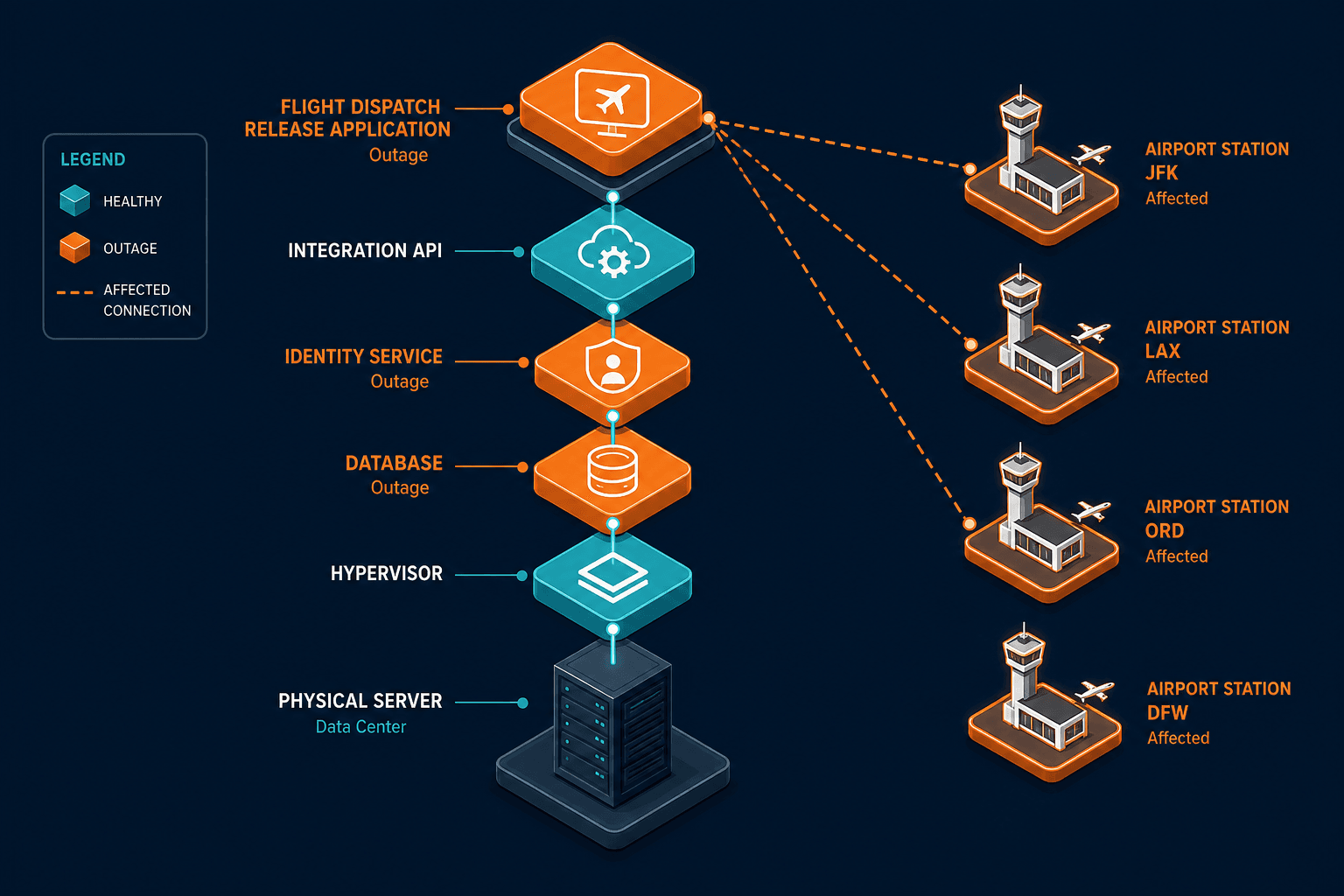
By implementing service dependency mapping for airline IT, infrastructure teams can trace the exact execution path supporting each operational function:
- Infrastructure layer: Physical servers, cloud instances, SAN storage arrays, network switches, firewalls, and load balancers.
- Platform and identity layer: Operating systems, hypervisors, Active Directory/IAM nodes, database instances, and container orchestrators.
- Integration layer: API gateways, enterprise service buses (ESB), MQ messaging queues, and data pipeline interfaces.
- Application tier: Crew scheduling engines, dispatch release software, weight-and-balance calculators, and load planning portals.
When scheduled discovery scans run across the ground estate, the ITOM platform automatically updates configuration item (CI) relationships. If a network engineer plans maintenance on a core router, the ITOM system analyzes the change’s impact before it happens, immediately displaying which station dispatch feeds or crew-tracking interfaces pass through that hardware segment.
If an unplanned hardware failure occurs, IT service desk and operations control teams can instantly view the blast radius, isolating the failed component before attempting recovery actions. See how ViVID™ service maps visualize these dependency chains, so teams aren’t tracing them manually for the first time during an outage.
Scoping ITOM for aviation and airlines: 4 practical steps
Airline IT environments encompass thousands of hardware devices and software applications across corporate headquarters, regional data centers, and dozens of airport stations. Attempting to map the entire enterprise simultaneously often leads to project fatigue. Instead, IT leaders should scope ITOM initiatives strategically, prioritizing the ground infrastructure supporting flight authorization:
- Map identity and authentication paths for crew systems: Identify all Active Directory controllers, single sign-on (SSO) gateways, and multi-factor authentication (MFA) services feeding crew-pairing and crew-tracking applications.
- Audit compute and database infrastructure for dispatch release: Document all physical and virtual hosts, database clusters, and storage volumes supporting weight-and-balance calculations and flight release sign-offs.
- Trace integration middleware linking operations control to stations: Map the messaging queues, API endpoints, and WAN connections that transport dispatch releases and crew manifests to airport gate agents.
- Validate data-center redundancy and failover paths: Use high-frequency discovery cycles to verify that backup servers and secondary network paths do not depend on single points of failure in the primary environment.
By establishing clear dependency records for these core operational paths, airlines can maintain accurate asset records in their ITAM software architecture, ensuring software licenses, hardware lifecycles, and security patches across flight-critical servers are fully tracked.
How do airline IT teams scope ITOM for flight-critical applications?
Airline IT teams scope ITOM by mapping infrastructure dependencies supporting four operational pillars: crew scheduling identity protocols, dispatch release server clusters, operational control integration middleware, and multi-data-center redundancy paths. This mapping establishes clear blast-radius visibility before hardware or network failures occur.
Maintaining airline IT resilience across ground infrastructure
The headline-making IT outages that ground commercial flights are rarely passenger website glitches or aircraft hardware failures — they are ground-based infrastructure disruptions in the applications that legally authorize flights to depart. Preventing multi-day ground stops means moving from static dashboards to active, discovery-sourced dependency mapping: full visibility into the infrastructure chains behind flight-critical systems lets airline IT teams analyze change impacts before maintenance occurs, identify blast radius instantly during incidents, and recover on a coordinated timeline instead of a manual one. That is the operational core of ITOM for aviation and airlines — turning an unmapped ground estate into one IT teams can trust before, during, and after a failure.
Frequently Asked Questions
Why don’t standard server monitoring tools prevent airline ground stops?
Standard monitoring tools track individual metrics like server CPU utilization or ping availability. They do not map the multi-tier dependency chains connecting network interfaces, databases, and middleware to flight-authorization applications. Without dependency mapping, IT teams cannot identify how localized hardware glitches affect flight dispatching or crew tracking.
How do DOT passenger rights rules impact airline IT operations?
The Department of Transportation classifies flight disruptions caused by an airline’s internal IT outages or software failures as controllable delays. This mandate requires airlines to issue automatic cash refunds and provide passenger accommodations, making ground-based system downtime a direct balance-sheet liability.
What role does Virima play in airline IT operations management?
Virima provides automated IT discovery, CMDB configuration management, and ViVID™ service maps for an airline’s corporate and ground-based IT infrastructure. It maps dependencies between servers, networks, databases, and operational applications, giving IT teams real-time blast radius visibility and change impact analysis.
Does Virima integrate with existing IT Service Management (ITSM) platforms?
Yes. Virima integrates with major ITSM platforms to populate and reconcile Configuration Management Database (CMDB) records. This ensures that change management, incident response, and IT service desk workflows operate on accurate, discovery-verified infrastructure relationship data.