What Is the ITIL Standard? ITIL 4 Framework Explained

The ITIL standard is a best-practice framework for managing IT and digitally enabled services — not a certifiable compliance standard like ISO 20000. It provides guidance across 34 management practices, from incident management to service configuration management, that organizations adopt selectively rather than implement wholesale. As of February 2026, ITIL Version 5 extends this framework with AI-native guidance and a revised digital product and service lifecycle model, while ITIL 4 (2019) remains the certification path many practitioners are still on.
ITIL is a framework, not a compliance standard
The phrase “ITIL standard” is widely used but technically imprecise. ITIL is a best-practice framework, not a formal standard in the way ISO 20000 or ISO 27001 are. Organizations cannot be audited for “ITIL compliance.” ITSM tools cannot be “ITIL-certified.” What they can be is ITIL-aligned, designed to support the practices ITIL describes.
PeopleCert, which owns and manages ITIL, describes it as “the most widely recognized framework for IT and digitally enabled services in the world,” providing “practical and proven guidance for establishing an effective service management system.” PeopleCert acquired Axelos, ITIL’s original creator, in 2021 and now manages the framework and its global certification program.
This distinction matters for how organizations use ITIL. Because it is guidance rather than a mandate, teams can adopt the practices that fit their context, without implementing all 34 management practices or reaching a specific certification tier first.
How ITIL evolved from 1989 to 2026
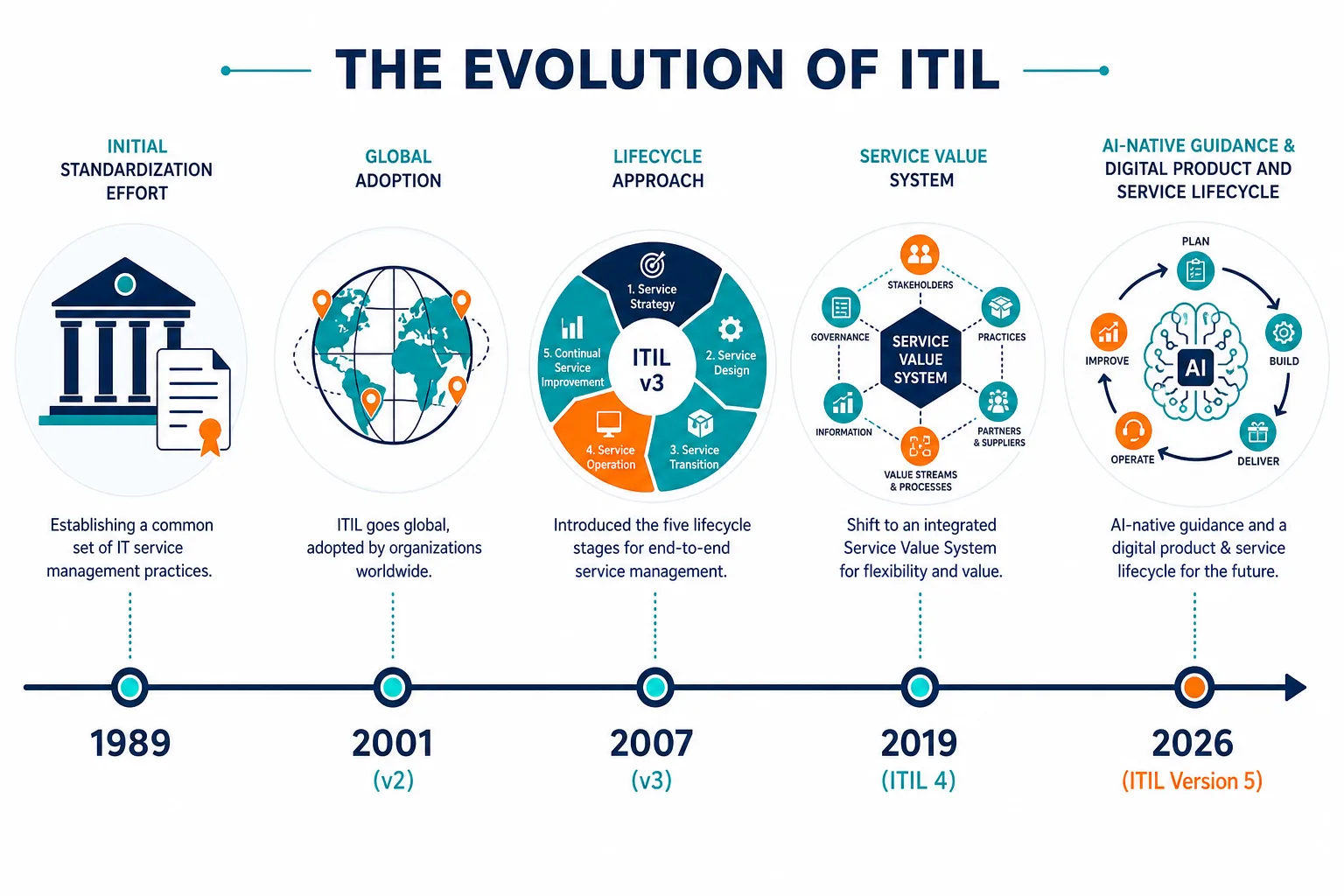
ITIL began in 1989 as a UK government effort to standardize IT service delivery across public sector agencies, then expanded with version 2 in 2001, which became the dominant reference for IT service management globally.
ITIL v3 followed in 2007, organizing best practices into five lifecycle stages: Service Strategy, Service Design, Service Transition, Service Operation, and Continual Service Improvement. The 2011 edition refreshed v3 without structural changes.
ITIL 4 launched in February 2019, marking a significant departure from the v3 lifecycle model. It introduced a Service Value System (SVS), replaced 26 processes with 34 management practices, and broadened its scope beyond IT to service management across the whole organization.
ITIL Version 5, the current release, launched its Foundation course and exam on February 12, 2026. It builds on ITIL 4’s foundation while restructuring several of its core elements, including a new lifecycle model and a revised qualification structure. ITIL 4 remains available for professionals already on that certification path.
The ITIL 4 core structure: SVS, service value chain, and four dimensions
ITIL 4 is built around the Service Value System, a model that shows how demand for services is converted into value. The SVS has five elements: the service value chain, 34 management practices, guiding principles, governance, and continual improvement.
The service value chain
The service value chain is an operating model with six activities: Plan, Improve, Engage, Design and Transition, Obtain and Build, and Deliver and Support. These activities are not a linear sequence. They operate as interconnected loops, allowing different combinations depending on the service or situation at hand.
The four dimensions of service management
ITIL 4 frames every practice across four dimensions:
- Organizations and people: culture, roles, capabilities
- Information and technology: data, tools, infrastructure
- Partners and suppliers: relationships, contracts, dependencies
- Value streams and processes: workflows, procedures, controls
Any change or improvement to a practice is evaluated across all four dimensions, not in isolation.
The 34 management practices
ITIL 4 replaced v3’s 26 processes with 34 management practices, grouped into three categories.
General management practices (14): architecture management, continual improvement, information security management, knowledge management, measurement and reporting, organizational change management, portfolio management, project management, relationship management, risk management, service financial management, strategy management, supplier management, and workforce and talent management.
Service management practices (17): availability management, business analysis, capacity and performance management, change enablement, incident management, IT asset management, monitoring and event management, problem management, release management, service catalogue management, service configuration management, service continuity management, service design, service desk, service level management, service request management, and service validation and testing.
Technical management practices (3): deployment management, infrastructure and platform management, and software development and management.
What is the ITIL standard and what does it cover?
ITIL is a best-practice framework for managing IT and digitally enabled services, not a formal compliance standard. It provides guidance across 34 management practices covering incident management, change enablement, IT asset management, service configuration management, and other service delivery disciplines. Organizations adopt it selectively based on their context and maturity.
What changed in ITIL Version 5 (2026)
ITIL Version 5 launched in phases beginning February 2026. It builds on ITIL 4 rather than replacing it, but changes more of the underlying structure than a phased rollout might suggest.
A new lifecycle model replaces the service value chain. Version 5 introduces an 8-activity Product and Service Lifecycle Model — Discover, Design, Acquire, Build, Transition, Operate, Deliver, and Support — in place of ITIL 4’s six-activity service value chain. Management practices are regrouped into two categories, Product and Service Management Practices and General Management Practices, rather than ITIL 4’s three, and “Experience” becomes a standalone core area alongside them.
AI-native by design. Practices are structured so roles, activities, and value streams can be augmented by AI capabilities. AI Governance is one of the new core books in Version 5’s qualification scheme, covering responsible AI adoption in service management.
Digital product and service life cycle. Where previous ITIL versions focused primarily on services, Version 5 introduces end-to-end life cycle guidance for digital products and services together. This reflects how modern organizations manage integrated products rather than standalone services.
Revised qualification structure. The new scheme organizes advanced certifications into three designation streams: ITIL Practice Manager (PM), ITIL Managing Professional (MP), and ITIL Strategic Leader (SL), with ITIL Foundation as the entry point and ITIL Master at the top for deep cross-stream expertise.
For IT teams already running ITIL 4 practices, Version 5 is an evolution rather than a reset. Existing certifications retain their value as new modules are introduced over time.
What is ITIL Version 5 and how is it different from ITIL 4?
ITIL Version 5, launched February 2026, replaces ITIL 4’s service value chain with an 8-activity Product and Service Lifecycle Model, regroups management practices into two categories instead of three, and adds AI-native guidance, a digital product and service life cycle model, and a revised qualification structure with three designation streams. Existing ITIL 4 certifications remain valid during the phased rollout.
Where ITIL connects to your CMDB and asset data
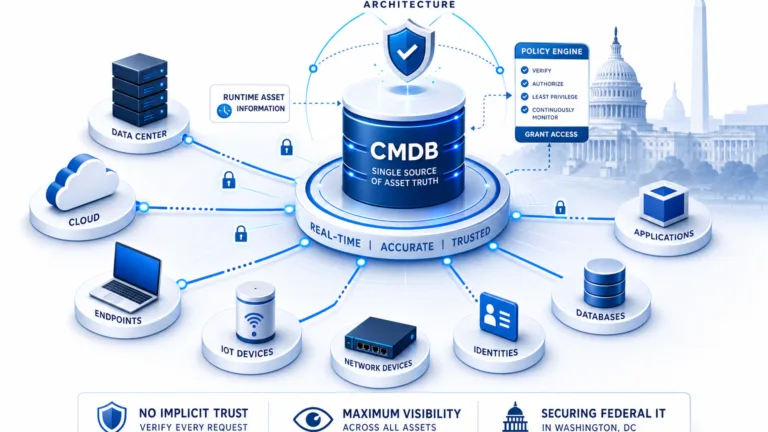
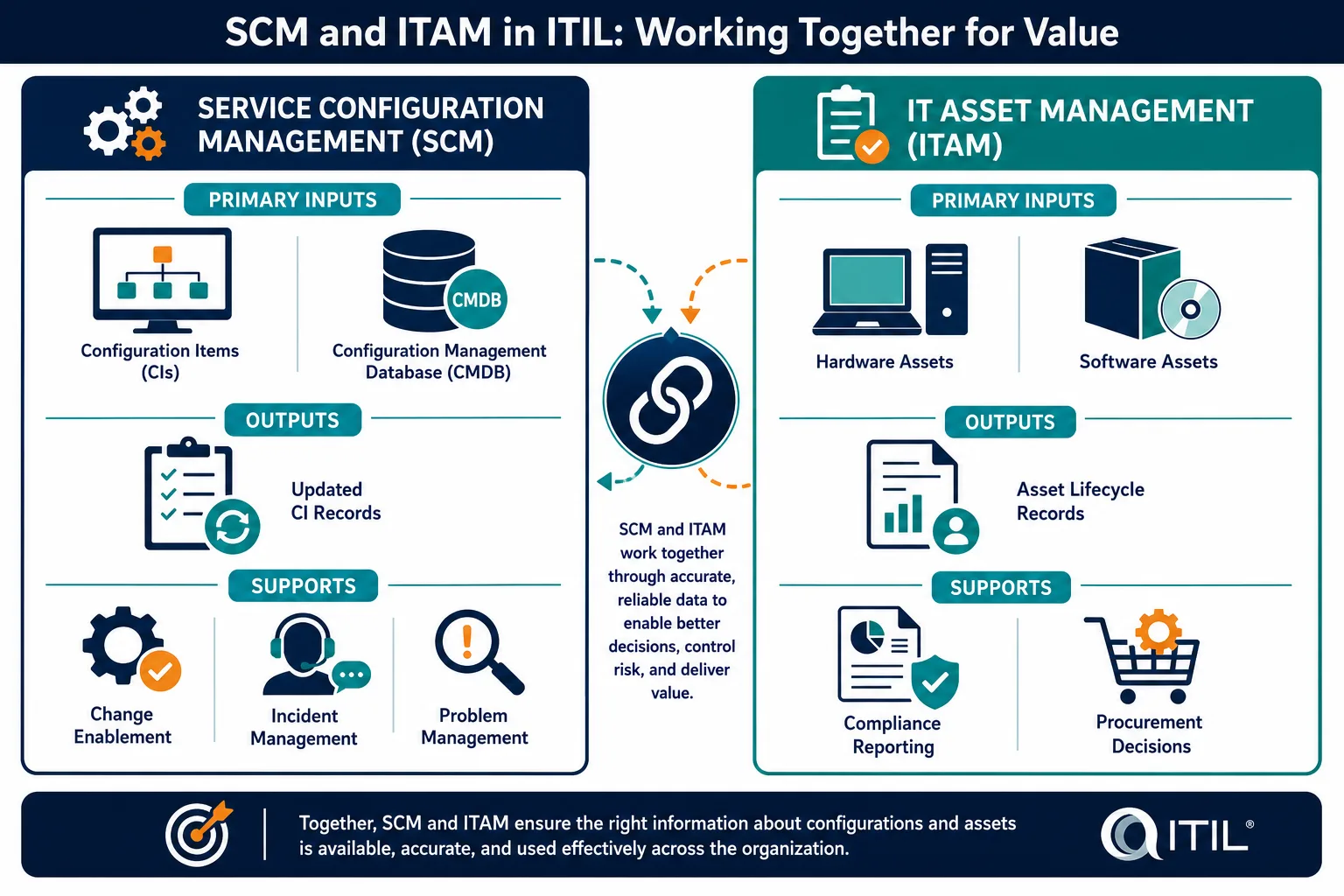
Two practices sit at the intersection of ITIL and operational data quality: service configuration management and IT asset management. In ITIL Version 5, both are explicitly grouped inside the Plan, Implement and Control module, acknowledging that configuration and asset data are foundational to how IT operates.
Service configuration management (SCM), what ITIL calls SACM, defines how configuration items (CIs) are identified, recorded, and maintained in a configuration management database (CMDB). Virima’s guide to ITIL v4 SACM covers how this practice is structured in more depth. An inaccurate CMDB undermines every other ITIL practice that depends on it. Change enablement cannot assess impact without reliable CI relationships. Incident management cannot identify affected services without current topology data. Problem management cannot trace root causes without historical CI records.
IT asset management (ITAM) tracks the ownership, life cycle, and financial value of hardware and software assets. In ITIL’s framework, ITAM provides the asset record data that feeds into service configuration management, procurement decisions, and audit readiness. Asset records populated from automated discovery stay current as the environment changes. Records built from manual entry age immediately.
Enterprises typically cannot see at least a fifth of their IT assets, per Gartner research cited by Oomnitza, which limits how reliable service configuration management and ITAM records can be until that gap closes.
Virima’s configuration management capabilities address both practices directly, using automated discovery across on-premises, AWS, and Azure environments to source the asset and configuration records that keep ITIL’s most data-dependent practices reliable.
How does ITIL relate to the CMDB?
ITIL’s service configuration management practice defines how configuration items are recorded and maintained in a CMDB. That data feeds change enablement (impact assessment), incident management (affected service identification), and problem management (root cause analysis). An inaccurate CMDB means each of these practices operates on assumptions rather than facts about what exists in the environment.
Why ITIL implementations stall: the data quality gap
The most common ITIL implementation gap is not process design but data quality. Organizations stand up incident management, change enablement, and configuration management processes correctly modeled from ITIL guidance, then find the records those processes depend on are incomplete or out of date.
Up to 75% of CMDB deployments fail to fully deliver on their intended goals due to data quality and completeness issues, according to ReadyWorks, which explains why change and incident processes built on that data underperform their design.
A well-structured change enablement process calculates risk against CI relationships. If those relationships are missing or stale, change risk assessments are approximations. A service desk running on ITIL incident management routes tickets by service affiliation, and Virima’s guide to ITIL incident and problem management breaks down how that routing depends on configuration data quality. If configuration data does not accurately reflect which infrastructure items support which services, routing is at best an educated guess.
The practices work as designed when the data underneath them is reliable. Bridging this gap requires investment in the discovery and configuration management layer, not only in the process layer.
Virima’s guide to ITIL and CMDB management covers how these two disciplines connect in greater depth.
Turning the ITIL framework into working operations
ITIL provides the vocabulary, structure, and practice guidance IT teams need to deliver reliable services. ITIL 4 replaced v3’s lifecycle model with a Service Value System built around 34 management practices, and ITIL Version 5 restructures that foundation further with a new product and service lifecycle model and AI-native guidance for digital organizations.
What separates an ITIL program that produces real operational improvement from one that generates documentation is the quality of the data feeding its practices. Configuration records, asset inventory, service dependencies, and change history all need to be accurate and current, as a maintained operational standard, not an aspiration.
For teams building or modernizing their ITIL-aligned ITSM environment, Virima’s ITAM platform connects discovery-sourced asset and configuration data to ITSM workflows across ServiceNow, Jira Service Management, Ivanti, HaloITSM, Xurrent, and Hornbill.
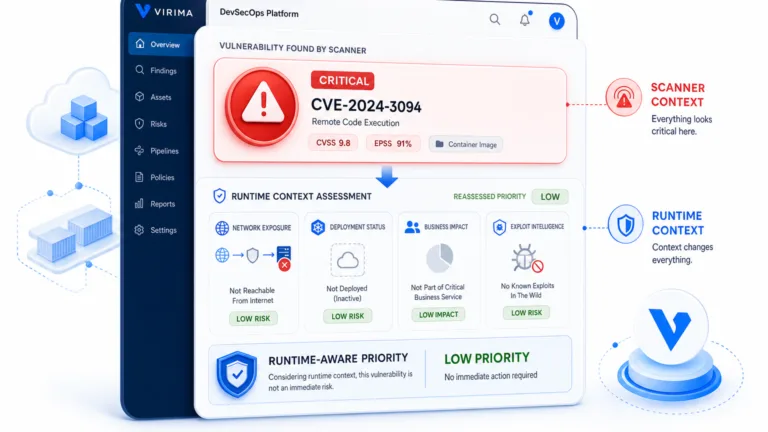
See how Virima’s discovery-sourced runtime truth gives ITIL’s configuration management and asset management practices the data foundation they need. Explore the Trusted Runtime Truth approach.
Frequently Asked Questions
What is the ITIL standard?
ITIL is a best-practice framework for managing IT and digitally enabled services, not a formal compliance standard. Organizations cannot be audited for “ITIL compliance,” and tools cannot be “ITIL-certified.” The ITIL standard provides 34 management practices covering incident management, change enablement, service configuration management, IT asset management, and other service delivery disciplines. Individuals earn ITIL certifications and apply the guidance within their organizations.
What is the difference between ITIL 4 and ITIL Version 5?
ITIL 4, launched in 2019, introduced the Service Value System, a six-activity service value chain, and 34 management practices across three categories. ITIL Version 5, launched in February 2026, replaces the service value chain with an 8-activity Product and Service Lifecycle Model, regroups practices into two categories, and adds AI-native guidance, an end-to-end digital product and service life cycle model, and a revised qualification scheme with three designation streams. Existing ITIL 4 certifications remain valid as Version 5 is introduced in phases.
Why do ITIL implementations fail?
Most ITIL implementations stall not because the process design is wrong but because the data feeding those processes is unreliable. Change enablement, incident management, and service configuration management all depend on accurate CI records. When the CMDB is incomplete or stale, ITIL practices that rely on it produce approximations rather than informed decisions. Sustained success requires investment in the discovery and configuration management layer.
How does Virima support ITIL practices?
Virima provides discovery-sourced CMDB and ITAM capabilities that directly support ITIL’s service configuration management and IT asset management practices. Automated discovery across on-premises, AWS, and Azure environments keeps CI and asset records current as the environment changes. Virima integrates with ServiceNow, Jira Service Management, Ivanti, HaloITSM, Xurrent, and Hornbill to connect that data to ITSM workflows.
Is ITIL the same as ISO 20000?
No. ISO 20000 is a formal international standard for IT service management that organizations can be certified against through an audit. ITIL is a best-practice framework that informs how service management processes are designed and run. ITIL guidance is widely used to help organizations meet ISO 20000 requirements, but the two are distinct: one is a certifiable standard, the other is practical guidance.