ITIL v4 SACM Explained: What Service Asset and Configuration Management Means for Your CMDB and Service Delivery

TLDR: SACM is the ITIL v4 practice that governs how service assets and configuration items are identified, controlled, verified, and managed across their lifecycle. Virima 6.1.1 supports the full SACM lifecycle — from CI identification and blueprint-driven population to audit history, configuration baselines, drift detection, and business rules governance.
Most ITIL conversations focus on the visible, high-traffic practices: Incident Management, Change Enablement, and Service Desk. These practices touch end users, generate tickets, and produce metrics that executives track in dashboards.
Service Asset and Configuration Management — SACM — works behind all of them. It’s the practice that determines whether the data those other practices depend on is trustworthy.
When a change manager approves a change, they rely on CI data to assess impact. When an incident responder troubleshoots a service outage, they rely on service relationships in the CMDB. When a problem manager investigates a recurring failure, they rely on configuration history to identify what changed. If the CMDB is inaccurate, stale, or inconsistently governed, every downstream practice degrades.
SACM is how you make the CMDB trustworthy. It’s the practice, the discipline, and the governance model that transforms a database of configuration records into a reliable source of truth for IT service delivery.
Yet SACM is consistently underimplemented. Organizations buy CMDB tools, populate them during implementation, and then let them drift. They have the tool without the practice. This article explains what SACM actually is, what it requires, and how Virima 6.1.1 supports its full implementation.
What Is SACM in ITIL v4?
Service Asset and Configuration Management (SACM) is one of the 34 management practices defined in the ITIL v4 framework. Its purpose, as defined by ITIL v4, is to ensure that accurate and reliable information about the configuration of services — and the CIs that support them — is available when and where it is needed.
SACM covers:
- The identification of all service assets and configuration items (CIs) within scope
- The control of those assets throughout their lifecycle — ensuring only authorized changes are made
- The status accounting of each CI — tracking its current state (New, Active, Maintenance, Retired)
- The verification and audit of CI data — confirming that what the CMDB says matches what actually exists in the environment
- The governance model that defines who can create, update, or retire CIs, and under what conditions
SACM is distinct from simply owning a CMDB. The CMDB is the tool. SACM is the discipline that governs how that tool is populated, maintained, and verified. An organization can have a fully deployed CMDB and no meaningful SACM practice — and many do.
In ITIL v4, SACM sits within the Service Management practice group and interacts directly with Change Enablement, Incident Management, Problem Management, and IT Asset Management. It’s the connective tissue that makes those practices data-reliable.
The Seven Key Activities of SACM
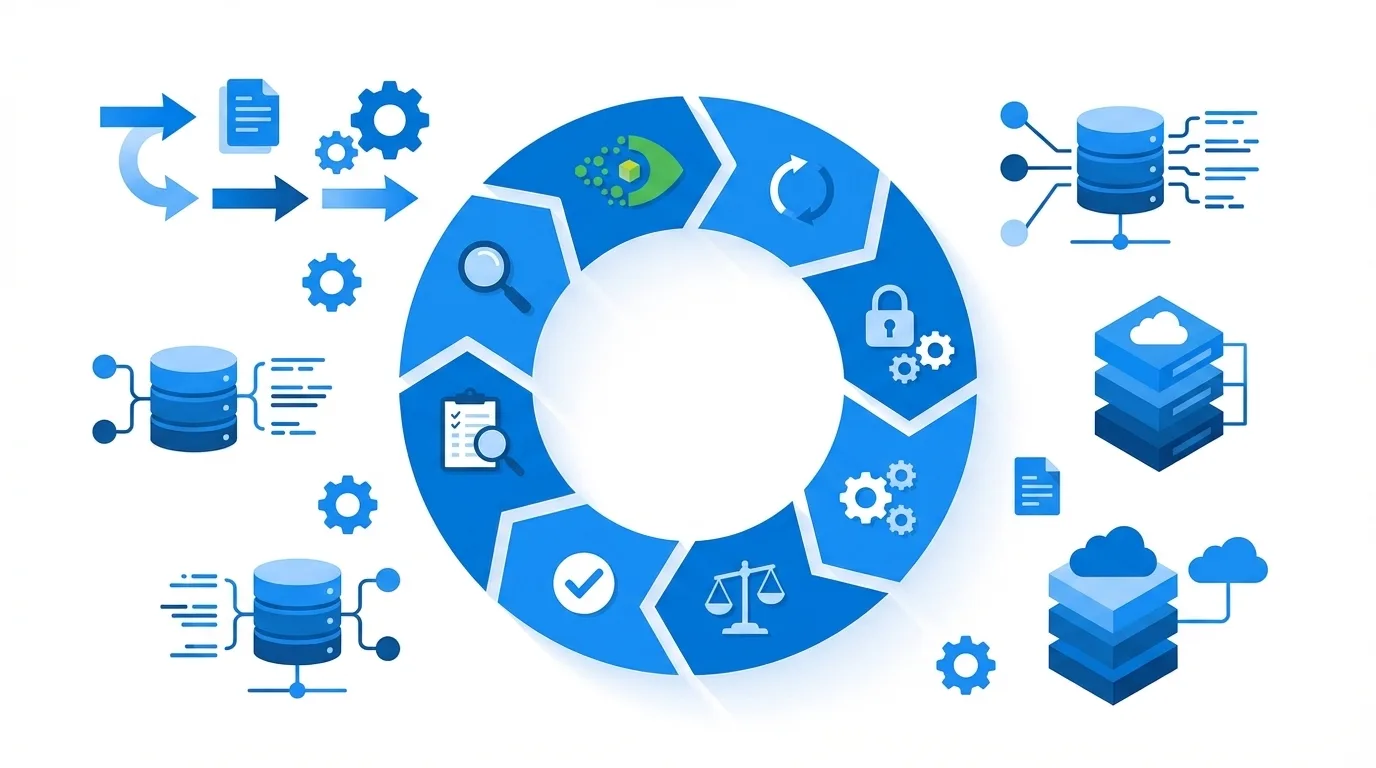
SACM organizes around a set of core activities that together constitute the practice:
1. CI Identification
Define the scope of what the CMDB tracks: which types of CIs matter (servers, software, services, network devices), what attributes each CI type captures, and what relationships between CIs are tracked. CI identification also covers naming conventions and CI type taxonomies.
2. CI Control
Ensure that only authorized changes are made to CI records. CI control connects directly to Change Enablement — every change to the physical or logical environment should have a corresponding CI record update, and that update should happen through a governed process, not ad-hoc editing.
3. Status Accounting
Track each CI through its lifecycle states. Typical lifecycle states include New, Active, Maintenance, Retired, and Deleted. Status accounting provides the current state of every CI and the history of state transitions — essential for audit trails and for understanding which CIs actively support services.
4. Configuration Verification
Confirm that CI data in the CMDB matches the actual state of the environment. This is where discovery tooling becomes critical — automated discovery provides the ground truth that verification checks against. Discrepancies between CMDB records and discovered reality are flagged for review and correction.
Research published by Enterprise Management Associates (EMA) in their 2025 ServiceOps report confirms that configuration management gaps and incomplete CI inventories remain primary contributors to unplanned outages in enterprise IT — making configuration verification a practice-critical activity, not a periodic cleanup task.
5. Configuration Audit
A formal review of CI data against authoritative records — purchase orders, blueprints, configuration baselines — to confirm data integrity. Audits may be scheduled (regular compliance audits) or event-driven (triggered by a major incident or change failure).
6. Configuration Reporting
Produce reports on the configuration estate: which CIs are in each lifecycle state, which have unresolved discrepancies, which have changed recently, and how the configuration supports current service delivery. Reports support change planning, compliance programs, and executive-level IT governance.
7. Configuration Baseline
A recorded, approved snapshot of the configuration of a service or system at a specific point in time. Baselines serve as the reference point for change verification — if a CI drifts from its baseline, that drift is detectable and reportable. Baselines also support rollback planning and regulatory compliance.
SACM vs. CMDB: What’s the Difference?
This distinction is fundamental and often misunderstood.
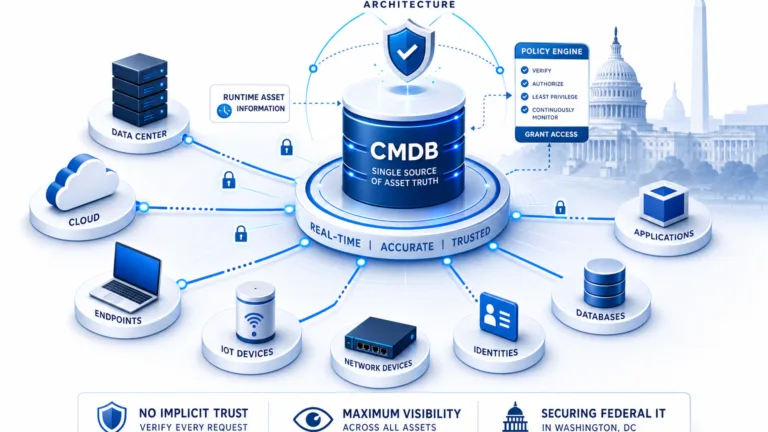
The CMDB is a tool — a database that stores CI records, attributes, and relationships. It’s technology. You can deploy a CMDB in days with modern tooling.
SACM is a practice — the set of policies, processes, roles, and governance structures that determine how the CMDB is populated, maintained, and used. You cannot deploy a practice in an afternoon. It requires organizational design, stakeholder alignment, tooling configuration, and ongoing governance.
An organization with a CMDB but no SACM practice has a database that starts accurately and progressively degrades. CI records become stale as the environment changes. Relationships become orphaned as devices are decommissioned. Baselines are never defined, so drift is never detected. Discovery runs, but discrepancies are never resolved because no governance process owns them.
An organization with both a CMDB and a SACM practice has a database that stays accurate because the practice defines who is responsible for keeping it accurate, how changes are controlled, how discrepancies are resolved, and how data quality is measured.
How Virima Supports the Full SACM Lifecycle
Virima 6.1.1 is designed to support the ITIL v4 SACM practice end-to-end. Each SACM activity maps to specific Virima capabilities:
CI Identification — Virima supports the definition of CI types, attributes, and relationship types through a configurable data model. IT teams define the scope of the CMDB within Virima, establishing which CI types matter, what attributes each captures, and how relationships are named and categorized.
CI Control — Virima’s business rules engine governs CI record creation, updates, and status transitions. Rules define who can perform which operations on which CI types, ensuring that CI data changes through authorized processes rather than ad-hoc edits.
Status Accounting — Each CI in Virima tracks its lifecycle state: New, Active, Maintenance, Retired, Deleted. State transitions are logged with a timestamp and user attribution, providing a complete status history for every CI.
Configuration Verification — Virima Discovery provides the ground truth for verification. After each discovery run, Virima surfaces discrepancies between what Discovery found and what the CMDB currently records. These discrepancies enter a review queue where SACM practitioners confirm, correct, or investigate each one.
Configuration Audit — Virima’s audit history framework logs every change to every CI record — attribute updates, relationship changes, and status transitions — with a timestamp and user attribution. This audit log supports both scheduled SACM audits and event-driven reviews triggered by incidents or change failures.
Configuration Reporting — Virima produces configuration reports exportable for compliance, audit, and governance purposes. Reports cover CI lifecycle status distribution, recent changes, unresolved discrepancies, and relationship completeness.
Configuration Baseline — Virima supports the definition and storage of configuration baselines — recorded, approved snapshots of CI configurations at a specific point in time. Drift from a baseline is detectable through the combination of Discovery data and CMDB record comparison.
ViVID Service Mapping for automated service relationship discovery connects supporting infrastructure to the business services they enable, giving SACM practitioners a full dependency picture for impact assessment and audit.
Configuration Baselines and Drift Detection in Virima
Configuration baselines are one of the most operationally valuable SACM capabilities, and one of the least implemented. A baseline captures the known-good configuration of a CI or group of CIs at a specific point in time — after a successful change, after a planned upgrade, or at the start of a compliance period.
In Virima, baselines serve as the reference point for drift detection. When Discovery runs and updates CI records, the CMDB compares current configuration attributes against the baseline. Any deviation — a new software install, a configuration parameter change, a relationship that has appeared or disappeared — surfaces as a drift event.
Drift detection supports three critical operational activities:
- Change verification: Confirming that a change was implemented as planned, and that no unintended side effects occurred in adjacent CIs
- Incident investigation: Identifying configuration changes that preceded an incident — answering the question “what changed since the last known-good state?”
- Compliance monitoring: Demonstrating to auditors that critical systems stayed within approved configuration parameters during a compliance period
How SACM Supports Change, Incident, and Problem Management
SACM is the data foundation for three of ITIL v4’s most operationally intensive practices:
Change Enablement relies on SACM data to assess the impact of proposed changes. Before approving a change, the change manager reviews which CIs are affected, what services depend on those CIs, and what other changes are in flight for the same infrastructure. Without accurate CI relationships, impact assessment is guesswork — and guesswork produces change failures.
Incident Management uses CMDB data to understand the scope of an incident, identify affected services, and route the incident to the right resolver group. Accurate service mapping — maintained by SACM — determines whether an incident affecting one CI triggers cascading alerts for dependent services, or whether the impact is isolated.
Problem Management uses configuration history — maintained by SACM — to identify what changed in the environment before a problem manifested. The CI audit trail is the primary artifact for root cause analysis. Without that trail, problem investigations rely on human memory rather than structured data.
SACM and IT Asset Management: How They Overlap
SACM and ITAM are related but distinct practices. Both involve tracking IT resources with structured data. The difference is in scope and purpose:
- ITAM tracks assets for financial, procurement, and lifecycle management purposes — what you own, what it cost, when warranties expire, and what the refresh cycle is.
- SACM tracks CIs for service delivery and configuration governance purposes — what supports your services, what configuration it’s in, and how that configuration changes over time.
The same physical asset — a server — is both an ITAM asset record and a CMDB CI. The ITAM record tracks cost, vendor, and lifecycle. The CMDB CI record tracks configuration, relationships, and service impact.
Virima 6.1.1 supports both, with ITAM and CMDB records connected through the same data model. The same discovery run that populates configuration data also updates asset lifecycle records. There’s no duplicate data entry and no reconciliation between separate ITAM and CMDB systems.
How to Implement SACM in Your Organization Using Virima
A practical implementation path for SACM in Virima follows these stages:
Step 1 — Define CI scope. Identify which CI types matter for your service delivery objectives. Start with the infrastructure that supports your most critical services. Do not attempt to track everything at once.
Step 2 — Configure CI types and attributes. In Virima, configure the CI type taxonomy, attribute schemas, and relationship types for your defined scope.
Step 3 — Run Discovery. Configure and run Virima Discovery to populate the CMDB with discovered CIs. Review the initial population for completeness and accuracy.
Step 4 — Define blueprints. Create CI blueprints in Virima — templates that define the expected configuration of each CI type. Blueprints become the basis for integrity checking and baseline comparison.
Step 5 — Establish governance. Configure business rules to control who can create, update, and retire CIs. Define the review workflow for Discovery discrepancies.
Step 6 — Define baselines. Capture configuration baselines for critical services after the initial CMDB population is validated.
Step 7 — Operate the practice. Run Discovery on a regular schedule, review discrepancies, resolve drift events, and conduct periodic configuration audits. Report on data quality metrics.
Conclusion
SACM is the ITIL v4 practice that makes the CMDB trustworthy. Without SACM, even the best CMDB tool degrades into an inaccurate database that practitioners stop trusting and start working around.
Virima 6.1.1 supports the full SACM lifecycle — CI identification, control, status accounting, verification, audit, reporting, and baseline management — through a combination of configurable CI types, automated Discovery, business rules governance, audit history, and drift detection.
For a broader context on why configuration management gaps remain a leading operational risk, download the EMA ServiceOps 2025 report.
Schedule a Demo at virima.com to see how Virima supports ITIL v4 SACM implementation in a live environment.
Frequently Asked Questions
Is SACM a mandatory practice in ITIL v4?
ITIL v4 does not prescribe mandatory practices — organizations adopt the practices relevant to their service management maturity and goals. That said, SACM is foundational. Practices like Change Enablement, Incident Management, and Problem Management all depend on the accurate CI data that SACM governs. Organizations that skip SACM typically find that their other ITIL practices degrade because the underlying data cannot be trusted.
How long does it take to implement a meaningful SACM practice with Virima?
Implementation timelines depend on the complexity of the environment and the scope of the initial CI population. Organizations typically achieve an initial CMDB population via Discovery within weeks of deploying Virima. Establishing the full SACM governance framework — CI control rules, baseline definitions, discrepancy review workflows — is an iterative process that matures over months. The practical recommendation is to start with a defined scope (critical services and their supporting CIs) and expand from there.
What is the difference between a configuration baseline and a configuration snapshot?
A configuration snapshot is a point-in-time record of CI attributes — a historical record of what the configuration looked like at a specific moment. A configuration baseline is an approved, named reference configuration — the declared known-good state that serves as the standard for comparison. Baselines are intentional and governed; snapshots are automatic. Virima maintains both: the audit history provides snapshots, and the baseline framework allows teams to declare specific states as approved baselines for ongoing drift detection
This article reflects capabilities in Virima 6.1.1. For the latest feature information, visit virima.com.