IT Asset Management Compliance: ISO Standards Explained

IT asset management compliance is the practice of ensuring your organization’s hardware, software, and cloud assets are tracked, governed, and audited in line with regulatory and standards requirements, including ISO/IEC 19770-1, ISO/IEC 27001 Annex A, and ITIL. That’s a different topic from financial or investment compliance, which shares the same search terms but has nothing to do with servers, laptops, or SaaS entitlements. Most compliance failures are not caused by missing policies. They are caused by asset records that do not reflect what is actually running at the time of an audit. This guide breaks down which standards apply, what auditors check first, and why that gap between paper and reality keeps widening.
What IT Asset Management Compliance Actually Covers
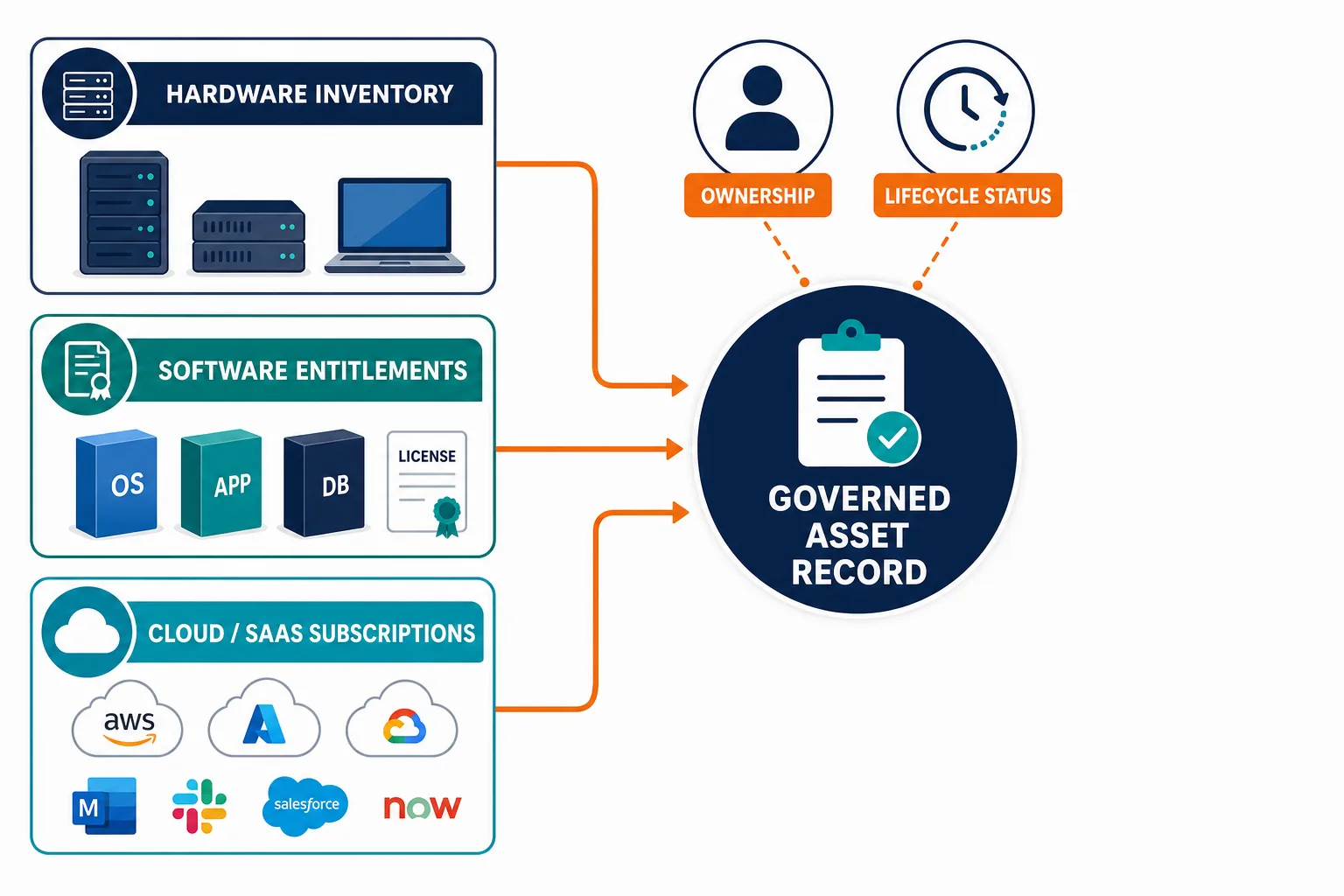
IT asset management compliance means your hardware, software, and cloud inventory can be verified, at any point in time, against what auditors, regulators, or your own risk team expect to see. That includes physical devices, licensed software entitlements, cloud and SaaS subscriptions, and the ownership and lifecycle status attached to each one. It is narrower than general IT compliance (which spans network security, access control, and data handling) and broader than a single license audit, because it covers the full asset record an auditor pulls, not only the software counts.
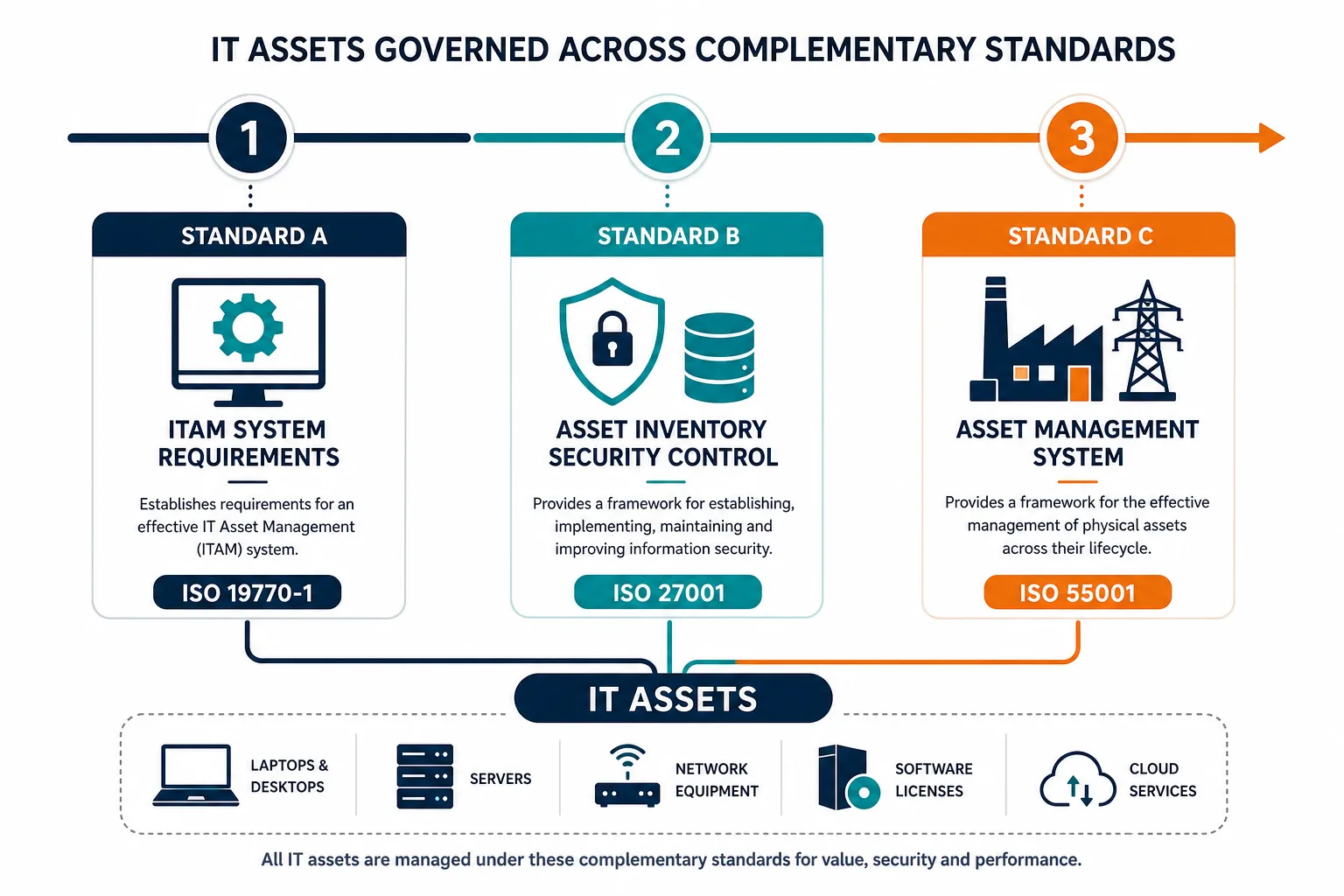
Three standards define most of what “compliant” means in this space: ISO/IEC 19770-1 for the IT asset management (ITAM) system itself, ISO/IEC 27001 Annex A for information security asset controls, and ISO 55001 for general asset management, which applies more to physical and infrastructure assets but still touches IT hardware in regulated industries. None of these standards require a specific tool. All three require the same underlying thing: an asset inventory that is current, owned, and traceable.
That’s the part most organizations get wrong. A written ITAM policy satisfies a checklist question. An asset register that is six months out of date does not satisfy an auditor who cross-checks it against a live network scan.
Lifecycle status matters as much as existence. An asset flagged end-of-life or end-of-support six months ago but still shown as “active” in your register is exactly the kind of discrepancy that turns a routine audit into a finding, because it signals the register was never updated after the status changed, not only that one field was missed.
The ISO Standards That Define IT Asset Management Compliance
| Standard | What It Governs | Names a Specific Tool? | Applies To |
|---|---|---|---|
| ISO/IEC 19770-1:2017 | The ITAM system itself — full asset lifecycle from acquisition through retirement | No | IT hardware, software, and cloud assets |
| ISO/IEC 27001 (control 5.9) | Asset inventory as one information security control, with a named owner per asset | No | Information assets and the systems that store or process them |
| ISO 55001:2024 | General asset management under a documented decision-making framework | No | Physical and infrastructure assets, extending to IT hardware in regulated industries |
ISO/IEC 19770-1:2017: the ITAM system requirements standard
ISO/IEC 19770-1:2017 defines what a functioning IT asset management system looks like, structured as a tiered maturity model that organizations can build toward rather than an all-or-nothing certification. It covers the full asset lifecycle: acquisition, deployment, ongoing management, and retirement, with an emphasis on data that is trustworthy enough to support decisions, not data that merely exists somewhere in a spreadsheet.
ISO/IEC 27001 Annex A: asset inventory as a security control
ISO/IEC 27001’s 2013 edition addressed this under Annex A.8.1, and many teams still refer to it by that name. The 2022 revision renumbered and consolidated it into control 5.9, “Inventory of information and other associated assets,” which requires that information assets and the systems that store or process them be identified, inventoried, and assigned an owner responsible for their protection (DataGuard). ISO 27001 does not name a CMDB (a configuration management database that records IT assets and the relationships between them) or any specific tool. It requires the outcome a CMDB is built to produce: a current, owned asset inventory that maps to your information security scope.
ISO 55001:2024: general asset management, briefly
ISO published updated editions of ISO 55000 and 55001 on July 3, 2024, adopting the same harmonized structure used by ISO 9001 and ISO 14001 and adding an explicit requirement for a documented asset management decision-making framework (ISO). ISO 55001 applies more broadly to physical and infrastructure assets than to IT specifically, but organizations in regulated industries such as financial services, healthcare, and utilities often need to show IT hardware fits inside that same asset management system.
What Auditors Actually Look for in Asset Evidence
Auditors do not evaluate whether you have an asset management policy. They evaluate whether your asset record survives a spot check. That typically means three things: every asset has a named owner, every asset’s location and status can be confirmed against a recent scan (not an annual review), and the record reconciles with financial or procurement data instead of showing assets that finance capitalized but IT cannot locate.
In practice, that evidence takes a specific shape: a timestamped inventory export, ownership fields populated for every asset and not only the flagship servers, and a change history showing when each asset entered or left the environment. Auditors increasingly ask for that change history explicitly, because a single snapshot cannot show whether an asset was added last week or three years ago.
This is where most organizations struggle, and the numbers back that up. A 2025 GRC audit research study found that only 29% of organizations say their compliance programs consistently meet internal and external standards, which means a majority of teams walk into an audit with a compliance program that will not hold up under scrutiny (Swimlane). The gap is rarely a missing policy document. It’s a record that was accurate on the day someone last checked it and has been quietly drifting ever since.
Reconciliation matters as much as inventory completeness here. An auditor who finds a mismatch like 340 servers in your finance system against 287 in your discovery scan isn’t going to accept “we’ll look into it” as an answer during the audit window itself, which is exactly why software license compliance audits treat entitlement reconciliation as a standing process, not a once-a-year scramble.
The three-part evidence test: a named owner for every asset, status confirmed against a recent scan rather than an annual review, and reconciliation against financial or procurement records. A written policy satisfies none of these three on its own.
Why Inaccurate Asset Records Are the Most Common Compliance Gap
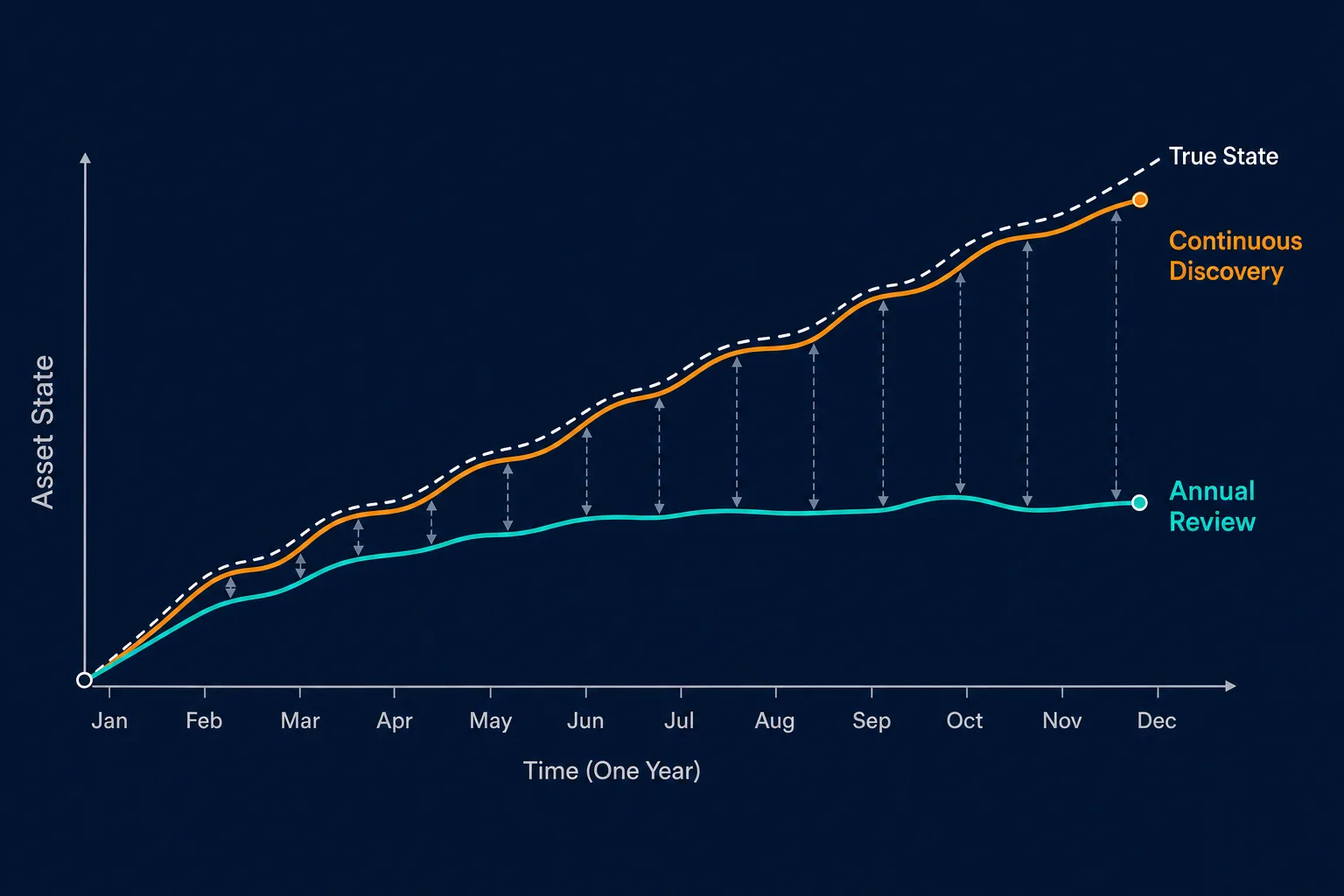
Most ITAM compliance gaps trace back to one root cause: the inventory is a snapshot, and the environment is not. Gartner research cited in a 2025 IT asset management analysis found that 24% of organizations have not verified their asset inventory in the past five years, and only 17% can confidently account for 95% or more of their assets at any given time (retire-it.com). That’s not a policy failure. That’s a measurement problem, and it’s the same problem whether the standard in question is ISO 19770-1, ISO 27001, or a sector-specific framework layered on top.
Manual, periodic reviews cannot close that gap on their own, because they are accurate only on the day they run. Agentless discovery changes the mechanism instead of the schedule: it scans the network directly, so the asset record reflects what’s actually connected today rather than what someone documented at the last review cycle. That shift, from periodic manual verification to continuous agentless discovery, is what turns an ISO-mapped policy into an asset record an auditor can trust on any given day, not only the day it was last updated. The enterprise asset management best practices guide goes deeper on building that kind of continuously current inventory.
How to Keep IT Asset Records Compliant Between Audits
Passing an audit once does not mean the underlying record stays compliant. The gap reopens the moment someone provisions a new server, retires a laptop, or spins up a cloud workload that nobody logs in the register. Closing that gap for good takes a few concrete practices, not a bigger binder of policy documents.
Start with discovery frequency. Annual or quarterly scans leave months of drift between checkpoints. A continuous IT discovery process run on a daily or weekly cadence catches new and retired assets close to when they actually change, which is what keeps an ISO 19770-1 lifecycle record current rather than reconstructed after the fact.
Next, assign ownership at the point of discovery, not after an audit request forces the issue. ISO 27001’s control 5.9 requires a named owner for every asset. That’s straightforward to satisfy when ownership is captured as part of the onboarding workflow, and hard to satisfy when someone has to track down who owns 340 servers the week before an assessor arrives.
Reconcile the operational record against financial and procurement systems on a fixed schedule, too, not only when an audit is scheduled. Assets that finance capitalized but IT cannot locate, or assets IT tracks that finance never logged, are exactly the discrepancies auditors flag first. Tying discovery data to ownership and financial records in one system removes the manual cross-referencing that otherwise lets this gap persist between review cycles.
The three-part evidence test above — named ownership, recent-scan-confirmed status, and financial reconciliation — is what turns an ISO-aligned policy into a record that survives a spot check. See how discovery-sourced asset records support ITAM compliance audits to keep that evidence current between review cycles.