What Is Software Asset Management (SAM)? A Complete Guide

Software asset management (SAM) is the discipline of discovering, tracking, and optimizing every software asset an organization runs, from procurement through retirement. Most SAM programs underperform not from poor process design but from an incomplete inventory: Flexera’s 2026 State of ITAM Report found only 36% of organizations have complete IT asset visibility, leaving the rest exposed to audit penalties and wasted spend.
Most IT teams don’t discover this gap until an audit letter arrives or a renewal comes in higher than expected — by then, nobody has a complete picture of what software the organization runs or what it costs. This guide covers what a working SAM program includes and how discovery-sourced inventory closes the gap before an auditor finds it.
What software asset management actually covers
Software asset management is the set of processes and tools an organization uses to discover, track, manage, and optimize software assets throughout their life cycle. Those assets include on-premises applications, perpetual licenses, subscription software, SaaS tools, and AI-enabled platforms whose pricing models continue to shift.
The scope of SAM is broader than many IT teams initially expect. Beyond counting licenses, a working SAM program tracks what is actually installed versus what has been licensed, who uses each application and how frequently, when contracts and renewals fall due, and where compliance gaps exist.
According to the Zylo 2026 SaaS Management Index, organizations carry an average software portfolio of 305 applications and spend $55.7 million on SaaS annually, but IT controls only 15% of that spend. The remaining 85% flows through business units, teams, and direct employee purchases — activity a SAM program built on self-reporting will miss before the first analysis runs.
SAM, ITAM, and SLM: where each discipline starts and stops
These three terms appear together frequently enough that their distinctions get blurred. Knowing where each starts and stops helps organizations build the right governance structure.
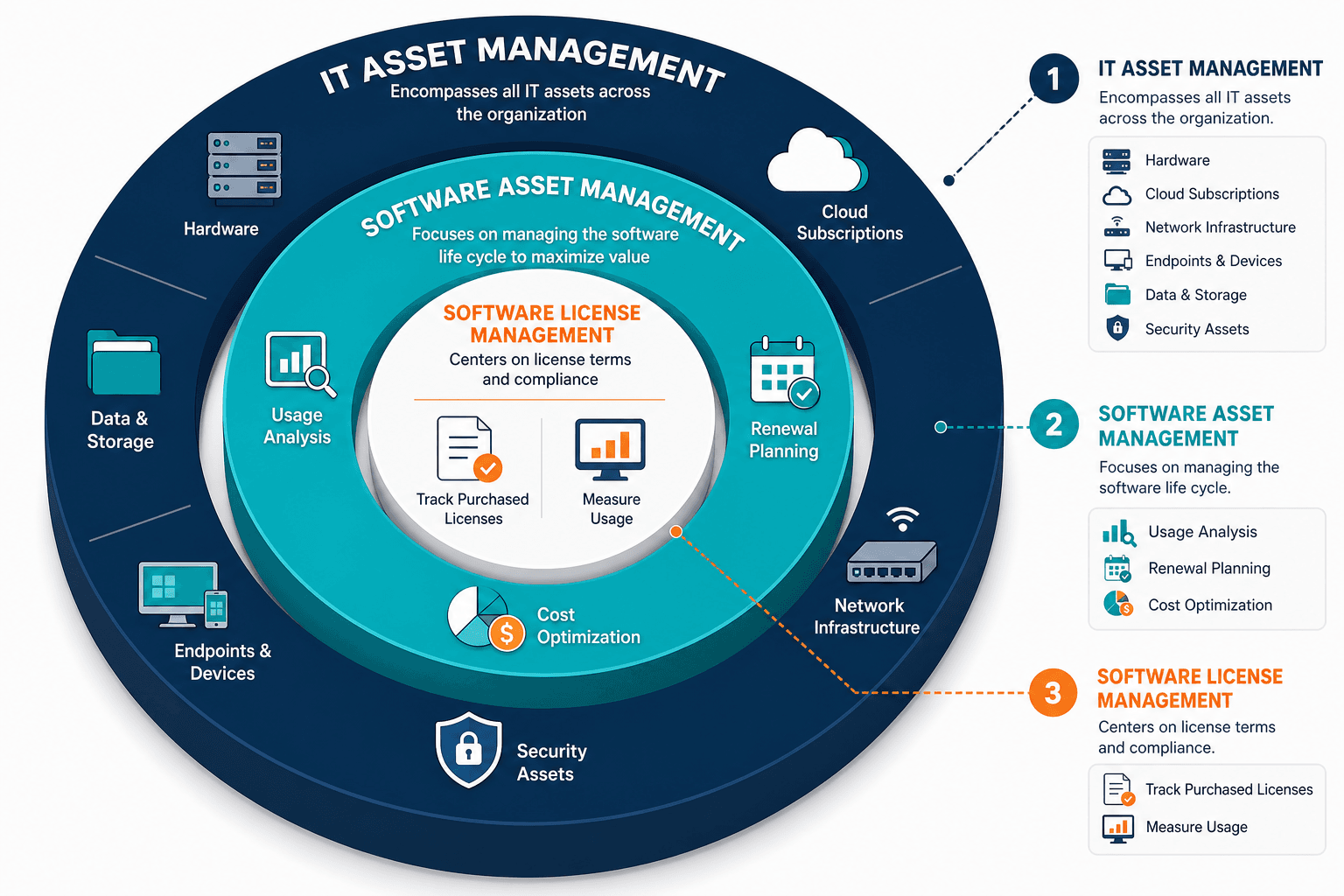
IT asset management (ITAM) is the broadest of the three. It covers all technology assets, including hardware, software, cloud subscriptions, and network infrastructure, across their entire life cycles. ITAM provides the overarching framework: the data model, the policies, the life cycle stages, and the reporting structure.
Software asset management (SAM) operates within the ITAM framework, focusing specifically on software. SAM teams handle license positioning, usage analysis, compliance reporting, renewal planning, and software cost optimization. They ensure the organization is neither over-licensed nor under-licensed and can demonstrate compliance when audited.
Software license management (SLM) is narrower still. It focuses on the specific terms of license agreements: what has been purchased, what the vendor permits, how usage is measured, and what the audit exposure is. SLM provides the compliance data SAM uses to make optimization decisions. For a closer look at how license tracking and audit preparation work in practice, see Virima’s guide to software license management in ITAM.
In practice, most organizations run SAM and SLM as integrated functions within one ITAM program.
Why SAM programs fail: the inventory problem
The most common reason SAM programs underperform is not a lack of process or tooling. It is an incomplete software inventory. A SAM tool can only manage software it knows about.
Most explanations for SAM program failure point to governance gaps, unclear ownership, or under-resourcing. The data points to something more specific underneath those symptoms: according to the Flexera 2026 State of ITAM Report, complete IT asset visibility dropped to 36%, declining year over year as AI, SaaS, and cloud environments expand the software footprint faster than manual inventory processes can track it. Nearly two-thirds of organizations manage their software spend and compliance posture with an inventory they know is incomplete.
The consequence is twofold: optimization decisions get made on partial data, so savings opportunities are missed and redundant tools persist; and compliance positioning is calculated against an install base that doesn’t include everything actually running. When an auditor scans what’s installed, that gap is where penalties originate.
Virima’s IT discovery addresses this by running agentless and agent-based discovery across on-premises, AWS, and Azure environments, surfacing installations never reported through procurement: tools expensed by individuals, software installed by business units, and legacy applications running on infrastructure that predates the current SAM program. License reconciliation, usage analysis, and renewal planning then run against what discovery actually found rather than a list assembled from memory, and Virima’s ViVID service maps connect that inventory to the services it already tracks through ServiceNow or another ITSM tool, so it becomes operational context rather than a static spreadsheet.
Why do software asset management programs fail?
Most explanations for SAM program failure point to governance gaps or under-resourcing. Flexera’s 2026 State of ITAM Report suggests the deeper cause: only 36% of organizations have complete IT asset visibility, so optimization and compliance decisions are built on an inventory that is already wrong.
The five core components of a working SAM program
A SAM program that delivers reliable results rests on five interconnected components, each dependent on the quality of the data feeding into it.
1. Software discovery and inventory. Automated discovery tools scan endpoints, servers, cloud environments, and network infrastructure to identify what software is installed and running. This is the data layer every other SAM component depends on.
2. License entitlement tracking. SAM teams record what has been purchased: license type, quantity, terms, and the metric by which the vendor measures compliance (per user, per device, per processor, per subscription). Entitlements and actual installations are then reconciled to identify compliance gaps.
3. Usage and utilization monitoring. License metering tracks whether installed software is actively used. Applications showing zero usage over a defined period become reclamation candidates before the next renewal. Utilization data is how organizations recover wasted spend before it compounds at contract renewal.
4. Compliance and audit readiness. SAM programs maintain current compliance positions for every major software publisher in their environment. When an audit request arrives, the team produces an accurate, reconciled position immediately rather than spending weeks building one under pressure.
5. License optimization and renewal planning. Using entitlement, installation, and usage data together, SAM teams identify consolidation opportunities, right-size renewals, and negotiate from a position informed by actual consumption rather than historical estimates.
Virima’s ITAM platform handles all five components in a single system, connecting discovery-sourced software inventory to license entitlements, usage records, and ITSM workflows, so every compliance and optimization decision draws from what discovery actually found.
What are the key components of a software asset management program?
A working SAM program has five core components: software discovery and inventory, license entitlement tracking, usage and utilization monitoring, compliance and audit readiness, and license optimization and renewal planning. Each component depends on an accurate, continuously updated software inventory as its data foundation.
How SAM connects to security and compliance
SAM is not purely a cost discipline — untracked software is also unpatched, since applications never formally procured receive no updates through standard patching.
The compliance stakes are significant. The Flexera 2026 State of ITAM Report found that 48% of organizations were audited in the past year, and 44% spent more than $1 million on software audits over three years. Microsoft conducted audits for 64% of audited organizations; Oracle audit activity rose from 24% to 38% year over year.
The pattern is consistent: audit penalties grow when the gap between what is installed and what is licensed is not measured continuously. SAM programs that run regular compliance reconciliation, comparing discovery-sourced install data against current entitlements, catch gaps before auditors do. Those that run periodic manual reconciliation catch them after.
What does a software audit cost organizations?
Flexera’s 2026 State of ITAM Report found that 44% of organizations spent over $1 million on software audits across three years, and 48% were audited in the past year alone. Microsoft conducted audits for 64% of those organizations. The root cause is a compliance gap between installed software and licensed entitlements.
Closing this gap starts before the audit letter arrives — Virima’s ITAM platform keeps license positions reconciled against discovery-sourced installs, so audit prep starts from a position already maintained, not one rebuilt under pressure.
SAM in 2026: cloud, SaaS, and AI complexity
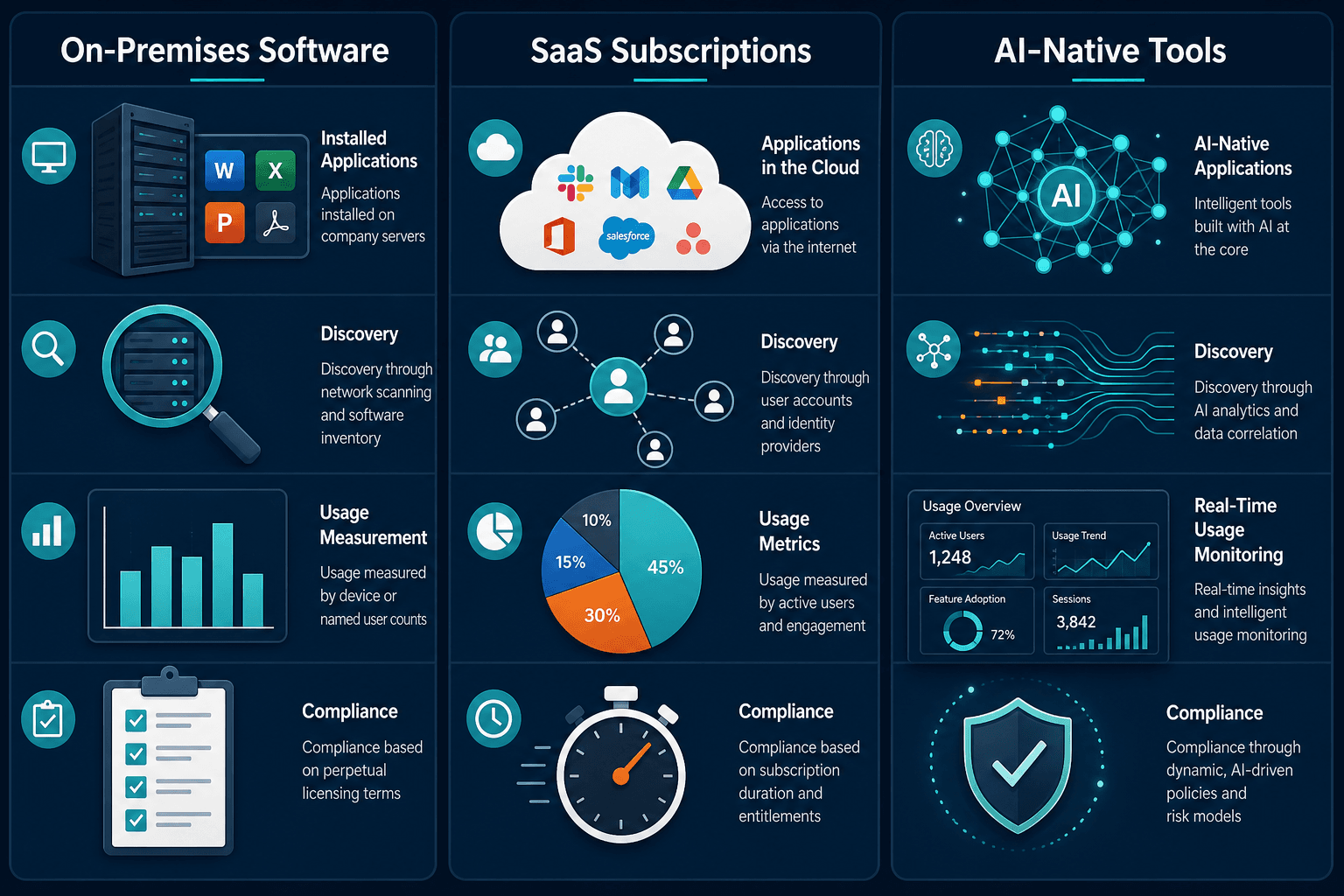
Three forces are expanding the scope of SAM faster than most programs have adapted to.
SaaS sprawl. Business unit procurement has shifted the software estate beyond IT’s direct oversight. IT controls only 15% of software spend (Zylo 2026); the rest flows through departments, individuals, and credit card purchases that generate no procurement record. Forrester similarly found 27% of organizations report over half their non-IT tech spend happens without IT’s oversight.
AI-native tools. The Flexera 2026 State of ITAM Report found that only 31% of organizations have accurate visibility into AI software, while 59% say wasted AI spend increased year over year. AI-native applications typically use consumption-based or token-based pricing rather than per-seat models, making their cost structures harder to forecast and compliance positions harder to calculate.
How exposed are organizations on AI software spend?
AI-native software is the newest SAM blind spot: Flexera’s 2026 report found only 31% of organizations have accurate visibility into AI software spend, while 59% report wasted AI spend growing — driven by consumption-based pricing that doesn’t fit per-seat license models.
Hybrid and cloud environments. Software installed on AWS or Azure infrastructure requires discovery mechanisms that reach into those environments directly. Traditional endpoint scanning covers on-premises and physical devices well; cloud workloads require API-based discovery to surface what’s actually running.
How is software asset management changing in 2026?
SAM in 2026 is being reshaped by three forces: SaaS sprawl that puts most software spend outside IT’s direct control, AI-native tools with consumption-based pricing that are hard to track and forecast, and hybrid cloud environments where traditional scanning methods don’t reach cloud-hosted software workloads.
SAM as a continuous practice, not a one-time project
Software asset management delivers sustained value only when it runs as an ongoing discipline, not a one-time inventory pass that decays as the software estate changes. Continuous discovery refreshes the inventory as new software gets installed; ongoing reconciliation catches license gaps as deployments grow; regular usage analysis flags reclamation candidates before renewals lock in over-provisioned seats.
Organizations that avoid large audit penalties and unnecessary SaaS overspend don’t need uniquely sophisticated SAM processes — they have accurate inventory data that stays current, and they use it before external events force their hand.
For a closer look at keeping a software estate under control after the initial rollout, see Virima’s guide to managing the software asset life cycle effectively and its guide to enterprise software asset management solutions.