GDPR Health-Data Compliance via CMDB for Madrid’s Private Hospital Networks

Madrid private hospital groups carry a compliance question that spreadsheets answer slowly. GDPR treats health data as a special category, and every system touching patient data needs a documented place in the record of processing activities. The European Health Data Space adds a second horizon: EHDS entered into force in March 2025, with transition milestones running toward 2027. Hospital networks that cannot name every system holding health data will struggle with both duties.
GDPR health-data compliance via CMDB for Madrid private hospital networks gives those groups a shared system inventory that processing records, impact assessments, and access reviews can cite with confidence. See how enterprise teams establish Trusted Runtime Truth as the shared evidence layer under clinical data operations.
GDPR expects hospital networks to name every system holding health data
GDPR requires controllers to maintain records of processing activities that describe purposes, categories of data, recipients, retention, and security measures. Health data falls under Article 9 special categories, so the legal basis, safeguards, and access controls need explicit documentation for each processing operation. Spain’s data protection authority supports risk management and impact assessment work for these duties through its innovation and technology guidance area.
Private hospital networks complicate the record because processing spans multiple sites and shared platforms. A radiology image captured at one clinic lives in a central PACS archive. Laboratory orders flow through a shared integration engine into a central LIS.
Patient administration data replicates between hospital sites and a cloud-hosted backup. Each handoff adds a system to the processing chain, and each system needs an owner, a purpose, and a verification date in the record.
When the system inventory splits across facilities, three gaps open for compliance teams. Facility registers miss shared platform components that process data centrally. Platform inventories miss facility devices that capture data at the edge. That split in ownership carries into audits too: clinical engineering, IT infrastructure, and application teams each hold a piece of the picture with no joint view. A regulator asking for the full processing chain then receives three partial answers.
Spain’s AEPD has already penalized that exact gap. In February 2025, it fined a health-sector data processor 500,000 euros. The fine cited, in part, the processor’s refusal to disclose which third-party IT systems handled patient data during an inspection, and treated that lack of transparency as an aggravating factor (Enforcement Tracker, ETid-2568). See how a discovery-sourced CMDB closes this exact visibility gap before an inspector asks the question.
Why do hospital networks need a CMDB for GDPR health-data duties?
GDPR records must name every system that stores or moves patient data with purposes and safeguards. A discovery-sourced CMDB joins facility devices and shared platforms into one inventory with owners and verification dates, so processing records cite observed systems instead of assembled lists.
What a health-data CMDB must prove across Madrid hospital sites
A compliance-ready CMDB rests on three proofs. Prove the inventory covers every facility plus the shared platforms behind clinical services. Prove each processing operation links to its full system set across sites. Prove the record stays current through scheduled verification at every location.
Prove completeness across facilities and shared platforms
Discovery must reach every layer of the health data inventory hospital network compliance teams are expected to produce:
- Hospital data centers and clinic networks
- Imaging modalities and laboratory analyzers
- Pharmacy systems and endpoints
- Cloud accounts, containers, and integration engines
Shared clinical platforms need one record per asset with a stated owner. Systems without owners need named remediation, since an unowned interface engine or clinic gateway weakens every processing record that depends on it.
Prove processing linkage for records and assessments
Each admission workflow, imaging pathway, laboratory service, and discharge process needs its facility-by-facility system set named behind it. Service composition comes from user input through manual entry, spreadsheet import, or architecture input, and the dependency map builds from those definitions. Records of processing activities and data protection impact assessments then cite the service and its full cross-site systems together. A data protection impact assessment needs three things from that map: the full system list behind the processing operation, a named owner for each system, and the legal basis documented for each one — without all three, the assessment can’t score risk accurately.
Prove freshness on a facility schedule
Virima reconciles multi-source discovery into one authoritative CI record with source tags and last-verified dates. Scheduled cycles refresh each facility and platform account. Manual entries stay fenced behind review. Freshness becomes a timetable that audit teams can verify directly. Before You Run AI Agents on ServiceNow, Answer These 5 Questions About Your CMDB walks through how other regulated IT teams set that verification cadence.
Join clinical systems, shared platforms, and enterprise IT in one map
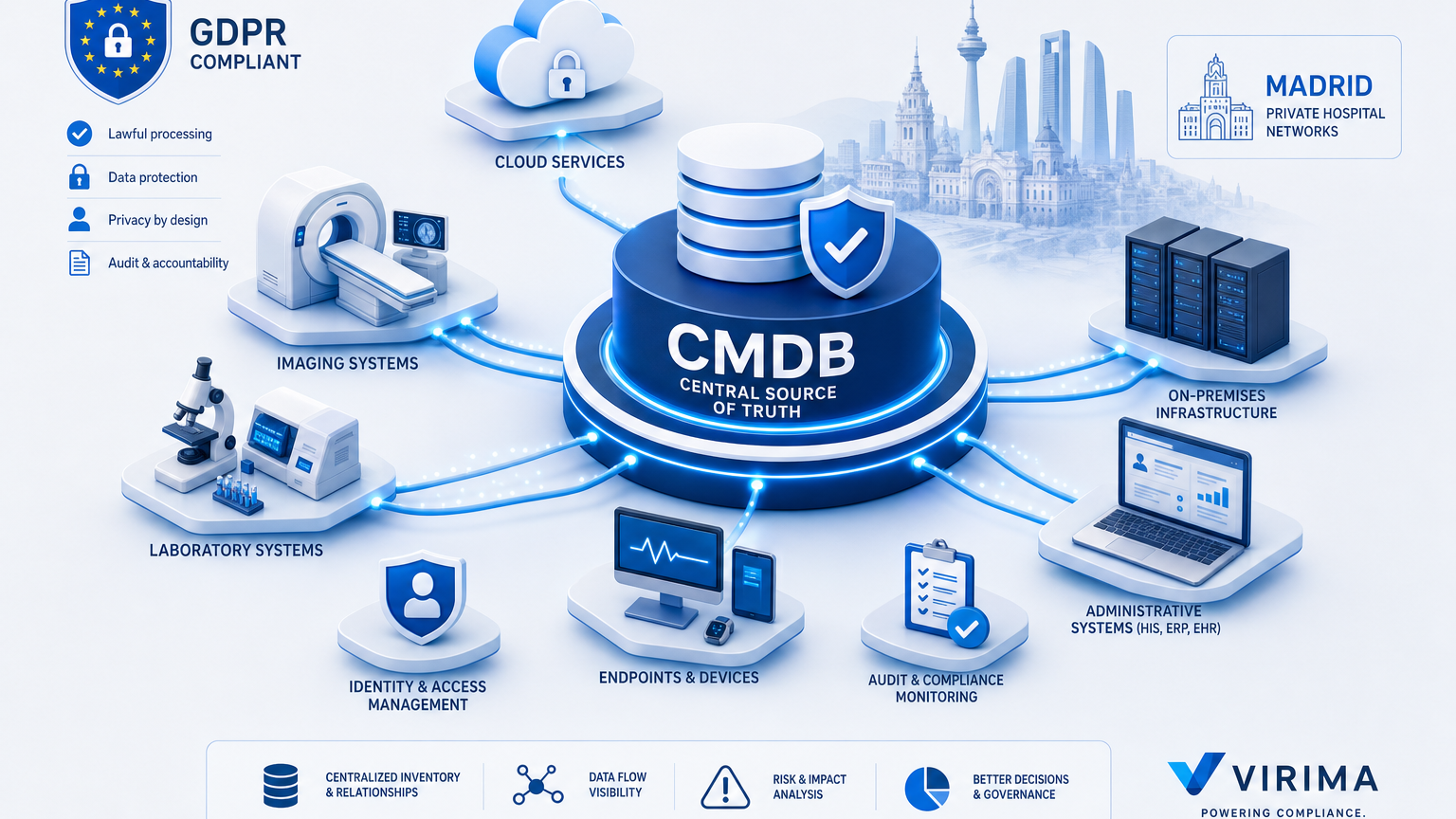
The fix is not a larger spreadsheet per hospital. It is one Madrid private hospital CMDB built as a ViVID™ service map with three node types, each fed by scheduled discovery and each tied to named clinical processing operations.
What each node contributes
Each node type contributes a distinct layer to the map:
- Facility nodes — servers, network closets, imaging modalities, laboratory instruments, pharmacy systems, and endpoints across hospitals and clinics
- Platform nodes — patient administration systems, imaging archives, laboratory information systems, integration engines, and databases behind shared clinical services
- Enterprise IT nodes — identity, patch, backup, and monitoring systems that span every site
Discovery finds the infrastructure. Service definitions name which pieces form one processing operation.
How the map supports audits and impact assessments
When an auditor asks where a category of health data flows, the compliance team opens the service map and traces the processing operation to every facility system and shared platform involved. Ownership shows on the same screen. Clinical, platform, and compliance teams brief from one record. That path from processing operation to supporting system is the core behavior to demand from any CMDB platform. Virima blog post on service dependency mapping for compliance teams covers that audit trail in more detail.
Which systems belong in the first health-data service map?
Start with one processing operation across two facilities: admission, imaging, or laboratory services with the shared platforms behind them. Add pharmacy, discharge, and administrative operations once the first map holds. Narrow scope proves completeness faster than network-wide collection.
Prepare the EHDS horizon while meeting GDPR today
The EHDS framework builds on GDPR foundations with structured rules for primary and secondary use of electronic health data. The full legal text appears in Regulation EU 2025/327 on the European Health Data Space. Hospital networks that hold a verified system inventory today will answer data-holder duties, access requests, and quality expectations with less rework during transition. Achieve simplified compliance mapping with Virima solutions and Before You Run AI Agents on ServiceNow, Answer These 5 Questions About Your CMDB show the same inventory discipline applied in other regulated, multi-site environments.
Three EHDS-ready habits follow directly from CMDB discipline:
- Maintain verified inventories of systems holding electronic health data, with documented owners
- Keep service maps that show how data moves between capture, storage, and exchange points
- Hold verification dates current through scheduled cycles so access and sharing decisions rest on observed infrastructure
These habits also strengthen GDPR posture immediately. Access reviews cite the same system set as processing records. Retention actions target verified storage locations. Breach scoping starts from the service map instead of assembled recollection.
Feed health-data context into the ITSM you already run
Compliance visibility earns trust when it shows up inside daily ITSM work. Incident tickets link to the affected CI and its clinical service. Change requests check the dependency map before approval across facilities. Problem records reference the same service definition that audit evidence cites.
Virima supports this pattern by syncing discovered CIs and relationships into existing ITSM workflows. Platform names stay as plain references here: ServiceNow, Jira Service Management, Ivanti, HaloITSM, Xurrent, and Hornbill teams each keep their desk while reading the same CI truth. One integration reference covers the path: the integrations hub lists the supported ITSM sync options. Why Virima is the best CMDB integration for your ITSM processes covers how other regulated teams wire this sync without disrupting existing ticket workflows.
Keep the data flow one-directional at first. Discovery sources the CMDB, the CMDB feeds the desk, and manual edits stay fenced behind review. That order keeps compliance evidence anchored to observed data.
How should health-data asset information reach the service desk?
Sync discovered CIs and relationships into incident and change workflows so agents and approvers read the same record. Keep discovery as the source and fence manual edits behind review. One-directional flow keeps compliance evidence anchored to observed data.
Where to start: one processing operation across two facilities, then expand
Start with one processing operation across two facilities. Pick one shared clinical service and discover its full system set at both sites. Define the service explicitly, then run incident and change work from that map for one full cycle.
Measure three outcomes before expanding. Check whether incident tickets link to the right CI on first touch. Check whether change reviews name cross-facility impact without extra calls. Check whether the service map matches both sites at cycle end. Expand facility by facility only when all three hold.
Turn the three proofs above into a working checklist: score your own hospital network against completeness, processing linkage, and freshness before your next GDPR or EHDS review using the How to Build an AI-Ready CMDB Checklist for 2026. Teams ready to scope a specific rollout can also start a conversation through the demo request path with their facilities and platforms listed.
Build the joint record before the next audit sets the deadline
Regulatory calendars move without waiting for inventory projects. GDPR accountability, EHDS transition milestones, and internal audit cycles each arrive with evidence expectations attached. Hospital networks that map one processing operation across two facilities before that pressure will answer faster and remediate with more precision than teams that assemble records under deadline. Build the joint layer now, prove it on one service, and expand while verification dates stay fresh. That’s what GDPR health-data compliance via CMDB looks like in practice for a Madrid private hospital network: one verified record, not three partial ones.
Frequently Asked Questions
What does GDPR require for health-data system records?
Controllers must document processing purposes, data categories, recipients, retention periods, and security measures for each operation. Systems holding special-category health data need explicit legal basis and safeguard documentation behind every entry.
How does the EHDS change hospital data duties?
EHDS adds structured rules for primary care use and secondary research use of electronic health data with transition milestones toward 2027. Verified system inventories and data-flow maps prepared for GDPR carry directly into EHDS readiness work.
Do Virima’s service maps update automatically when hospital systems change?
Yes — Virima reconciles discovery changes into the CI record automatically. Service definitions still come from manual entry, spreadsheet import, or architecture input, and the dependency map rebuilds from those definitions as discovery refreshes each facility.
Can facility teams keep their existing ITSM tools?
Yes. Discovered CIs and relationships sync into incident and change workflows so every facility reads the same record. Keep discovery as the source during rollout.
How does Virima support hospital network compliance work?
Virima reconciles multi-source discovery into authoritative CI records, builds service dependency maps from provided definitions, and syncs that context into ITSM workflows for incident and change decisions.