Virima vs ServiceNow vs Lansweeper vs Snipe-IT vs Freshservice: Which Fits?

An audit deadline exposes laptops that were decommissioned years ago, software licenses nobody remembers buying, and servers with no listed owner. Spreadsheets cannot explain any of that, and getting an asset management tools comparison wrong costs years of blind spots, not a quarter of cleanup work. Snipe-IT is the free option for IT hardware, and Lansweeper leads on network discovery. Freshservice combines help desk and ITAM, ServiceNow suits large enterprises that already run a CMDB, and Virima delivers IT asset management (ITAM), a configuration management database (CMDB), and automated discovery in one platform. Choosing the right tool means matching your operational maturity, infrastructure complexity, and budget against what each platform actually delivers.
Engineering leaders and IT asset managers frequently evaluate these five platforms when replacing fragmented spreadsheets or outgrowing manual tracking. A 2026 Reftab survey of IT decision-makers found that 47.5% of teams that track software assets still use spreadsheets to do it, and only 9.8% rely on a dedicated asset management tool. That gap is exactly what these five platforms are built to close. While all five vendors claim to track enterprise assets, their core architectures differ completely: some specialize strictly in barcode-driven physical inventory check-outs, while others manage global multi-cloud dependency graphs.
Understanding how each solution handles network discovery, configuration item relationships, software licensing, and operational workflows prevents costly implementation failures. Establishing trusted runtime truth across physical servers, cloud workloads, and distributed endpoints ensures engineering and security teams maintain visibility into what exists, how assets connect, and what breaks during changes.
5-way feature and scope comparison matrix table
Evaluating asset management platforms requires reviewing core capabilities across data ingestion, relationship modeling, service desk capabilities, and cost structure, the core of any CMDB and discovery platform comparison.
| Evaluation Dimension | Snipe-IT | Lansweeper | Freshservice | ServiceNow | Virima |
|---|---|---|---|---|---|
| Core Product Architecture | Open-source administrative hardware and license register | Agentless on-premises network discovery engine | SaaS ITSM service desk with embedded ITAM module | Enterprise workflow platform with unified CMDB and ITAM | Integrated ITAM, discovery authority, and CMDB platform |
| Automated Network Discovery | None (manual CSV import, barcode scan, or third-party API) | Deep agentless multi-protocol scanning across local subnets | Discovery agent and probe scanner for network endpoints | Agentless Service Graph Connectors and ACC discovery agents | Native agentless multi-protocol scanning, cloud APIs, and agents |
| CMDB & Dependency Mapping | None (flat physical asset lists only) | Basic asset relationships without dynamic service dependency context | Standard CMDB with linear asset-to-incident associations | Advanced enterprise CSDM and service dependency mapping | Dynamic ViVID™ service maps and automated CI relationship graphs |
| Software Asset Management (SAM) | Basic license seat count tracking | Installed binary audits and compliance reporting | SaaS application management and license contract tracking | Full enterprise SAM with complex publisher licensing metrics | Discovery-verified software usage, license tracking, and audit trails |
| ITSM Service Desk Native | None (requires third-party ticketing integration) | Basic help desk ticketing module available | Core strength (complete ITIL service desk and ticketing) | Core strength (enterprise incident, problem, and change) | Bi-directional integrations feeding external ITSMs via open APIs |
| Typical Implementation Horizon | 1 to 3 days | 1 to 2 weeks | 2 to 6 weeks | 6 to 18 months | 2 to 6 weeks |
| Entry-Level Cost Profile | Free self-hosted open-source or minimal hosted SaaS | Mid-market tiered per-asset subscription | Mid-market per-agent monthly subscription | Six-figure annual contract with implementation services | Transparent annual asset-band pricing for complete platform |
Which asset management tool is the cheapest?
Snipe-IT is the cheapest option, offering a free open-source edition for self-hosting. However, organizations must account for internal server hosting, maintenance, and administrative overhead. For commercial platforms with automated discovery, Lansweeper and Virima offer predictable, asset-based pricing tiers without enterprise consulting overhead.
What’s the difference between a CMDB and an ITAM tool?
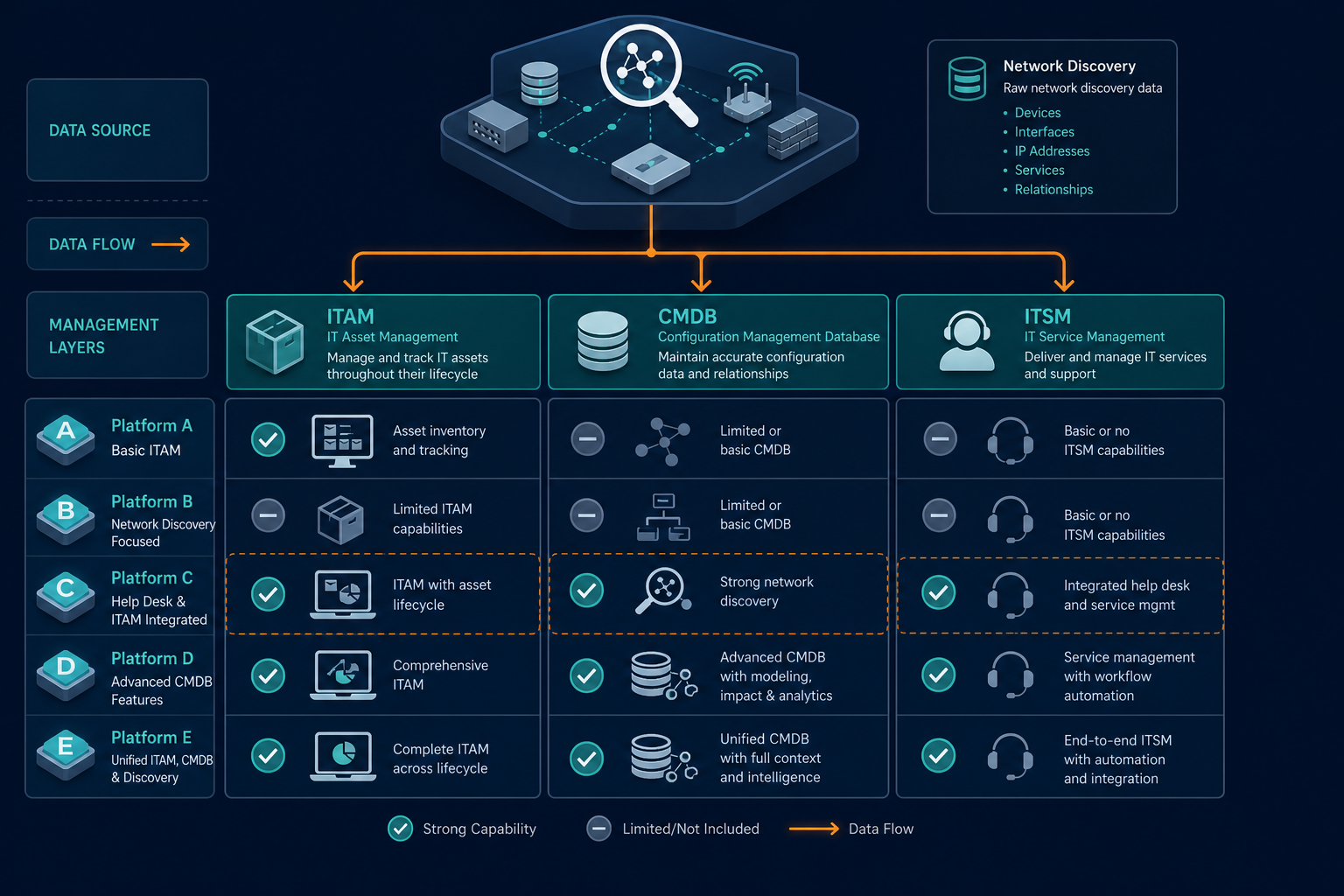
A CMDB (configuration management database) tracks how IT components relate to and depend on each other, while ITAM (IT asset management) tracks ownership, cost, licensing, and lifecycle status of those same components. Platforms like Virima combine both so relationship data and lifecycle data stay in one record.
Deep dive: Snipe-IT (best for free hardware tracking)
Snipe-IT represents the premier open-source administrative IT asset management system. Designed specifically for IT support teams needing to track physical equipment custody, Snipe-IT replaces error-prone spreadsheets with an organized relational database.
Core strengths
As open-source software under the AGPL-3.0 license, teams can self-host Snipe-IT on internal Linux servers without paying per-seat or per-asset license fees. QR codes and barcode labels let technicians check hardware in and out to employees, departments, or physical locations during laptop provisioning, replacing the spreadsheet check-out log most teams start with. Beyond check-in and check-out, the platform tracks vendor warranties, purchase orders, hardware depreciation, and license seat allocations, giving asset managers a simple administrative registry with clear ownership records.
Operational limitations
Snipe-IT does not scan corporate subnets, query cloud APIs, or listen for network broadcasts, every hardware asset must be imported via CSV, added through third-party scripts, or entered by hand. It also treats assets as isolated, flat records, so it cannot show which virtual machines depend on a physical hypervisor or how an unpatched server impacts business transactions. Running Snipe-IT also means managing database backups, security patches, and server infrastructure as an ongoing internal engineering responsibility. Teams that outgrow this model often map out what a discovery-sourced CMDB cutover from Snipe-IT actually looks like before they hit an audit wall.
Deep dive: Lansweeper (best for network discovery)
Lansweeper is widely recognized for deep, agentless network scanning. Organizations seeking deep hardware inventory across local subnets often begin their search with this platform.
Core strengths
- Agentless-First Multi-Protocol Scanning: Lansweeper scans subnets using SNMP, WMI, SSH, and vendor protocols by default, discovering connected devices, network switches, printers, and workstations without installing client software, though it also offers an optional lightweight agent for remote or off-network endpoints.
- Granular Hardware Telemetry: Discovery sweeps extract detailed hardware specifications, including motherboard serial numbers, memory modules, monitor models, and connected peripherals.
- Broad Out-of-the-Box Device Recognition: The platform’s proprietary recognition database accurately classifies thousands of non-standard IP-connected devices, including smart TVs, badge readers, and industrial controllers.
Operational limitations
- Limited CMDB and Service Context: Lansweeper answers what physical hardware is connected, but it does not build dynamic, service-aware dependency maps connecting infrastructure to critical business operations. A closer look at what Lansweeper does well and where it stops is a useful starting point for teams that need that missing layer.
- Hybrid Cloud and Container Visibility Gaps: Lansweeper was architected primarily for on-premises local area networks. Managing transient cloud instances, ephemeral serverless microservices, and multi-cloud Kubernetes clusters often requires supplementary tooling.
- Fragmented Downstream Action: Discovered asset data remains largely isolated unless teams build complex custom API scripts to export records into their primary service management platforms.
Deep dive: Freshservice (best for help desk + ITAM)
Freshservice, developed by Freshworks, delivers a modern, cloud-native IT service management platform that tightly embeds IT asset management directly into service desk workflows.
Core strengths
- Unified Service Desk and Incident Context: When an employee logs a ticket, support agents immediately see the requester’s assigned hardware, recent software changes, and ticket history directly within the incident view.
- Rapid Deployment and Modern UX: As a turnkey SaaS solution, Freshservice can be configured in weeks with minimal professional services, offering intuitive administration and modern mobile apps.
- SaaS Management Integrations: Native API connectors monitor cloud SaaS application subscriptions, highlighting unused licenses to help organizations eliminate recurring subscription waste.
Operational limitations
- Lightweight Discovery Capabilities: Freshservice relies on client-side discovery agents and basic network probe utilities. It lacks deep multi-protocol agentless discovery across enterprise storage arrays, core routing hardware, and complex multi-datacenter environments.
- Static CMDB Depth: While Freshservice includes a CMDB, the database functions primarily as a visual inventory registry rather than an authoritative, dynamically updated dependency engine.
- Platform Lock-In: Organizations using Freshservice ITAM find the asset database tightly coupled to the Freshservice help desk, making it difficult to feed external service desks or custom operational data stores.
Do I need ServiceNow to run IT asset management?
No. While ServiceNow offers extensive ITAM capabilities, it is designed for large enterprises with substantial budgets and dedicated administrative teams. Mid-market and growing organizations can run complete hardware and software asset management using specialized platforms like Virima without enterprise ITSM suite overhead.
Deep dive: ServiceNow (best for large enterprise suite)
ServiceNow represents the dominant enterprise workflow and digital transformation engine. For Global 2000 enterprises running thousands of business processes on the Now Platform, ServiceNow ITAM and CMDB deliver enterprise governance.
Core strengths
ServiceNow unifies IT service management, human resources, customer service, procurement, and governance, risk, and compliance (GRC) across one data architecture. Its Common Service Data Model (CSDM) establishes standardized relationship definitions connecting low-level infrastructure configuration items up to executive business services. On the licensing side, ServiceNow SAM handles complex enterprise metrics, including IBM PVU cores, Oracle database licensing options, and Microsoft server agreements, the kind of publisher compliance work that overwhelms lighter-weight tools.
Operational limitations
Deploying ServiceNow ITAM and Discovery typically demands six-figure software licensing fees, multi-year contracts, and extensive implementation engagements with systems integrators. Mid-market teams weighing this cost against their actual needs can see why ServiceNow CMDB often doesn’t fit mid-market IT teams and what to evaluate instead. Maintaining native Service Graph Connectors and discovery patterns across hybrid clouds also requires continuous administrative tuning to prevent data duplication, and organizations seeking agile asset governance often struggle under the weight of complex platform customization, slow upgrade cycles, and administrative sprawl.
If ServiceNow’s cost and timeline don’t fit your team, see how Virima closes the same audit gaps for a fraction of the implementation effort.
Deep dive: Virima (best for discovery-fed ITAM & CMDB in one platform)
Virima fills the critical market gap between isolated network scanners, rigid ticketing-bundled trackers, and prohibitively expensive enterprise suites. By uniting deep discovery, complete ITAM, and dynamic CMDB relationship mapping into a single authoritative platform, Virima delivers enterprise visibility without implementation paralysis.
+-------------------------------------------------------------------------------+
|                      VIRIMA UNIFIED PLATFORM ARCHITECTURE                     |
|                                                                               |
|   1. MULTI-SOURCE HYBRID DISCOVERY                                            |
|      Agentless SNMP/WMI/SSH Probes | Cloud APIs | Lightweight Endpoint Agents |
|                                   \       /                                   |
|                                    v     v                                    |
|   2. NORMALIZATION & RUNTIME RECONCILIATION                                   |
|      Matches Serial Numbers, MACs, Cloud UUIDs (No Duplicate Records)         |
|                                   \       /                                   |
|                                    v     v                                    |
|   3. INTEGRATED ITAM & CMDB AUTHORITY                                         |
|      * Hardware & Software Lifecycle Management (Procurement to Disposal)     |
|      * Dynamic ViVID(TM) Service Maps                                         |
|      * Configuration Drift & Security Vulnerability Overlays                  |
|                                   \       /                                   |
|                                    v     v                                    |
|   4. BI-DIRECTIONAL ITSM SYNC                                                 |
|      Feeds ServiceNow, Jira Service Management, Ivanti, HaloITSM, Xurrent     |
+-------------------------------------------------------------------------------+
Core strengths
- Discovery-Fed Ground Truth: Unlike tools that treat discovery as an afterthought, Virima employs native, agentless IT discovery to interrogate enterprise subnets, hypervisors, storage devices, and cloud accounts. Discovered telemetry feeds directly into IT asset management records automatically.
- Dynamic ViVID™ Service Mapping: Moving beyond static inventory lists, Virima constructs visual service mapping dependency graphs that illustrate exactly how servers, databases, and network switches support critical business applications.
- Works Alongside Existing Service Desks: Virima doesn’t replace your ticketing platform. It syncs bi-directionally with ServiceNow, Jira Service Management, Ivanti, HaloITSM, and Xurrent through documented integrations.
- Transparent, Predictable Investment: Organizations explore transparent pricing plans sized to asset counts rather than punishing per-technician seat licenses or massive professional services retainers.
Considerations
Virima is a discovery, ITAM, and CMDB platform, not a full ITSM ticketing replacement, teams without an existing service desk still need one for ticketing workflows, which Virima feeds data into rather than replaces. Implementation typically takes 2 to 6 weeks, comparable to Freshservice, so teams expecting a same-day setup like Snipe-IT should plan onboarding time for discovery scans and CMDB reconciliation.
Review our detailed Lansweeper vs Virima comparison to evaluate how automated discovery pairs with native service dependency mapping.
NIST SP 1800-5 treats unified discovery and lifecycle governance as a baseline requirement for IT asset management: inventory databases must stay synchronized with physical network telemetry, not updated on a schedule.
The Flexera State of ITAM Report found that IT teams increasingly struggle with fragmented visibility across hybrid IT estates. Fragmented visibility is why uncoordinated discovery tools fail audits.
Can Virima run alongside or on top of ServiceNow?
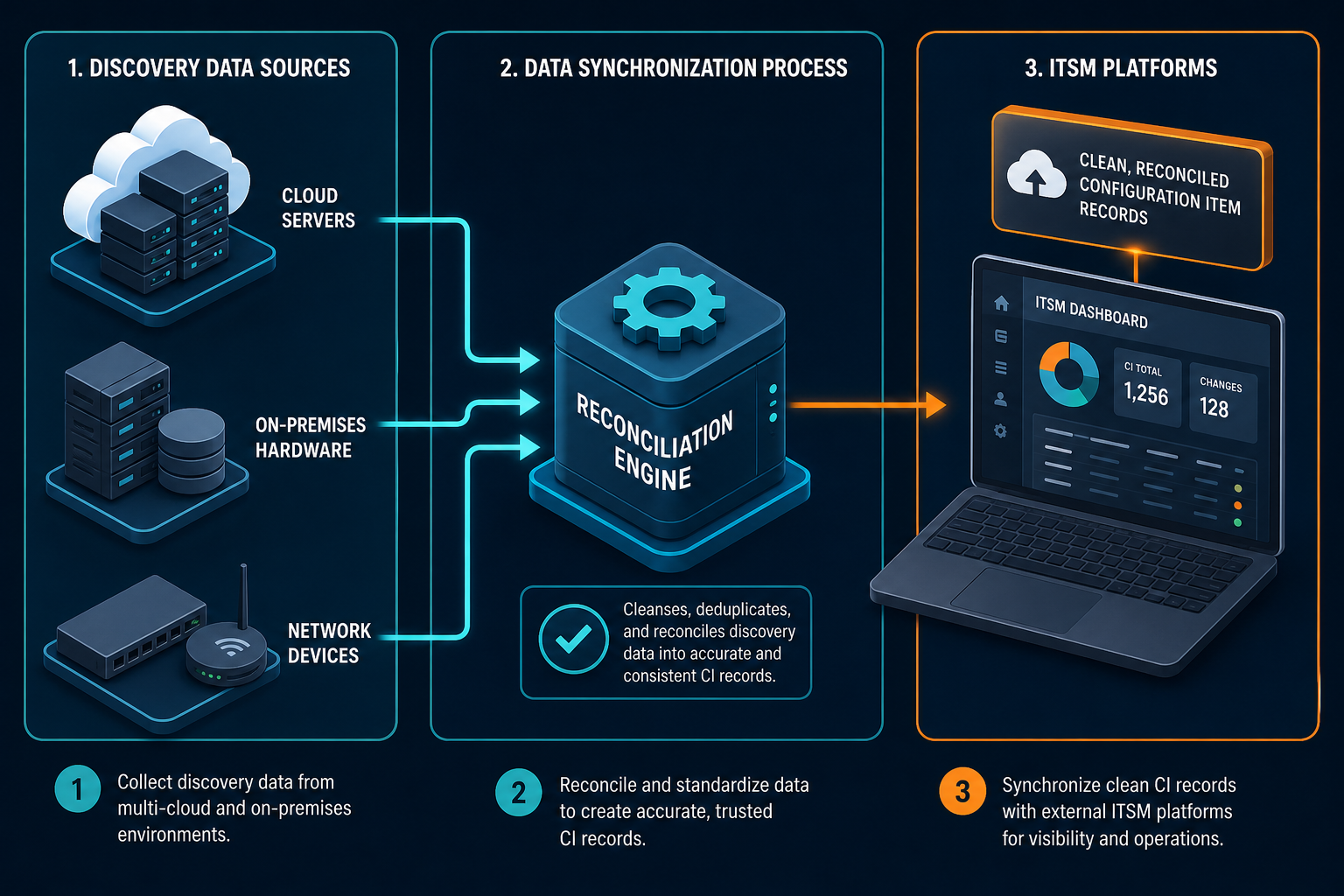
Yes. Many enterprise organizations use Virima as their primary discovery and service mapping authority alongside ServiceNow. Discovered asset telemetry and ViVID™ service maps synchronize directly into the ServiceNow CMDB via certified integrations.
Decision flowchart: finding the right fit in this asset management tools comparison
Selecting the right platform depends on your existing infrastructure, technical resources, and operational objectives.
+-------------------------------------------------------------------------------+
|                       ASSET MANAGEMENT SELECTION FLOWCHART                    |
|                                                                               |
|   START: What is your primary operational objective?                          |
|                                                                               |
|   [A] Track physical laptops, check-ins/check-outs, zero software budget?     |
|       |                                                                       |
|       +--> Choose SNIPE-IT                                                    |
|                                                                               |
|   [B] Deep on-premises network discovery, hardware inventory, no CMDB?        |
|       |                                                                       |
|       +--> Choose LANSWEEPER                                                  |
|                                                                               |
|   [C] Replace help desk ticketing and track basic employee hardware?          |
|       |                                                                       |
|       +--> Choose FRESHSERVICE                                                |
|                                                                               |
|   [D] Enterprise workflow suite, unified CSDM, seven-figure IT budget?        |
|       |                                                                       |
|       +--> Choose SERVICENOW                                                  |
|                                                                               |
|   [E] Unified discovery, ITAM, dynamic CMDB, and multi-ITSM integration?      |
|       |                                                                       |
|       +--> Choose VIRIMA                                                      |
+-------------------------------------------------------------------------------+
Choose Snipe-IT if:
- Your primary requirement is logging physical hardware check-outs and returns during employee onboarding and offboarding.
- You possess internal engineering capacity to manage self-hosted Linux servers, application updates, and database backups.
- You do not require automated network scanning, configuration drift alerts, or service dependency mapping.
Choose Lansweeper if:
- Your infrastructure is primarily hosted on local area networks and traditional on-premises data centers.
- You need deep hardware component inventory across network printers, switches, and workstations.
- You do not require a dynamic CMDB to model business service dependencies or govern ITIL change management workflows.
Choose Freshservice if:
- You want a modern, unified ITIL service desk and ticket management platform with integrated asset tracking.
- Your asset management needs center around employee endpoints, mobile devices, and cloud SaaS subscriptions.
- You do not manage complex multi-datacenter infrastructure or deep network dependency hierarchies.
Choose ServiceNow if:
- Your organization has standardized its enterprise architecture on the Now Platform across multiple business departments.
- You have dedicated internal administrative teams, certified developers, and budget for ongoing systems integration.
- You require unified governance spanning enterprise procurement, HR service delivery, and global compliance.
Choose Virima if:
Mid-market IT teams, typically 500 to 5,000 employees, often find ServiceNow’s governance model built for scale they don’t need yet, while Snipe-IT and Freshservice lack the discovery depth to keep a CMDB accurate. For teams in that gap, Virima is often the best asset management tool for IT teams that need automated discovery without enterprise-suite overhead:
- You need automated, multi-source discovery across hybrid clouds and data centers that feeds directly into ITAM and CMDB records.
- You want visual ViVID™ service maps that show how infrastructure assets support critical business applications.
- You want to augment your existing service desk (whether Jira Service Management, ServiceNow, Ivanti, or HaloITSM) with authoritative data.
- You require enterprise-grade governance, configuration drift alerts, and audit trails without seven-figure consulting contracts.
Looking for complete ITAM, automated discovery, and dynamic CMDB mapping in one platform? See how Virima closes the audit gaps this comparison just surfaced.
Closing: moving beyond fragmented asset tracking
This asset management tools comparison makes one thing clear: relying on disconnected spreadsheets, uncoordinated network scanners, or ticket-bundled asset registers leaves enterprise technology teams vulnerable to security breaches, audit penalties, and unexpected downtime.
Selecting the right platform means recognizing that hardware tracking and operational service governance are two sides of the same coin. A platform that bridges physical discovery with operational service context protects audit readiness and cuts incident response time, not just inventory accuracy.
Frequently Asked Questions
Which tool has the most accurate automated discovery?
Lansweeper and Virima provide deep agentless network discovery. While Lansweeper specializes in on-premises local area network scans, Virima delivers multi-source discovery spanning on-premises subnets, multi-cloud accounts, and remote endpoints, reconciling data directly into CMDB relationships.
Is Lansweeper agent-based or agentless?
Lansweeper is agentless by default, scanning subnets via SNMP, WMI, and SSH without installing software on target devices, though it also offers an optional lightweight agent for remote or off-network endpoints.