Achieve simplified compliance mapping with Virima solutions

Compliance auditors do not ask for good intentions. They ask for evidence — specific records showing which IT assets are in scope, how they are configured, who owns them, and how changes to those systems were assessed before they were made.
Most IT teams have no shortage of documentation, but their compliance mapping breaks down because the asset data feeding it is weeks or months old, manually maintained, or incomplete at the edges. That gap is where audit findings live.
IT compliance mapping is the process of linking regulatory requirements — from frameworks such as NIST SP 800-53, PCI-DSS v4.0, SOX, and HIPAA — to the specific IT assets, configurations, and processes responsible for satisfying those controls. It creates a traceable evidence layer that shows auditors which systems are in scope, how they are controlled, and how changes to those systems are tracked. Accurate CMDB data is the foundation that makes compliance mapping defensible.
What Is Compliance Mapping — and Why It Breaks Down in IT
Compliance mapping is the process of linking your organization’s internal controls — policies, technical configurations, operational procedures — to the specific requirements of regulatory frameworks like SOX, HIPAA, ISO 27001, NIST CSF, and GDPR. The goal is straightforward: for every regulatory requirement, you should be able to point to a control that satisfies it, with evidence that the control is working.
In IT operations, this breaks down for a predictable reason: the environment changes faster than the documentation. A server gets decommissioned, a new cloud instance spins up, a network dependency shifts after a migration — and the compliance map you built last quarter no longer reflects reality. According to IBM’s 2024 Cost of a Data Breach Report, the average breach now costs $4.88 million, a 10% year-over-year increase. Stale compliance maps directly contribute to that risk because they mask the gaps auditors and attackers find.
For IT teams specifically, compliance mapping intersects with three operational systems: your CMDB (which tracks what exists and how it’s connected), your IT asset management platform (which tracks ownership, lifecycle, and licensing), and your ITSM platform (which records changes and incidents). When these three systems are accurate and connected, compliance mapping becomes a reporting problem — closely tied to CMDB compliance and IT security risk management. When they’re not, it becomes a credibility problem.
Why Traditional Compliance Mapping Fails in Hybrid Environments
Hybrid IT environments have made compliance mapping harder to maintain. Hybrid infrastructure — a mix of on-premises servers, private cloud, and public cloud (AWS, Azure) — means your compliance map must now cover assets that live in fundamentally different management planes.
Here’s what typically goes wrong:
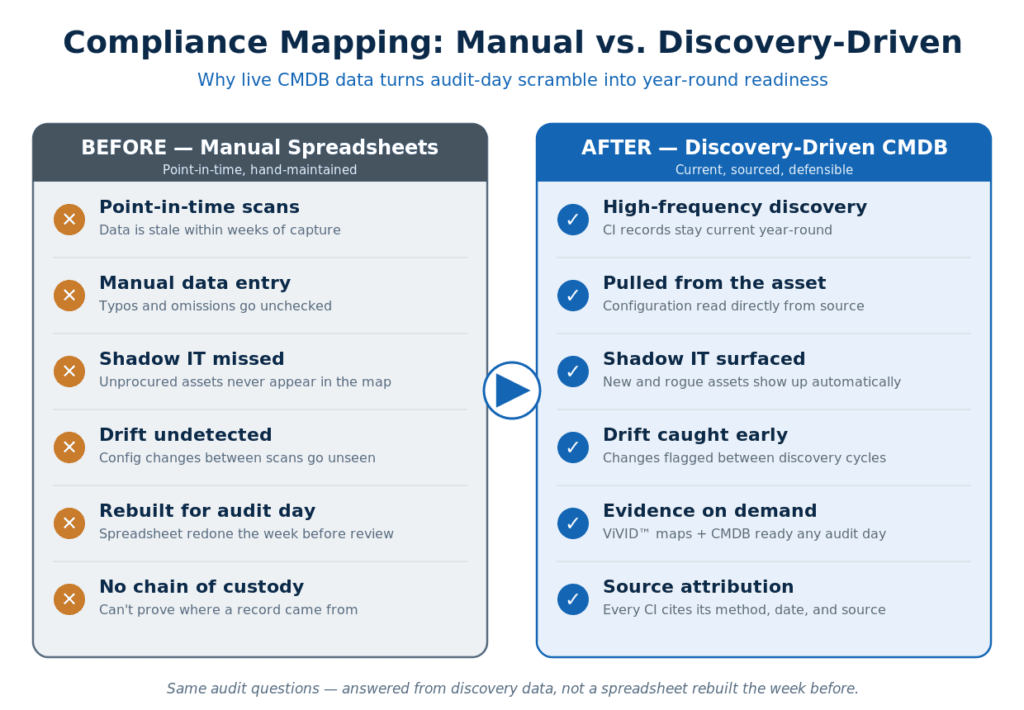
Asset inventory drift. Manual or semi-annual discovery scans miss assets that were provisioned between scans. Shadow IT compounds this — 68% of compliance leaders cite managing policies across multiple platforms as their top challenge (DataStackHub, 2025). If an asset isn’t in your inventory, it can’t appear on your compliance map, and it becomes an uncontrolled risk.
Relationship blindness. Compliance frameworks like SOX and HIPAA don’t just care about individual assets — they care about data flows and service dependencies. If your patient records database depends on three middleware services and a storage cluster, and one of those components falls out of compliance, the entire chain is affected. Without dependency visibility, you can’t trace that risk.
Evidence staleness. Auditors under ISO 27001 and SOC 2 expect current evidence, not a snapshot from six months ago. When configuration data is maintained manually, the gap between your documented state and your actual state widens with every change window. Multi-framework alignment adoption has increased 29% since 2023 (DataStackHub, 2025), which means organizations are now mapping controls against more frameworks simultaneously — making staleness even more dangerous.
How Discovery-Driven CMDB Changes Compliance Mapping
When compliance mapping breaks down, the root cause is almost always data quality. Fix the data — make it accurate, current, and relationship-aware — and compliance mapping becomes a reporting exercise rather than detective work.
This is where automated IT discovery changes the equation. Instead of relying on manual inventory updates, discovery scans your environment continuously using agentless, agent-based, and API-based methods. Every asset — physical servers, virtual machines, cloud instances, network devices, installed software — is identified, cataloged, and tracked with its relationships intact.
When that discovery data feeds directly into a CMDB, you get a compliance mapping foundation that stays current without manual intervention. Each configuration item (CI) carries its discovery source, last-seen timestamp, and relationship context. For compliance purposes, this means:
- Controls can be mapped to specific CIs rather than vague asset categories
- Dependency chains are visible, so you can trace compliance exposure across connected services
- Evidence is timestamped and discovery-sourced, giving auditors confidence that the data reflects the actual environment
- Changes are tracked automatically, providing the change history that SOX, HIPAA, and ISO 27001 auditors require
Virima’s discovery approach covers hybrid environments — on-premises infrastructure through agentless and agent-based scanning, plus AWS and Azure cloud assets through API-based discovery. The result is a single, continuously updated CMDB that serves as the compliance mapping source of truth across frameworks.
Using ViVID™ Service Maps for Compliance Risk Assessment
Compliance risk assessment depends on understanding impact — if this asset fails or falls out of compliance, what else is affected? That’s a dependency question, and it’s the question most compliance tools answer poorly.
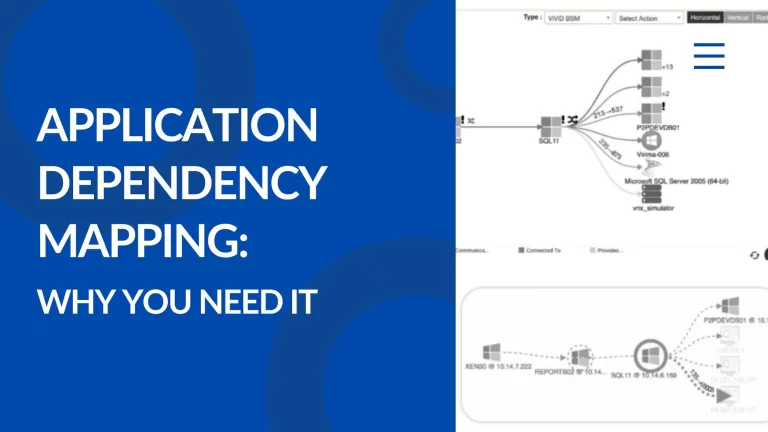
ViVID™ service maps address this by visualizing service dependencies with overlays that show incidents, changes, and vulnerabilities in a single view. For compliance mapping, this capability translates directly into three outcomes:
Blast radius visibility before changes. Before approving a change that affects a compliance-critical asset, ViVID™ shows every upstream and downstream dependency. This prevents a common scenario: a routine infrastructure change inadvertently breaks a compliance control because no one checked what depended on that asset. Gartner estimates that 80% of unplanned downtime is caused by poorly planned changes — and compliance gaps follow the same pattern (Gartner).
Faster root cause during compliance incidents. When an auditor flags a gap, or when a compliance control fails, ViVID™ maps let your team trace the issue to its source in the dependency chain rather than investigating asset by asset. Teams using dependency-mapped CMDBs typically resolve compliance findings faster because they can see the full chain of affected CIs at a glance — instead of working through each asset individually.
Audit-ready evidence of service relationships. Frameworks like SOX Section 404 and HIPAA Security Rule require organizations to document how systems that process regulated data are interconnected. ViVID™ provides that documentation as a live, discovery-sourced artifact — not a static Visio diagram that was accurate six months ago. For a deeper look at maintaining this audit readiness year-round, see CMDB audit essentials.
Why compliance maps degrade: Compliance maps become inaccurate when the underlying asset inventory is stale. New deployments, configuration changes, decommissions, and shadow IT additions all occur between scheduled discovery cycles. Each gap between the actual environment and the CMDB record is a potential audit finding. High-frequency discovery cycles that populate CI records directly from assets — rather than relying on manual updates — keep compliance evidence current throughout the audit period.
Building a Compliance Mapping Workflow That Stays Current
A compliance map is only as useful as its last update. The organizations that sustain audit readiness aren’t the ones with the most detailed initial maps — they’re the ones whose maps update automatically as the environment changes.
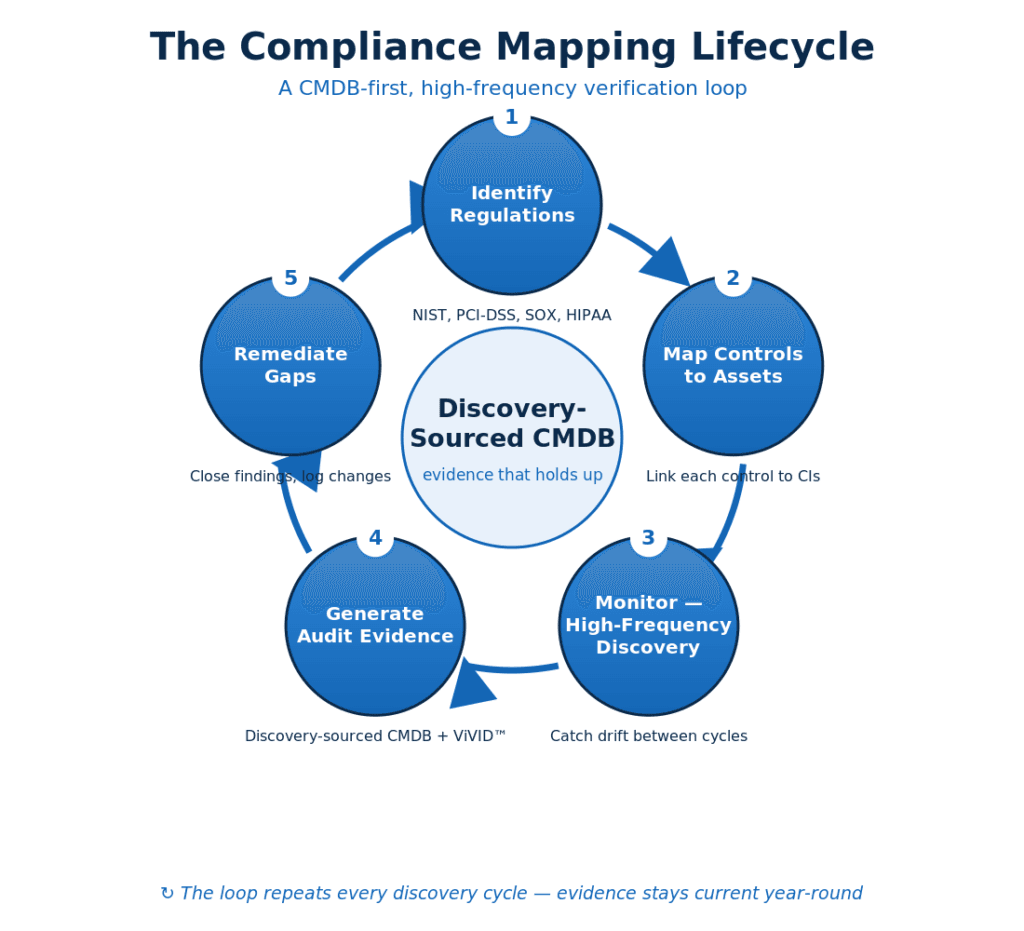
Here’s a practical workflow for keeping compliance mapping current using discovery and CMDB:
Step 1 — Establish your regulatory scope. Identify every framework your organization must comply with (SOX, HIPAA, ISO 27001, NIST CSF 2.0, PCI DSS, DORA, NIS2). Map each framework’s requirements to control categories: technical, administrative, and physical. If you’re building an IT risk register, this scope feeds directly into your risk-to-control mapping.
Step 2 — Run continuous discovery. Schedule IT discovery scans to run on a recurring cadence — daily or more frequently for compliance-critical network segments. This ensures your CMDB reflects the actual state of your environment, not a past snapshot.
Step 3 — Map controls to CIs in your CMDB. This is where most organizations get the biggest return. For each regulatory requirement, link the corresponding control to the specific CIs it protects or monitors. A discovery-fed CMDB makes this sustainable: new assets get flagged as unmapped automatically, so nothing slips through between audit cycles.
Step 4 — Use service maps for impact assessment. For any CI that falls out of compliance, use ViVID™ service maps to assess which services and business processes are affected. Prioritize remediation based on actual blast radius, not guesswork.
Step 5 — Generate audit evidence from live data. Pull compliance reports directly from your CMDB and ITAM records. Because the data is discovery-sourced and timestamped, auditors get evidence that reflects the current state — not a manually assembled packet.
This workflow integrates with the ITSM platforms your team already uses. Virima’s native integrations with ServiceNow, Jira Service Management, Ivanti, HaloITSM, Xurrent, Hornbill, and TeamDynamix mean compliance-relevant changes and incidents flow bi-directionally between your ITSM and your CMDB — no manual reconciliation needed.
From Reactive Audits to Continuous Compliance Readiness
Reactive audit preparation is giving way to continuous compliance readiness — the same shift IT operations has made from periodic manual checks to automated monitoring. Your compliance maps don’t sit in a binder until audit season. They’re backed by discovery data, updated with every scan, and queryable at any time.
Virima supports this shift by unifying IT discovery, CMDB, IT asset management, and ViVID™ service maps into a single platform that feeds compliance evidence from live operational data. Instead of assembling audit packets from five different spreadsheets and three different tools, your compliance team queries one source of truth that was populated by automated discovery — not human memory.
Compliance Mapping FAQ
What is compliance mapping? Compliance mapping links your internal IT controls — policies, configurations, and procedures — to the specific requirements of regulatory frameworks like SOX, HIPAA, and ISO 27001, with documented evidence that each control is working.
Why does compliance mapping fail in hybrid IT environments? Three common reasons: asset inventory drift (assets provisioned between scans go untracked), relationship blindness (no visibility into service dependencies), and evidence staleness (manual documentation falls behind daily infrastructure changes).
How does a CMDB support compliance mapping? A discovery-fed CMDB tracks every configuration item with its relationships, discovery source, and last-seen timestamp — giving auditors current, sourced evidence instead of manually assembled snapshots.
How often should discovery scans run for compliance? Daily or more frequently for compliance-critical network segments. The goal is to ensure your CMDB compliance data reflects the actual state of your environment at all times.
See how Virima keeps your compliance maps accurate with discovery-sourced CMDB data and ViVID™ dependency maps. Schedule a demo and walk through your compliance mapping workflow with our team.