Before You Run AI Agents on ServiceNow, Answer These 5 Questions About Your CMDB

ServiceNow Knowledge 2026 marked a clear shift: agentic AI crossed from pilot to production mandate across enterprise IT. Bill McDermott’s keynote outlined a platform where AI agents think, plan, and execute multi-step tasks without human intervention, from autonomous incident resolution to zero-touch service desks.
The vision is compelling, and for the first time, it is achievable.
But there is a constraint that K26 sessions acknowledged directly and that production deployments will surface immediately: none of it works reliably if your CMDB is unreliable.
AI agents that act on stale CI records, incomplete service maps, or unverified ownership records do not fail because the AI logic is wrong. They fail because the runtime data they acted on was wrong — and at machine speed, without a human in the loop, that failure propagates fast.
Before you come back from K26 with an agent deployment roadmap, answer these five questions about your CMDB. The answers determine whether your deployment succeeds in production or stalls on the data layer.
The Agentic Deployment Trap
Most organizations approaching agentic AI on ServiceNow focus on workflow design, agent orchestration, and AI Control Tower governance. Those are the right areas to focus on — after the data layer is solid.
The trap is treating CMDB quality as a parallel track rather than a prerequisite. Teams that deployed ServiceNow automation over the past three years hit this wall. Workflows that worked perfectly in staging broke in production because the CI records they relied on reflected an environment that no longer existed.
Agent-driven workflows execute faster and touch more systems than traditional automation. The amplification effect of bad data is proportionately larger. IT discovery that produces accurate, multi-source CI data is the foundation that every agent-driven deployment is built on — and the foundation that most organizations underinvest in until production failures make the cost visible.
Question 1: Is Your CMDB Actively Discovery-Sourced?
“We have a discovery tool” and “our CMDB is actively discovery-sourced” are not the same statement.
The first means discovery runs on a schedule and generates snapshots. The second means every CI has an authoritative, verified source that keeps it current as your environment changes — agent-based discovery for endpoints, agentless scanning for network infrastructure, and cloud asset discovery for AWS, Azure, and GCP environments, all feeding a multi-source reconciliation engine.
If your team is still hand-updating CIs, importing spreadsheets to fill gaps, or relying on records that have not been reconciled in weeks, that gap surfaces immediately when you deploy autonomous workflows. An AI agent acting on a CI last verified 60 days ago is acting on a stale record in an environment where infrastructure changes at normal enterprise velocity.
The standard for agentic AI is not periodic snapshots — it is authoritative, multi-source discovery with a reconciliation layer that resolves conflicts between sources into a single trusted CI record.
What to check: Pull a sample of 50 CIs from your CMDB and verify the last discovery date for each. If more than 20% have not been discovery-verified in the past 30 days, your CMDB is not ready for autonomous workflows that will act on those records.
Question 2: Do You Know the Blast Radius Before Any Change?
Agentic IT means automated changes happen at machine speed, triggered by autonomous agents acting on real-time incident data, change requests, or optimization logic. Before taking action — whether triggered by an AI agent or a human — your environment needs to answer: what is downstream? What depends on this CI? What will break?
A CMDB without verified service mapping provides only half the picture. Authoritative CI data tells you what exists. Service dependency maps tell you how those CIs are connected to business services and what the impact path looks like when one of them changes.
Both are required for safe autonomous operations. An AI agent that can identify a failing CI but cannot trace its impact to dependent services and downstream applications is an agent that cannot govern its own blast radius. That is not an AI problem — it is a data infrastructure problem.
What to check: Select three critical business services. Trace the CI dependency chain from the service definition down to the infrastructure level. If any tier of that chain is missing, incomplete, or reflects a past-state architecture rather than current production, your service maps are not ready to support autonomous change workflows.
Question 3: Can You Explain Every Action an AI Agent Took?
Governance teams will ask. Auditors will ask. Regulators in financial services, healthcare, and critical infrastructure are already asking.
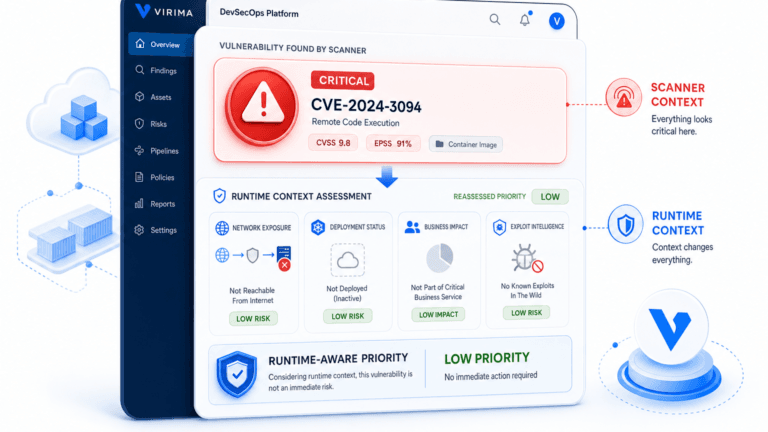
When an AI agent resolves an incident, modifies a configuration, or triggers a downstream change, the audit trail needs to be explainable — not just logged. Explainability means being able to reconstruct what the agent read, what it concluded, what it acted on, and what changed as a result. That reconstruction depends entirely on the quality of the runtime data the agent consumed.
ServiceNow’s AI Control Tower provides the governance layer for managing AI agents at enterprise scale. According to Futurum Research’s analysis of ServiceNow’s strategic direction into 2026, security stack expansion for agentic AI is one of the platform’s core investment areas — with governance and audit capability central to that expansion.
But the AI Control Tower governs based on what your CMDB and runtime data tell it. If CI records are incomplete, ownership fields are stale, or change history has gaps, the governance layer enforces policy against a partial picture. The audit trail is only as complete as the data that produced it.
What to check: Walk through a recent change or incident resolution in ServiceNow. Can you identify every CI involved, confirm its ownership at the time of the action, and verify the change history? If any step requires manual investigation to reconstruct, your explainability foundation needs work before autonomous workflows go live.
Question 4: Do You Know Who Owns Every CI and Service?
Ownership is one of the most consistently broken fields in enterprise CMDBs. Teams reorganize, people leave, responsibilities shift — and the CMDB does not get updated. This is tolerable when humans are in the loop: experienced IT staff know who actually owns what even when the CMDB says otherwise.
That institutional knowledge does not transfer to AI agents. When an agent needs to escalate an incident, assign a remediation task, or notify a service owner before a high-impact change, it reads the ownership field in your CMDB. A blank or stale ownership record is a workflow failure point in any automated escalation path.
Audit your ownership records before you build autonomous workflows on top of them. The ITAM and CMDB programs that define ownership as a governance requirement — not a field maintenance task — are the ones that produce data AI agents can act on reliably.
What to check: Run a report on CIs and service records where the owner field is blank, contains a generic team name, or references a person who has left the organization. In most enterprise CMDBs, this is 15–30% of records. Each of those records is a potential failure point for AI-driven workflows that need to escalate or reassign.
Question 5: Are Your Non-Human Identities Tracked as CIs?
One of K26’s breakout tracks addressed non-human identity (NHI) security: the governance challenge created by the proliferation of service accounts, API keys, automation scripts, and now AI agents across the enterprise.
AI agents are infrastructure. They execute actions, read data, connect to systems, and trigger workflows. Like other infrastructure components, they carry risk — and they need governance. If your AI agents are not tracked as CIs in your CMDB — with verified ownership, documented dependencies, and policy alignment from deployment — you have extended your attack surface without visibility into it.
The non-human identity surface in enterprise environments is growing faster than any other identity category. Treating these agents as CIs from day one, with the same lifecycle management, change tracking, and ownership governance applied to other managed assets, is the approach that keeps that surface auditable.
What to check: Identify every AI agent, RPA bot, service account, and API key currently active in your ServiceNow environment. Confirm that each one is tracked as a CI with a defined owner, documented dependencies, and a review date. An NHI without a CI record is an ungoverned asset.
A CMDB Readiness Summary Before Agentic Deployment
| Question | What You Need | Why It Matters |
| Is your CMDB discovery-sourced? | Multi-source discovery with reconciliation | Agents act on CI data; stale records produce incorrect autonomous actions |
| Can you trace blast radius? | Verified service dependency maps | Automated changes need downstream impact visibility before execution |
| Can you explain agent actions? | Complete audit trail with runtime context | Governance and audit require explainability, not just logging |
| Is ownership data current? | Verified CI and service owners | Escalation and assignment workflows break when ownership is blank or outdated |
| Are NHIs tracked as CIs? | AI agents registered with owner, dependencies, policy | Ungoverned AI agents expand the attack surface without visibility |
What Comes After the Assessment
The organizations that succeed in the agentic era will not necessarily be the ones with the most sophisticated AI. They will be the ones with the most trusted runtime foundation underneath it.
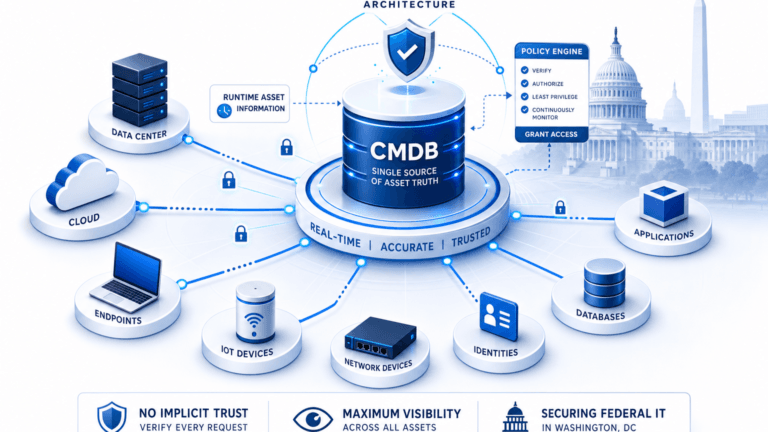
Trusted Runtime Truth — what exists, how it is connected, what changed, what will break, and who owns it — delivered live, explainable, and policy-aware, is what makes autonomous IT operations safe to run at scale. It is the data layer that the AI Control Tower governs against, that autonomous incident resolution reads before it acts, and that audit teams reconstruct after an agent makes a decision.
If your answers to these five questions revealed gaps, the work is concrete: validate your discovery coverage, build or reconcile your service dependency maps, audit ownership data, and register your AI agents and NHIs as CIs in your CMDB before your first agentic workflow goes live.
The ServiceNow integration that feeds accurate, discovery-sourced CI data into your ServiceNow CMDB is the place to start. Every deployment that follows will be safer and more governable for it.
Ready to assess your CMDB foundation? Schedule a demo to see how Virima delivers Trusted Runtime Truth for enterprise IT teams deploying AI agents on ServiceNow.