How to Build an AI-Ready CMDB Checklist for 2026

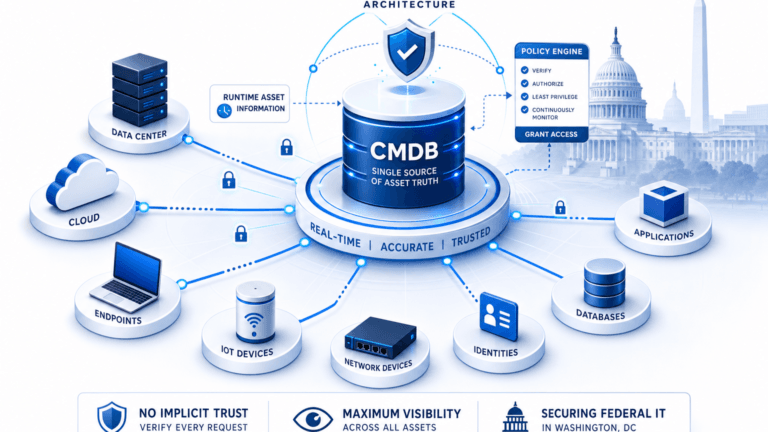
Building an AI-ready CMDB checklist starts with an uncomfortable truth: most CMDBs were never designed for the job AI agents are about to hand them. Gartner has forecast that by 2028, at least 15% of day-to-day work decisions will be made autonomously through agentic AI, up from none in 2024. Those agents will lean on CMDB data to reason, decide, and act, and most of that data sits in systems built for a very different purpose.
A typical enterprise CMDB was designed to pass audits, close change tickets, and satisfy quarterly reviews. It was not designed to serve as the ground-truth layer for software that executes actions on production infrastructure on its own. The gap between a compliance-grade CMDB and one that can guide autonomous decisions is where many agentic IT initiatives stall.
This AI-ready CMDB checklist covers 20 criteria across five areas: discovery coverage, CI data quality and freshness, relationship mapping, governance and policy awareness, and integration readiness. Clear all 20 and your CMDB can support trusted AI operations. Fall short on some, and you have a prioritized gap list to work from.
Discovery Coverage: Where the AI-Ready CMDB Checklist Begins
Your CMDB can only be as accurate as what it discovers. High-frequency discovery cycles are the foundation of every other item on this list. For a closer look at how discovery methodology shapes CMDB accuracy, discovery-driven CMDB practices cover the core tradeoffs.
☐ 1. Multi-source discovery is active across all environments
A single discovery method leaves gaps. Your CMDB should ingest CI data from agent-based discovery, agentless scanning, cloud APIs for AWS and Azure, and third-party tools such as Intune and SCCM. Each source covers infrastructure that no single method reaches alone.
☐ 2. Cloud assets are covered alongside on-premises infrastructure
Cloud-only or on-premises-only coverage creates a split view that misleads AI agents operating across both environments. Your discovery scope should include virtual machines, containers, and cloud-native services alongside physical servers and network devices.
☐ 3. Discovery job health is monitored and failures surface immediately
A discovery job that fails silently can be worse than no discovery, because teams keep trusting data that has quietly gone wrong. CI confidence scores should be tracked per record so stale or incomplete data is visible before it reaches an automated workflow. Choosing the right method for each environment matters here, too; active vs passive IT asset discovery explains when each performs best.
☐ 4. Orphaned CIs are identified and resolved on a defined schedule
Decommissioned assets that linger in the CMDB as active records produce false impact calculations and inflate change risk scores. A CI lifecycle process should flag records that have not been refreshed within a defined threshold and route them for review or removal.
CI Data Quality and Freshness
Discovery coverage gets data in. The next stretch of the AI-ready CMDB checklist tests whether that data can be trusted. For a baseline on what accurate, complete CI records look like, CMDB best practices are a useful starting point.
☐ 5. Each CI record has a defined owner
Ownership is not optional for agentic IT. When an AI agent needs to route an incident, approve a change, or assess impact, it has to know who is responsible for the affected CI. Missing ownership fields stop autonomous workflows at the point of action.
☐ 6. Data from multiple sources is reconciled into a single authoritative record
Duplicate CIs distort impact analysis and inflate risk scoring. Multi-source reconciliation merges records from discovery, ITSM imports, and third-party feeds into one authoritative record per CI, with conflicts resolved by a defined source priority.
☐ 7. CMDB health scoring is ongoing, not a quarterly review
A one-time accuracy audit is not enough. CMDB health scoring should track completeness, accuracy, and freshness per CI class and surface degrading records before they affect downstream processes or AI decisions. For teams building a CMDB from the ground up, health scoring belongs in place before any external data feeds are connected.
☐ 8. CI attributes meet the minimum data requirements for your AI use cases
Identify which CI attributes your AI workflows depend on: OS version, patch level, network zone, service relationship, and owner. Map those requirements against your current CMDB population and document every gap. If your IT asset management program already tracks asset attributes at this level, those records should feed your CMDB directly rather than being maintained separately.
Relationship Mapping and Service Context
An AI-ready CMDB not only knows what exists. It knows how everything connects, what will break, and which services are affected when something changes. This is the layer the AI-ready CMDB checklist weighs most heavily, because it is where agentic deployments most often go wrong.
☐ 9. CI relationships are built from discovery data, not manual entry
Hand-maintained relationships go stale as infrastructure shifts. Relationships sourced from IT discovery reflect the environment as it actually runs, not as it was documented at project close.
☐ 10. Service maps are current and tied to named business services
ViVID service maps connect infrastructure CIs to the business services they support. When an AI agent assesses the impact of a failing CI, it needs to know which services are at risk, not just which other CIs it touches. Without service context, impact analysis stays infrastructure-level only.
☐ 11. Downstream impact is visible before every change
Change impact analysis should surface the downstream blast radius of any proposed change: which CIs are affected, which services are at risk, and who owns each. This is the context that keeps AI-triggered changes from causing unintended service disruptions.
☐ 12. Dependency maps reflect multi-tier application architecture
Modern applications span web, application, and database tiers. A service map that captures only one tier misses cascading failure paths that AI agents will not anticipate. Multi-tier mapping helps agents see the full dependency chain before they act.
Governance and Policy Awareness
Governance is where the AI-ready CMDB checklist gets serious about trust. Runtime truth is not about scanning every asset around the clock; it is about live, explainable, governed data that an agent or a human can act on with confidence. The governance layer is what makes those decisions defensible, both to auditors and to the teams who own the affected infrastructure.
☐ 13. Audit records are maintained for all CI changes
Every change to a CI record (what changed, when, from which source, and the previous value) should be logged. That decision log tells an AI agent and any human reviewer exactly where each data point came from and when it was last confirmed.
☐ 14. Pre-change baseline data is queryable per CI
Knowing what a CI looked like before an incident is one of the highest-value diagnostics in IT operations. Pre-change baselines should be stored and queryable so AI agents can correlate configuration changes with incident timelines without relying on human memory or manual log review.
☐ 15. Role-based access controls are applied to CI data and relationships
AI agents inherit the permissions of the identity they operate under. RBAC governance restricts automated workflows so they do not read, modify, or act on CI data outside their authorized scope, which any enterprise deploying agents across production systems will need.
☐ 16. Every CI attribute carries a source label
An AI agent making decisions from CMDB data should be able to cite its source: which discovery method, which integration, or which import cycle produced the attribute it is acting on. That source label is what makes an AI decision explainable to a human reviewer and auditable after the fact.
Integration and Workflow Readiness
The final stretch of the AI-ready CMDB checklist covers integration and workflow readiness. An AI-ready CMDB does not operate in isolation; it feeds data to the tools and agents that act on it and takes context back from the workflows they run.
☐ 17. Bidirectional ITSM integration is configured and tested
Your CMDB should sync CI data bidirectionally with your ITSM platform, pushing discovered records in and receiving incident and change context back. Confirmed integrations with platforms including ServiceNow, Ivanti, HaloITSM, Jira Service Management, and Xurrent are increasingly expected in agentic IT environments.
☐ 18. CI data is accessible via API for AI agent consumption
AI agents need a programmatic path to query CI records, relationships, and confidence scores. REST API access is the minimum technical requirement for agentic CMDB integration. If your CMDB requires a person to pull a report before data reaches an agent, the architecture will struggle to support the workflows you are building toward.
☐ 19. CMDB coverage matches the operational scope of your AI agents
If your agents operate across cloud and on-premises environments, your discovery scope has to match. A CMDB that covers only part of your infrastructure leaves blind spots that agents cannot compensate for and may act on anyway with the data they have.
☐ 20. Alert and incident correlation is configured against CI records
When an alert fires, the CMDB should be the first lookup: which CI is affected, what is its service context, who owns it, and what changed recently. Correlating alerts and incidents against CI data speeds triage and gives AI agents the operational context to act without unnecessary escalation to human review.
See how Virima builds this kind of governed, discovery-driven CMDB across hybrid environments. Schedule a demo to walk through it with your own infrastructure in view.
What This AI-Ready CMDB Checklist Reveals
A CMDB that is ready for agentic IT is not defined by the platform it runs on. It is defined by what it can truthfully answer at any moment: what exists, how it is connected, what changed, what will break, and who owns it.
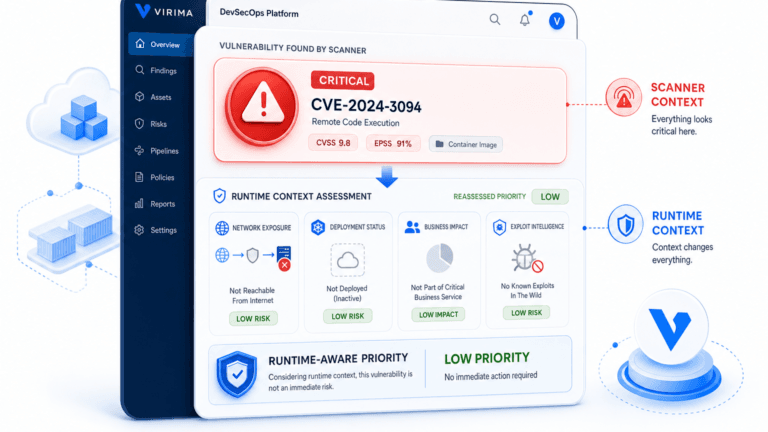
That is what runtime truth means in practice. It is not about scanning everything around the clock. It is about refreshing data when a decision depends on it, building on what Virima discovery and ViVID service map rescans already do, so AI agents act on current information and people can see when data is too old to trust. For a deeper look at how outages and AI initiatives intersect with CMDB data quality, the EMA ServiceOps 2025 report is worth reviewing alongside this checklist.
A CMDB that clears every item on this AI-ready CMDB checklist is positioned to support the AI workflows your organization is building toward. Fall short on a few, and you now have a prioritized place to start.
Schedule a demo to see how Virima delivers runtime truth across your full environment.