Enterprise CMDB for Hybrid Cloud IT in Madrid: The Gap Between DORA and Your Dashboard

On 28 April 2025 at 12:33 CEST, the power systems of continental Spain and Portugal went dark. ENTSO-E later documented the event as the most severe blackout on the European power system in more than twenty years, and the first of its kind in the Continental Europe Synchronous Area. A technical Expert Panel of forty-nine members reconstructed the sequence: oscillations, gaps in voltage and reactive power control, rapid output reductions, generator disconnections in Spain, and cascading generation loss that took continental Spain and Portugal offline.
It was not an IT failure. A configuration management database would not have kept the Iberian grid up. The episode still shows what cascading dependency failure looks like when interdependent systems lose a shared, current picture of how they connect. Madrid felt that loss in banking halls, metro platforms, mobile networks, and ATMs that went dark with the grid.
Hybrid cloud estates inside Madrid’s banks and telecom operators fail in a quieter way. A payment path, a core network segment, or a cloud workload drifts out of the system of record. Dashboards stay green. The next change window, ICT incident report, or supervisory request exposes the gap. An enterprise CMDB for hybrid cloud IT in Madrid is the layer that keeps configuration items, relationships, and ownership current enough that those requests do not turn into reconstruction projects.
What is an enterprise CMDB?
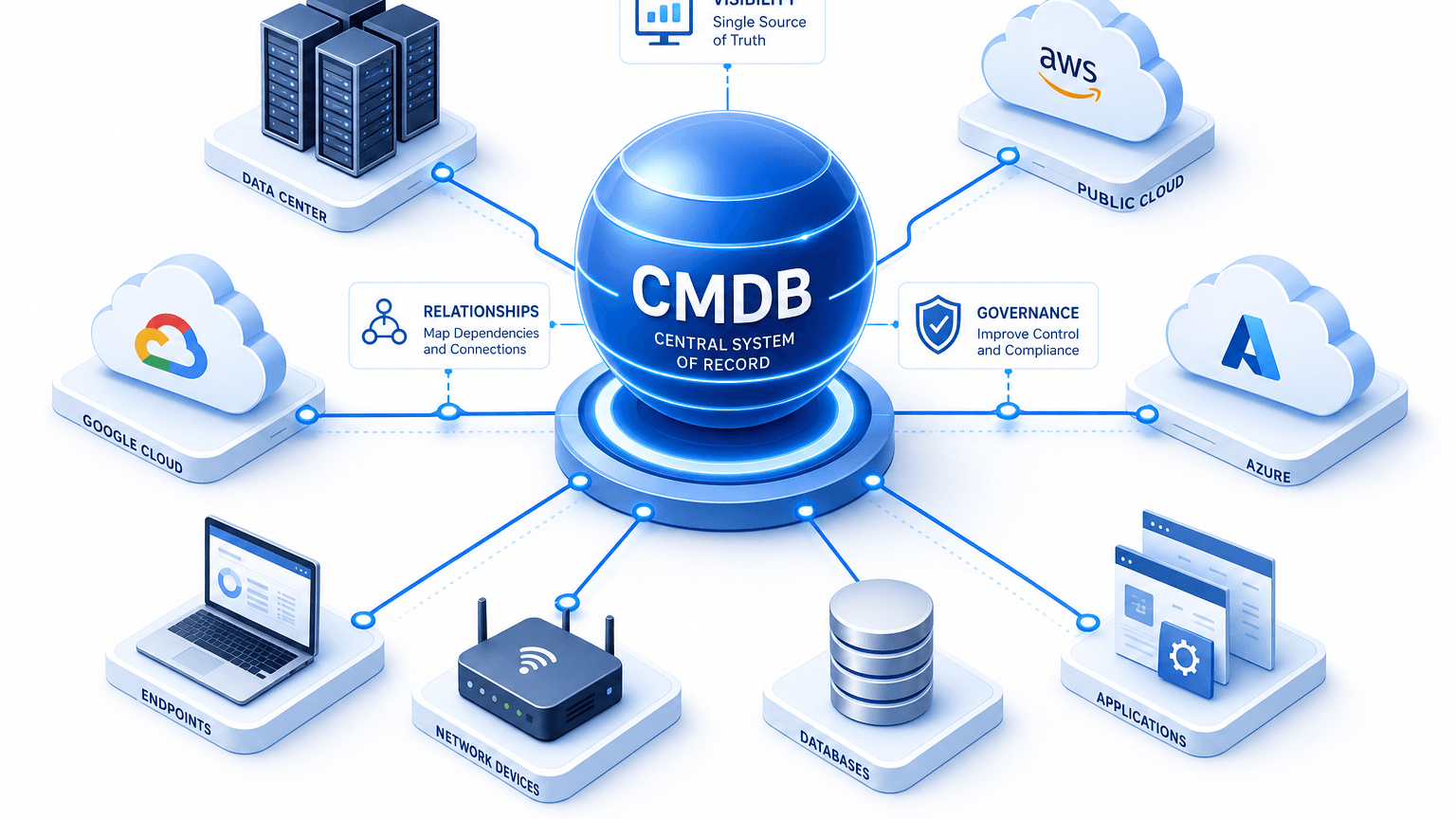
Under ITIL 4 Service Configuration Management practice materials published through AXELOS and PeopleCert, a configuration management database (CMDB) stores configuration records and the relationships between them. A configuration item (CI) is any component that must be managed to deliver an IT service. That definition is practice language, not vendor marketing.
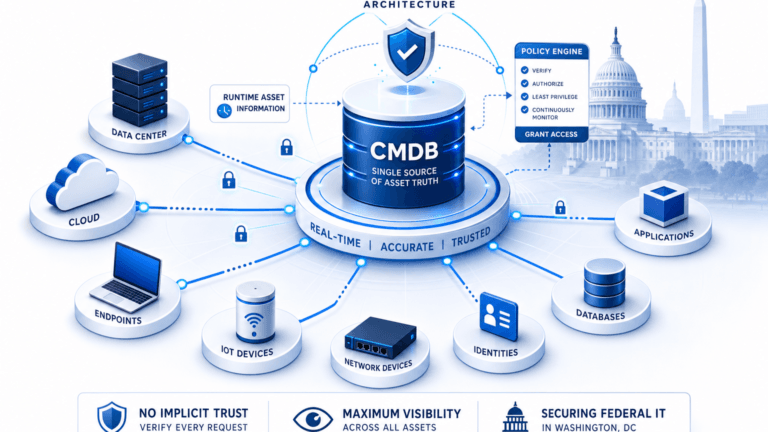
An enterprise CMDB extends the same idea across the full hybrid estate: on-premises servers and network gear, virtualization, AWS and Azure accounts, and the service relationships that tie those components to business outcomes. Atlassian’s CMDB overview frames the same core idea for ITSM teams: the value sits in relationships and currency, not in a static asset list.
Four requirements separate a working enterprise CMDB from a neglected one:
- CI identification. Every managed component has a stable identity, owner, and lifecycle state.
- Relationship mapping. Dependencies between CIs are recorded so change and incident teams can see the blast radius.
- Currency. Records refresh on a high-frequency scheduled discovery cadence, not on memory or quarterly spreadsheet imports.
- Auditability. Who changed what, when, and from which source remains inspectable.
Virima’s CMDB is built as that relationship and evidence layer. It is only as trustworthy as the discovery that feeds it. Teams that treat the CMDB as a one-time load project rediscover the same problem every audit cycle.
Where hybrid estates outrun the CMDB record
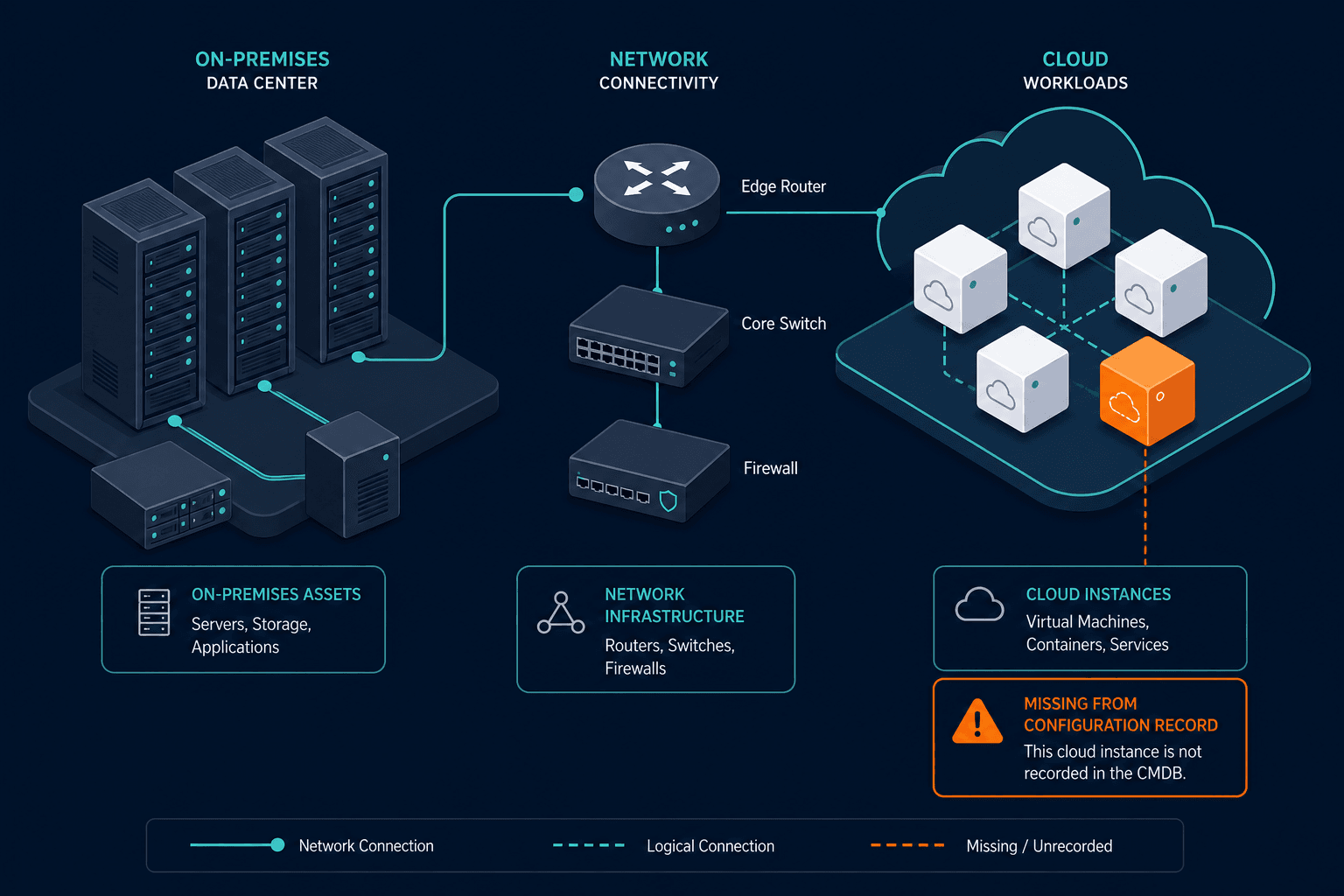
Hybrid estates break the CMDB in predictable ways. The table below is illustrative of patterns operators report, not a named customer case.
| Situation | What happens |
|---|---|
| Cloud instance provisioned via Terraform | Never appears in the CMDB until someone notices it on a bill. |
| Network device swapped during a telecom maintenance window | CMDB still shows the retired device as active. |
| Short-lived container workload spins up and down within hours | Discovery cycle misses it if the scan cadence is too coarse. |
Each row is a different flavor of the same failure: the live estate moves faster than the record. A cloud-oriented CMDB for hybrid environments only stays useful when discovery, relationship rules, and ITSM handoff keep pace with that change velocity.
Why an enterprise CMDB matters for Madrid’s financial and telecom IT
Madrid concentrates financial and telecom infrastructure that the rest of Spain depends on. Telefónica is headquartered in Spain with a global operator footprint. Banco Santander and BBVA run large corporate and operational centers in the Madrid area. When inventory or dependency data is wrong in those environments, the blast radius is not a single application team. It is customer channels, settlement paths, and national connectivity.
Hybrid adoption raises the stakes. Industry coverage of Gartner’s November 2024 cloud research has widely cited the forecast that roughly nine in ten organizations will take a hybrid cloud approach through 2027. Madrid banks and operators already live that pattern: regulated data on premises or in EU-constrained regions, burst capacity and analytics in public cloud, and network fabrics that still carry the business.
Uptime Institute’s 2025 Annual Outage Analysis (press release, 6 May 2025) reported that IT and networking issues accounted for 23% of impactful outages in 2024, up from prior years. The release ties that rise to IT and network complexity, change management problems, and misconfigurations. Power still leads overall outage causes, but the IT and networking share is the part CMDB and discovery work can influence.
Four failure modes show up repeatedly in Madrid financial and telecom estates:
- Discovery gaps in multi-cloud sprawl. New accounts, regions, and tags appear outside the CMDB source of truth. Result: audit findings when evidence cannot show a complete ICT inventory.
- Undocumented dependencies before a change window. A payment hop or signaling path is missing from the map. Result: preventable outages when the change hits an unlisted neighbor.
- Network-device inventory drift (telecom-specific). Swaps and decommissions leave ghost devices in the record. Result: blind spots in the asset class that is the product.
- Manual reconciliation that cannot keep pace. Engineers spend hours joining CMDB, cloud bills, and network exports. Result: a CMDB that exists on paper but is operationally untrusted.
ITIL change management and CMDB accuracy fail together when configuration drift compounds between approved changes. Network asset management is not optional for operators whose revenue is the network itself.
What incomplete CMDB evidence costs under DORA
For leaders
DORA (Regulation (EU) 2022/2554) applies across EU financial entities. EIOPA’s DORA overview summarizes the scope: ICT risk management, ICT third-party risk, incident reporting, resilience testing, information sharing, and oversight of critical ICT third-party providers. Application began on 17 January 2025.
DORA arms competent authorities with supervisory and administrative powers over ICT risk failures, including measures and pecuniary penalties set out in the regulation and related national application. Exact exposure depends on entity type, the competent authority, and the facts of the case. The practical leadership cost is clearer than any single fine figure: personal accountability for operational resilience evidence, board questions after major ICT incidents, and supervisory follow-up when registers and inventories cannot be produced on demand.
For ops teams
Uptime’s 2025 analysis links a growing share of impactful outages to IT, networking, change management, and misconfiguration. CMDB owners feel that as night work after failed changes, war-room time spent identifying the real CI, and weekly hours spent reconciling exports nobody trusts. The cost is not abstract ROI. It is engineer time and change success rate.
For regulated environments
DORA’s ICT third-party risk chapter requires financial entities to maintain a register of information on ICT third-party arrangements. EIOPA documents implementing technical standards and reporting tools for that register. Supervisors can inspect the register. The CMDB does not replace the register, GRC workflows, or legal contracts. It supplies the infrastructure layer: which systems, services, and dependencies sit behind each arrangement, and whether that picture is current.
Spain’s competent authorities for financial entities include the Banco de España and the CNMV, depending on entity type. Entity-level registration and reporting paths should be confirmed with counsel and the relevant supervisor. The operational requirement does not change with that split: when someone asks which ICT assets and third-party services support a critical function, the answer has to come from a maintained inventory, not a scramble.
Market-scale challenge in Madrid
Infrastructure fragility in Madrid has national consequences because so much of Spain’s banking and telecom operating weight sits here. An incomplete enterprise CMDB for hybrid cloud IT turns every supervisory request into a multi-team reconstruction.
For a deeper compliance framing on financial services asset visibility, see Virima’s guide to IT asset management for financial services compliance.
How a discovery-driven CMDB fixes this
Three mechanisms close the gap between DORA-grade questions and dashboard green lights.
1. High-frequency scheduled discovery across on-prem, AWS, and Azure
Agent-based, agentless, and API discovery pull network-connected infrastructure and cloud account inventory into the CMDB on a configurable schedule. That closes hybrid visibility gaps that manual entry never catches. Coverage is the estate you can reach with credentials and network path, not browser-rendered SaaS screens. Virima’s IT discovery and hybrid discovery patterns for on-prem, VMware, and cloud describe how those sources land in one CI model.
2. ViVID™ service maps for dependency and blast radius
Once service definitions are supplied (manually, by import, or via integration), Virima builds dependency maps from discovery data. Change owners see installed-on, runs-on, and related relationships before the window opens. That is the difference between approving a host change and approving a payment-path change. See service map.

3. ITSM and ITOM handoff that keeps evidence current
Bi-directional integration with platforms such as ServiceNow and Jira Service Management keeps incidents, changes, and CMDB records aligned. Audit evidence stays closer to “current on demand” than “rebuild before the assessor arrives.” Partner names stay plain text; the integration surface is the integrations hub. For the ITSM versus ITOM boundary, see the ITOM vs ITSM guide and the ServiceNow hybrid discovery path.
| Dimension | Manual reconciliation | Discovery-driven CMDB |
|---|---|---|
| Update frequency | Whenever someone remembers | High-frequency scheduled scans |
| Audit readiness | Scramble to reconcile before assessment | Evidence closer to current on demand |
| Dependency visibility | Workshop diagrams, stale within weeks | Service maps built from discovery data |
| Effort | Manual entry, engineer time | Automated refresh with exception review |
How Virima powers enterprise CMDB for hybrid cloud IT
Madrid financial and telecom teams do not need another dashboard that stays green while the CMDB drifts. They need discovery that lands in one CI model, maps that show blast radius before the change window, and handoff into the ITSM desks already running the process. Virima is built as that stack: discovery, CMDB, ViVID™ service mapping, ITAM, and ITOM context under one operating idea, Trusted Runtime Truth: what exists, how it connects, what changed, what breaks, and who owns it, explained enough for people and automation to act safely.
Discovery that closes hybrid and network gaps
Virima discovery combines agent-based, agentless, and cloud API collection across on-premises hosts, network devices, virtualization, and AWS and Azure accounts. Scan cadence is configurable so CMDB owners can match change velocity without claiming passive event-driven refresh between scheduled cycles. New instances and chassis land as CIs after the next scheduled cycle instead of after someone notices a bill or a spare rack. That is how an enterprise CMDB for hybrid cloud IT stays usable in multi-account bank estates and multi-vendor telecom fabrics.
Coverage stays honest: network-connected infrastructure and cloud accounts you credential, not every browser-rendered SaaS screen. Exception queues surface conflicts and stale candidates so engineers reconcile outliers rather than re-key the whole estate.
CMDB and ViVID™ maps as the decision layer
Discovery without relationships is still inventory. Virima’s CMDB stores CIs and the dependency edges that incident teams need. After service definitions are supplied (manual entry, import, or integration), ViVID™ builds service maps from discovery data so a payment path or core network service is visible as a graph, not a host list. CAB and war-room owners can see installed-on, runs-on, and related hops before they approve a window or page the wrong team.
That map layer is what turns DORA-style questions (“which ICT supports this critical function?”) into inspectable structure instead of tribal knowledge. It does not replace GRC registers or legal contracts. It supplies the infrastructure evidence those processes query.
ITAM, CSAM, and audit-oriented reporting
Hardware and software inventory that stays joined to the same CI identity supports IT asset management work without a second spreadsheet of record. Cybersecurity Asset Management (CSAM) teams inherit a cleaner inventory for prioritization when the CMDB is discovery-sourced rather than project-loaded. Scheduled reporting and export patterns support standing audit readiness instead of an annual scramble. For the CSAM framing, see the essential guide to cybersecurity asset management. For how automated discovery keeps the CMDB from decaying after cleanup, see CMDB with automated discovery for hybrid IT.
Integration without ripping out the desk
Virima does not ask Madrid banks or operators to replace ServiceNow, Jira Service Management, or other ITSM platforms. Bi-directional handoff feeds discovery-sourced CIs and maps into the tools teams already use for tickets and changes, through the integrations hub. ITOM and ITSM both consume the same runtime picture: operations sees impact; service management sees ownership and change history. Trusted Runtime Truth is the category name for that shared picture, not a second product silo.
What changes for Madrid operators day to day
- Fewer reconciliation hours. CMDB owners review exceptions instead of rebuilding inventory from cloud bills and network exports.
- Safer change windows. Dependency context is available before approval, not after a failed deployment.
- Faster incident context. Alerts and tickets can attach to current CIs and services instead of hostnames that left the estate last quarter.
- Defensible supervisory responses. Asset and dependency evidence is closer to current when Banco de España, CNMV, or internal audit asks how a critical function is supported.
Virima remains the discovery and CMDB evidence layer under DORA programs. It does not satisfy DORA by itself, and it does not replace GRC, legal, or supervisory reporting tools.
See how discovery-sourced CMDB and service maps give Madrid hybrid estates the runtime picture DORA evidence and change windows both need. Explore Trusted Runtime Truth.
Moving from manual records to a map-driven CMDB
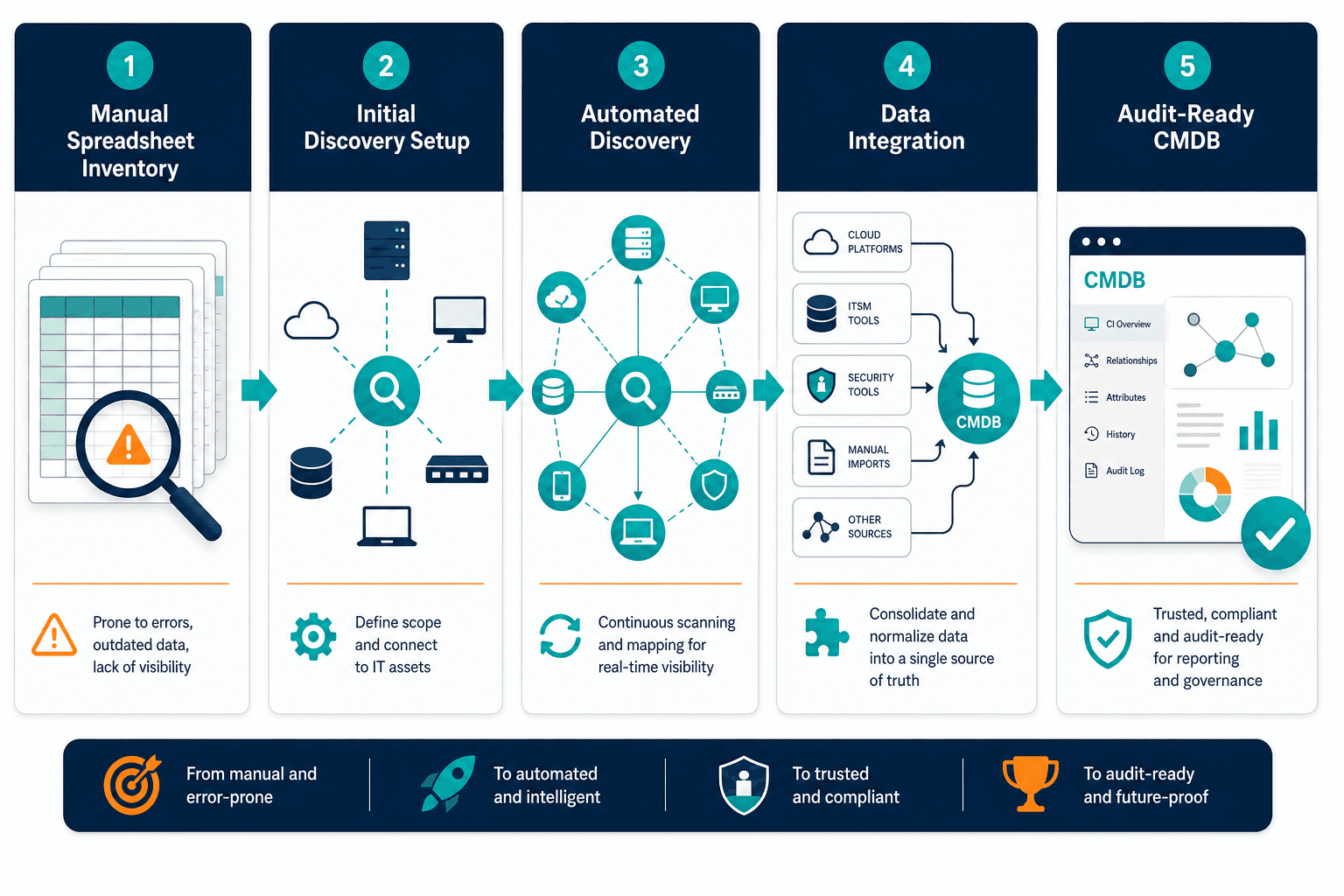
| Old way | Map-driven way |
|---|---|
| Spreadsheet inventory updated from memory | Discovery-sourced CMDB on a scheduled cadence |
| Dependency mapping in ad hoc workshops | ViVID™ service maps built from discovery data |
| Audit prep as an annual scramble | Standing, audit-oriented reporting from current CIs |
Who benefits
- CIO. Defensible inventory and dependency evidence when boards and supervisors ask how critical functions are supported.
- CTO. Architecture-level confidence that hybrid changes will not surface unknown dependencies after the window opens.
- CMDB owner. Fewer reconciliation hours and less time defending data nobody trusted.
Getting started
- Inventory the current state across on-premises, cloud, and network assets you can already list.
- Run discovery to establish a verified baseline for network-connected and cloud-account sources.
- Validate discovered CIs against existing ITSM records and resolve identity conflicts.
- Build service maps for the most critical business services first.
- Establish an audit-ready reporting cadence instead of a once-a-year export.
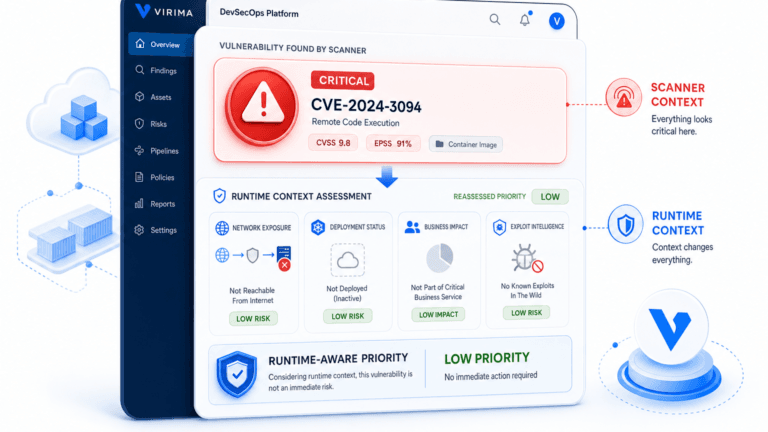
Federal inventory practice outside the EU still underlines the same principle: CISA BOD 23-01 treats asset visibility as a prerequisite for vulnerability and risk programs. Madrid teams under DORA face a different legal text with the same operational dependency on knowing what they run.
Close the gap between DORA and the dashboard
DORA asks financial entities to manage ICT risk, third parties, and incidents with evidence. Dashboards answer “is this component up right now?” An enterprise CMDB for hybrid cloud IT in Madrid answers “what exists, how it connects, what changed, and what breaks if we touch it.” Discovery keeps that answer current, service maps make it usable in change and incident work, and integrations put it where operators already work.
For the next step on regulated financial-services inventory and compliance context, read IT asset management for financial services compliance.
Frequently Asked Questions
What is an enterprise CMDB?
An enterprise CMDB stores configuration items and their relationships across the full hybrid estate: on-premises, network, and cloud. ITIL 4 treats it as the system of record for service configuration, not a simple asset spreadsheet.
Why does CMDB accuracy matter for financial services compliance?
Supervisors and auditors sample inventories, change evidence, and ICT third-party arrangements. Stale CIs and missing dependencies produce findings even when dashboards look healthy. Accurate CMDB data shortens that evidence path.
Does Virima’s CMDB integrate with ServiceNow for DORA evidence in banking environments?
Yes. Virima integrates bi-directionally with ServiceNow, feeding discovery-sourced CIs and dependency data into existing workflows rather than replacing them. That gives DORA-relevant ICT asset and third-party evidence a home in the ITSM tool banking teams already use for change and incident records.
How does Virima’s ViVID™ service mapping show blast radius before a change window?
ViVID™ service maps connect discovered CIs: servers, network devices, and cloud workloads into dependency graphs before a change window opens. Change owners see installed-on, runs-on, and related relationships, so blast radius is visible as a map instead of something discovered mid-incident.
Does a CMDB satisfy DORA compliance in Spain?
No. A CMDB does not satisfy DORA. It supports compliance by supplying current asset and dependency data that ICT risk, third-party registers, and incident processes require under Article 8. Legal and GRC controls remain separate.