IT Asset Management for Financial Services: Compliance and Risk Management in 2026

IT asset management for financial services has become a regulatory problem, not just an operational one. When auditors arrive, they do not want a spreadsheet you assembled last week. They want evidence that your organisation knows exactly what assets it owns, where they are, what they connect to, and how they have changed over time.
Most IT teams struggle to provide that. Not because they lack effort, but because their asset data was never designed to stay current at the speed their environments actually change.
This guide covers what IT asset management for financial services needs to do in 2026 to keep you compliant, audit-ready, and operationally sound. To set the stakes: IBM’s 2025 Cost of a Data Breach Report put the average breach in the financial sector at $5.56 million, the second-highest of any industry, and regulatory fines were a growing share of that total. In an environment where the cost of a control gap is measured in millions, asset data you cannot defend is a liability.
Why IT Asset Management for Financial Services Faces a Different Kind of Pressure
Banks, insurers, investment firms, and payment processors operate under overlapping regulatory frameworks. A single organization might need to satisfy SOX, PCI DSS, GLBA, DORA, and internal audit requirements at the same time. Each framework has its own expectations around asset visibility, access controls, change traceability, and risk documentation.
The IT environment underneath all of this is rarely simple. Hybrid infrastructure mixing on-premises data centers with AWS and Azure cloud workloads is now standard. Shadow IT, acquired entities from M&A activity, and end-of-life systems that cannot be decommissioned quickly add further complexity.
The result: your asset inventory is often incomplete or out of date, and that gap is a direct compliance and operational risk.
The Compliance Frameworks Shaping IT Asset Management in 2026
SOX and IT Asset Traceability
The Sarbanes-Oxley Act requires controls over financial reporting systems, which means IT must demonstrate that the assets supporting those systems are known, tracked, and change-controlled. Auditors want to see documented change history, ownership records, and evidence that unauthorized changes trigger alerts or reviews.
If your CMDB is maintained by hand, configuration items drift from reality within weeks. When a SOX auditor asks you to prove that no unauthorized changes occurred to a financial reporting system, an out-of-date CMDB is not a defensible answer. Feeding the CMDB from agent and agentless IT discovery closes that gap at the source.
DORA and Operational Resilience
The Digital Operational Resilience Act, which applies to financial entities operating in or serving the EU, requires organizations to map their ICT assets and understand dependencies across critical business services. DORA specifically calls for maintaining accurate, up-to-date registers of ICT assets and mapping how those assets support critical functions.
This is not a checkbox exercise. DORA expects you to understand the impact. If a critical payment processing system fails, which other services does it take down? Which assets are in scope? Which third parties are affected? Without discovery-sourced ground truth, answering those questions takes days you do not have.
PCI DSS and Scoped Asset Visibility
PCI DSS version 4.0.1 tightened requirements around asset inventory for cardholder data environments. Requirement 12.3 explicitly calls for targeted risk analysis and an accurate inventory of system components in scope. You need to know which assets touch cardholder data, what software runs on them, and how they connect to the rest of your network.
Scoping errors are one of the most common PCI audit failures. Assets that should be in scope get missed because discovery was incomplete or the inventory was not refreshed after a cloud migration or infrastructure change.
GLBA and Data-Bearing Asset Controls
The Gramm-Leach-Bliley Act requires financial institutions to protect customer financial information. The Safeguards Rule, updated and enforced by the FTC, requires a written information security program that includes an inventory of all data-bearing assets. You need to know where customer data lives, on which assets, and who has access.
That requires asset discovery that goes beyond hardware counts. You need software inventory, data flow visibility, and ownership tracking grounded in current discovery data, not a spreadsheet someone updated six months ago.
Why Out-of-Date Asset Data Creates Regulatory Risk
The core problem is not that financial services IT teams ignore compliance. Most teams take it seriously. The problem is that the tools and processes they use to maintain asset data cannot keep pace with the rate of change in their environments.
Consider what happens in a typical quarter at a mid-to-large financial institution:
• Cloud workloads spin up and down on demand
• New software gets deployed outside formal change processes
• Acquired entities bring in unknown assets and configurations
• Contractors and vendors introduce devices that never get formally registered
• Legacy systems get patched or reconfigured without CMDB updates
Each of these events creates a gap between what your asset records say and what is actually running in your environment. When an auditor asks for evidence of control, that gap becomes a finding.
Records kept up by hand make this worse. Asking engineers to update CMDB records after every change assumes near-perfect adherence to process, which rarely holds at scale. The CMDB drifts. By the time you prepare for an audit, you are scrambling to reconcile records rather than demonstrating sustained control. A CMDB built from discovery keeps that record current without the reconciliation scramble.
What Audit-Ready IT Asset Management Actually Requires
Audit readiness is not a point-in-time activity. It is an ongoing state. To maintain it, IT asset management for financial services needs to deliver four things consistently:
1. Complete, current asset inventory. Every hardware and software asset, on-premises and in the cloud, needs to be discovered and recorded without manual data entry. Records kept up by hand cannot maintain completeness at scale.
2. Relationship and dependency mapping. Auditors and risk managers need to understand how assets connect to each other and to critical business services. An asset list without relationships is not enough for DORA, PCI scoping, or SOX change impact analysis.
3. Change history and ownership tracking. Who owns each asset? What changed, when, and who approved it? This history needs to be captured at the source, not reconstructed from memory or ticket comments.
4. Software license and contract compliance. Unlicensed software on financial systems creates both regulatory and legal exposure. You need ongoing visibility into what software is installed, whether it is licensed, and when contracts expire.
How Trusted Runtime Truth Supports IT Asset Management for Financial Services
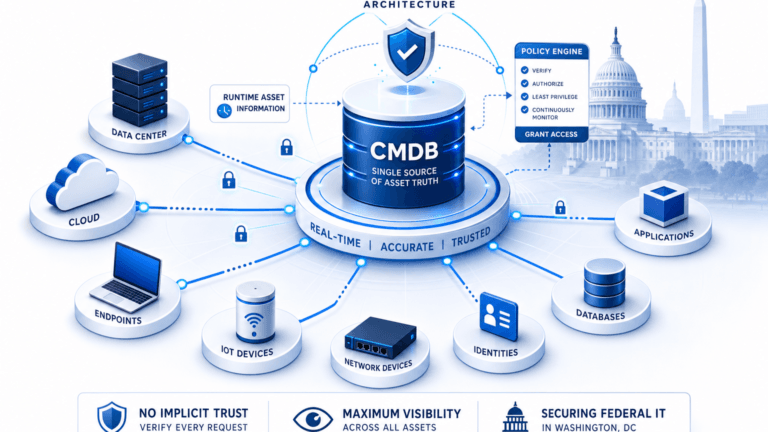
This is where the idea of trusted runtime truth becomes directly relevant to IT asset management for financial services. A static asset database, however well-structured, cannot serve as a reliable compliance foundation if it does not reflect what is running in your environment when a decision depends on it.
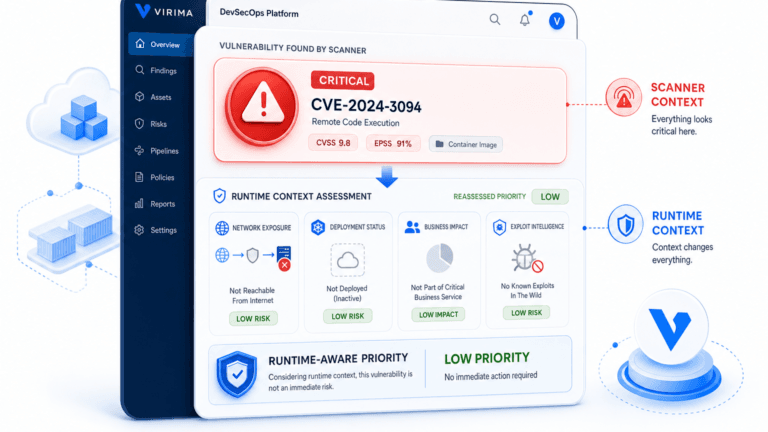
Virima already keeps your records current through discovery. Trusted runtime truth extends that foundation: instead of trusting a six-month-old snapshot, Virima watches the confidence in each record and refreshes on demand when that confidence drops or a decision calls for the latest state. You get live, explainable, policy-aware context across assets, services, dependencies, ownership, change history, vulnerabilities, and impact. That is what financial services compliance frameworks ask for.
Discovery-Driven Ground Truth Across Hybrid Environments
Virima uses agentless, agent-based, and API-based discovery methods to run high-frequency discovery cycles that keep your CMDB current without manual updates. This covers on-premises infrastructure, AWS environments, and Azure workloads in a single view.
For PCI DSS scoping, this means you can identify the assets that touch your cardholder data environment, including assets added since your last manual inventory. For DORA, it means your ICT asset register reflects your infrastructure as it changes. For SOX, it means your financial reporting systems and their dependencies are tracked on an ongoing basis, not just at audit time.
Discovery-sourced ground truth narrows the gap between what your records say and what is actually running. That gap is where compliance findings live.
Live, Explainable Asset Context for Auditors
When an auditor asks about a specific system, you need to show more than its existence. You need its current configuration, its ownership, its change history, its software inventory, and its relationships to other systems.
Virima’s discovery-driven CMDB tracks ownership details, relationship data, and configuration history as part of normal operation. The data is live and explainable, so you can show an auditor what changed, when, and what it connects to, without manually assembling evidence packages the week before the audit. That shifts audit preparation from a reactive scramble toward a straightforward reporting exercise.
Governed Change Management With Impact Visibility
Change management is a critical control area for SOX and DORA. Financial services organizations need to demonstrate that changes to critical systems are assessed for impact before approval, not after an incident.
ViVID™ Service Mapping builds dynamic dependency maps that show impact and service relationships before a change is approved. If a proposed change to a payment processing server would affect downstream settlement systems or customer-facing applications, that dependency is visible in the change record before anyone signs off.
This gives your change advisory board the context it needs to make a governed decision. It also gives you documented evidence that impact was assessed, which is exactly what SOX and DORA auditors want to see.
Software License and Contract Compliance
Unlicensed software is a compliance risk in financial services, both from a regulatory standpoint and from a vendor audit perspective. Virima’s IT asset management capabilities track software installations against license entitlements, contract terms, and renewal dates on an ongoing basis.
If software gets installed outside formal procurement channels, discovery surfaces it. If a license is approaching expiration, you see it before it lapses. That ongoing visibility means you are not discovering compliance gaps during an audit or after a vendor audit letter arrives.
ITAM for Financial Services: Build vs. Buy Considerations
Some financial services IT teams try to build asset management capabilities internally, typically by extending their ITSM platform’s native discovery or by combining spreadsheets with point tools. This approach has real limits.
| Capability | Manual / DIY Approach | Dedicated ITAM Platform |
| Discovery completeness | Partial, protocol-limited | Agentless, agent, and API coverage |
| CMDB accuracy over time | Degrades without manual effort | Kept current through discovery |
| Dependency mapping | Absent or static | Dynamic, relationship-tracked |
| Audit evidence generation | Manual assembly | Ongoing and reportable |
| Software license tracking | Spreadsheet-based | Tracked against entitlements |
| Change impact visibility | Not available pre-change | Impact shown before approval |
The build approach tends to work at a small scale and then breaks down as environments grow, as cloud adoption accelerates, or as M&A activity introduces new assets. The cost of a failed audit, a compliance finding, or a major incident caused by an undocumented dependency usually exceeds the cost of a dedicated platform. For a wider view of the market, see this guide to the best IT asset management tools for hybrid teams.
For financial services organizations with 500 or more employees running hybrid environments, a dedicated ITAM platform built on discovery-sourced trusted runtime truth is a practical path to sustainable compliance.
Integrating ITAM With Your Existing ITSM Stack
One objection that comes up frequently in financial services is the concern about adding another tool to an already complex stack. The answer depends on what the tool actually does to your existing workflows.
Virima is designed to work with your existing ITSM platform, not replace it. Native integrations include ServiceNow, Ivanti, Halo, Jira Service Management, and Xurrent. Discovery data, CMDB records, and service dependency maps feed directly into the ITSM workflows your teams already use.
This means your service desk engineers see asset context in the tickets they already work on. Your change managers see impact in the change records they already review. Your compliance team gets audit-ready reporting from the same data source that drives operations.
You do not need to migrate platforms or retrain teams on new workflows. That discovery-sourced layer sits underneath your existing tools and makes them more accurate and more useful. For financial services organizations that have invested in ServiceNow or Jira Service Management, this is a low-disruption way to close the asset visibility gap that creates compliance risk.
Audit-Ready Beats Audit-Anxious Every Quarter
Financial services IT teams do not have the luxury of approximate asset data. Regulators, auditors, and operational risk all demand the same thing: accurate, current, explainable records of what you own, what it connects to, and how it has changed.
The path to that level of visibility is not more manual effort. It is discovery-driven IT asset management for financial services that maintains trusted runtime truth across your hybrid environment, so you are audit-ready by default rather than perpetually preparing.
If your current ITAM approach relies on manual updates, periodic scans, or ITSM-native discovery that leaves gaps, now is the time to close them. Request a Virima demo and see how this approach holds up under a financial services audit.
FAQs
What is IT asset management in financial services?
IT asset management (ITAM) in financial services is the practice of discovering, tracking, and managing all hardware and software assets across an organization’s IT environment. In financial services, ITAM must also support compliance with regulatory frameworks like SOX, PCI DSS, DORA, and GLBA by maintaining accurate, current, and auditable asset records.
Why is ITAM compliance so important for banks and financial institutions?
Financial institutions operate under strict regulatory requirements that demand documented control over IT assets, particularly those supporting financial reporting, payment processing, and customer data. Out-of-date or incomplete asset data creates compliance gaps that can result in audit findings, regulatory penalties, and operational risk during incidents or changes.
How does discovery-driven inventory improve audit readiness?
High-frequency discovery cycles scan your environment and update your CMDB without manual effort. This keeps asset records current as your infrastructure changes, so when auditors request evidence of asset controls, you can produce accurate, up-to-date records rather than records you assemble by hand that may not reflect current reality.
What is the impact (blast radius) visibility, and why does it matter for financial services compliance?
Impact visibility shows which assets, services, and business processes would be affected if a specific system failed or were changed. For financial services, this supports DORA operational resilience requirements and SOX change impact assessment. Knowing the impact before approving a change lets you make a governed decision and document that the impact was assessed.
How does ITAM support PCI DSS compliance?
PCI DSS requires an accurate inventory of all system components in scope for cardholder data environments. Discovery-driven ITAM helps keep your PCI scope complete and current, including assets added through cloud deployments or infrastructure changes that might otherwise be missed in a point-in-time inventory.
Can ITAM tools integrate with ServiceNow or Jira Service Management?
Yes. Virima offers native integrations with ServiceNow, Ivanti, Jira Service Management, and other ITSM platforms. Asset data, CMDB records, and service dependency maps flow into your existing ITSM workflows, so teams work with the current asset context without switching tools or maintaining separate systems.
What is the difference between a CMDB and an IT asset management system?
A CMDB (Configuration Management Database) tracks configuration items and their relationships, focusing on operational context and service dependencies. An IT asset management system tracks the full lifecycle of assets, including procurement, licensing, contracts, and financial data. The most effective platforms combine both, giving you operational visibility and compliance-oriented asset tracking grounded in a single source of trusted runtime truth.