Hybrid Discovery: On-Prem, VMware, and Cloud in One CMDB

The change window is Friday. Network has a switch export, VMware admins have a vCenter list, cloud has three account CSVs, and nobody can confirm which host list is current when the bridge opens. Hybrid discovery on-prem VMware and cloud is the practice of running agent, agentless, and cloud-API collection under one reconciliation authority — so five exports stop disagreeing about what exists.
This guide is for CMDB owners, discovery leads, and IT operations managers running mixed estates. It is not a multi-cloud CMDB geography story or a pure AWS inventory how-to, and it is not the hybrid cloud CMDB coexistence brief for dual-core banks. The focus is coverage architecture: on-prem VMware cloud discovery only becomes hybrid discovery when every method feeds one shared authority, not five side lists.
How should hybrid discovery cover on-prem, VMware, and cloud without five disconnected tools?
Five tools feel complete until the lists disagree
Most hybrid programs buy tools the way they buy domains. On-prem gets a network scanner. VMware gets a hypervisor connector. Each cloud gets a native inventory or CSPM export. Endpoints get an agent stack. Sometimes a sixth spreadsheet glues the rest together for the CMDB import. Hybrid discovery without tool sprawl means one authority governing all of it, not five disconnected lists that each look right in isolation.
Each tool can look successful on its own. The network scanner returns thousands of IPs. vCenter shows every VM registered to the cluster. AWS and Azure consoles list instances in the accounts someone remembers to grant.
The problem is not missing products. The problem is missing authority. When those feeds disagree on existence, owner, or last-seen facts, operators pick a favorite list under pressure. That is how hybrid discovery on-prem VMware and cloud collapses into tribal inventory.
Flexera’s 2025 State of the Cloud report coverage keeps documenting multi-cloud and hybrid reality as the default enterprise pattern, not a temporary migration phase. More clouds and more private estates raise governance load. Tool count rises with that load unless someone designs a single discovery control plane on purpose.
When partial inventories still drive change and incident decisions, start with Trusted Runtime Truth. Pressure-test whether one discovery authority still owns existence across bare metal, VMware, and cloud after the project party ends.
Why do hybrid estates end up with five disconnected discovery tools?
Teams buy a scanner per domain as each platform arrives. On-prem, VMware, AWS, Azure, and endpoints each get a native inventory. Without a shared authority rule, those feeds never reconcile. Operators then trust the list that shipped last under incident pressure.
Hybrid discovery means method coverage, not product count
Hybrid discovery that covers on-prem, VMware, and cloud is a coverage map with named methods, not a shopping cart of point tools. A useful map answers four questions for every scope:
- Which method runs
- Who owns credentials
- How often the cycle must succeed
- Which system wins when sources conflict
For a deeper comparison of when to use agent-based versus agentless collection, see Agent-based vs. agentless discovery: which is best for your business?.
On-prem ranges need agent and agentless options
Bare-metal servers, network gear, and locked segments rarely share one access path. Agent-based discovery fits deep hardware and software inventory where agents are allowed. Credentialed agentless discovery fits ranges where agents are blocked. Network device collection covers routers, switches, and firewalls the host scanners never own. The method mix matters more than the brand label on the scanner.
VMware needs hypervisor-aware inventory
vCenter and ESXi hold identity facts host-only scans miss:
- Cluster membership
- Datastore ties
- Guest-to-host placement
- Template sprawl
Hybrid discovery that keeps VMware inventory in a separate spreadsheet from bare-metal and cloud CIs recreates the same reconciliation gap Flexera’s 2025 State of the Cloud report describes as a durable, not temporary, enterprise problem. Hybrid discovery on-prem VMware and cloud fails when VMware stays a side export that never joins the same CI model as physical hosts. Virtual machine discovery should feed the same reconciliation path as bare metal, not a parallel spreadsheet.
Cloud needs API pull on a written account scope
AWS and Azure inventories move faster than quarterly CMDB imports. Hybrid discovery without five disconnected tools still requires scheduled API pull per account and subscription in scope, with owners for credentials and last successful cycle. Cloud-only consoles are fine as secondary evidence. They are poor as the only system of record for cross-domain change impact.
CISA BOD 23-01 treats incomplete federal asset inventory as a control failure, not a documentation gap. The same standard applies to any hybrid enterprise splitting on-prem, VMware, and cloud discovery across five disconnected tools: partial visibility is a governance risk, regardless of sector. Hybrid estates that split discovery by platform inherit the same gap under a private label.
Why disconnected tools stay disconnected after go-live
Buying five products is cheaper than designing one authority model, until year two. Each tool keeps its own schedule, credential vault, and export format. So CMDB stewards become human ETL. Security trusts the scanner. Cloud trusts the account export. VMware trusts vCenter. Enterprise IT trusts the last import job. Nobody owns the merge rule when serial numbers collide or a VM appears in two places.
That pattern scales until volume exceeds attention. Then hybrid discovery on-prem VMware and cloud becomes a quarterly cleanup project instead of a control. Incident bridges invent host lists. Change boards approve paths nobody can prove. Automation pauses because operators fear acting on bad CIs.
Reconciliation is the product, not the export
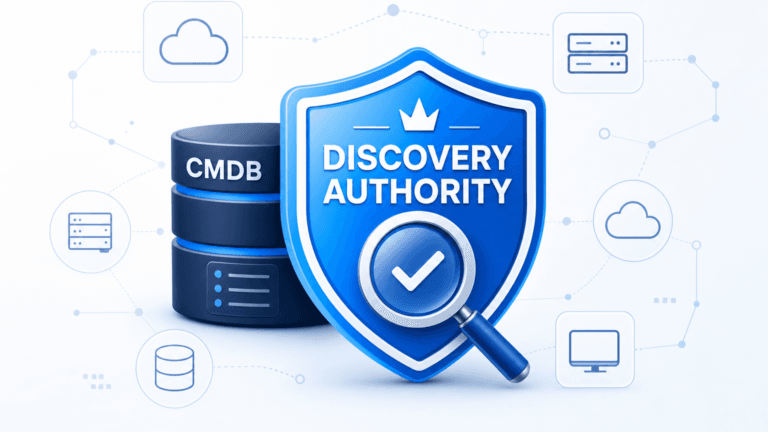
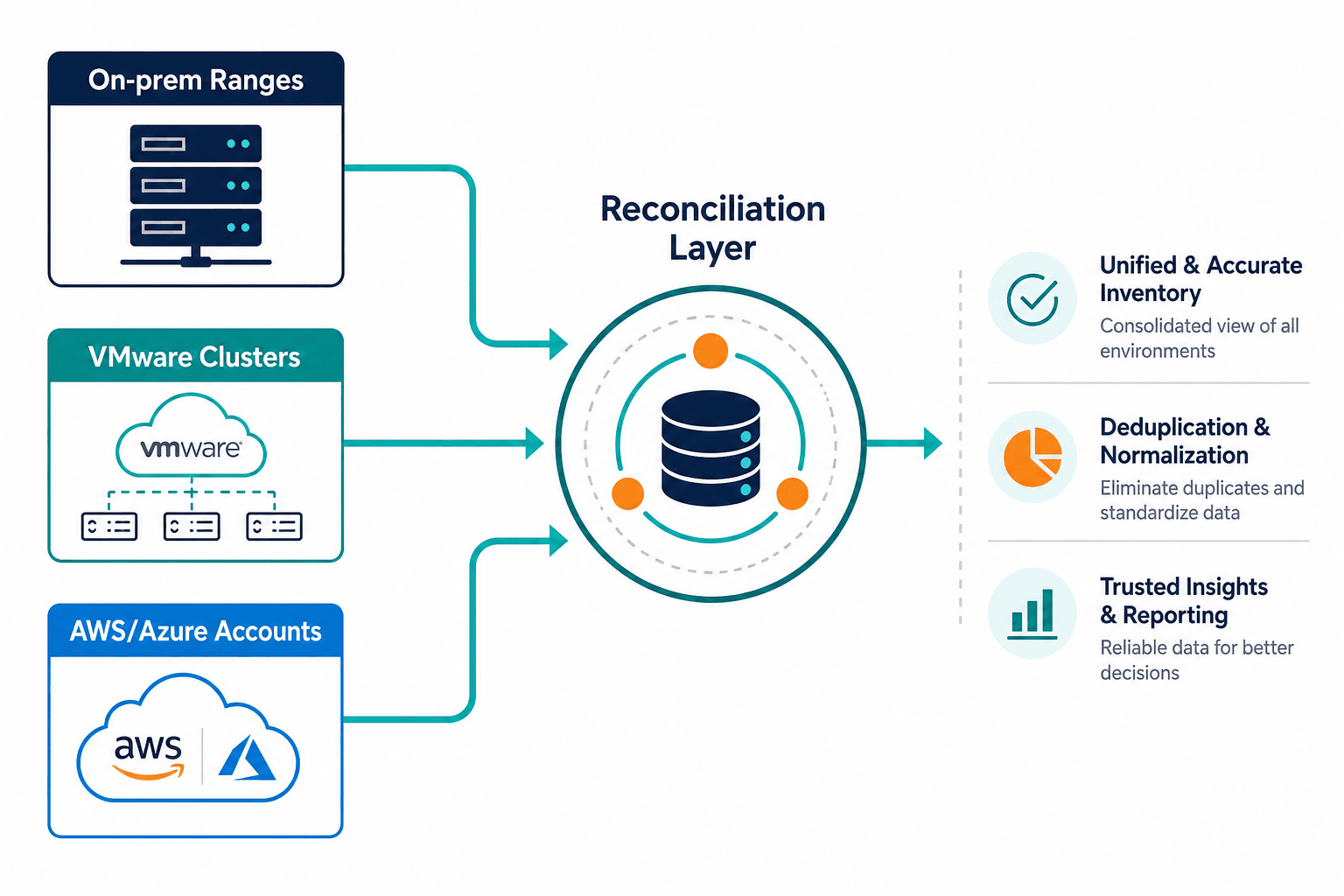
A single export dump into the CMDB is not hybrid discovery. Hybrid discovery on-prem VMware and cloud requires one reconciliation authority that decides which source wins when feeds disagree on existence or last-seen data. Without that rule, teams default to whichever export shipped most recently — a practice that breaks down under incident pressure when accuracy matters most. A multi-source discovery CMDB should prefer recent discovery evidence for existence, identity, and last-seen facts while leaving business metadata to owners and finance systems. Without that rule, the fifth tool is always a spreadsheet.
Cadence beats hero scans
Hero scans before an audit produce a temporary green chart; they do not fix a stale CMDB. Scheduled agent, agentless, hypervisor, and cloud-API discovery cycles — each with a named owner and a maximum age before a cycle counts as failed — keep CI data honest between audits, not just during them. Virima does not claim passive event-driven discovery today. For a deeper look at why cadence outperforms point-in-time scans, see blog post on discovery cadence versus audit-driven scans.
Internal teams evaluating platform fit should review how Virima IT discovery combines agent-based and agentless methods for VMware and cloud asset discovery on a shared schedule. Pair discovery-sourced CMDB truth with dedicated EDR, SIEM, and vulnerability platforms. Do not force one product to own every security job if the risk model says otherwise.
What does hybrid discovery covering on-prem, VMware, and cloud require beyond more scanners?
It requires a written method map, shared reconciliation rules, and cadence short enough that stale last-seen data counts as a defect. Product count alone does not create authority when exports disagree on existence and ownership.
One control plane, many methods
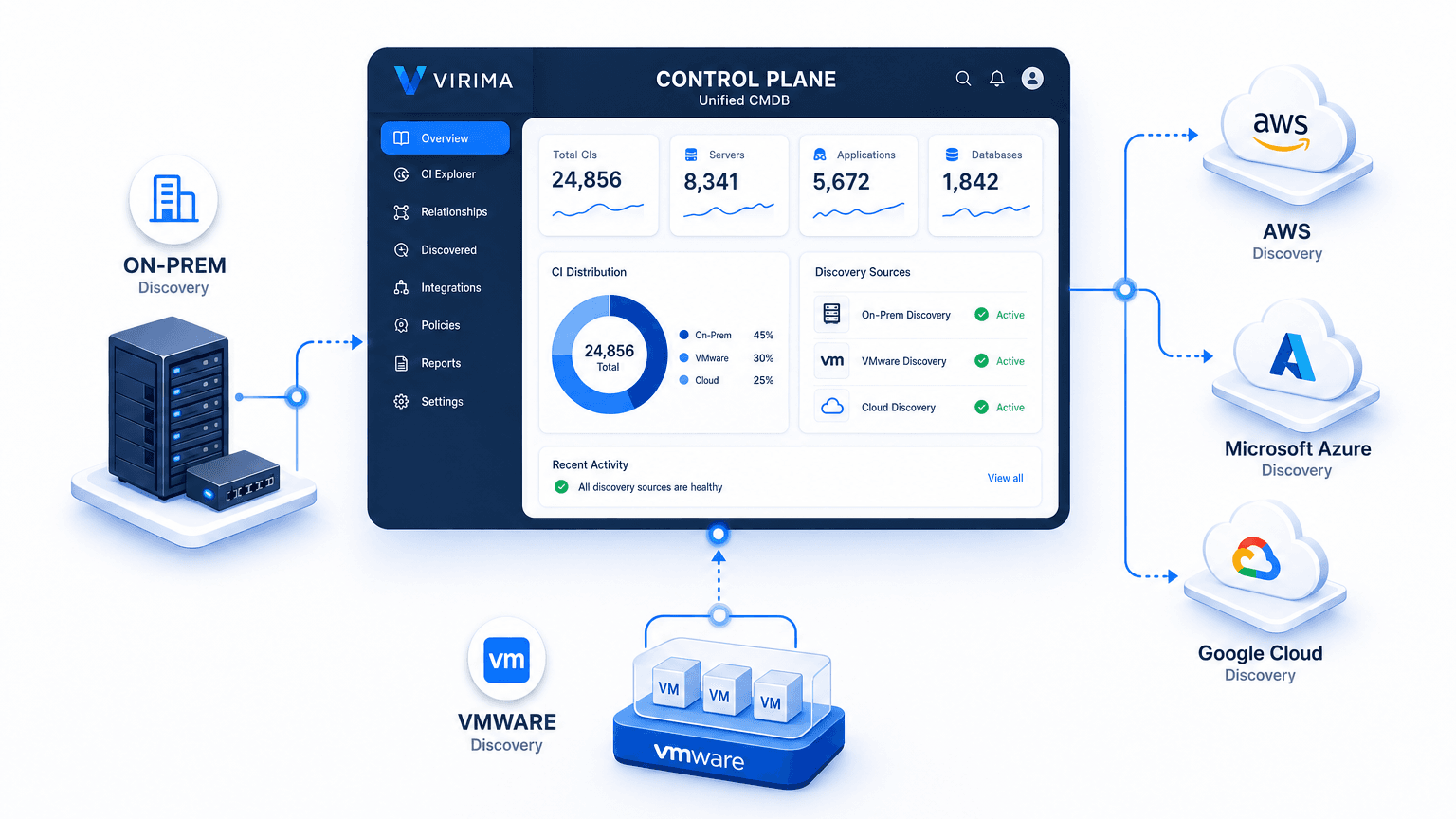
The design that answers how hybrid discovery should cover on-prem, VMware, and cloud without five disconnected tools is a control plane pattern. Methods stay specialized. Authority stays shared. That’s unified hybrid discovery: methods stay specialized, authority stays shared.
Write the scope map first
List every on-prem range, VMware cluster, and cloud account in scope. Name the method, credential owner, and maximum age for a successful cycle. Unknown devices must open an ownership workflow instead of remaining unlabeled forever.
Prefer recent discovery evidence
When AWS inventory shows an instance and the CMDB lacks an owner, open a workflow. When vCenter shows a guest and the network scanner never saw it, do not delete on first conflict. Reconcile with timestamps and identity keys. Manual overrides stay allowed for cost center and service fields without freezing scanner facts.
Keep service maps on discovery-fresh CIs
Once service definitions exist, ViVID™ service maps can show installed-on and runs-on links. Virima ViVID™ builds those maps from defined services rather than inventing service composition automatically. Maps stay honest only while infrastructure CIs underneath stay discovery-fresh across on-prem, VMware, and cloud.
Integrations can push that truth into ServiceNow, Jira Service Management, Ivanti, HaloITSM, Xurrent, and Hornbill workflows. Tickets stop inventing separate asset lists. Partner connections sit on the Virima integrations hub.
See how hybrid discovery covers on-prem, VMware, and cloud under one authority so inventory stops splitting across five tools.
A short scorecard before you buy tool six
Leaders can score readiness without another vendor bake-off slide. A hybrid discovery program is audit-ready when every on-prem range, VMware cluster, and cloud account has a named collection method, an owner, and a last-successful-cycle timestamp newer than policy allows — and when unknown devices trigger an ownership workflow instead of sitting unlabeled.
- Every on-prem range, VMware cluster, and cloud account in scope has a named method and a last successful cycle newer than policy allows.
- Unknown devices open ownership workflows.
- Multi-source reconciliation prefers recent discovery evidence for existence fields.
- CMDB health tracks completeness and staleness, not only ticket volume.
- Service maps for crown-jewel services sit on infrastructure CIs that discovery still confirms across domains.
See Before You Run AI Agents on ServiceNow, Answer These 5 Questions About Your CMDB for a fuller checklist teams use to track completeness and staleness over time.
When those conditions hold, hybrid discovery on-prem VMware and cloud stops being a tool-count problem. It becomes an authority problem you can measure. Flexera’s cloud research cited above keeps showing hybrid and multi-cloud complexity as durable. Durable complexity needs durable discovery design, not another disconnected export.
If your teams still fund cleanup sprints because five inventories never became one authority, the scorecard above is the place to start. Validate cadence and conflict rules against the estate you already run before the next audit or incident forces the comparison.
Frequently Asked Questions
Does hybrid discovery require one physical appliance for every domain?
No. Hybrid discovery is a coverage and authority design. Methods can differ by domain while reconciliation and CI identity stay shared. Appliance count is a deployment detail, not the definition of hybrid coverage.
Can VMware stay on a separate inventory from cloud forever?
It can, until change and incident work crosses both. Separate inventories force human merge under pressure. Hybrid discovery that covers on-prem, VMware, and cloud puts hypervisor and cloud facts through one reconciliation path even when collection methods differ.
Does Virima replace ServiceNow or other ITSM CMDBs?
Virima supplies discovery-sourced CI truth and dependency context that can enrich ITSM workflows. Many teams keep ServiceNow, Jira Service Management, Ivanti, HaloITSM, Xurrent, or Hornbill as the workflow system while discovery evidence keeps inventory honest across domains.
Does Virima run continuous passive discovery across on-prem, VMware, and cloud?
No. Virima runs high-frequency scheduled agent, agentless, hypervisor, and cloud-API cycles across on-prem, VMware, and cloud rather than continuous passive collection. That cadence meets the accuracy need for most enterprises without claiming a capability Virima doesn’t run today.
Where should teams start if five discovery tools already disagree?
Write the scope map and authority rule first. Restore cadence on on-prem, VMware, and cloud scopes next. Open ownership workflows for unknowns. Then attach service definitions for the few crown-jewel services that create the most change and incident risk.