COBIT vs ITIL: The Comparison Everyone Gets Right in Theory, Wrong in Practice

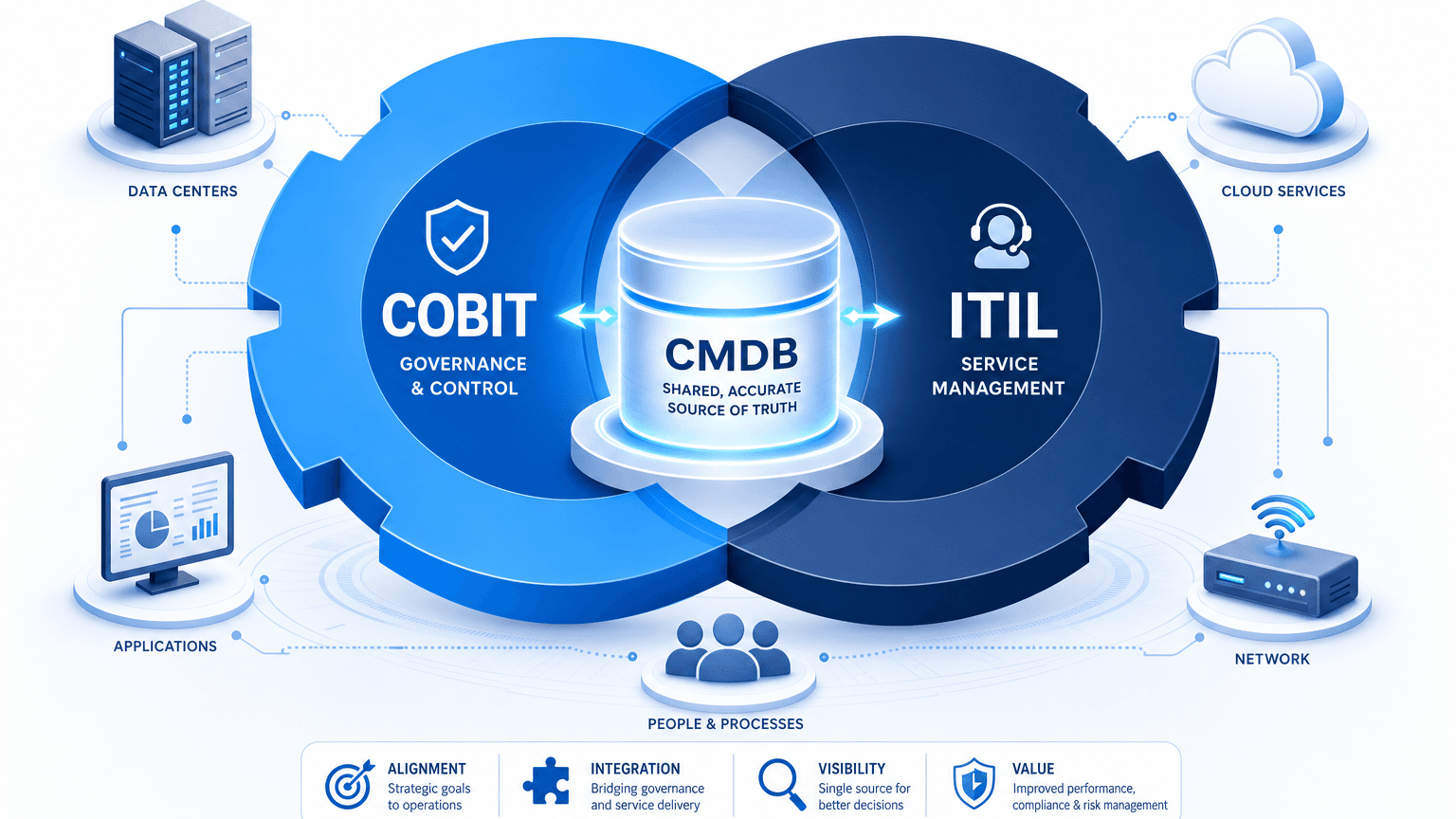
Governance and service-management teams hit the same wall right after the frameworks deck lands. Policies name control objectives, service catalogs name processes, and audit still asks for evidence against systems, owners, and data flows that no one can prove are current. Ask whether you should adopt COBIT or ITIL, and the tidy answer is almost always the same: both, because they are complementary, not competing. That answer is right in theory. In practice the cobit vs itil debate usually stops there, treating two philosophies as peers and leaving the inventory problem off the slide. COBIT is ISACA’s framework for governing enterprise IT; ITIL is the practice set that runs the service system governance depends on.
This guide covers what each framework is for, where “they coexist” is right in theory, and what coexistence still gets wrong in practice when configuration data is incomplete. It does not replace either framework. It names the middle layer between governance intent and operational truth that both frameworks quietly assume is already accurate.
What COBIT is, and what it isn’t
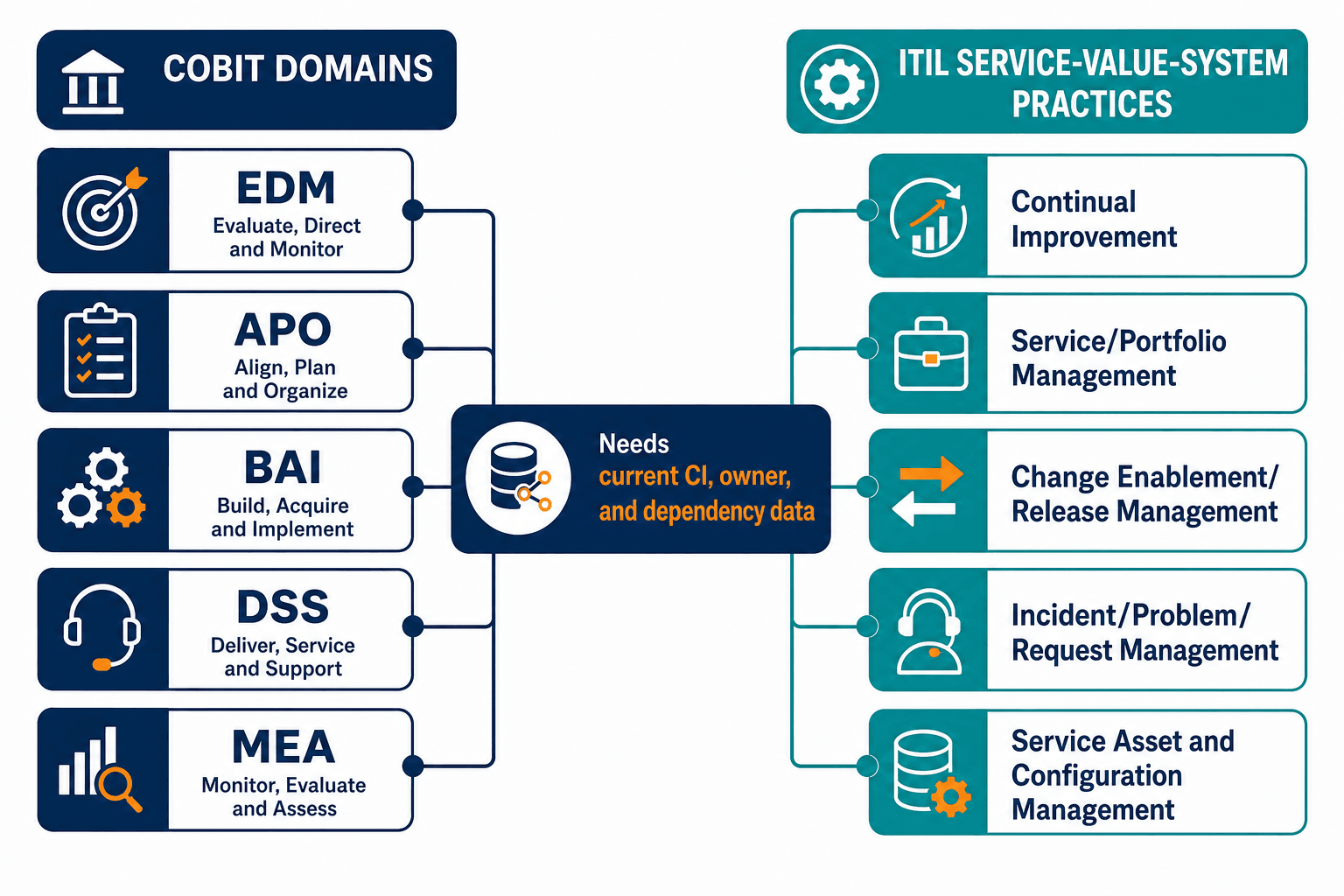
COBIT (Control Objectives for Information and Related Technology) is ISACA’s framework for governing and managing enterprise information and technology. Its job is to connect stakeholder needs to measurable objectives, and to give boards and risk leaders a way to evaluate, direct, and monitor IT. In current COBIT practice that work is organized across five domains: Evaluate, Direct and Monitor (EDM); Align, Plan and Organize (APO); Build, Acquire and Implement (BAI); Deliver, Service and Support (DSS); and Monitor, Evaluate and Assess (MEA).
COBIT is a governance framework, not a service-desk runbook. It sets what good control looks like. It does not invent configuration items, dependency graphs, or owner lists. COBIT spans governance and management objectives: the governing body owns evaluate/direct/monitor work, while executives and practitioners own management objectives. Delivery mechanics still live elsewhere.
That boundary matters for audit prep, and audit pressure is rising, not falling. Sixty-two percent of organizations reported being audited by a major software vendor within the past year, up from 40% in 2023, according to a 2025 Unisphere Research survey sponsored by LicenseFortress (The Rising Cost of Software Compliance: 2025 Survey). A COBIT program can define policies, RACI charts, and monitoring metrics. It cannot invent a trustworthy asset population if the estate record is incomplete. For how inventory quality shows up in audit outcomes, see what makes an IT audit successful.
What ITIL is, and where it overlaps with COBIT
ITIL (Information Technology Infrastructure Library) is the widely adopted practice set for IT service management. COBIT leans toward enterprise governance of technology. ITIL leans toward how services are designed, delivered, supported, and improved. Incident, problem, change, release, and request handling sit more naturally in ITIL than board-level EDM objectives.
The textbook split is fair as a first cut: COBIT for strategic oversight, ITIL for tactical service delivery. In real enterprises the line blurs. Change enablement has governance consequences, and service-level reporting feeds board packs. The split still helps teams stop treating the frameworks as rivals for the same budget line.
COBIT domains vs. ITIL practice areas at a glance
| COBIT Domain | Governance Focus | Closest ITIL Practice Area | Service Focus |
|---|---|---|---|
| EDM (Evaluate, Direct, Monitor) | Board-level oversight | Continual Improvement | Ongoing service refinement |
| APO (Align, Plan, Organize) | Strategy and resourcing | Service/Portfolio Management | Demand and investment planning |
| BAI (Build, Acquire, Implement) | Change and solution delivery | Change Enablement, Release Management | Controlled delivery of change |
| DSS (Deliver, Service, Support) | Day-to-day assurance | Incident, Problem, Request Management | Day-to-day service operation |
| MEA (Monitor, Evaluate, Assess) | Compliance and performance | Service Asset and Configuration Management (SACM) | Accuracy of the record everything above depends on |
The domains and practices don’t map one-to-one – this shows where each framework’s center of gravity sits, and why MEA-style assessment and SACM end up leaning on the same data.
Both frameworks care that technology supports business outcomes, expect defined roles, and fail when the service and component record is a spreadsheet nobody trusts. Adjacent literacy lives in our ITOM vs ITSM guide.
The “they coexist” answer, and what it leaves unexplained
Search results for cobit vs itil almost always end the same way. Mature organizations run both. COBIT sets governance direction. ITIL runs the service system. That industry consensus is not wrong.
What it leaves unexplained is the operating contract. COBIT objectives need populations to sample, systems to scope, and owners to interview. ITIL practices need configuration baselines so change, incident, and release work is not guesswork. If those baselines are stale, “we run both” becomes two process languages speaking over an incomplete map.
Most comparison tables stop at scope, audience, structure, certification, and business-value focus. Those rows help certification candidates. They do not tell a GRC lead how a control objective is tested against live hybrid infrastructure, or why the next COBIT assessment bounces tickets back to discovery. The COBIT-ITIL-coexist line is the start of the design problem, not the finish.
Can COBIT and ITIL be used together?
Yes. Most enterprises use COBIT for governance objectives and ITIL for service management practices. Coexistence works when control evidence and service decisions share the same current record of configuration items, owners, and dependencies. Without that shared record, teams maintain two frameworks against two different pictures of the estate.
Why COBIT’s governance objectives need something ITIL is supposed to supply
COBIT tells you what should be governed and to what standard. It does not maintain the living inventory those standards are measured against. In the ITIL practice model, that inventory work sits with Service Asset and Configuration Management (SACM). SACM is the discipline that identifies, controls, and accounts for configuration items and their relationships so other practices can trust the data.
COBIT can require that changes are authorized against impact, and that critical services have owners and continuity arrangements. SACM is supposed to keep the impact model and service-to-component join keys current. When SACM is weak, COBIT assessments still produce findings, but those findings attach to a half-true estate.
That is the quieter gap in the default IT governance framework comparison. Peer-choice content presents two frameworks; operational reality is a chain. Governance objectives depend on configuration management quality. That quality depends on discovery refreshing on a defined schedule across agent, agentless, and API sources – not a one-time import – and its absence is a configuration management governance gap no policy document closes on its own.
For practice-level depth, read the ITIL v4 SACM guide and CMDB vs SACM. Those pieces own the technical ground. This piece only needs the dependency: governance without configuration currency is control language without a trustworthy population to test.
What does ITIL’s SACM discipline have to do with COBIT compliance?
ITIL’s Service Asset and Configuration Management (SACM) practice maintains the configuration items, relationships, and ownership data that COBIT control objectives are tested against. COBIT defines the governance standard. SACM is the practice expected to keep the estate picture accurate enough for that standard to be enforceable in audit and day-to-day risk decisions.
The current test case: AI governance
ISACA is not treating COBIT as a finished 2010s binder exercise. Its January 2025 white paper, Leveraging COBIT for Effective AI System Governance, applies COBIT domains across the AI system lifecycle: evaluate/direct/monitor cycles, planning and build controls, delivery and support, and MEA-style assessment. That is COBIT applied to AI governance, in ISACA’s own words.
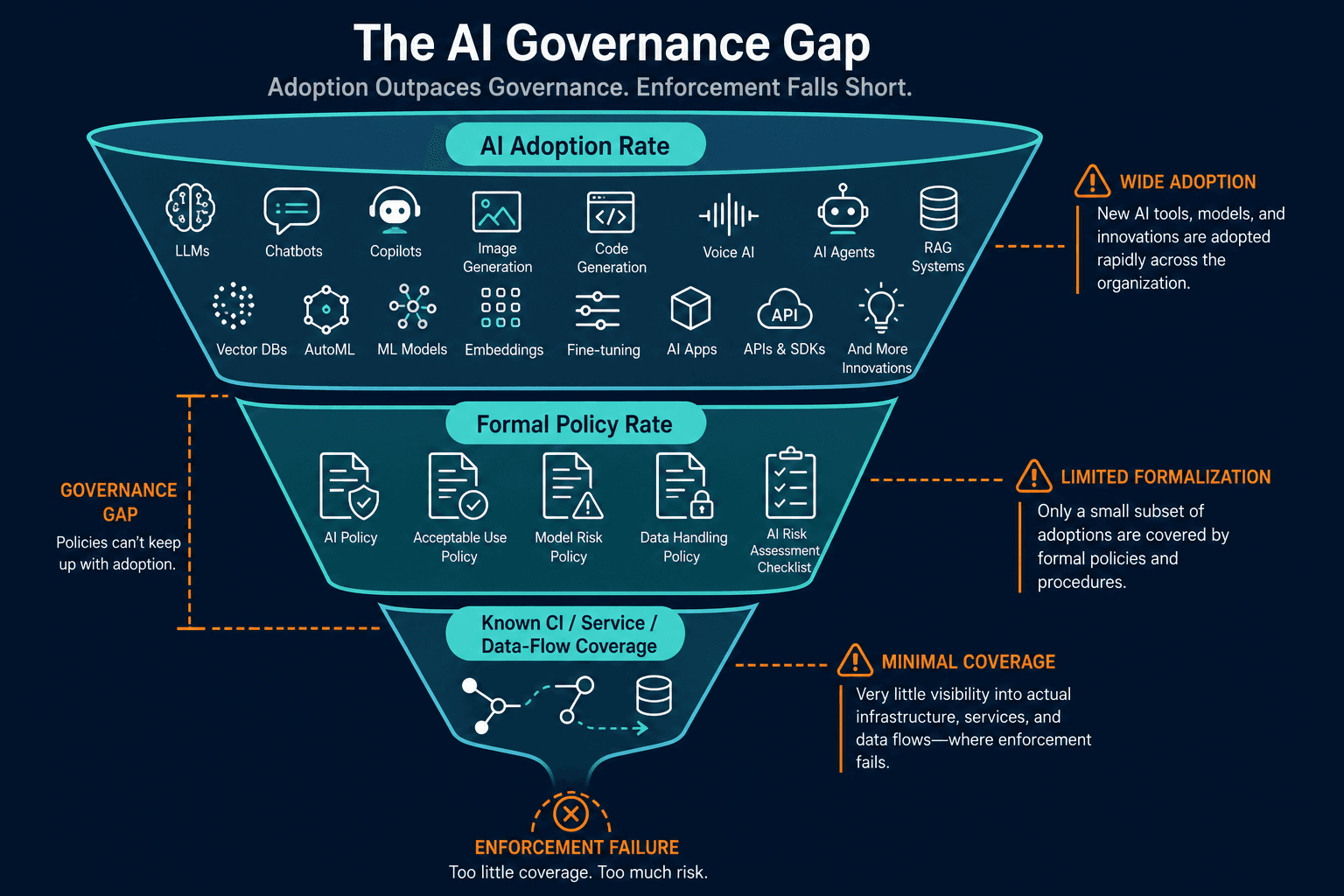
ISACA’s 2026 AI Pulse Poll (more than 3,400 digital trust professionals) shows practice lagging intent. Ninety percent believe employees use AI. Only 38 percent report a formal, fully documented AI policy – up from 28 percent in 2025 – and 25 percent have no active policy at all. ISACA’s release title states it plainly: AI use accelerates while governance and ROI lag.
COBIT can structure what AI governance should look like. The poll shows policy and operational readiness still trail adoption. A framework can define what should be controlled. It says nothing about whether anyone knows which models, agents, data pipelines, GPU estates, SaaS copilots, and integration paths are running. Shadow AI – AI tools and models employees adopt without IT’s knowledge or sanction – is a policy gap and an inventory gap. You cannot apply MEA-style monitoring to systems you have not identified, or prove BAI and DSS controls against components you cannot name.
That is why the classic cobit vs itil article feels finished too early in 2026. The frameworks question is settled for most enterprises. The harder question is whether the configuration picture under those frameworks is complete enough to govern new system classes, including AI, without guessing.
Where discovery and CMDB accuracy fit into this picture
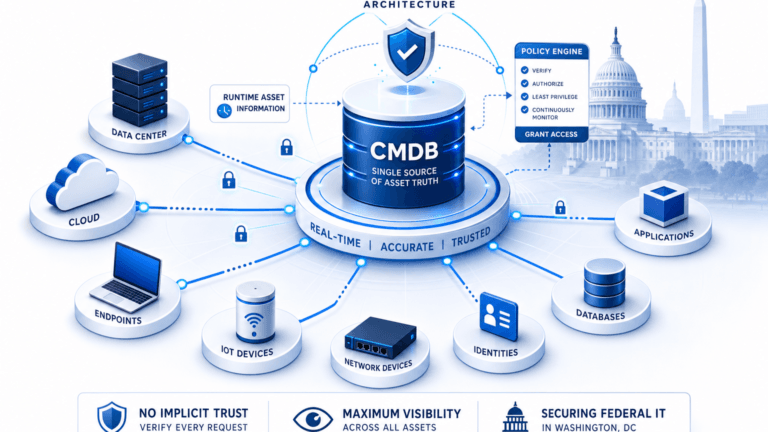
Virima does not implement COBIT, does not sell ITIL as a methodology package, and is not a GRC or governance-policy platform. Its territory is narrower. High-frequency discovery cycles (agent, agentless, and API-based) feed a governed configuration management database so service, asset, and dependency records stay closer to the live estate. That is the visibility layer SACM is supposed to deliver, and that COBIT objectives treat as accurate when they call for scoped controls and evidence.
When that layer is manual or project-based, drift wins – cloud accounts multiply, contractors leave, and agents appear outside the change calendar. A mature COBIT program can still govern against last quarter’s host list; ITIL practices can still route incidents to the wrong owner. The frameworks didn’t fail as documents. The data contract under them did.
Treat discovery-sourced CMDB accuracy as part of coexistence design: map governance objectives to the CI classes they require, and put SACM ownership on keeping those classes current so the CMDB isn’t a museum of the last cleanup. Start with IT discovery and the CMDB capability set.
Applied tooling stories that assume the framework split, including governance work with partners such as Ivanti, live in IT governance with Virima and Ivanti.
So, COBIT vs ITIL, or Both?
Most organizations under real audit and service pressure need both, sequenced rather than bought as one identity.
If you are early and audit-driven, start with COBIT objectives that match board and regulatory questions – don’t pretend the service desk is your governance system. If you are service-desk mature but board reporting is weak, keep ITIL practices and add COBIT-style EDM and MEA discipline around material-risk services. If you already claim both, stop expanding process maps until SACM shows current coverage for the CI classes those processes touch.
Certification paths can run in parallel with adoption. They do not replace the data problem. A COBIT certificate does not invent missing cloud accounts. An ITIL path does not heal a CMDB that only updates when someone has spare cycles.
- Choose COBIT when the pain is governance clarity, control design, and assurance language.
- Choose ITIL when the pain is service flow and support quality – not control design.
- Choose both when you need oversight and delivery, then fund the configuration layer both assume.
That is the useful end of the cobit vs itil decision.
What to do after the frameworks decision
Treat the frameworks vote as closed once roles are clear, then spend the next cycle on the record those objectives are measured against – the CI classes and SACM ownership assigned above. Re-test one control or change path against the refreshed map and document where the old inventory would have lied. That keeps governance and service management honest without turning either framework into a product category it is not.
Frequently Asked Questions
What is the difference between COBIT and ITIL?
COBIT is ISACA’s framework for governing and managing enterprise IT, organized around domains such as EDM, APO, BAI, DSS, and MEA. ITIL is a practice set for designing, delivering, and improving IT services. COBIT emphasizes control objectives and board-facing governance. ITIL emphasizes service-management practices. Most large organizations use both rather than treating them as substitutes.
Can COBIT and ITIL be used together?
Yes. Coexistence is the normal enterprise pattern. COBIT sets governance and management objectives. ITIL provides service practices. The combination holds when both share current configuration, ownership, and dependency data. Without that shared record, teams maintain two frameworks against inconsistent estate pictures.
Is COBIT a governance framework or a management framework?
COBIT includes both governance and management objectives. Governance objectives sit with the governing body through evaluate, direct, and monitor activities. Management objectives cover planning, build, delivery, and monitoring work executed by management. It is not only a board policy pack, and it is not a full service-delivery methodology like ITIL.
How does COBIT apply to AI governance?
ISACA’s 2025 white paper on leveraging COBIT for AI system governance maps COBIT domains across the AI lifecycle so organizations can evaluate, direct, build, deliver, and monitor AI systems with the same control logic used for broader enterprise technology. Policy design still needs a current inventory of AI systems, data flows, and supporting infrastructure to be enforceable.
Does Virima replace COBIT or ITIL?
No. Virima does not implement COBIT or ITIL as a methodology and is not a GRC policy platform. It provides discovery-fed configuration and asset visibility that Service Asset and Configuration Management is expected to maintain, which both COBIT-style controls and ITIL practices rely on when they need accurate estate data.
How does Virima support COBIT or ITIL compliance work?
Virima doesn’t implement COBIT or ITIL. Its discovery-fed CMDB gives ITIL SACM a current record of configuration items, owners, and dependencies – the data COBIT control objectives and ITIL practices both need to be enforceable rather than aspirational.