Strengthen IT Governance with Virima and Ivanti

Without IT governance and risk management, you get security breaches, data loss, regulatory penalties, and direct financial damage. Leave those unchecked, and customer trust erodes, legal liability grows, and fines pile up.
Organizations are only getting more dependent on technology. Adapting governance and risk frameworks isn’t optional anymore. It’s the difference between preventing problems and reacting to them.
This article covers how Virima and Ivanti’s partnership strengthens IT governance and risk management. We’ll start with what both concepts mean, why they matter, and then get into the integration specifics.
Understanding IT governance and risk management
IT governance and risk management are tightly linked. Together, they help organizations use technology effectively while protecting against the threats that come with it.
What is IT governance?
IT governance covers the frameworks, processes, and structures that keep IT systems aligned with business objectives. COBIT, ITIL, and FAIR are the most widely adopted frameworks.
In practice, you make smart technology investment decisions that support your goals. You choose and integrate an ITSM platform like Ivanti to manage your services better. At the same time, you secure your data to reduce risks. This way, you build a strong and reliable IT setup.
Next, you set clear policies to monitor your IT service performance. You track issues closely and resolve them quickly. As a result, you keep your systems running with minimal downtime. Over time, you adjust your operations to maintain the uptime you need.
What is risk management?
Risk management is identifying, assessing, and prioritizing threats, then acting to reduce their impact. That looks like investing in security measures, building backup and recovery plans, and keeping systems patched. The goal is to stay ahead of disruptions before they hit.
How IT governance and risk management connect
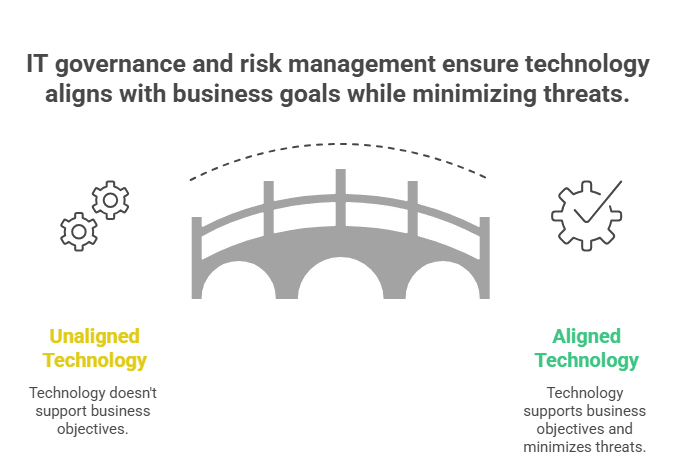
IT governance and risk management are interconnected frameworks that ensure technology aligns with business goals while minimizing threats. IT governance provides the strategic direction, while risk management operationalizes threat mitigation within that structure.
They work together smoothly when you deploy a new online banking system. Governance helps you choose the right platform and set clear policies. At the same time, risk management finds and fixes security gaps early. This reduces the chance of breaches and system failures.
For example, financial firms lost an average of $6.08 million per breach in 2024. So, you need to act quickly to lower risks and avoid downtime. You can use targeted countermeasures to protect your systems and data. As a result, you keep your services stable and reliable.
Why IT governance and risk management matter for Ivanti customers
For Ivanti Neurons customers, understanding these risks is the first step toward managing them.
Organizations depend more on technology than ever
Technology drives nearly every business function, from operations and communication to growth. A 2020 McKinsey Global Survey found that 85% of organizations accelerated digital technology adoption during the COVID-19 pandemic.
That kind of dependence demands a governance and risk framework that keeps IT systems efficient, aligned with business goals, and resilient against threats.
IT environments are getting more complex
AI, machine learning, IoT, and cloud computing add capability and complexity in equal measure. Without structured governance and IT operations management practices, that complexity turns into a liability fast.
Standardized governance processes help teams navigate layered IT environments without losing control over what’s running where.
What are the consequences of an inaccurate CMDB?
An inaccurate CMDB undermines IT governance faster than almost anything else. When configuration data is stale or incomplete, every downstream process feels it.
Change advisory boards approve changes against dependency maps that don’t match reality. Incident response teams burn time tracing connections by hand. Compliance audits surface gaps nobody saw coming. Asset refresh planning runs on inventory data that’s already out of date.
The fallout: higher chance of failure rates, longer mean time to resolution, failed audits, and wasted IT spend. An inaccurate CMDB doesn’t just introduce risk. It compounds it across every governance activity that depends on reliable configuration data.
The consequences of poor IT governance and risk management
When governance and risk management slip, the problems stack up.
- Security breaches: Cybercriminals exploit weak oversight. A breach damages reputation, erodes trust, and triggers regulatory fines.
- Data loss: Weak data protection increases the risk of loss from accidents, system failures, or attacks, leading to compromised IP and legal exposure.
- Regulatory non-compliance: IT systems have to meet industry standards and government regulations. Poor governance makes non-compliance both expensive and avoidable.
- Financial losses: Breaches, data loss, and non-compliance create direct costs (legal expenses, compensation) and indirect costs (lost business, decreased productivity, higher insurance premiums).
How Virima and Ivanti integration strengthens IT governance and risk management
The Virima-Ivanti partnership gives IT teams the visibility and data accuracy they need for effective governance and risk management.
Building a trustworthy Ivanti CMDB
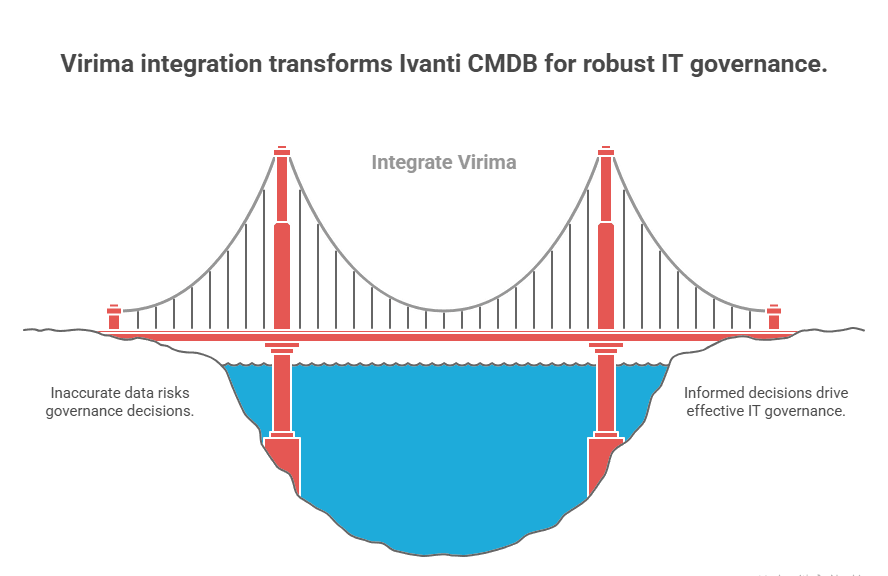
Your CMDB is the single source of truth for your IT environment: what assets you have, where they sit, and how they connect. When that data is accurate, governance decisions are informed. When it’s stale, every decision based on it carries risk.
How Virima’s automated discovery keeps Ivanti CMDB current
Virima powers Ivanti Neurons for Service Mapping, using agentless IT discovery with over 140 extendable probes to identify, categorize, and map relationships across IT assets in on-premise and cloud environments. Optional agents for Windows, macOS, and Linux add persistent monitoring for configuration changes and software usage. Unlike many IT asset discovery platforms that rely on installed agents to see the environment, this agentless approach cuts deployment friction across mixed on-premise and cloud estates.
Discovery covers hardware (servers, storage, networking equipment), software applications, services, and virtual assets. For each discovered asset, Virima captures manufacturer, model, hardware, and OS configuration details, plus the relationships between assets. The integration to the Ivanti CMDB is codeless, configured entirely through the Virima and Ivanti UIs using over 100 blueprints to map to Ivanti CMDB objects, including custom objects.
When your organization deploys, replaces, or changes assets, Virima picks up the updates and gives you two ways to sync them to the Ivanti CMDB: select specific assets from a filterable list, or apply business automation rules for hands-free updates. Either way, no manual data entry. No stale records sitting undetected for months.
For Ivanti Neurons for ITSM customers, this means a complete, current asset inventory without relying on manual processes. That’s the base layer for IT governance and risk management.
Making confident decisions with a reliable Ivanti CMDB
Ivanti Neurons for Service Mapping, powered by Virima, keeps your CMDB data accurate through automated discovery, codeless sync with built-in deduplication, and blueprint-based mapping to Ivanti CMDB objects. That reliability supports critical governance decisions:
- Capacity planning and infrastructure investment prioritization
- Risk assessment and vulnerability prioritization
- Reducing the rate of failed changes
- Speeding up incident response
- Planning and passing compliance audits
- Developing incident response strategies
With Virima keeping the Ivanti CMDB accurate, it becomes the source of truth your teams actually trust, aligned with business objectives and regulatory requirements.
Enhancing risk management through visibility
Managing IT risk requires knowing exactly what’s in your environment and how everything connects. Virima provides that visibility through service mapping and impact analysis.
Ivanti Neurons for service mapping: See the full picture
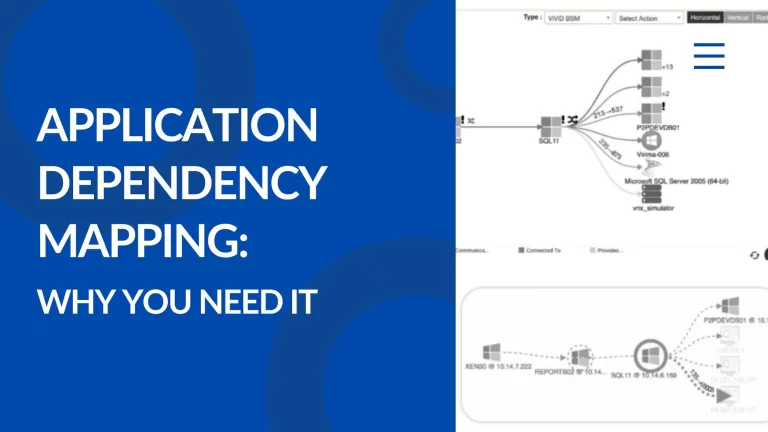
Virima-powered Ivanti Neurons for Service Mapping creates dynamic visual maps of the relationships and dependencies between IT assets and services. IT teams can identify critical assets and see exactly how a failure or breach would ripple through business operations.
Virima Visual Impact Display (ViVID™) for data-backed decisions
Ivanti Neurons for Service Mapping includes Virima Visual Impact Display (ViVID™), which overlays ITSM data (incidents, changes, and event management alerts) directly onto service maps. Through Virima’s integration with the NIST National Vulnerability Database, ViVID also overlays vulnerability data, including CPEs (Common Platform Enumerations) and CVEs (Common Vulnerabilities and Exposures).
ViVID pulls incident and change data from your ITSM platform, event alerts from monitoring tools like SolarWinds, Nagios, and LogicMonitor, and vulnerability data from the NIST NVD. Together, these overlays reflect the current operational state, so your team can make data-backed decisions on service outages, disaster recovery planning, root cause analysis, impact analysis, and audit preparation. ViVID shows how current and historical incidents, changes, and vulnerabilities relate to your infrastructure, giving your team the context to identify risks faster and build stronger mitigation plans. For a deeper look at how CVEs are automatically linked to affected CIs, see vulnerability management for IT assets.
How IT asset management strengthens IT governance
Effective IT Asset Management is the bedrock of governance. It provides the data and visibility that drive strategic decisions and risk management.
Asset lifecycle management
Virima’s discovery integration with Ivanti improves your ITAM capability. It detects new assets as soon as they join your network. It also keeps their configuration data updated until you retire them. As a result, you always have accurate and current asset information.
At the same time, Ivanti manages the full lifecycle from procurement to retirement. Meanwhile, Virima keeps your CMDB data accurate at every stage. This helps you make better decisions without relying on outdated data. In turn, you reduce errors and improve overall control.
The integration also delivers a detailed, accurate record of every asset’s configurations and relationships. Ivanti customers can optimize usage, cut unnecessary spending, and stay compliant with relevant standards.
Strategic decision support
Virima’s discovery integration improves your service management by keeping the Ivanti CMDB up to date. It runs scheduled scans that refresh your data automatically. As a result, you get a clear and reliable view of your assets and their dependencies. This helps you maintain strong IT governance at a high level without extra effort.
Next, your governance framework includes clear goals and objectives that stay strategically aligned with your business needs. With better visibility, you can ensure compliance more easily. You can also improve resource management and make faster, smarter decisions. In addition, you reduce guesswork and avoid costly mistakes.
Finally, you can manage your IT budget with more confidence. You can plan asset refresh cycles at the right time. You can also simplify and improve your IT services over time. This way, you build a stronger and more effective governance framework.
Strengthening governance and risk management with Virima and Ivanti
The Virima-Ivanti integration gives ITSM customers a complete, current view of their IT assets, backed by clear dependency visualizations and current ITSM data from Ivanti. That’s what moves IT governance and risk management from guesswork to measurable outcomes.
Request a demo to see how Virima’s discovery, service mapping, and ViVID capabilities integrate with Ivanti Neurons for ITSM to keep your CMDB accurate and your governance data trustworthy.
FAQ
How does automated IT discovery improve risk management?
Automated discovery eliminates the blind spots that manual inventory creates. When a new asset shows up on your network, whether it’s a cloud instance, a virtual machine, or a rogue device, Virima detects it during the next scheduled scan and adds it to the CMDB with full relationship mapping.
Your risk assessments then reflect what’s actually deployed, not what was deployed three months ago. Unmanaged assets are the ones that get breached. Automated discovery makes sure they don’t stay unmanaged.
How do you measure IT governance effectiveness?
Governance effectiveness comes down to measurable outcomes. Key indicators include change success rate (percentage of changes that don’t cause incidents), mean time to resolution for incidents, audit pass rate, CMDB accuracy percentage (CIs verified as current vs. total CIs), and asset utilization rate.
Tracking these metrics gives ops teams a clear picture of governance maturity. When CMDB accuracy improves through automated discovery, the downstream effect shows up everywhere: fewer failed changes, faster incident response, cleaner audits.
How does service mapping support change management?
When a change advisory board reviews a change request, they need to know what depends on the asset being changed. Without accurate dependency maps, they’re guessing. And guessing leads to failed changes and unplanned outages. Virima’s service maps show the full dependency chain for any CI. Before approving a change management request, the CAB can see exactly which services, applications, and users are affected. That visibility cuts change failure rates and shortens change windows.