ITIL Release Management: Process, Practices, and Risk Data

The change window closed clean. Approvals were signed. Test evidence sat in the ticket. Two hours after cutover, a shared middleware path nobody listed on the release plan started failing, and a customer-facing workflow went dark with it.
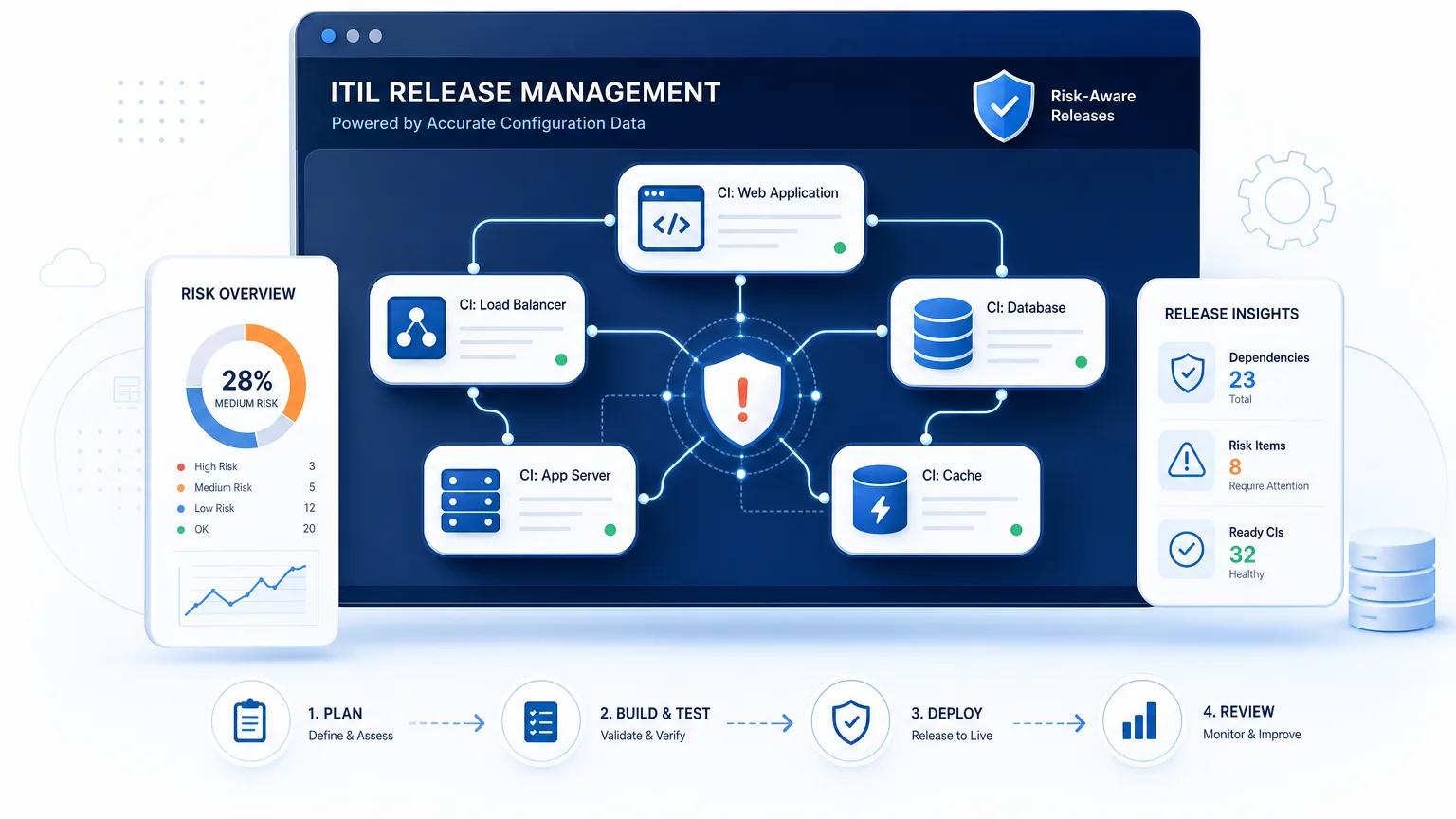
That pattern is common in ITIL release management. The phases can look complete while the plan still rests on an incomplete picture of what was actually running. Release management succeeds or fails on one axis every phase shares: the accuracy of the configuration data behind the risk assessment.
Failed releases burn rework, extend unplanned outages, and leave audit samples that do not match production. DORA tracks change failure rate and related delivery metrics for that reason. Federal asset-visibility programs keep pressing the same foundation. CISA BOD 23-01 is one clear example: you cannot govern what you cannot inventory.
This guide covers definition, ITIL placement, the full process, where releases break, and how to close the configuration-data gap. For the broader runtime context under change and release risk, start with Trusted Runtime Truth.
What Is ITIL Release Management
ITIL release management — sometimes called ITIL release and deployment management — is the practice of planning, packaging, testing, and deploying a set of changes into the live environment as a controlled release unit. PeopleCert maintains the current ITIL certification path, including a dedicated Release Management practitioner track. On first expansion, ITIL means Information Technology Infrastructure Library.
In the classic five-stage service lifecycle, release work sits primarily in Service Transition. That stage moves a tested change from build into production under controlled conditions. The other four stages set context without replacing release discipline. Service Strategy sets direction and demand. Service Design shapes services and supporting agreements. Service Operation runs day-to-day delivery and incident response. Continual Service Improvement measures outcomes and feeds the next cycle of better releases.
Release packages can include application code, infrastructure updates, configuration changes, data fixes, or a mix. The unit of work is the release, not a single ticket in isolation. Strong programs also connect release records to ITIL change management best practices so approval and deployment stay aligned on the same risk story.
What is ITIL release management in one sentence?
ITIL release management plans, builds, tests, and deploys a controlled package of changes into production, usually under Service Transition, so the live environment receives a known unit of work with documented risk, rollback, and ownership rather than ad-hoc installs.
Is release management the same as deployment management?
No. Release management governs the end-to-end packaging and risk decision for a set of changes; deployment management, a distinct ITIL practice, executes the technical delivery of that release into a specific environment. The CAB approves the release decision, not the deployment mechanics.
Release Management vs. Change Management vs. Configuration Management
Teams blur three practices and then wonder why risk calls feel hollow.
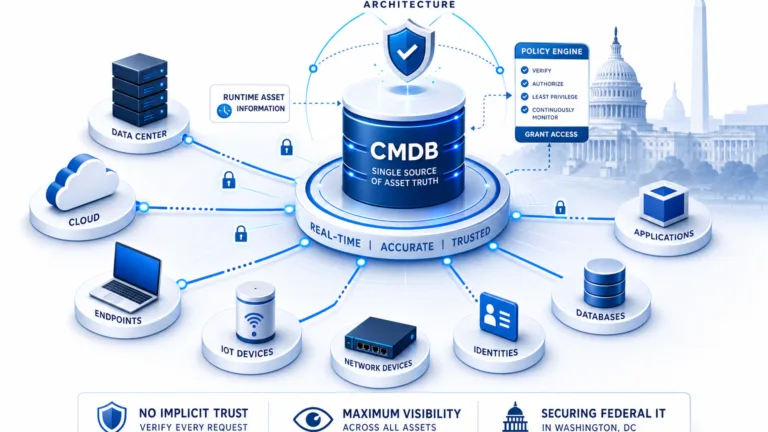
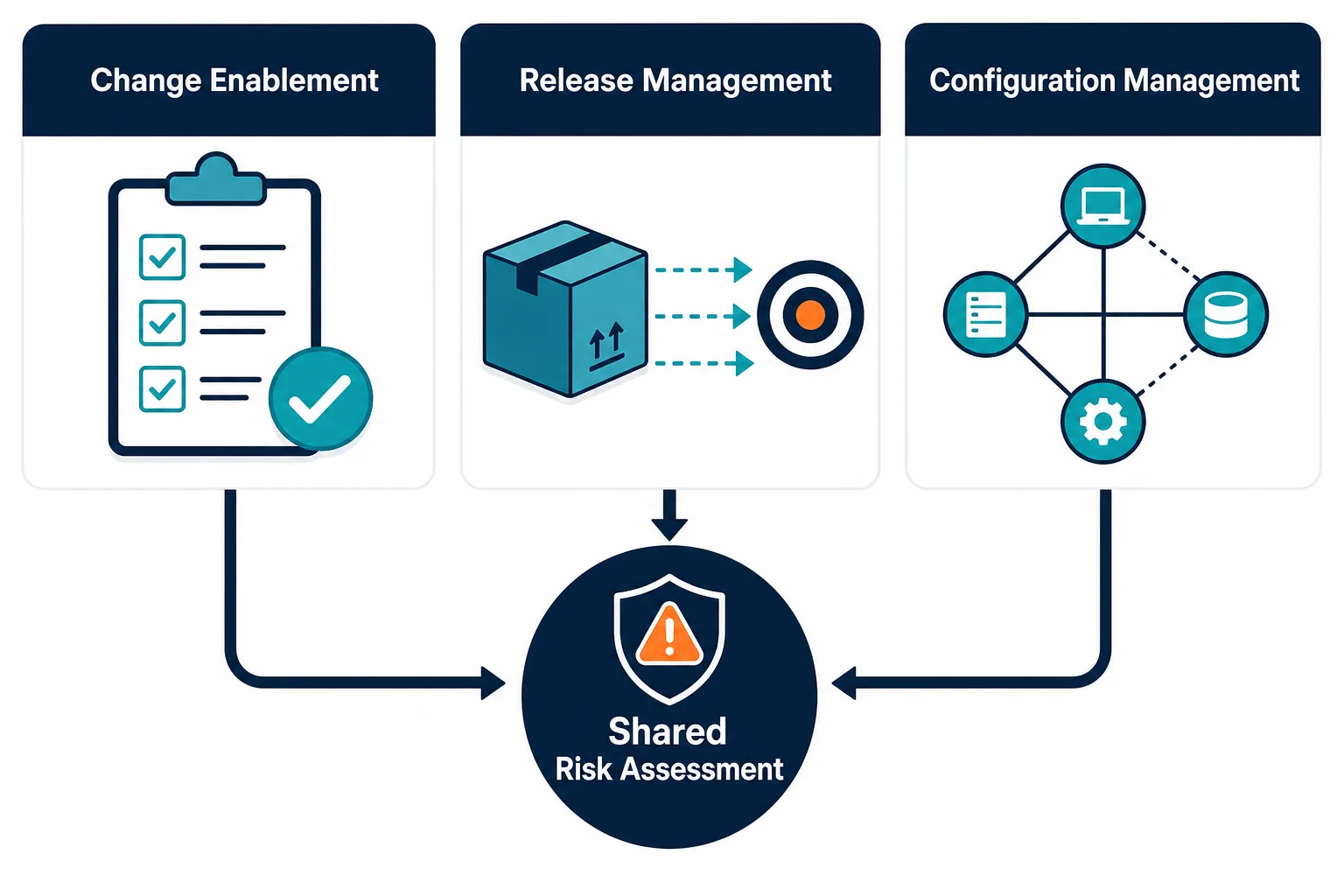
Change Enablement (change management in many shops) decides whether a change should proceed. It owns policy, risk class, approval path, and schedule authority. Release management governs how approved work is packaged, validated, and introduced to production. Configuration management, through the configuration management database (CMDB), supplies the record of what exists, how items relate, and who owns them so both change and release can assess impact.
Take a CRM rollout. Change Enablement may approve the business case and the freeze window. Release management builds the deployment package, runs integration tests, and chooses blue-green or phased cutover. Configuration management must show which application servers, identity paths, batch jobs, and downstream reporting feeds the CRM actually touches. If that distinction collapses, the Change Advisory Board (CAB) votes on a narrative while the release team deploys against an estate map that is already wrong.
For how change and configuration practices reinforce each other in ITIL terms, see change vs configuration management.
The Release Management Process, Phase by Phase
Most programs share five phases. Keep them disciplined, and keep each phase honest about the data it consumes.
- Planning and preparation
- Build and packaging
- Testing and QA
- Deployment strategies
- Review and closure
Planning and preparation
Define scope, release contents, entry and exit criteria, owners, and the risk assessment. Resource the window and name rollback triggers. Planning quality tracks the completeness of configuration item (CI) and dependency data used in impact analysis.
Build and packaging
Assemble the release package, resolve integration points, and document install order, configuration deltas, and known constraints. Packaging fails quietly when the bill of materials omits a shared library or a batch dependency still live in production.
Testing and QA
Cover unit, integration, user acceptance, and regression automation where it exists. Tests only prove the environments you actually built. If staging does not mirror production relationships, green tests still miss production paths.
Deployment strategies
Choose phased rollout, blue-green, canary, or a controlled big-bang only when the blast radius is truly small. Every strategy needs a tested rollback path and a clear signal for when to abort. Strategy choice should reflect real consumers of the change, not the last spreadsheet export.
Review and closure
Run the post-implementation review, capture lessons, update known errors, and close the release record. Closure without updating configuration and ownership records leaves the next release planning on the same stale base.
This phase model is familiar across mature shops. The differentiator is whether each phase reads a current estate picture or a hopeful one.
Why Release Risk Assessment Depends on Configuration Data
Every phase above assumes the environment picture is correct. When dependency data is stale, planning misses downstream consumers. A release that looks local to one application can still interrupt a shared authentication service. It can also hit a reporting extract or a partner API path that never appeared on the plan.
Impact assessment is only as strong as the CI record behind it. Missing relationships, wrong environment tags, and orphaned CIs all produce the same outcome. The risk score looks precise and still fails in production.
The CAB inherits that problem. A board that approves a release without accurate CI relationships is approving blind. Missing edges on a ViVID™ service map stay missing no matter how complete the ticket checklist looks. Programs that want lower change risk treat the CMDB as an input to release decisions, not a side archive. See how a CMDB reduces change risk across planning and approval.
Release owners who brief the board still need evidence, not opinion alone. Application-level change playbooks that spell out how a change advisory board should weigh dependency proof sit downstream of that same data requirement. If you’re the one briefing the CAB on a release touching a shared, ServiceNow-tracked service, the CI relationships in that ticket are the real risk data — not the checklist.
Why does ITIL release risk assessment depend on configuration data?
Release risk scores, CAB approvals, and deployment strategies all assume current configuration items, owners, and dependency links. When that record is incomplete or outdated, teams miss shared services and downstream consumers — the real signal is configuration data release risk, not ticket completeness.
See the CI and dependency fields a CAB needs before approving a release — the Release Risk Assessment Checklist walks the data path this section covers.
Where Releases Actually Break
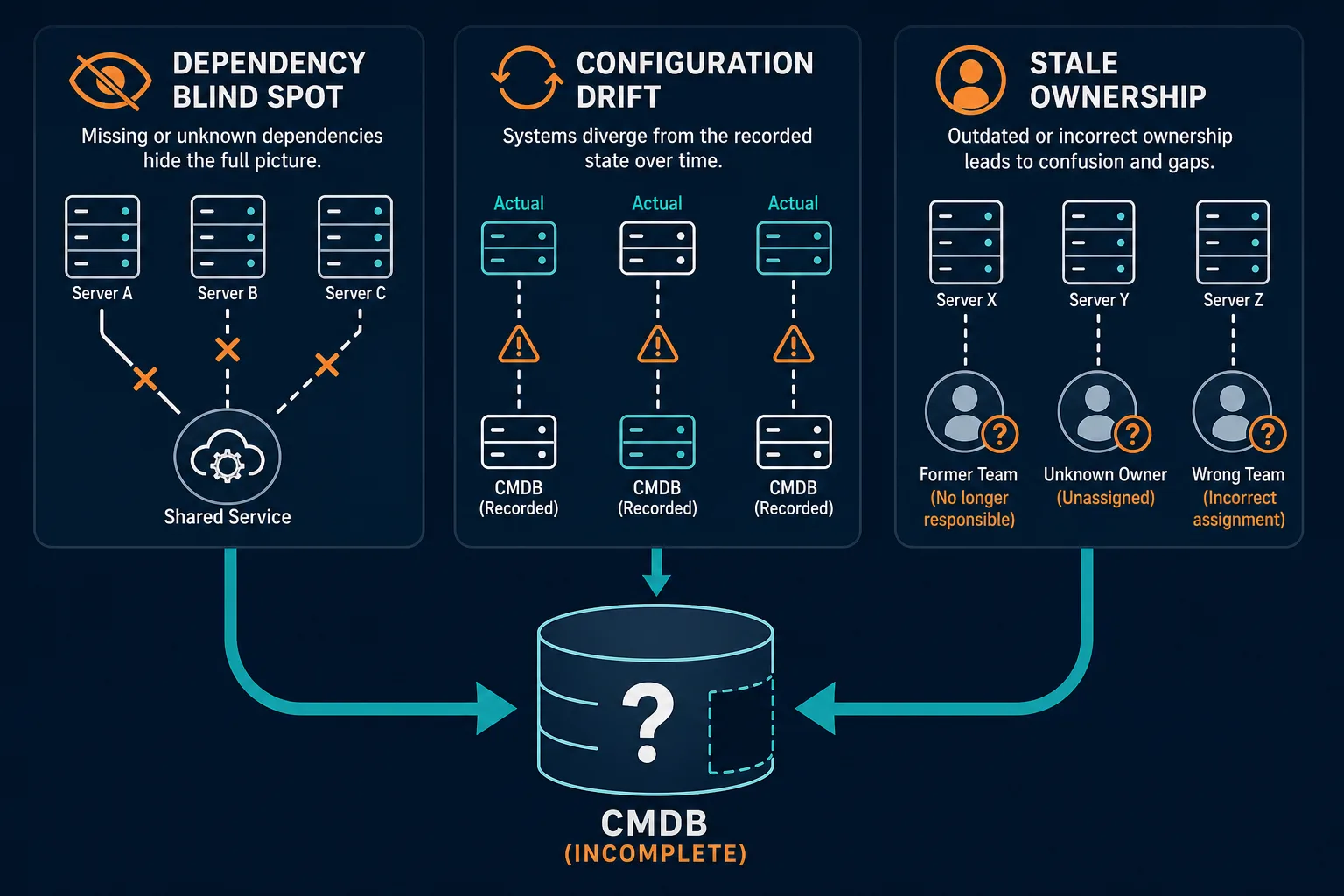
Three failure modes show up again and again.
Dependency blind spots. The release touches a shared service nobody flagged. The package and tests look clean because the shared path was outside the declared scope.
Configuration drift. The live environment no longer matches what planners documented weeks earlier. New instances, retired hosts, and silent config edits never made it back into the release plan.
Stale ownership records. Notifications and war-room invites go to the wrong team. Mean time to repair stretches because the people who can act learn late.
State the pattern plainly: each failure point traces to data that was incomplete or outdated when the plan was built. Fixing the runbook template does not fix a missing relationship on the CI graph. For what these outages cost once a hidden dependency cascades, see Virima’s outage cost analysis.
Measuring Release Management Success
ITIL 4 keeps continual measurement in view, which loops back to Continual Service Improvement from the lifecycle context above. Useful release management KPIs include:
- Deployment frequency: how often you successfully release to production.
- Change failure rate: the share of deployments that cause degraded service or need remediation (core DORA instability measure).
- Mean Time to Repair (MTTR): average time to restore service after a failed release or related incident.
- Mean Time Between Failures (MTBF): average clean run time between failures, useful for stability trends.
- Lead time for changes: elapsed time from commit or approved change request to production.
Track the suite together. High deployment frequency with a rising change failure rate is not progress. Falling MTTR with no improvement in lead time can hide a planning quality problem that only surfaces on the next major package.
What are the KPIs for ITIL release management?
The five KPIs that matter for ITIL release management are deployment frequency, change failure rate, MTTR, MTBF, and lead time for changes. Read them together, not individually — rising deployment frequency alongside a rising change failure rate signals a data-quality problem, not progress.
Keeping Release Data Current Without Manual Overhead
Manual CI updates cannot keep pace with hybrid estates. Teams that close the accuracy gap use scheduled, high-frequency discovery cycles to refresh CI and dependency records instead of waiting for spreadsheet uploads between releases. Agent, agentless, and API collection can feed the same CMDB your change and release tools already read.
Virima supports that model by discovery-sourcing configuration and relationship data into the CMDB your release risk assessments already depend on. That includes paths into ServiceNow, Jira, Ivanti, and other ITSM platforms via the integrations hub. Successful CMDB implementation steps still matter for ownership, reconciliation rules, and service definitions once discovery is feeding the store.
How do teams keep release configuration data current without manual overhead?
They run scheduled, high-frequency discovery cycles that refresh configuration items and dependency links in the CMDB, then feed that record into change and release risk assessment. Manual spreadsheet updates between releases cannot match hybrid estate churn at planning time.
A Release Plan Is Only as Strong as Its Data
Before the next package goes to the CAB, audit three things: what changed in the estate since the last discovery cycle, who owns the CIs the release touches, and whether the rollback plan was tested against current topology rather than last quarter’s map. Skipping that audit is how a clean approval still ends in a 2 a.m. page.
Schedule a demo to walk the configuration path your next release plan will use, from CAB pack to cutover.
Frequently Asked Questions
What is ITIL release management?
ITIL release management is the practice of planning, packaging, testing, and deploying changes into the live environment as a controlled release. In the classic lifecycle it sits mainly in Service Transition, coordinated with change enablement and configuration management.
What are the stages of the release management process?
Typical stages are planning and preparation, build and packaging, testing and QA, deployment (including rollback design), and review and closure. Each stage consumes configuration and dependency data for scope and risk.
How is release management different from change management?
Change management decides whether a change may proceed. Release management governs how approved work is packaged, validated, and deployed into production.
What KPIs measure release management success?
Common KPIs are deployment frequency, change failure rate, mean time to repair (MTTR), mean time between failures (MTBF), and lead time for changes. Read them as a set, not in isolation. Virima feeds the discovery-sourced configuration and dependency data those KPIs depend on into the CMDB your release tools already read.
Why do releases fail even when the process is followed correctly?
Because every phase still depends on configuration data for impact and ownership. Stale CI relationships, drift from the live estate, and wrong owners produce process-compliant plans that miss real blast radius at cutover.