Stop Guessing What Depends on Your Vendors: Discovery-Sourced CMDB Hybrid Cloud Visibility for Denver

On Friday, 19 September 2025, a cyberattack affecting check-in and boarding software from Collins Aerospace disrupted operations at several major European airports, including Brussels, Berlin, and Heathrow, as reported by Michigan Public. The parent company, RTX (formerly Raytheon Technologies), said it was aware of a cyber-related disruption to its MUSE software at select airports. RTX added that the impact stayed limited to electronic check-in and baggage drop, and that manual check-in procedures could mitigate the disruption, as described in the RTX disruption report. Airport operators said the problem sat with their service provider, and on 22 September 2025 the European Union Agency for Cybersecurity (ENISA) said a third-party provider had suffered a ransomware incident, as reported by Security Affairs. The reporting says nothing about the records those airports kept, and this article claims nothing about them either.
The event leaves one practical question for any team that relies on a vendor platform: which internal systems and services depend on that platform today. That question is especially pressing for Denver aerospace, telecom, and energy enterprises running a mix of owned systems and cloud accounts. A CMDB for hybrid cloud visibility that Denver teams can verify gives a direct answer. A configuration management database (CMDB) records the systems a company runs, who owns each one, and how they connect, while information technology (IT) covers computers, servers, networks, and cloud accounts in this article. A discovery-sourced record answers the dependency question from scheduled discovery scans that carry a source and a last-seen date, instead of relying on manual entry that ages quickly. Readers who want background on the database itself can start with the CMDB overview.
Why Denver’s Three Sectors Share One Visibility Problem
Colorado holds a large aerospace footprint that shapes how Denver teams think about complex estates: the Colorado Office of Economic Development and International Trade (OEDIT) described the state as the second-largest aerospace economy in the nation by job count, and the largest per capita, in a 2022 report, and the Metro Denver Economic Development Corporation counted 33,460 employees at 290 Colorado aerospace companies in its 2020 study. Both figures are dated — treat them as background scale, not current headcount.
The telecom and energy presence around Denver is also well established through long-running cluster tracking, although citable current employment totals were unavailable during preparation, so this article cites no fresh number for those two clusters. No Denver company is named in this article, and no customer relationship is implied.
What these three sectors share is an estate pattern that mixes owned systems, cloud accounts, and vendor platforms. Aerospace programs combine engineering systems, ground systems, and supplier software. Telecom operations combine network infrastructure, support systems, and cloud workloads. Energy companies combine office systems, field support systems, and business applications that depend on shared servers.
Flexera surveyed 753 cloud decision makers and users for its 2026 State of the Cloud work and found that 73% of organizations run hybrid environments, as summarized in the Flexera 2026 findings. Hybrid cloud in this article means a mix of a company’s own systems and public cloud accounts, managed together. That mix creates the same operational question across all three sectors: leaders need to know which internal service depends on which vendor platform before an incident forces the question. Teams tracking wireless and chip-design angles can also review the related San Diego telecom and semiconductor analysis, and readers who need category background can use the hybrid cloud transformation guide.
Three Sectors, Three Documented Events, One Dependency Question
Each event below raised the same operational question: which of our systems sit behind this disruption, and none of the cited sources describes the affected firm’s internal records.
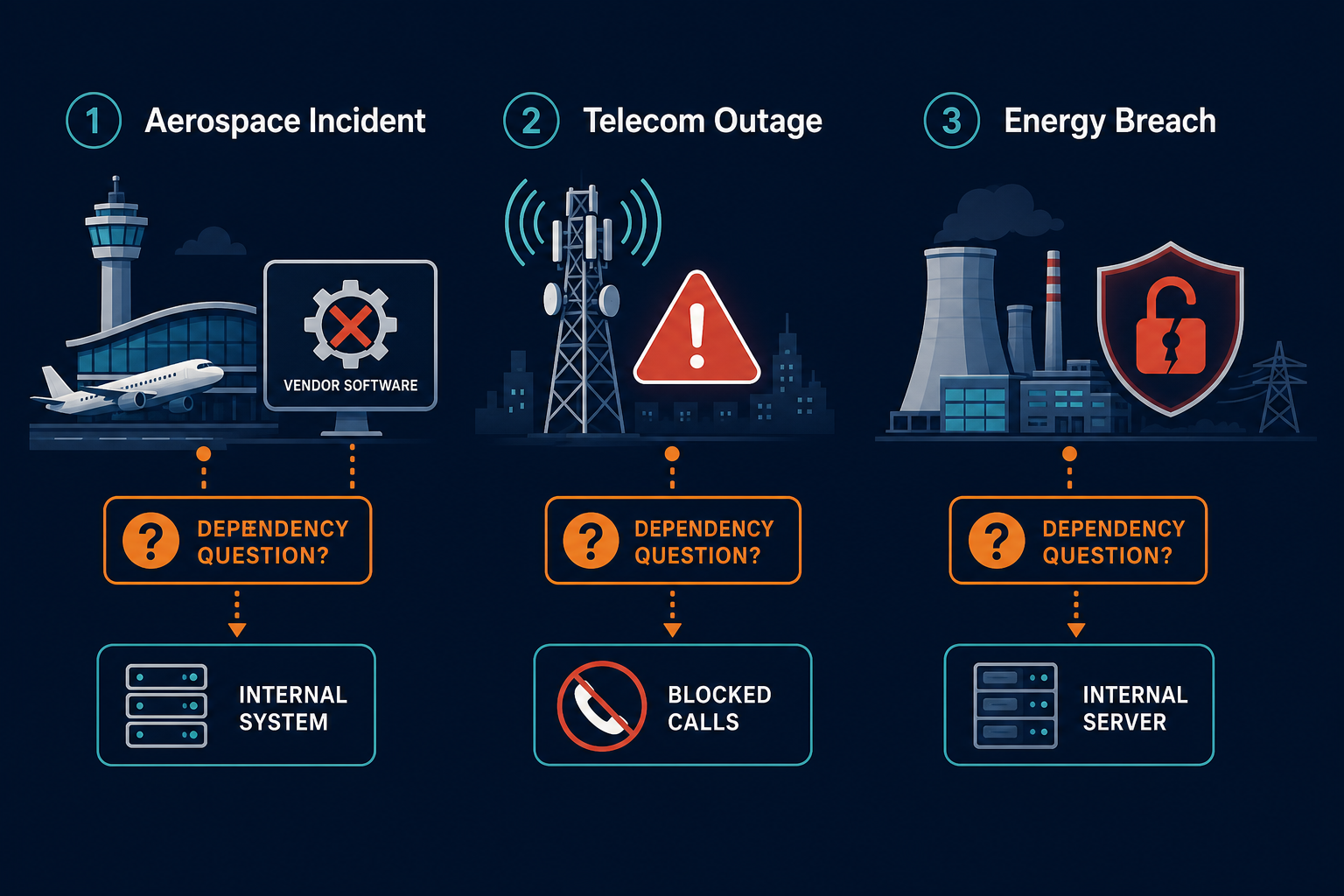
Aerospace faced that question in September 2025 when Collins Aerospace MUSE software was disrupted at European airports. RTX said the impact stayed limited to electronic check-in and baggage drop and that manual check-in could mitigate it, as reported by Michigan Public and in the RTX disruption report. ENISA later described the underlying cause as a third-party ransomware incident, as reported by Security Affairs. Airport operators said the problem sat with the provider. The dependency question for readers is direct, because any team using a vendor platform for check-in, boarding, engineering, or scheduling needs a list of internal systems that depend on that platform.
Telecom faced a different version of the same question in February 2024 during the nationwide AT&T outage. The Federal Communications Commission (FCC) reported that the outage lasted at least 12 hours, affected more than 125 million devices, blocked more than 92 million voice calls, and blocked more than 25,000 attempts to reach 911. The agency said the outage followed a network change that contained an equipment configuration error, and that lab testing had missed the error before deployment. The agency also said AT&T scanned its network within 48 hours for elements lacking the missing controls. Those details come from the Benton summary of the FCC report and the full FCC report PDF.
The dependency question here concerns configuration ownership, because response teams need to know which network elements carry a given configuration and who owns each one. Change review depends on that same ownership record, as described in the change management use case.
Energy faced the question again in April 2025 when Nova Scotia Power and Emera reported unauthorized access to parts of the network and servers supporting business applications. The companies said they discovered the activity on 25 April, isolated affected servers, and kept generation, transmission, and distribution operating. Those facts come from the company’s incident statement. The dependency question here concerns shared servers, because application owners need to know which business systems share those servers and what software runs on each one.
A maintained record supports all three questions by showing owned systems and their dependencies in one place. A configuration management database records owned systems and what those systems depend on, and it shows nothing inside a vendor platform. That limit matters because vendor platforms remain opaque to customer tooling, while the customer side of each connection stays recordable.
Where Virima Fits Across Cloud, On-Premises and Vendor Links
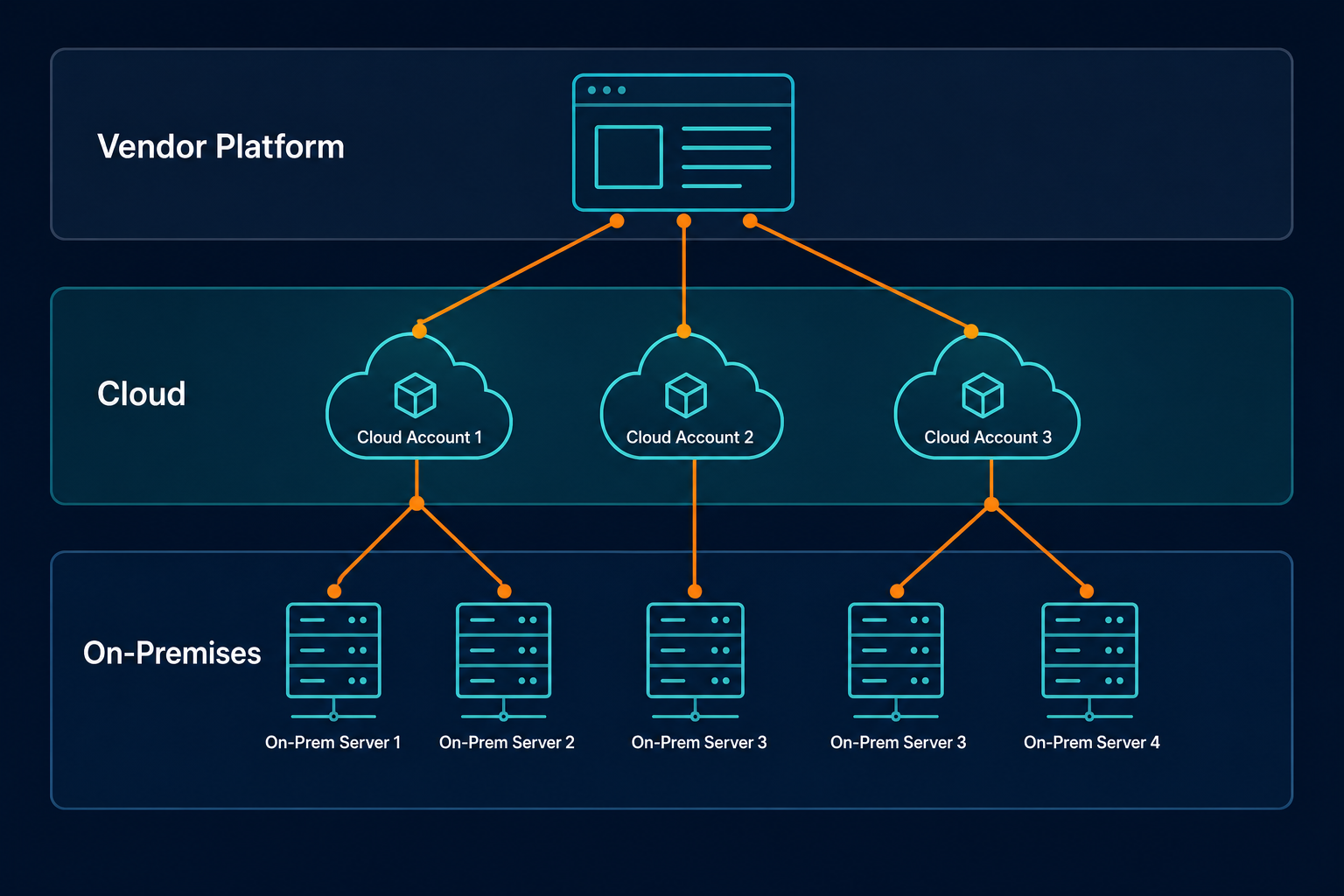
Virima supplies discovery-sourced records of owned systems and cloud accounts, with owners and last-seen dates, plus dependency maps once service definitions are provided. Discovery-sourced in this article means records that come from scheduled discovery scans, each with a source and a last-seen date, instead of being typed in by hand. Virima builds dependency maps after readers define which applications and platforms make up each service, and Virima shows nothing inside a vendor platform. The scope below rests on the published integrations catalog and the programming interface documentation, and it stays within those published claims.
| Layer | Published coverage | Practical use for Denver estates |
|---|---|---|
| Virtualization platforms | VMware, Microsoft Hyper-V, Nutanix | Records on-premises virtual servers, hosts, and workload relationships that sit beneath shared services |
| Network infrastructure | Aruba, Cato, Cisco Meraki, Juniper, NetApp | Records devices and relationships in credentialed scope, without claims about carrier-core systems beyond the catalog |
| Cloud | Amazon Web Services (AWS) and Microsoft Azure | Discovers cloud resources in those two platforms, where Amazon Web Services means Amazon’s cloud platform |
| Containers | Kubernetes, OpenShift, AWS EKS, Azure AKS, Docker | Associates container workloads with the underlying assets that support them |
| Ticketing and service desk tools | ServiceNow, Jira Service Management, Ivanti, HaloITSM, Xurrent, Hornbill, TeamDynamix | Syncs asset and service context with information technology service management (ITSM) workflows, where ITSM means the ticketing and service desk tools a company uses |
| Programming interface | Representational State Transfer application programming interface (REST API) with JSON support for GET, POST, and PATCH | Allows software to read and write records through a standard interface, where REST API means a standard way for software to read and write records, and access uses an API key and tenant ID issued by Virima |
Scheduled discovery keeps these records current through high-frequency scheduled discovery cycles that refresh what the scanners can reach. Teams can review the method in the IT discovery overview and the AWS and Azure discovery guide. Cloud resources that appear for short periods get reconciled on the next discovery cycle, and decommissioned hosts stay visible until the retirement decision and date are recorded. Peak-season instances and decommissioned hosts are reconciled on the next cycle through the same scheduled process.
Vendor links work through service definitions that readers provide. A team defines the service that uses a vendor platform, lists the applications and systems involved, and Virima builds the dependency map from discovered infrastructure. That map shows which owned systems touch the vendor-dependent service, so the headline question becomes a lookup during triage. Teams can see the approach in the service mapping overview. The full connector list sits in the integrations catalog.
The scope above stops at clear boundaries that Denver teams should plan around. Coverage applies to information technology in credentialed scope, while plant equipment, field controls, network-core hardware, and ground-station equipment stay outside discovery. Visibility covers owned systems and their links to vendor-dependent services, while activity inside a vendor platform remains with vendor status pages. Published cloud coverage includes Amazon Web Services and Microsoft Azure, with no Google Cloud claim. Refreshes run on scheduled discovery cycles, with no passive, event-driven, or real-time collection claimed. The platform serves as a system of record for infrastructure and dependencies, rather than a cost-management tool, compliance mechanism, or legal adviser.
What One Maintained Record Can and Cannot Cut
A maintained record cuts the time spent working out what depends on a vendor platform or a shared server. The record gives response teams owners, dependencies, and last-seen dates in one place, so triage starts from a list instead of a search across spreadsheets.
- Incident and operations teams: responders open the dependency map and see which owned systems connect to the affected vendor platform, which shortens the initial assessment period.
- Change and configuration owners: owners trace which network elements and servers carry a given configuration, which supports safer review before deployment.
- Application owners: owners identify which business systems share the same servers and supporting infrastructure, which clarifies coordination during isolation or recovery work.
- Finance and technology leaders: leaders track the internal time required to list dependencies before and after the record improves, using the same vendor platform for comparison.
- Governance and audit support: reviewers confirm owners, last-seen dates, and discovery sources from one record, which reduces manual evidence gathering across spreadsheets.
Industry context helps leaders set expectations without overstating tool outcomes. Flexera reported that respondents estimated wasted cloud spend at 29% in its 2026 survey, which marked the first increase in five years, as shown in the Flexera 2026 findings. That figure is an industry estimate from survey respondents, and it is not a Virima result. Outage scale provides similar context, because the FCC account of the AT&T outage describes at least 12 hours of impact and more than 92 million blocked calls, and that scale shows why dependency lists matter before an event. That outage history is not a Virima result either.
Leaders who want a conservative internal metric can track the time required to list everything that depends on a named vendor platform: record the current time using existing lists and spreadsheets, then record it again after the maintained record is in place. The comparison stays internal, uses the same vendor platform both times, and avoids invented savings. Teams that want background on spend visibility can read about how Virima addresses the cloud spend gap. Teams that want background on planning benefits can read about IT visibility and operational efficiency. Any decommissioning decision names the accountable owner, cites the retirement reason, and records the date in the system of record.
A Six-Line Self-Check for Your Hybrid Record
Use these six lines to assess whether the current record can answer vendor dependency questions during triage. Answer each line with yes, partly, or no, based on what the record shows today.
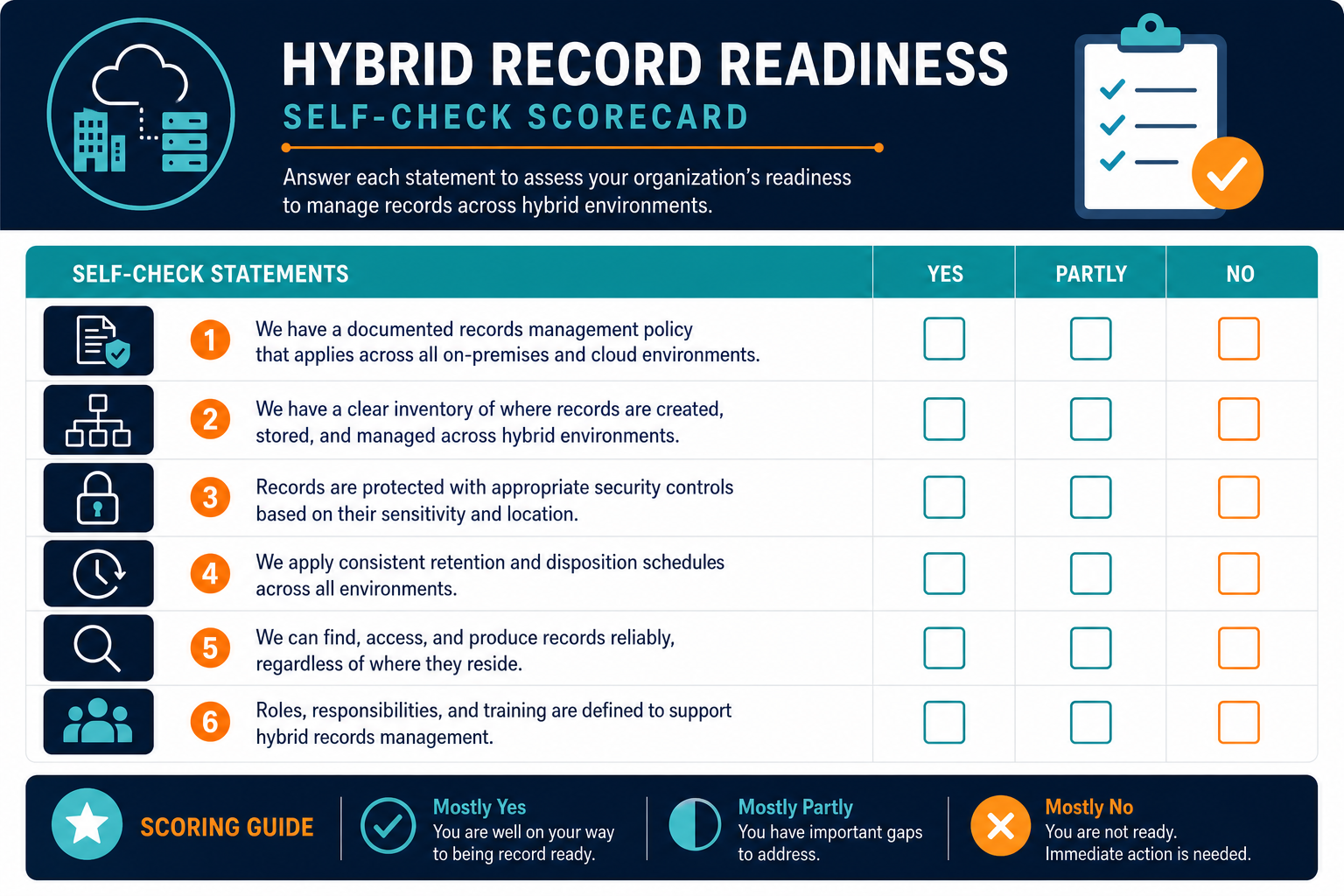
- The team can list the systems that depend on the largest vendor platform within minutes.
- Every cloud account in scope carries a named owner who accepts responsibility for review.
- Each record shows the date when scheduled discovery last confirmed its presence.
- The team can distinguish records from discovery scans versus records typed in by hand.
- The link between on-premises servers and cloud accounts appears in one record, rather than in separate lists.
- The decision owner for record retirement is documented, along with the retirement criteria.
See Your Vendor Dependencies Mapped
Vendor incidents expose dependency gaps within hours. See how discovery-sourced runtime truth keeps vendor links, owners, and hybrid dependencies visible in one record. Explore Trusted Runtime Truth.