San Diego Telecom and Chip Firms Need a Hybrid Cloud CMDB

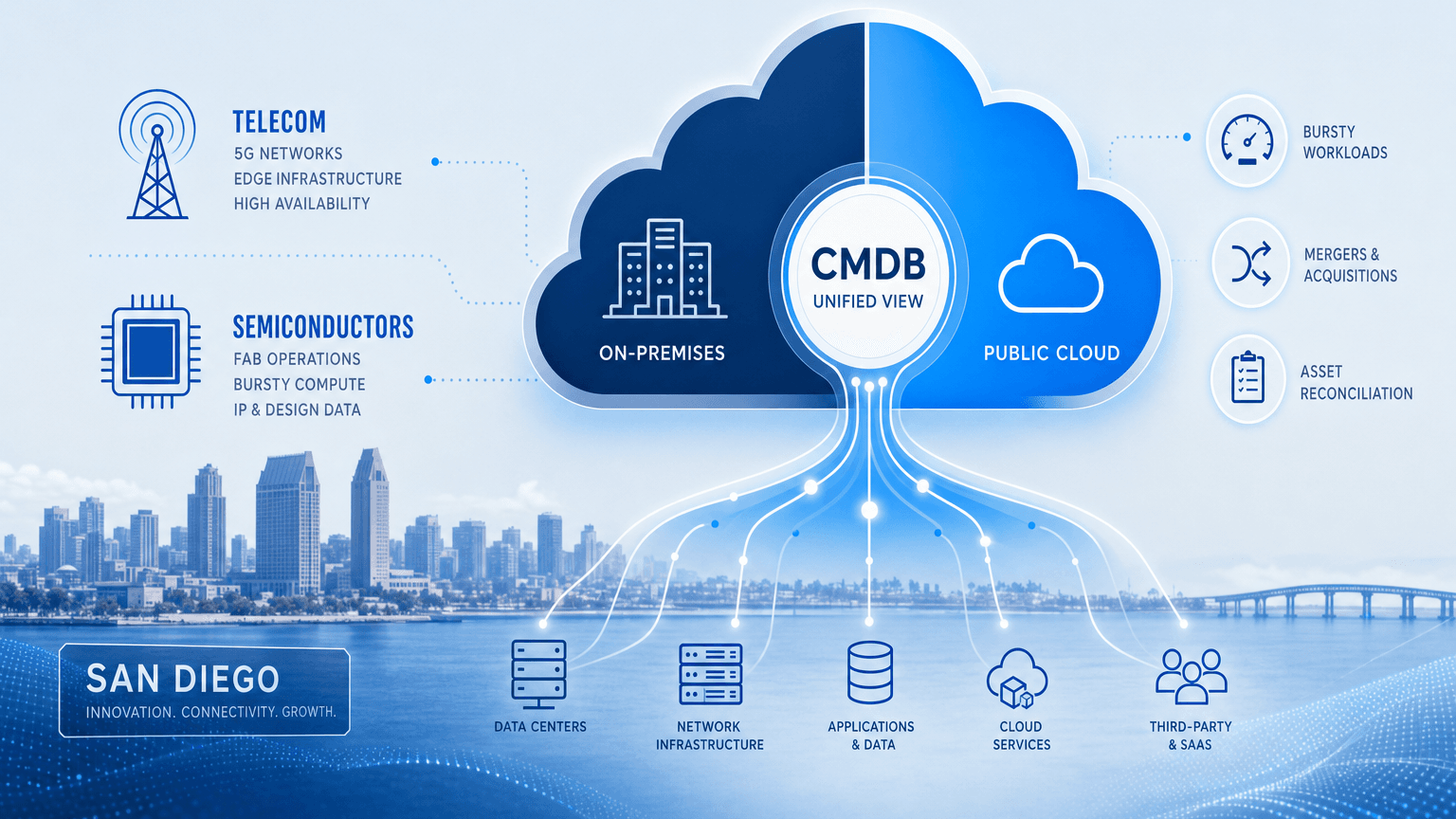
An acquisition closes on a Friday, and by Monday your CMDB has two “current” answers for the same server. In San Diego’s telecom and semiconductor cluster, that collision is routine: fabless chip-design teams burst EDA workloads into public cloud between on-premises HPC cycles, and the region’s largest employers keep buying infrastructure through M&A. That combination is a hybrid cloud CMDB problem before it’s anything else — the record that’s supposed to reconcile both kinds of change into one governed view instead holds two competing spreadsheets.
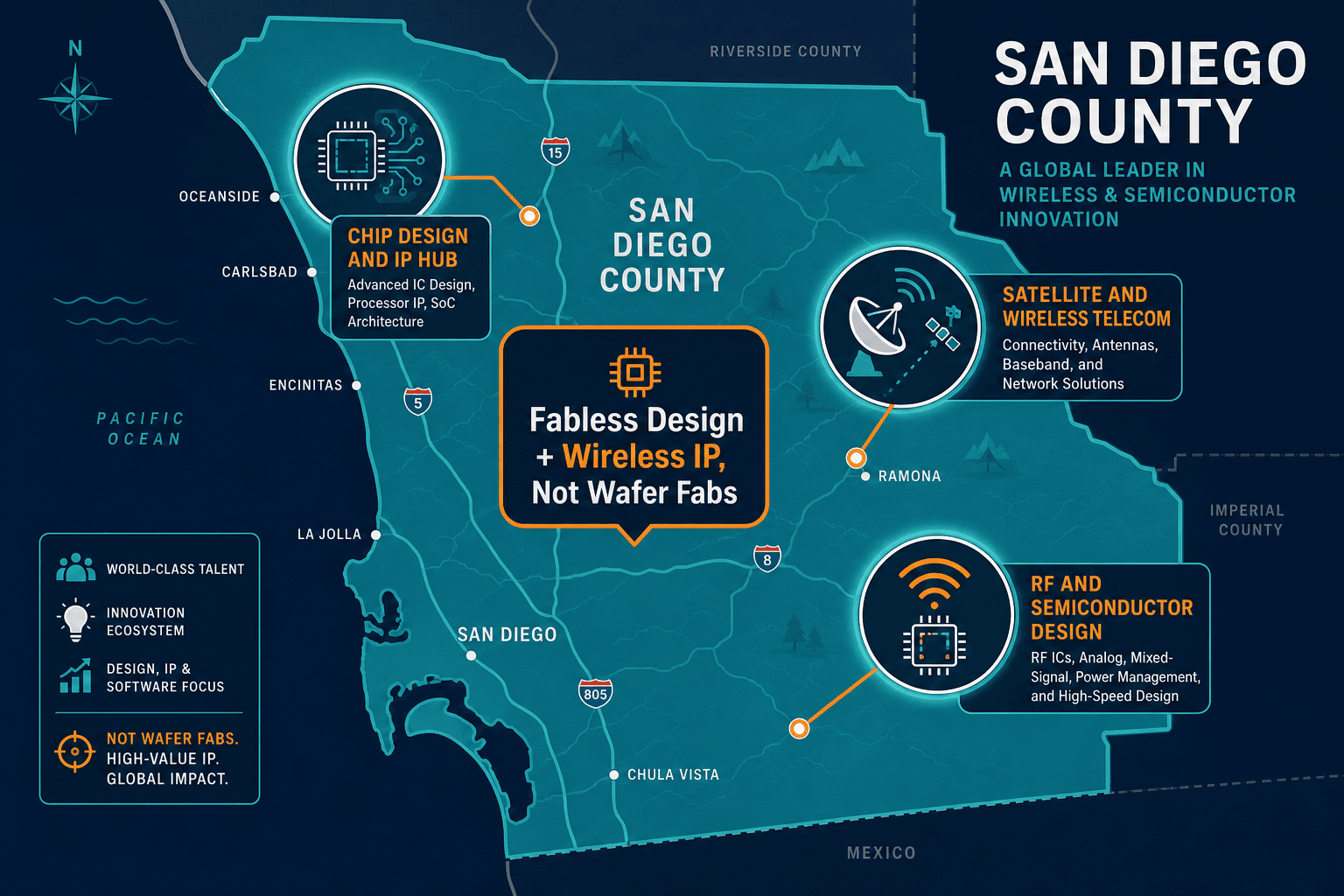
San Diego has no major computer-chip factory. Its semiconductor industry is almost entirely design and wireless intellectual property, not wafer manufacturing. That’s exactly why the city’s largest tech employer is spending billions stitching together data-center and AI infrastructure instead of building fabs. Design workloads spike through a cycle, on-premises capacity expands slowly, and teams burst compute into public cloud next to local high-performance clusters, while large acquisitions pull in separate cloud accounts, tooling, and asset records that rarely land cleanly in one system of record.
Defense and biotech still employ more people in the region than telecom and semiconductors, but San Diego’s fabless and wireless cluster is globally distinctive and unusually hard on hybrid infrastructure visibility. IT operations and infrastructure leaders at San Diego-site telecom and chip-design companies do not need another primer on what a configuration management database (CMDB) is — they need a way to see, reconcile, and govern estates that are both highly workload-variable and repeatedly fragmented by acquisitions. For category basics, Virima already covers hybrid cloud asset management and cloud CMDB in hybrid environments; this article stays on the San Diego-specific failure pattern.
San Diego’s tech economy runs on chip design and wireless IP, not chip manufacturing
Qualcomm was founded in San Diego in 1985 and remains the region’s largest publicly traded company. The San Diego Regional EDC reports roughly 13,000 local Qualcomm employees and an estimated $4 billion in regional economic impact. Across the broader tech sector, the same EDC page cites 63,295 jobs across 4,230 establishments at a $160,406 average wage. Named cluster companies include Qualcomm, ASML, Apple, Viasat, Verizon, Samsung Semiconductor, Sony, Cubic, and Cox Communications.
The World Intellectual Property Organization’s Global Innovation Index 2024 ranks metro San Diego the 10th-largest science-and-technology cluster on Earth. About 71% of the cluster’s international patent filings sit in electrical engineering — the wireless and semiconductor-design core, not fabrication. That patent mix is the economic fingerprint of design and IP licensing, not a factory floor.
Phoenix and Austin tell a different semiconductor story: those metros carry heavy wafer fabrication investment, and San Diego does not. Treating San Diego as a “chip city” without that distinction misstates the IT problem. Fab-heavy metros pull operations teams toward OT and plant-floor asset questions; a fabless design hub pulls them toward hybrid cloud compute, design-program burst capacity, and the infrastructure stacks that arrive with each new acquisition.
Why a fabless cluster produces a different IT problem than a fab cluster
Chip-design work is not a steady load. Simulation, verification, and place-and-route peak at different points in a design cycle. Synopsys notes that on-premises capacity often takes three to six months to expand. So design teams routinely burst electronic design automation (EDA) workloads into public cloud platforms such as Amazon Web Services (AWS), Microsoft Azure, and Oracle Cloud, keeping on-premises high-performance computing (HPC) clusters in the mix. NetApp documents the same hybrid pattern for EDA workflows that need synchronized data movement between on-premises storage and cloud compute.
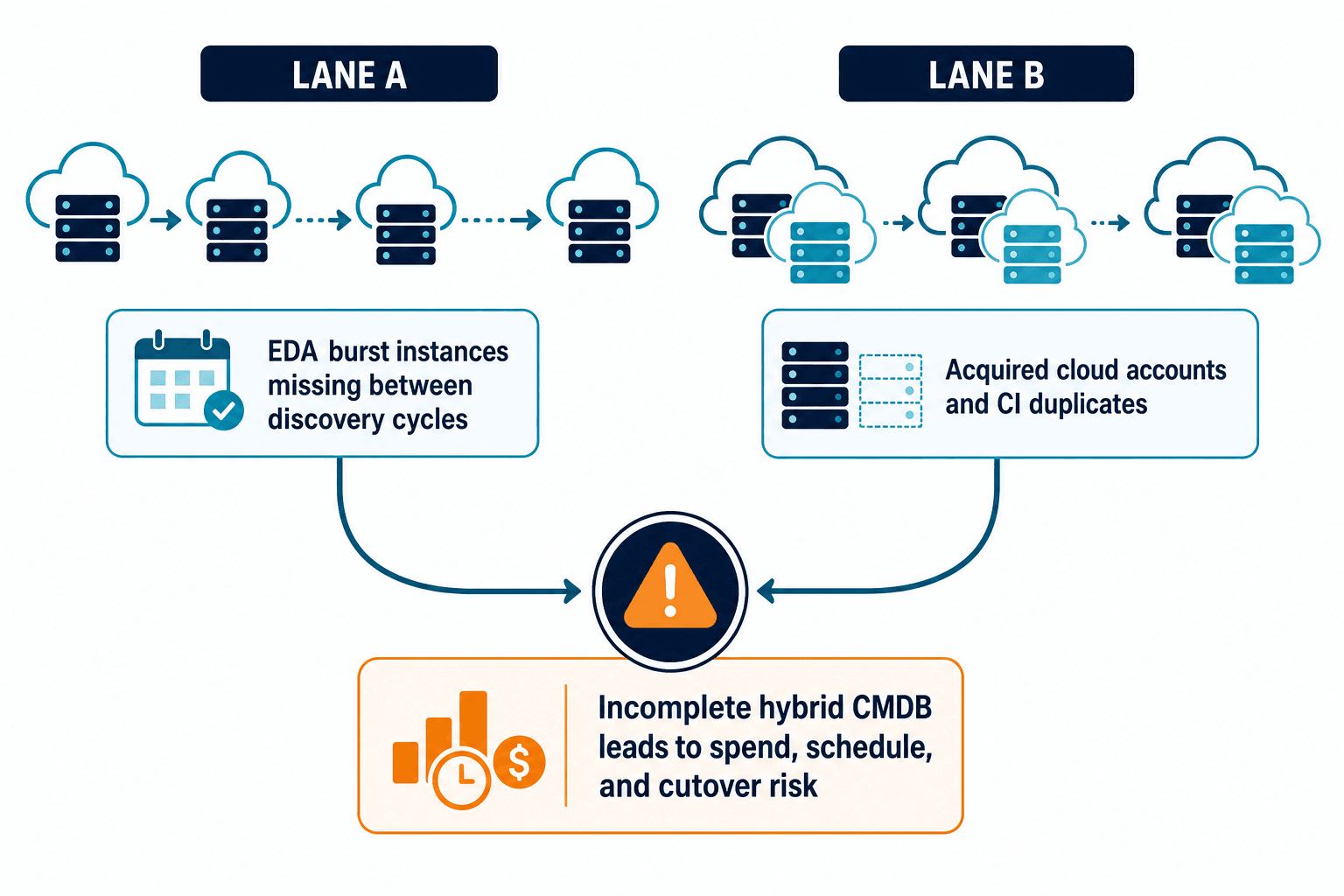
That operating model breaks point-in-time inventories almost as soon as they are written. An instance that exists for a verification sprint may be gone before the next scheduled audit. An on-premises host that looks idle in a weekly spreadsheet may be the landing pad for the next place-and-route run. Without discovery that covers both sides of the hybrid boundary on comparable terms, the CMDB records a partial estate. Stable lab and office assets sit in one place, burst cloud spend and short-lived compute sit somewhere else, and no shared relationship model connects them.
The acute risk for San Diego design and wireless operators is therefore hybrid cloud compute visibility and governance, not fab-floor OT discovery. Teams that copy a manufacturing-site inventory playbook onto a fabless design estate will inventory the wrong layer — and still miss the burst compute driving schedule and cost.
Why do fabless semiconductor design teams need hybrid cloud asset visibility?
Fabless design cycles create short-lived EDA compute peaks that outpace on-premises expansion timelines of three to six months, so teams burst work into public cloud beside local HPC. Those instances rarely appear in static inventories the way durable lab assets do, which leaves cost, capacity, and change decisions running on an incomplete estate picture.
The failure pattern: when bursty compute and aggressive M&A collide
Bursty design compute is only half the problem. The other half is infrastructure that arrives already owned by someone else. Qualcomm’s public 2025–2026 move into data-center and AI infrastructure illustrates the scale of that pattern industry-wide: RCR Wireless reports a roughly $2.4 billion agreement to acquire Alphawave Semi for high-speed data-center connectivity and compute intellectual property, with close expected in the first quarter of 2026, and HPCwire / AIwire covered a roughly $3.9 billion agreement to acquire Modular, positioned around an open AI software stack as part of a broader data-center push spanning CPUs, accelerators, memory, networking, and software. Those are completed and pending deal values, not projections. Separately, public earnings guidance points to a raised fiscal-2029 non-handset revenue target near $40 billion, with data-center revenue targeted above $15 billion annually — a forward goal, not a transaction total.
These figures describe commercial ambition and completed deal terms, not Virima’s visibility into any named company’s internal IT systems. Virima has no knowledge of Qualcomm’s, Alphawave’s, Modular’s, or Viasat’s live infrastructure; the operational lesson below applies to any acquisition-heavy technology company in this cluster, not to a specific one. Each deal of this kind can import separate cloud accounts, engineering tooling, naming conventions, and IT asset management records. Without authority rules for which source wins when two systems disagree, post-merger CMDB work becomes a contest of last scan rather than a governed reconcile. See Discovering IT Assets After Mergers and Acquisitions for a deeper look at conflict-resolution approaches.
Hybrid remains the intended operating model industry-wide, not a temporary bridge — the acquisitions above are aimed at extending data-center and AI infrastructure alongside existing on-device and cloud workloads, not replacing hybrid operation with a single environment. When burst compute already escapes inventory between design cycles, and M&A keeps adding unreconciled estates, untracked cloud spend, capacity guesswork, and cutover risk compound in the same configuration record.
CMDB auto-population with authority-rule conflict resolution is the general answer to whose infrastructure record wins after an acquisition. Most-recent-scan-wins logic is a poor substitute when two engineering cultures both treat their inventory as current.
The same root cause shows up in San Diego’s telecom layer, too
The semiconductor half of the cluster is not a separate story from the telecom half — both trace back to the same fragmented-infrastructure root cause: hybrid estates that change faster than manual inventory, plus major asset bases absorbed through acquisition.
Viasat, headquartered in nearby Carlsbad with roughly 7,000 employees, completed its acquisition of Inmarsat in May 2023 — roughly $550.7 million in cash plus 46.36 million shares, folding Inmarsat’s L-band satellite network into Viasat’s fleet under multi-jurisdictional regulatory review. That 2023 close is an illustrative precedent of the same pattern described above, not a claim about any ongoing integration state at Viasat today. What matters structurally: a large infrastructure base enters the operating picture through M&A and must be reconciled into one operational view if change, incident, and capacity decisions are going to stay coherent.
Other companies in the same San Diego County footprint show the same dual telecom-and-chip-adjacent structure: MaxLinear, an RF and semiconductor design firm, is headquartered in Carlsbad, and the San Diego Regional EDC also lists local Samsung Semiconductor and Sony research and development activity among the tech roster. Fragmented hybrid infrastructure is a feature of how this cluster builds and buys capability, not an anomaly at a single logo.
How does M&A create CMDB problems for telecom and semiconductor IT teams?
Each acquired company can bring separate cloud accounts, tooling, and configuration records. Without multi-source reconciliation and explicit authority rules, duplicate or conflicting configuration items (CIs) persist, so change and capacity decisions run on competing inventories instead of one governed estate view.
What a hybrid cloud CMDB built for this cluster actually needs to do
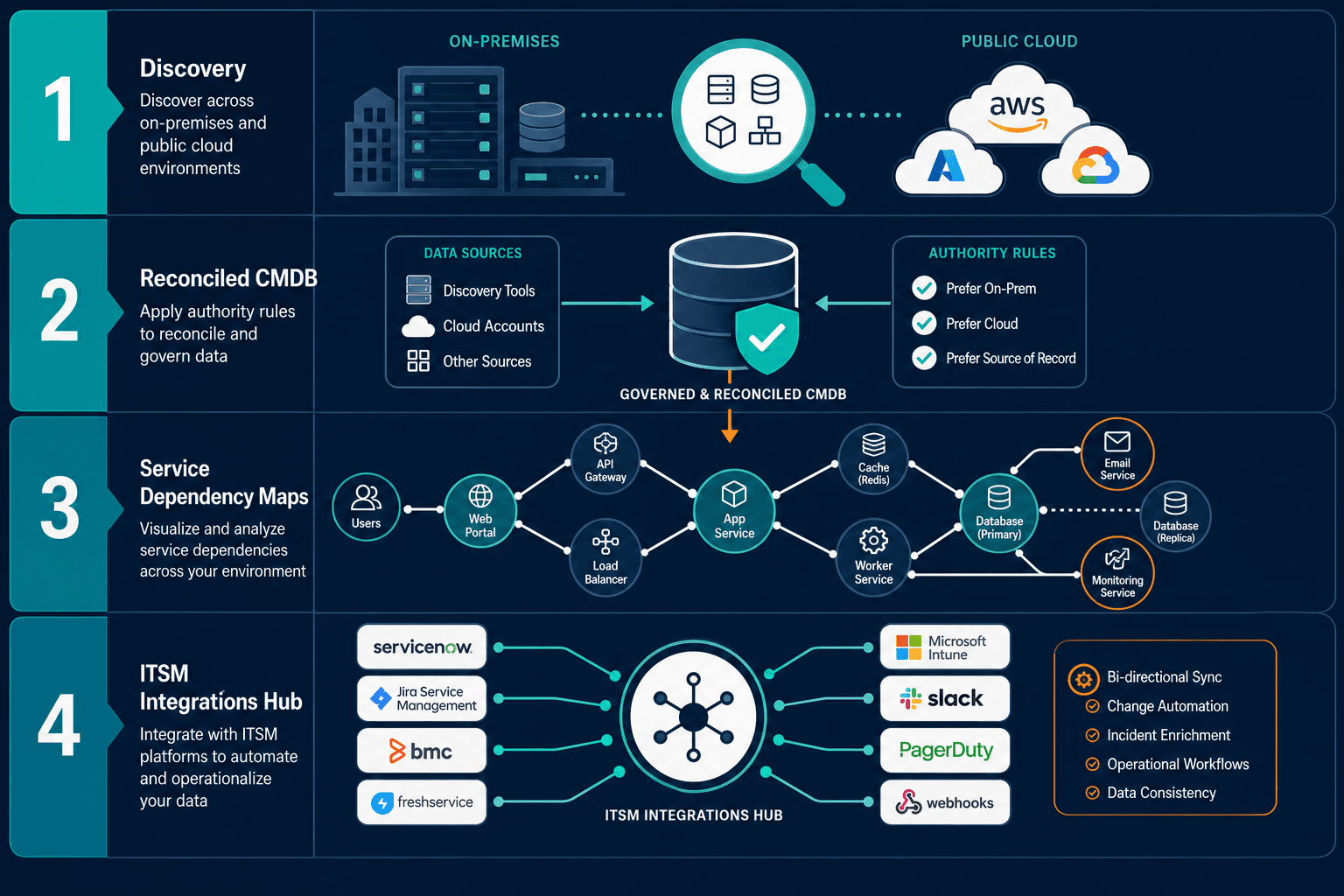
For design and telecom operators whose footprint spans on-premises HPC, multiple public clouds, and newly acquired infrastructure, a hybrid cloud CMDB has to do more than store a spreadsheet of servers. Capability requirements map to verified Virima product surfaces without inventing customers in this vertical.
Discovery that treats burst cloud and on-premises assets as one problem. IT Discovery covers agent-based and agentless methods, network device discovery, software inventory, and cloud asset discovery across AWS and Azure, plus VM discovery across hypervisors such as VMware and Hyper-V, on scheduled cycles — Virima does not claim event-driven discovery today. Short-lived cloud compute should enter the same inventory discipline as durable lab and data-center assets, rather than living only in a finance export.
CMDB population with authority-rule conflict resolution. CMDB capabilities include automated CI population, multi-source data reconciliation, relationship mapping, health scoring, lifecycle tracking, and change impact analysis. After an acquisition-style import of accounts and tooling, authority rules decide which source updates which attributes instead of letting scan order silently overwrite engineering truth.
Service maps for cutover and migration impact. Once service definitions are supplied manually, via spreadsheet, or through supported architecture inputs, ViVID™ (Virima’s service dependency mapping capability) builds and maintains application-to-infrastructure dependency maps, supporting blast-radius analysis before a data-center build-out, cloud migration wave, or integration cutover. Services aren’t auto-discovered as business compositions; map-building is automated only after definitions are supplied.
Timestamped change history through decommission. ITIL-aligned history that survives decommission supports internal governance when executives and integration leads ask what changed, when, and under whose record during a high-visibility infrastructure program.
Connective integrations rather than a forced single ITSM stack. Acquired teams often keep different service management tools. Virima integrates with ServiceNow, Jira Service Management, Ivanti, HaloITSM, Xurrent, and Hornbill — full roster at all integrations — feeding those workflows as a connective layer instead of demanding every inherited team abandon its ticket system on day one.
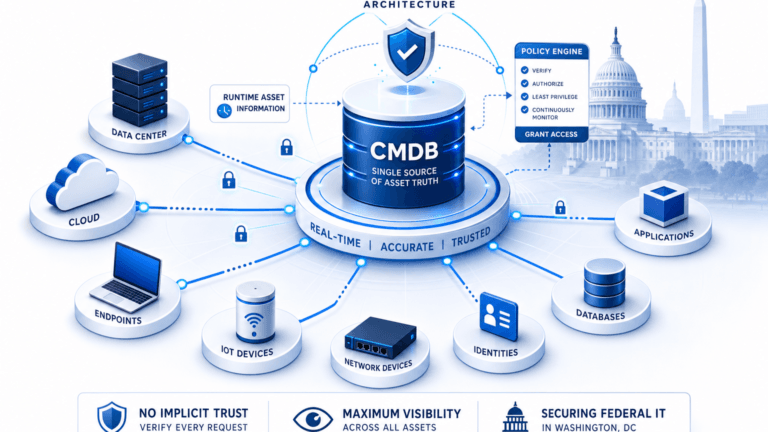
See how discovery-sourced Trusted Runtime Truth gives hybrid estates a governed picture of what exists, how it is connected, what changed, and what a change is likely to touch.
| Problem in this cluster | Capability requirement | Practical outcome |
|---|---|---|
| Cloud-burst EDA compute missing between design cycles | API and agent/agentless discovery across on-premises and AWS/Azure | Burst instances inventoried on comparable terms with lab and data-center assets |
| Conflicting records after infrastructure M&A | CMDB auto-population with authority-rule reconciliation | One reconciled CI record instead of scan-order guesses |
| Unclear blast radius before cutover or migration | ViVID™ dependency maps after service definitions are supplied | Scoped pre-change impact views for hybrid paths |
| Integration scrutiny during large infrastructure programs | Timestamped CI history retained through decommission | Governance trail for what changed and when |
| Inherited tools across acquired teams | Bi-directional ITSM integrations via one hub | CMDB as connective layer across service platforms |
Where San Diego telecom and semiconductor IT leaders should start
Full-estate rollouts are the wrong first move when the pain is concentrated in burst accounts and inherited infrastructure. Start discovery on one bounded surface: a single cloud-burst account tied to a named design program, one HPC pod that feeds hybrid jobs, or one recently acquired business unit’s cloud and compute footprint. Prove that short-lived and durable assets land in the same CMDB with clear ownership and relationships, then expand to the next program or the next inherited account.
Use ViVID™ maps on that scoped set before the next migration wave or cutover rehearsal — the question to answer is concrete: which services and dependencies does this change touch in the hybrid path you actually run. Pair that with authority rules so the next data import does not reopen duplicate CI fights.
San Diego’s fabless and telecom operators will keep bursting design and network workloads across on-premises and cloud, and large companies in the cluster will keep buying capability through acquisition. The visibility gap is structural, and it’s a hybrid cloud CMDB problem at its core: closing it starts with governed discovery and reconciliation on the slice of the estate where schedule, spend, and cutover risk already show up.
Frequently Asked Questions
Does San Diego have semiconductor manufacturing or only chip design?
San Diego’s semiconductor economy is overwhelmingly fabless design and wireless IP licensing rather than major wafer fabrication. Qualcomm anchors that pattern as a San Diego–founded design and IP leader, and WIPO cluster data shows electrical engineering dominating local patent activity. Fab-heavy capacity is more characteristic of metros such as Phoenix and Austin than of San Diego County.
What is hybrid cloud bursting for chip design (EDA) workloads?
Hybrid cloud bursting is running peak electronic design automation jobs in public cloud when local high-performance capacity can’t expand fast enough. Synopsys notes on-premises expansion often takes three to six months, so simulation and related design stages commonly spill into AWS, Azure, or similar platforms beside on-premises clusters — creating short-lived assets that static inventories miss.
How does a CMDB help during a company acquisition or IT integration?
A CMDB becomes useful in M&A when multi-source discovery and authority rules reconcile inherited cloud accounts, hosts, and relationships into one configuration record. Teams can then run dependency and change analysis against a shared estate view instead of competing spreadsheets from each legacy environment, supporting cutover planning and governance.
How does Virima’s CMDB cover hybrid cloud for San Diego telecom and semiconductor IT teams?
Virima’s approach inventories on-premises HPC and lab assets alongside AWS and Azure cloud resources, reconciles conflicting records after infrastructure acquisitions, and supports service dependency maps once business service definitions are supplied. Timestamped change history and ITSM integrations keep governance and ticket workflows aligned during migrations and cutovers common to this region’s design and telecom operators.
How does Virima support hybrid cloud CMDB use cases without replacing existing ITSM tools?
Virima discovers and reconciles configuration data across hybrid estates, populates CMDB records with authority rules, and builds ViVID™ service maps after service definitions are provided. Bi-directional integrations with platforms such as ServiceNow, Jira Service Management, Ivanti, HaloITSM, Xurrent, and Hornbill let the CMDB feed existing workflows rather than forcing every team onto one service desk product on day one.