CMDB for Hybrid Cloud Visibility Austin Semiconductor Teams Need Before the Next Server Shutdown

CMDB for hybrid cloud visibility Austin semiconductor leaders care about starts with a configuration management database (CMDB) that can answer one operational question when servers must be isolated. In August 2024, Microchip Technology Incorporated disclosed a cybersecurity incident that disrupted certain servers and business operations, according to its Form 8-K on the disruption. The company isolated affected systems, shut down certain hosts, and brought in external cybersecurity advisors while manufacturing facilities ran below normal levels and order fulfilment slowed. A follow-up Form 8-K on recovery later confirmed that operationally critical information technology (IT) systems were back online and that operations had been substantially restored.
Microchip is headquartered in Chandler, Arizona. Its filings describe its own incident and recovery path. They say nothing about Austin estates, dependency maps, or any other company’s records. The operational lesson still applies to any semiconductor estate that must isolate servers under pressure. When servers are isolated, plant and business functions that depend on those hosts need a named path in the record. A configuration management database holds the systems a company runs, who owns each one, and how they connect, so isolation decisions rest on owners and last-seen dates rather than hallway memory.
Why an Austin Estate Splits Into Two Halves
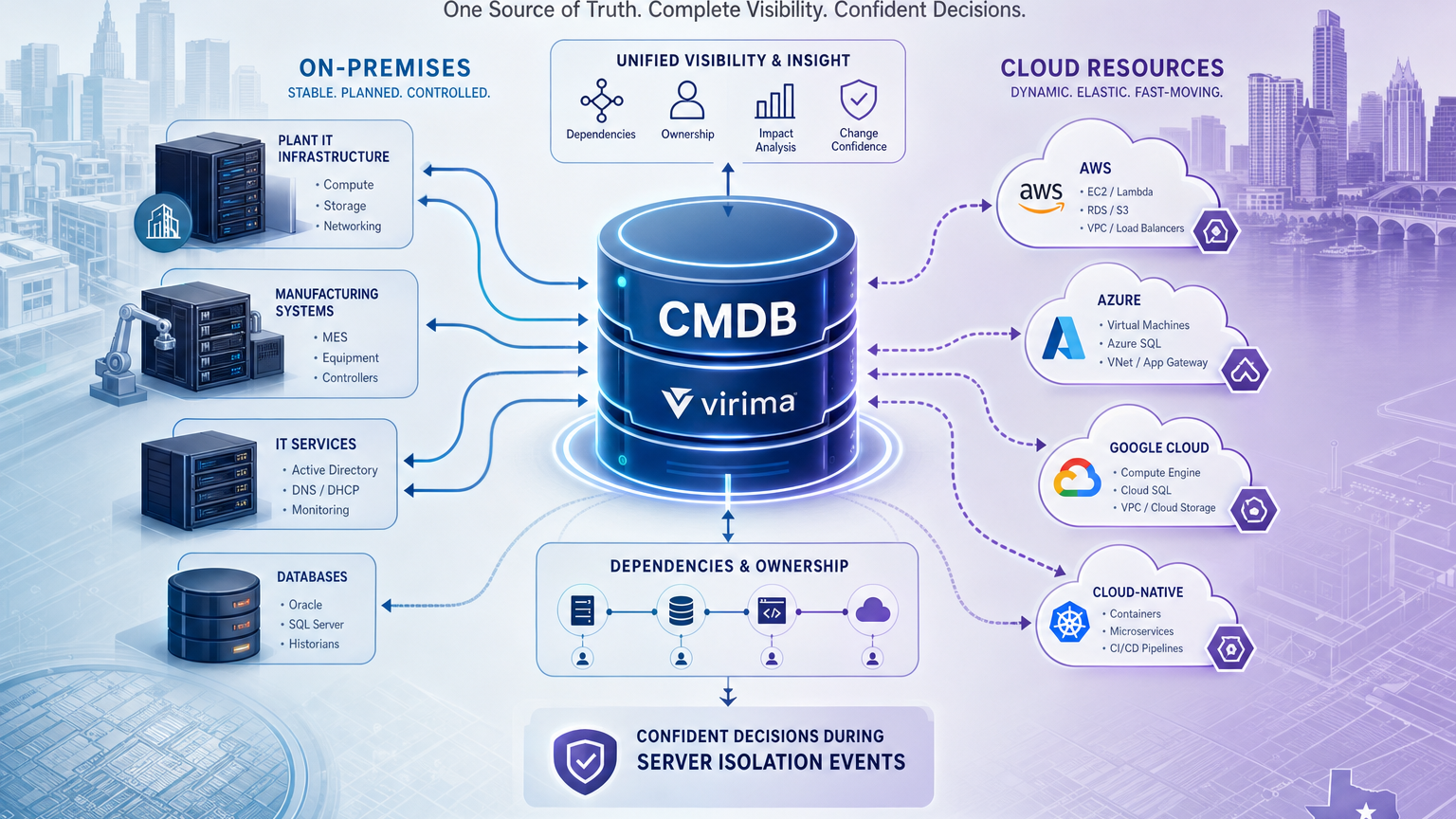
Austin carries both manufacturing and cloud-native work in the same metro story. In November 2021 the Office of the Texas Governor announced a new Samsung semiconductor manufacturing facility in Taylor, with total Texas investment by the company exceeding $35 billion since 1996 and more than 25 years of semiconductor manufacturing in the United States cited by company leaders on that announcement. Taylor sits in the Austin metro area. The fabrication plant (fab) side of the story is manufacturing capacity that changes through planned windows. The cloud-native side runs short-lived resources that appear and disappear within minutes or hours. Both halves still need a shared answer to what depends on what.
Hybrid cloud means a mix of a company’s own systems and public cloud accounts. Flexera’s 2026 State of the Cloud Report, based on a global survey of more than 750 cloud decision-makers and users, found that 73% of organizations operate hybrid environments. That share is industry research across global respondents, and it explains why plant-adjacent IT and cloud accounts often share one shutdown decision even when different teams own the day-to-day tools.
Chip design work sits next to this picture. Virima’s San Diego hybrid cloud CMDB post covers fabless design teams that move electronic design automation (EDA) workloads between their own servers and cloud compute. Austin’s manufacturing footprint is the other half of that semiconductor estate. Design-side bursting and plant-side stability ask different refresh rules of the same configuration record.
Where the Plant Floor Ends and the IT Record Begins
A configuration management database can record the information technology around a chip plant. Equipment and control systems that make chips on the plant floor stay with operational technology tools.
| Zone | What lives there | What the database can record | Who owns the record |
|---|---|---|---|
| Corporate information technology | Servers, laptops, networks | Assets, owners, last-seen dates, links | Information technology operations |
| Cloud accounts | Amazon Web Services (AWS) and Azure accounts, short-lived resources | Accounts, resources, relationships | Cloud or platform team |
| Plant-adjacent information technology | Servers, engineering workstations, jump hosts, data-transfer systems that connect to the plant | The same fields, inside credentialed scope | A named owner on each host |
| Operational technology (OT): equipment and control systems | Process equipment, tool controllers, plant control | Outside Virima’s claim | The plant’s own tools and team |
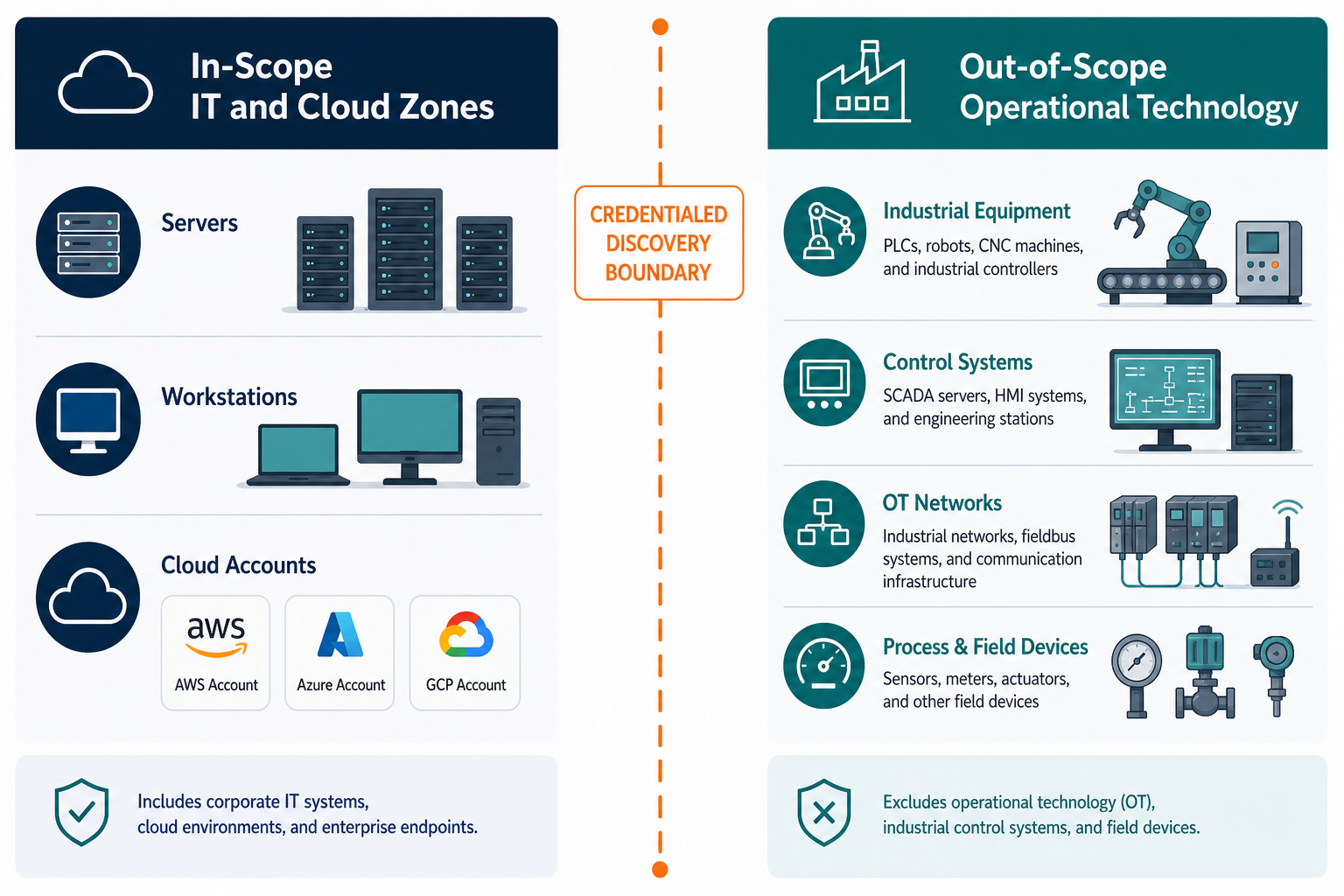
Virima’s published product boundary matches that table. Discovery and maps cover IT systems in credentialed scope. Operational technology plant systems and industrial control planes stay outside that claim. Interfaces next to plant systems that the IT organization owns can sit in the record with owners and last-verified dates, the same framing used on Virima’s NIS2 IT asset visibility guidance.
A second documented case shows how far an IT halt can reach a foundry. In July 2020, local reporting on X-FAB’s Lubbock site described a ransomware event that halted manufacturing and IT systems. The group stopped IT systems and production lines at all six locations worldwide as a preventive step. A foundry makes chips designed by other companies. The reporting quotes the company’s own statement on production stop, planned fab shutdowns pulled forward, and a gradual resume of systems. Stay inside those public facts from the company’s statement and the local report. Leave any plant’s internal inventory contents outside the narrative.
IT discovery is the path that populates plant-adjacent hosts, corporate servers, and cloud accounts inside the credentialed scope the owner defines. Plant floor tools stay with the plant team.
What an Isolation Decision Needs to Know
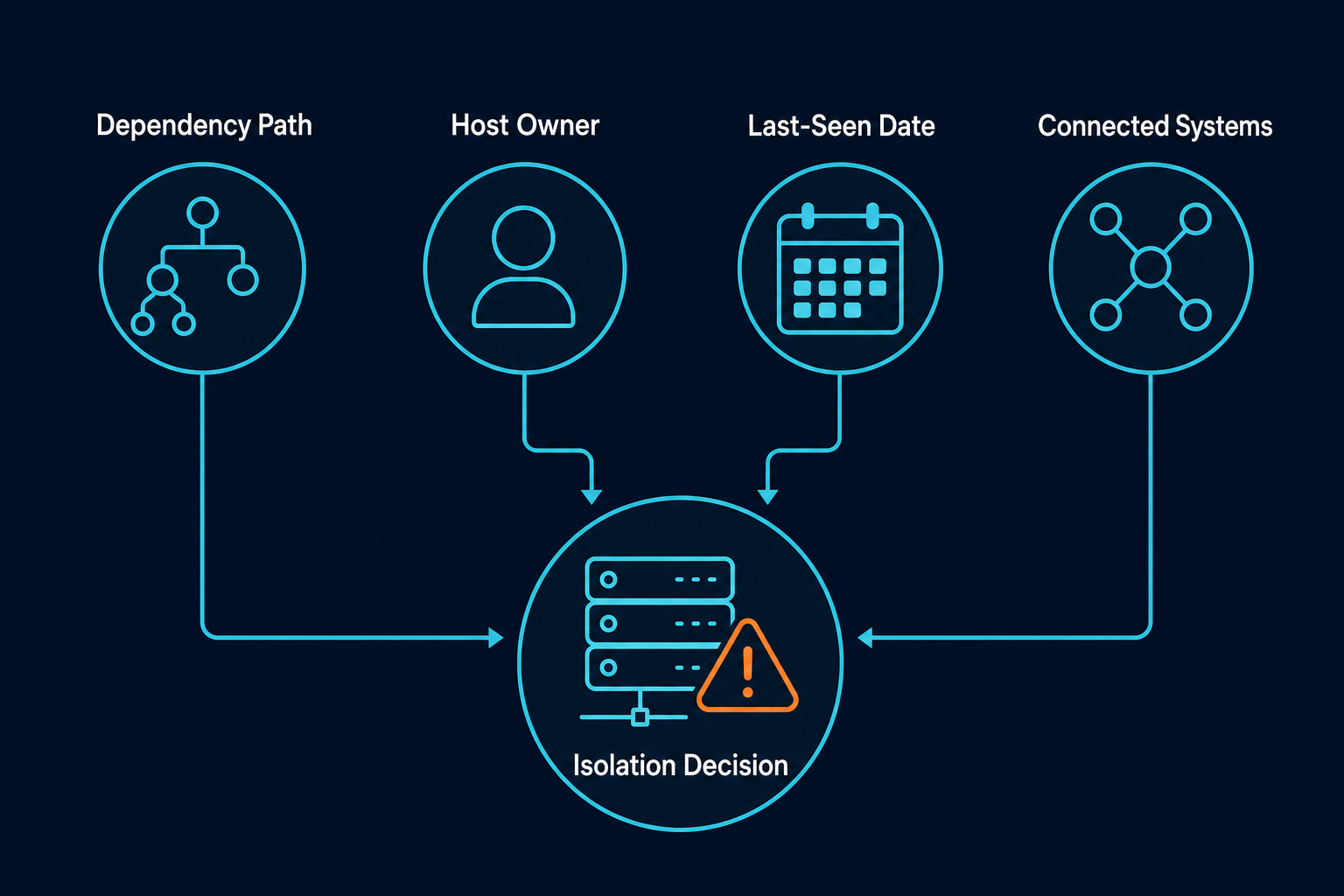
When a host must leave the network, four facts decide how wide the impact runs. Each fact assumes the estate already keeps a maintained record.
Which plant or business functions depend on this server? A dependency view built from defined services shows the path. Service composition must be supplied first. Once definitions exist, maps can show how applications sit on servers, databases, and network components. Without that join, the answer comes from people’s memory during the window.
Who owns each host under review? One named owner per host, with a reachable contact path, beats a shared inbox that no one monitors at 2 a.m. Ownership is a field on the configuration item (CI), which is one record such as a server or a cloud account.
When was this host last seen by discovery? A last-discovered date tells operators whether the record still describes the host that is about to be isolated. Stale last-seen values push the team back to manual confirmation before any shutdown step.
What else does it connect to? Include cloud accounts and plant-adjacent hosts around the same path. Isolation of one jump host can touch engineering workstations, data-transfer systems, and subscriptions that never appear on the same spreadsheet tab.
Service mapping is where those joins become visible after service definitions are in place. The map is only as good as the definitions and the discovery refresh behind them.
Where Virima Fits in an Austin Semiconductor Estate
Virima supplies discovery-sourced records of information technology and cloud accounts, with owners and last-seen dates. Plant equipment stays outside that discovery path. That boundary is the honest place to start any Austin semiconductor conversation about a CMDB for hybrid cloud visibility.
Published connectors and platform paths include the layers below. Partner product names appear as plain text in the table. The single integrations destination is Virima’s integrations catalog.
| Layer | Published integration | Notes |
|---|---|---|
| Virtualization platforms | VMware, Microsoft Hyper-V, Nutanix | On-premises virtual servers |
| Network infrastructure | Aruba, Cato, Cisco Meraki, Juniper, NetApp | Devices and relationships |
| Cloud | Amazon Web Services (AWS), Microsoft Azure | Published cloud coverage |
| Containers | Kubernetes, OpenShift, AWS EKS, Azure AKS, Docker | Per catalog descriptions |
| Ticketing and service desk tools (information technology service management) | ServiceNow, Jira Service Management, Ivanti, Halo, Xurrent, Hornbill, TeamDynamix | Two-way sync paths |
| Programming interface | Representational State Transfer application programming interface (REST API): JSON; GET, POST, and PATCH | Access uses an API key and tenant ID issued by Virima |
Discovery runs on a high-frequency schedule the owner sets. Virima keeps current product language on scheduled discovery rather than passive or event-driven real-time discovery. Cloud account discovery (AWS, Azure) is covered in Virima’s AWS and Azure CMDB discovery guide. Service maps are built after service definitions are supplied manually, by spreadsheet import, or through an architecture feed the customer controls. Virima builds maps from those definitions rather than inventing business services on its own. REST API detail for reading and writing records is documented in Virima’s REST API post.
What Virima Does Not Claim
Plant equipment and industrial control systems stay outside discovery scope. Published cloud integrations are Amazon Web Services and Microsoft Azure, so Google Cloud discovery sits outside the published catalog. Discovery refreshes on a high-frequency schedule the owner sets. Cost allocation and cloud spend forecasts stay with FinOps systems, and legal and regulatory advice stays with counsel. Those limits keep the record usable for the IT and cloud half of an Austin estate.
Cloud-Native Teams and Chip-Plant IT on One Record
| Half of the estate | How fast it changes | Record rule |
|---|---|---|
| Cloud-native teams | Minutes to hours | Record the template or service as the stable configuration item, rather than every short-lived instance |
| Chip-plant IT | Slowly, with planned change windows | Record owner, protection need, and last-seen date for each host |
Short-lived cloud resources churn faster than any manual import cycle, which is why a hybrid cloud CMDB treats the template or service as the durable object while instances come and go, per Virima’s guidance on a CMDB in cloud environments. Plant-adjacent hosts move on planned windows instead, so owner, last-seen, and service joins matter more than instance churn. Keeping both halves on one model lets an isolation decision see cloud subscriptions and plant-adjacent jump hosts in the same dependency path. For a cloud-native-only walkthrough of where hybrid visibility slips, see Virima’s Stockholm hybrid cloud visibility post.
What One Maintained Record Can and Cannot Cut
A maintained record can reduce the time spent working out what depends on a server, and the guesswork before a shutdown.
Industry research still helps set expectations for the cloud half of the estate. Flexera’s 2026 State of the Cloud Report states that estimated wasted cloud spend rose to 29%, the first increase in five years, in the same survey of more than 750 respondents. That figure is an industry estimate of waste across surveyed organizations. Treat it as context for cloud governance conversations rather than a Virima customer result or a fixed recovery promise.
For a chief information officer (CIO) measuring value, a conservative internal metric is the time required to list what depends on a given server, before and after the record is maintained with owners and last-seen dates. Decommission decisions still belong to the named owner and the change authority the organization already uses, the record supplies evidence for that decision, not a replacement for it. For how discovery-backed inventory relates to cloud spend conversations without claiming FinOps allocation, see how Virima addresses the cloud spend gap.
A One-Page Scope Statement for the Plant-Side Record
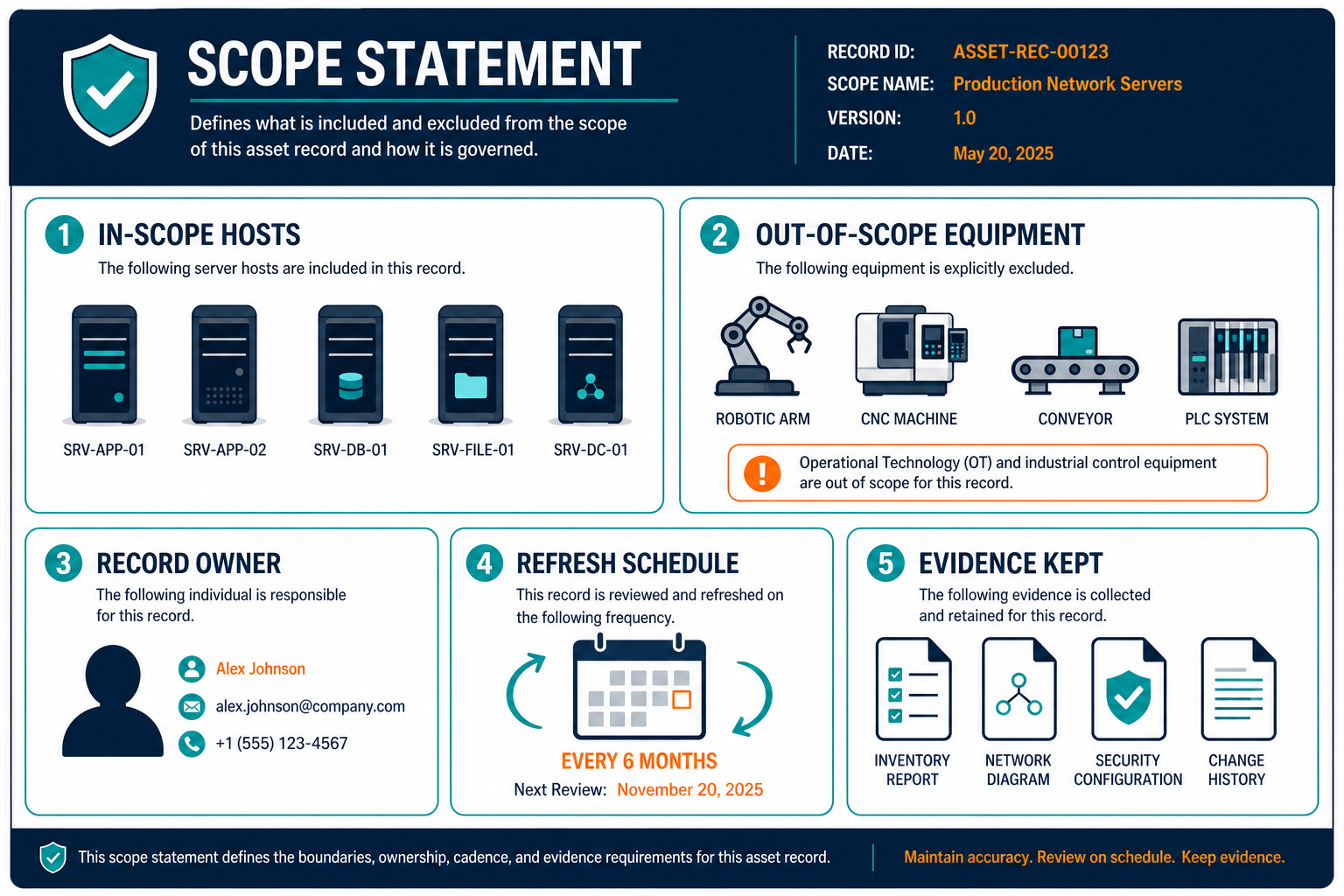
Write the plant-side boundary once, then keep it with the record owner. Fill the brackets with named roles and host classes your estate already uses.
In scope:         [for example: plant-adjacent servers, engineering workstations, jump hosts, cloud accounts]
Out of scope:     [operational technology: plant equipment and control systems, handled by the plant team's own tools]
Record owner:     [named role, rather than a team inbox]
Refresh decision: [how often discovery runs, decided by the owner]
Evidence kept:    [owner, last-seen date, and the services each host supports]
That page is the contract between plant operations and IT. Everything inside the credentialed scope receives an owner and a last-seen date, and cloud accounts that touch the same services sit in the same model so isolation and recovery share one dependency picture.
See Plant-Adjacent IT Mapped Beside Cloud Accounts
Plant-adjacent hosts and cloud accounts often share one isolation window even when different teams own the day-to-day tools. The record that supports that window needs owners on each host, last-seen dates from scheduled discovery, and the service joins that show what breaks when a jump host or subscription leaves the network.
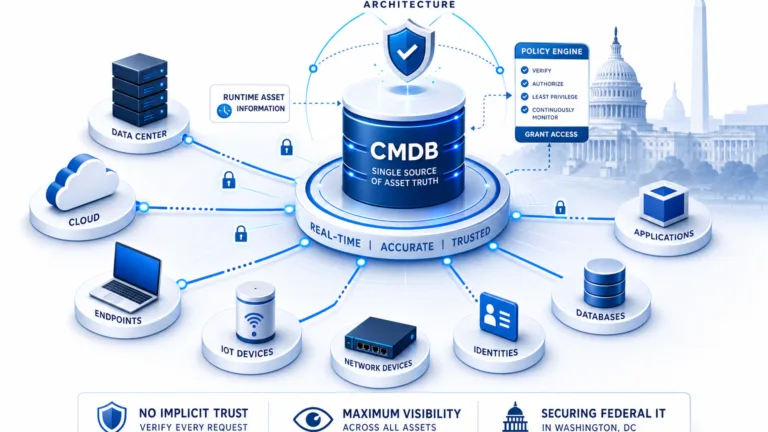
That picture is what Trusted Runtime Truth is built to hold: discovery-sourced ground truth across assets, dependencies, and ownership so isolation and recovery rest on a maintained map rather than hallway memory. Service mapping is where those joins become visible after service definitions are in place.
Frequently Asked Questions
Can a configuration management database discover chip-plant equipment?
A configuration management database records information technology in credentialed scope, including interfaces next to plant systems. Operational technology, meaning plant equipment and control systems, stays outside Virima’s claim and remains with the plant team’s own tools.
Which ITSM and cloud platforms does Virima connect to for an Austin semiconductor estate?
Virima’s published connectors include ServiceNow, Jira Service Management, Ivanti, Halo, Xurrent, Hornbill, and TeamDynamix for ticketing, plus VMware, Hyper-V, and Nutanix for virtualization, and Amazon Web Services and Microsoft Azure for cloud accounts. A REST API (JSON; GET, POST, PATCH) covers integrations beyond the published catalog.
What does hybrid cloud visibility cover for Austin’s cloud-native teams?
Record the template or service as the stable configuration item rather than each short-lived resource. Virima’s published cloud integrations for that work are Amazon Web Services and Microsoft Azure under high-frequency scheduled discovery.
Does Virima’s discovery run often enough to catch short-lived cloud resources?
Discovery runs on a high-frequency schedule the owner sets, rather than a fixed daily or weekly cycle. For cloud accounts, the practical fix is recording the template or service definition as the stable configuration item, since individual short-lived instances can appear and disappear faster than any discovery cycle.
What are examples of accuracy checks for plant-adjacent information technology?
Confirm each host’s owner, last discovery date, the services it supports, and the cloud accounts it connects to. Those four fields are the minimum evidence an isolation decision needs before a plant-adjacent server leaves the network.