Hybrid Cloud CMDB for Frankfurt Banks Migrating Core Systems

When a Frankfurt bank starts moving core or core-adjacent workloads into hybrid cloud, the configuration management database (CMDB) usually still describes last quarter’s on-prem estate. Mainframe or private core stays live. Landing zones grow in Amazon Web Services (AWS) and Microsoft Azure. Dual-run stretches for months. Cutover weekends then fail when dependency maps lag the estate that change control is trying to freeze.
This piece is about inventory that stays true while core systems migrate. It is not a Digital Operational Resilience Act (DORA) checklist, a Network and Information Security Directive 2 (NIS2) settlement-path brief, or a generic hybrid cloud digital-transformation guide. The operational problem is simpler and more brutal: who owns the dual-run record when half the path still sits on legacy iron and half already runs in cloud?
Dual-run is the default, not a temporary exception
Frankfurt and Rhein-Main institutions rarely flip core banking or payments paths in a single weekend. Programs keep regulated or high-risk components on-prem while new services land in EU cloud regions. Public bank reporting shows multi-year technology transformations that treat a new platform as the future core while older systems still process production traffic. Deutsche Bank’s Private Bank technology update illustrates this pattern for one large Frankfurt institution. The point for CMDB owners is structural, not promotional: dual-run is the operating model for a long stretch of the program.
During that stretch, three inventories often compete. The mainframe or private-core team keeps a change calendar and a host list. Cloud landing-zone teams keep account inventories and tags. Application owners keep spreadsheets of which batch jobs still hit legacy middleware. None of those lists is wrong on day one. They diverge the first time an instance is resized, a hostname is reused, or a cutover rolls back one tier and not another.
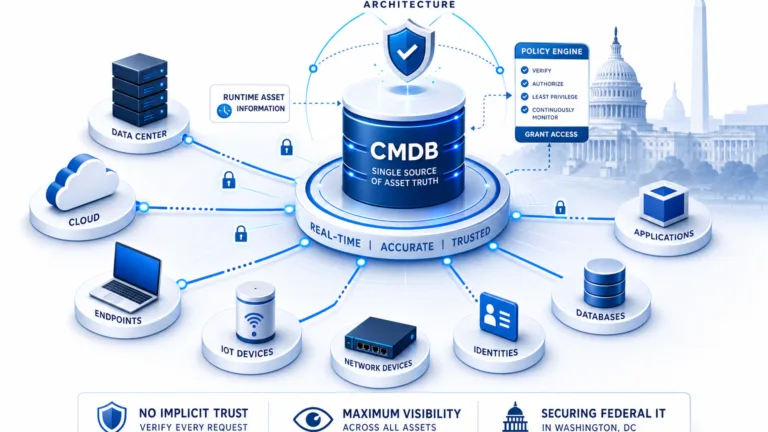
A hybrid cloud CMDB for Frankfurt banks migrating core systems has to treat that divergence as the primary risk. The CMDB is the system of record for configuration items (CIs), owners, and relationships across on-prem and cloud. If it only mirrors the pre-migration estate, change advisory boards approve windows against a map that no longer matches production. Teams scoping a multi-year dual-run can see how other hybrid migrations kept inventory current in blog post on hybrid cloud migration CMDB readiness.
What breaks first when discovery lags cutover
Failures during dual-run rarely start as a blank CMDB. They start as stale relationships.
Change windows for payments, customer master, or risk batch jobs still list the old application server as primary. The new cloud path is already taking a share of traffic, but the service map still points only at the legacy tier. When the window freezes the wrong host, operators discover the live path from monitoring alerts, not from the approved change ticket.
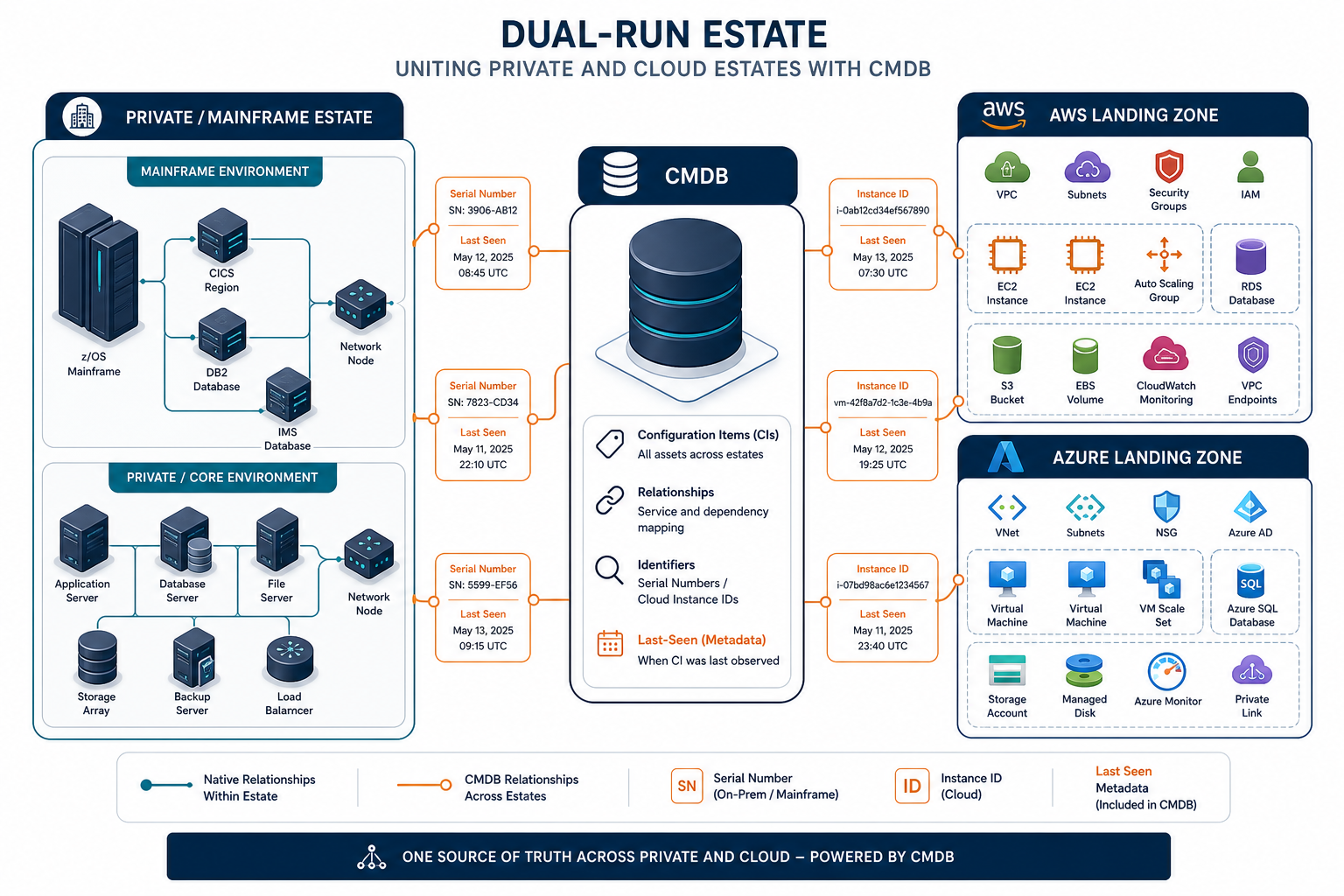
Hostname reuse makes the problem worse. Migration factories often recycle names across test, pre-prod, and production landing zones. A CMDB that joins on hostname alone merges two different machines into one CI or leaves orphan records after a rollback. Durable join keys matter: hardware serial numbers on physical and virtual hosts, and cloud instance identifiers on AWS and Azure resources. Hostname can be an attribute. It is not the identity of the CI.
Should a bank CMDB use hostname or serial number for CI identity?
CI identity should use hardware serial numbers and cloud instance IDs, not hostnames. Migration factories commonly reuse hostnames across test, pre-prod, and production landing zones, which merges distinct machines into one CI or leaves orphan records after a rollback.
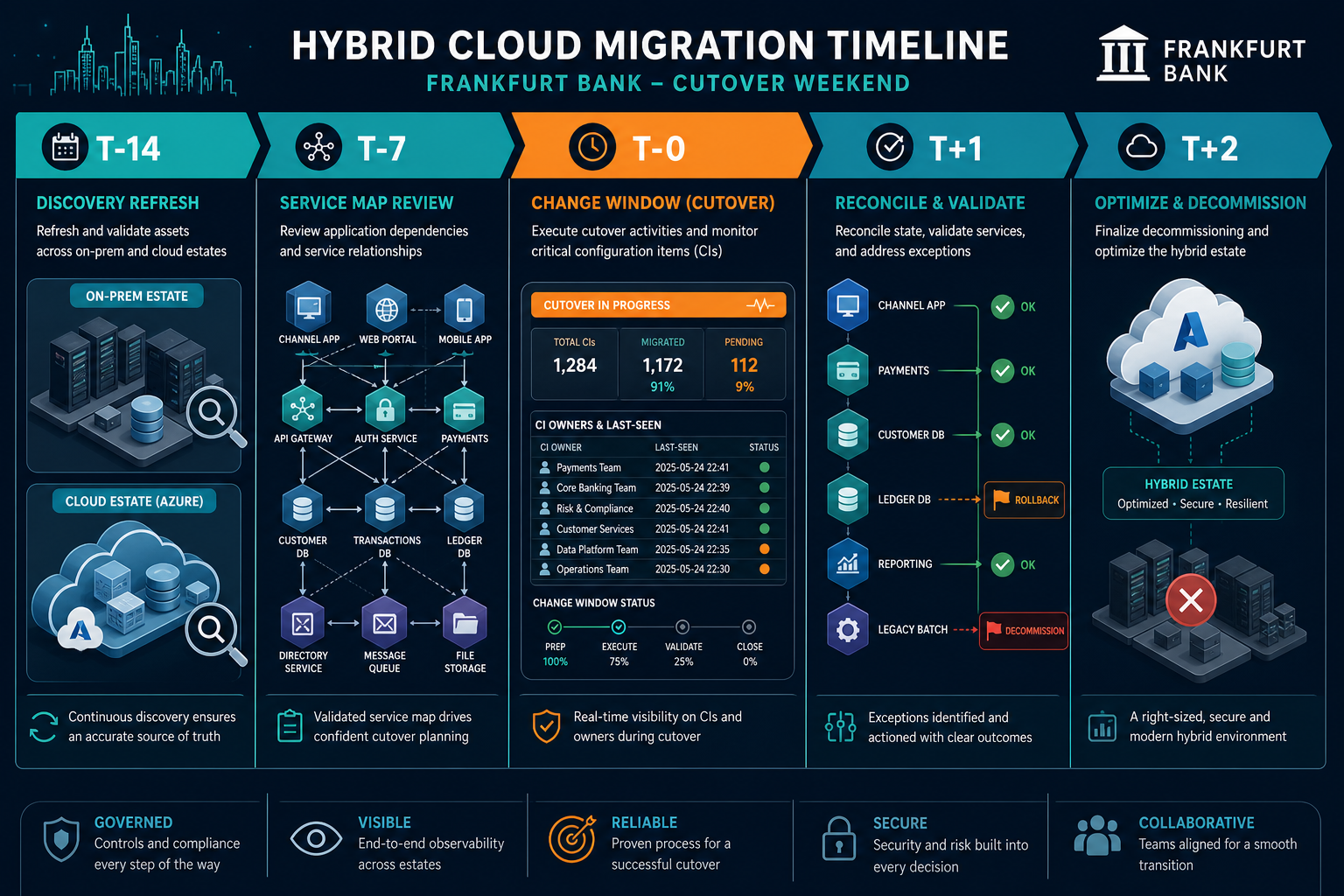
Rollback windows expose the same gap from the other direction. A tier returns to on-prem after a failed cutover, while dependent services stay in cloud for another night. Without a scheduled refresh of both sides, the CMDB still shows the cutover topology. Incident commanders then chase a blast radius that no longer exists, or miss the one that does. For a closer look at how stale CMDB relationships slow incident response, see ITIL Change Management and CMDB Accuracy: Why One Depends on the Other.
Federal inventory guidance outside banking still names the same principle banks feel in cutover. Organizations need reliable asset visibility on a defined cadence, not a one-time spreadsheet, as CISA Binding Operational Directive 23-01 frames for U.S. federal networks. Banks are not subject to that directive. The operational lesson travels: incomplete inventory under time pressure is an operational failure mode, not a paperwork gap.
What a discovery-sourced hybrid record must hold
Frankfurt migration programs need one record that spans credentialed on-prem scope and the AWS and Azure accounts in the landing-zone design. That record should carry a discovery source and a last-seen date on every CI that scanners can reach. Hand-entered rows can exist for known gaps, but they must be labeled as manual so change owners know the confidence level.
Multi-source reconciliation belongs in the CMDB layer. Agent-based and agentless discovery cover servers, network devices, and software footprint in scope. Cloud discovery covers resources in AWS and Azure accounts the bank has authorized. The join happens on durable identifiers, not on display names. When two sources disagree, the platform needs an explicit rule for which attribute wins and who reviews the conflict. For a breakdown of how agentless, agent-based, and API discovery combine into one record, see A Complete Picture of Managing Hybrid IT Environments.
Service maps sit one layer above. Teams define which applications and websites make up each business service, by spreadsheet, manual entry, or an enterprise-architecture feed. Once those definitions exist, infrastructure dependency mapping can run under each service. Without the definition step, maps cannot invent business service boundaries from infrastructure alone.
Readers who want product-level CMDB mechanics can review the CMDB feature overview. The same dual-run logic applies regardless of which desk handles the system of engagement:
- ServiceNow
- Jira Service Management
- Ivanti
- HaloITSM
- Xurrent
- Hornbill
The desk consumes CI and relationship context. Discovery must still feed an authoritative estate record. Partner product names stay descriptive here. Connector paths live on the integrations hub.
Regulatory pressure raises the cost of a wrong map without turning the CMDB into a GRC product. The Digital Operational Resilience Act (Regulation (EU) 2022/2554) requires financial entities to manage ICT risk and dependencies with operational discipline. A discovery-sourced hybrid CMDB supports that discipline by showing what exists and how it connects during migration. It does not replace registers, policies, or supervisory filings.
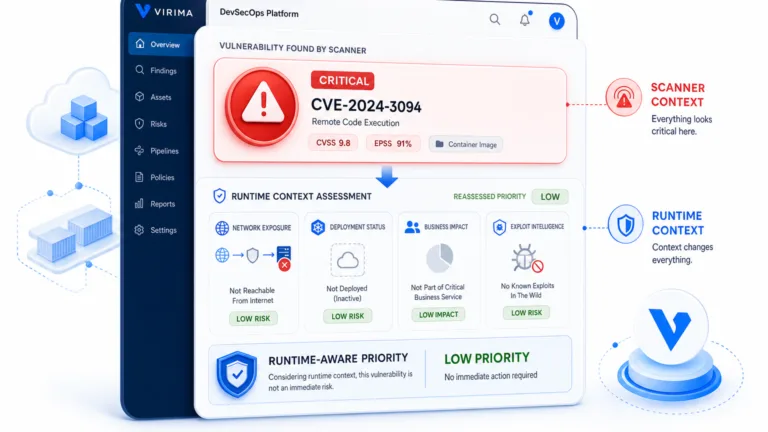
Teams that want the positioning behind discovery-sourced ground truth can read Trusted Runtime Truth.
How Virima supports dual-run without claiming continuous watch
Virima populates CI records from scheduled, high-frequency discovery cycles across on-prem scope and AWS and Azure accounts. Each refresh carries source and last-seen metadata so CMDB owners can see when a host or instance was last confirmed. The platform reconciles multi-source attributes into one CI where durable keys match. It does not claim passive, event-driven, or real-time collection.
ViVID™ service maps build after the bank supplies service definitions. Infrastructure relationships then update as discovery refreshes the underlying CIs. Change owners can inspect dependency paths before a dual-run freeze, instead of reconstructing them in the war room.
Boundaries stay explicit. Published cloud coverage in this framing is AWS and Azure. Google Cloud is out of scope for claims here. Plant, OT, and vendor-internal platforms stay outside customer discovery. Virima is a system of record for infrastructure and dependencies, not a core-banking migration factory, not a BaFin filing tool, and not legal advice.
Can one CMDB cover on-prem core and AWS or Azure landing zones during bank migration?
Yes, when discovery runs on both sides on a schedule and joins records on durable keys such as serial numbers and cloud instance IDs. Hostname-only joins break during dual-run. Manual rows can fill known gaps when they are labeled and owned.
A cutover-ready self-check for Frankfurt CMDB owners
Use these checks before the next dual-run freeze. Answer yes, partly, or no from the live record, not from the program slide deck.
- Every AWS and Azure account in the landing-zone design appears in the CMDB with a named technical owner.
- On-prem core and core-adjacent hosts in scope show a last-seen date from the latest discovery cycle.
- CI identity uses serial or cloud instance ID; hostname is an attribute only.
- Each dual-run business service has a written definition before any dependency map is treated as authoritative.
- Change tickets for the next freeze pull relationships from the CMDB, not from a static export taken at program kickoff.
- Rollback and decommission criteria name an owner and a date field in the same system of record.
- Manual CIs are flagged so auditors and change managers can see what discovery has not confirmed.
If three or more lines are partly or no, the migration factory is moving faster than the estate record. Fix the record before the next production cutover, not after the incident review.
Keep the map true through the next freeze
Frankfurt core migrations will keep dual-run estates in production for a long time. The CMDB either tracks both sides on a schedule with durable joins and defined services, or change control approves fiction. Discovery-sourced hybrid records, ViVID™ maps after service definitions, and a clear handoff into the existing ITSM desk give CMDB owners a defensible path through cutover.
For dependency paths under named services, review service mapping. To walk a dual-run estate against these checks with your own freeze calendar, schedule a demo.
Frequently Asked Questions
Who owns inventory during a bank dual-run core migration?
Ownership usually splits across mainframe or private-core operations, cloud landing-zone teams, and application owners. A hybrid CMDB works when one configuration owner sets join rules, last-seen expectations, and manual-CI policy, while those teams remain accountable for their scopes.
Can a CMDB span on-prem core systems and cloud landing zones?
Yes. Scheduled discovery on credentialed on-prem scope plus authorized AWS and Azure accounts can feed one CI layer when records join on serial numbers and cloud instance IDs. Separate tools can still exist; the CMDB is where reconciled identity and relationships should live for change control.
What breaks first when discovery lags a cutover weekend?
Relationship accuracy breaks first. Tickets freeze the wrong host, blast-radius views lag rollback, and hostname reuse merges or orphans CIs. Teams then rebuild the live path from monitoring instead of from the approved change record.
How do service maps help Frankfurt bank change windows?
After teams define which applications make up each business service, maps show infrastructure dependencies under that service. Change owners can see which CIs sit on the dual-run path before the freeze, which reduces surprise impact during core and core-adjacent windows.
Does Virima replace DORA or BaFin compliance tooling?
No. Virima supplies discovery-sourced CI and dependency context for on-prem and AWS/Azure estates. Registers, policies, supervisory filings, and GRC workflows stay in the bank’s compliance stack. The CMDB supports operational evidence; it does not file or certify compliance.
Does Virima’s CMDB replace ServiceNow or Jira Service Management during a bank migration?
No. Virima feeds CI and relationship context into the ITSM desk already in use — ServiceNow, Jira Service Management, Ivanti, HaloITSM, Xurrent, or Hornbill. The desk stays the system of engagement; Virima supplies the discovery-sourced record underneath it.