Can Virima Keep Our ITSM CMDB Current via Bi-Directional Sync Without Replacing It?

On July 18, 2024, a CrowdStrike software update affected an estimated 8.5 million Windows devices, which Microsoft put at less than one percent of all Windows machines. Every affected IT team immediately required two answers: which machines ran that agent, and which business services depended on those systems. Service desks logged the resulting incident volume without trouble, yet whether the underlying configuration management database answered those dependency questions depended entirely on how recently automated discovery had updated it.
As the IT manager, you answer directly for incident recovery times and change advisory outcomes on an enterprise platform that your organization has no plans to replace. The ticketing workflows, escalation paths, approval gates, and executive reports are already operational, and your engineering team knows how to use them. The data underneath remains the operational weak point, which makes your practical decision much narrower than choosing between ripping out the platform or living with chronic visibility gaps.
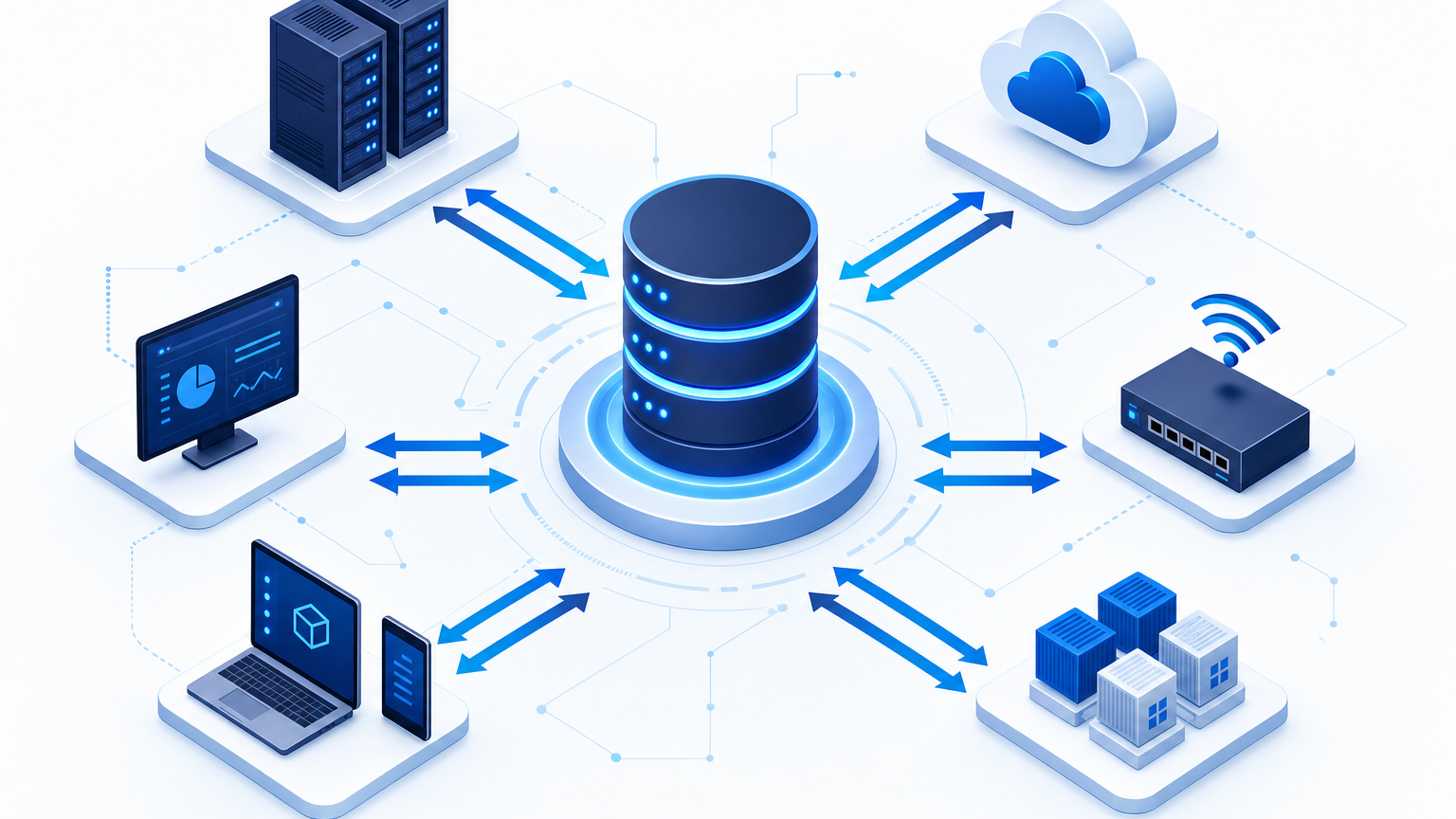
Can Virima keep your ITSM configuration repository current via bi-directional synchronization without replacing it? Virima keeps an existing service management repository accurate by writing multi-source discovery records into target tables on configured schedules. For platforms like ServiceNow, Jira Service Management, or Ivanti, field-level synchronization delivers trusted runtime truth by updating technical infrastructure attributes while preserving human-assigned ownership and operational approvals.
What Virima Writes to Your ITSM CMDB, Platform by Platform
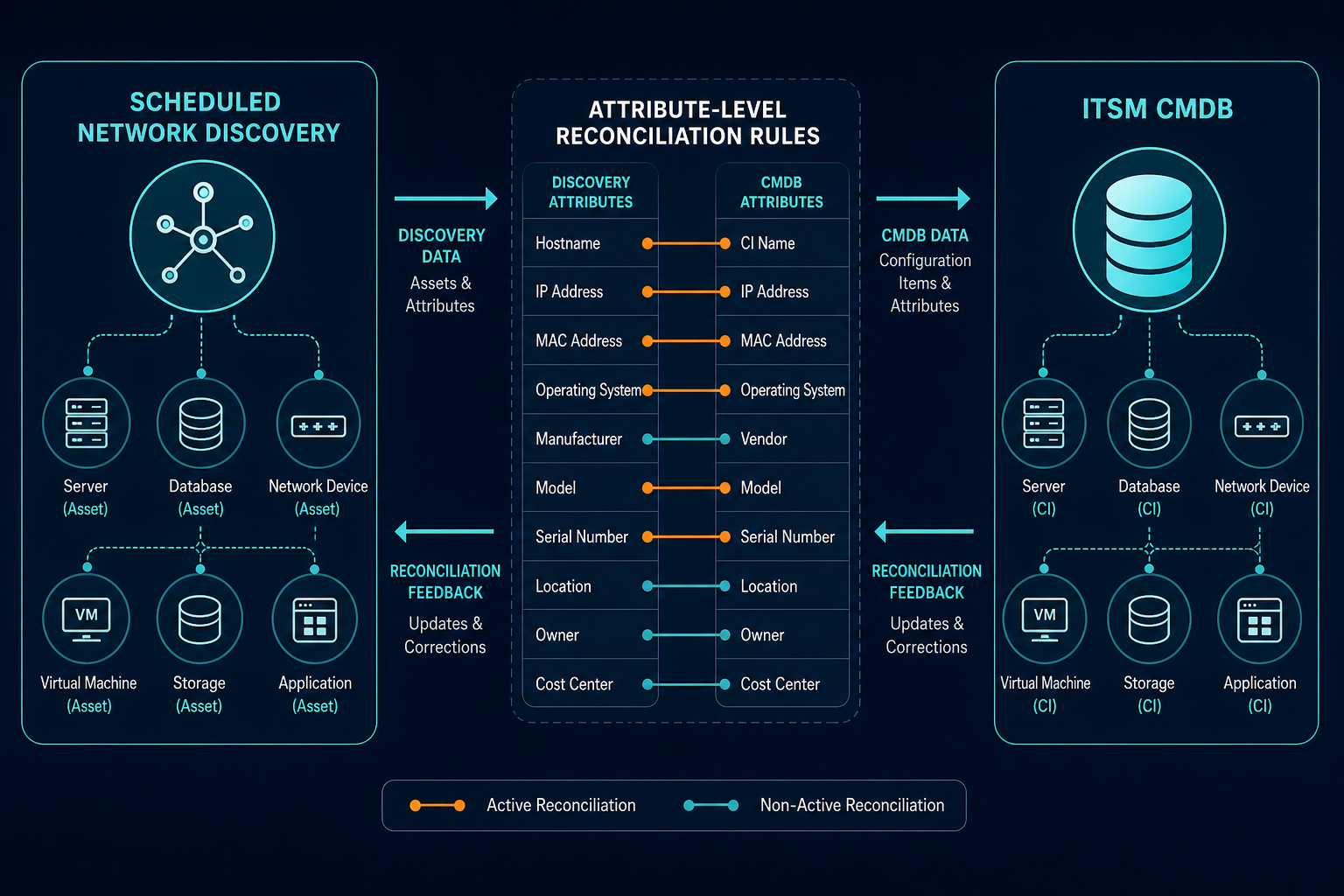
Virima operates alongside existing enterprise service desk platforms rather than displacing them. It introduces scheduled IT discovery and dynamic ViVID™ service mapping to the environment you already run, writing discovered assets and dependencies directly into your service desk tables. Virima’s analysis in the ITSM software platforms comparison guide reinforces this approach.
| ITSM Platform | What Virima Writes to the ITSM | What Synchronizes Back to Virima |
|---|---|---|
| ServiceNow | Discovery data mapped across standard configuration classes and custom tables | Operational ownership changes, approval records, and service desk enrichment notes |
| Jira Service Management | Discovered infrastructure components and dependency maps populating JSM Assets | Open incident records and planned change requests displayed on service maps |
| Ivanti | Discovered hardware and software properties mapped across platform blueprints | Incident references and configuration records linked for targeted discovery sweeps |
Detailed attribute mapping requires careful scoping across your target tables. While ServiceNow configurations regularly support extensive two-way synchronization, scoping should always confirm field-level directional behavior for Jira Service Management and Ivanti environments. Supported enterprise systems, including HaloITSM, Xurrent, Hornbill, and TeamDynamix, connect through the centralized Virima integrations hub, which standardizes field mapping across diverse service desk architectures.
Data freshness operates within configured network parameters rather than unverified instantaneous claims. Virima executes automated discovery through scheduled discovery cycles across configured subnets, cloud tenants, and data centers, keeping configuration records aligned with your scan schedule.
What Is Bi-Directional CMDB Sync?
Bi-directional CMDB sync means two operational platforms exchange configuration updates under defined, field-level precedence rules. A standard one-way import job repeatedly overwrites the destination database on an automated timer, frequently erasing operational updates entered by support technicians. In contrast, true bidirectional synchronization evaluates inbound data from both platforms, determining attribute by attribute which record represents the authorized source of truth.
This reconciliation logic separates governed synchronization from unmanaged database mirroring. Enterprise platforms like ServiceNow reflect this architecture in their official CI reconciliation rule documentation, which dictates that discovery sources require explicit authorization before modifying designated class attributes. Once established, incoming updates are accepted only from an authorized discovery source possessing equal or superior priority.
A reliable synchronization architecture resolves four engineering requirements before running in production:
- Attribute Authority: Establishing which platform owns the authoritative value for each field across the configuration lifecycle.
- Durable Identity: Matching newly discovered assets against existing records using immutable hardware serial numbers or cloud instance IDs rather than volatile hostnames.
- Execution Cadence: Defining the exact schedule for discovery sweeps and the subsequent write intervals into service desk tables.
- Audit Logging: Retaining timestamped conflict logs whenever incoming values disagree with established precedence definitions.
Why Is a Current ITSM CMDB Important?
Incident triage, change risk assessment, and regulatory compliance audits attach directly to configuration items. Federal security guidelines such as NIST SP 800-128 treat an accurate component inventory as an essential prerequisite for configuration governance. Despite this established requirement, broader industry research reveals systemic gaps across IT organizations. The Flexera 2026 State of ITAM report, which surveyed 512 enterprise technology leaders, revealed that organizations achieving complete IT asset visibility dropped to 36 percent.
When configuration governance degrades, enterprise visibility fractures across multiple operational silos. Virima examines the structural drivers of this breakdown in our breakdown of why CMDB data goes stale after initial cleanup and our analysis on why CMDB projects decay without authoritative discovery. For engineering leadership, stale configuration records directly degrade the operational metrics that determine service level adherence:
[Stale Hardware Records] ──> [Misrouted P1 Incidents]  ──> [Extended MTTR]
[Missing Dependency Maps] ──> [Unchecked Change Risks] ──> [Cascading Outages]
Three Ways an ITSM-Only Feed Goes Wrong
- Import Schedules Establish Freshness Ceilings: Native import connectors process data strictly when initiated. Service desk systems such as Jira Service Management allow administrators to schedule automated asset imports on fixed daily, weekly, or monthly cadences. If an infrastructure team reconfigures a production cluster between scheduled imports, the service desk operates with outdated network topologies until the next scheduled batch execution completes.
- Unranked Multi-Source Overwrites: Disconnected discovery utilities, manual CSV imports, and support technicians frequently update the same configuration attributes. Without strict attribute priority rules, the database accepts whichever update occurred most recently. Community practitioners analyzing ServiceNow IRE reconciliation mechanics note that updates bypass governance whenever unmapped classes enter the processing queue. The operational damage caused by last-scan-wins reconciliation overwrites leaves support staff unable to distinguish between genuine infrastructure updates and accidental regressions.
- Human Context Remains Disconnected From Scans: Operational ownership, business service hierarchies, and maintenance escalation tiers are established by engineering managers within service management workflows. Automated network sweeps cannot observe team reassignments across enterprise directories, while static spreadsheet uploads cannot track cloud workloads. Unreconciled environments produce configuration inventories that capture raw IP interfaces while missing the technical owners responsible for incident resolution.
What Moves in Each Direction, and Who Wins a Conflict
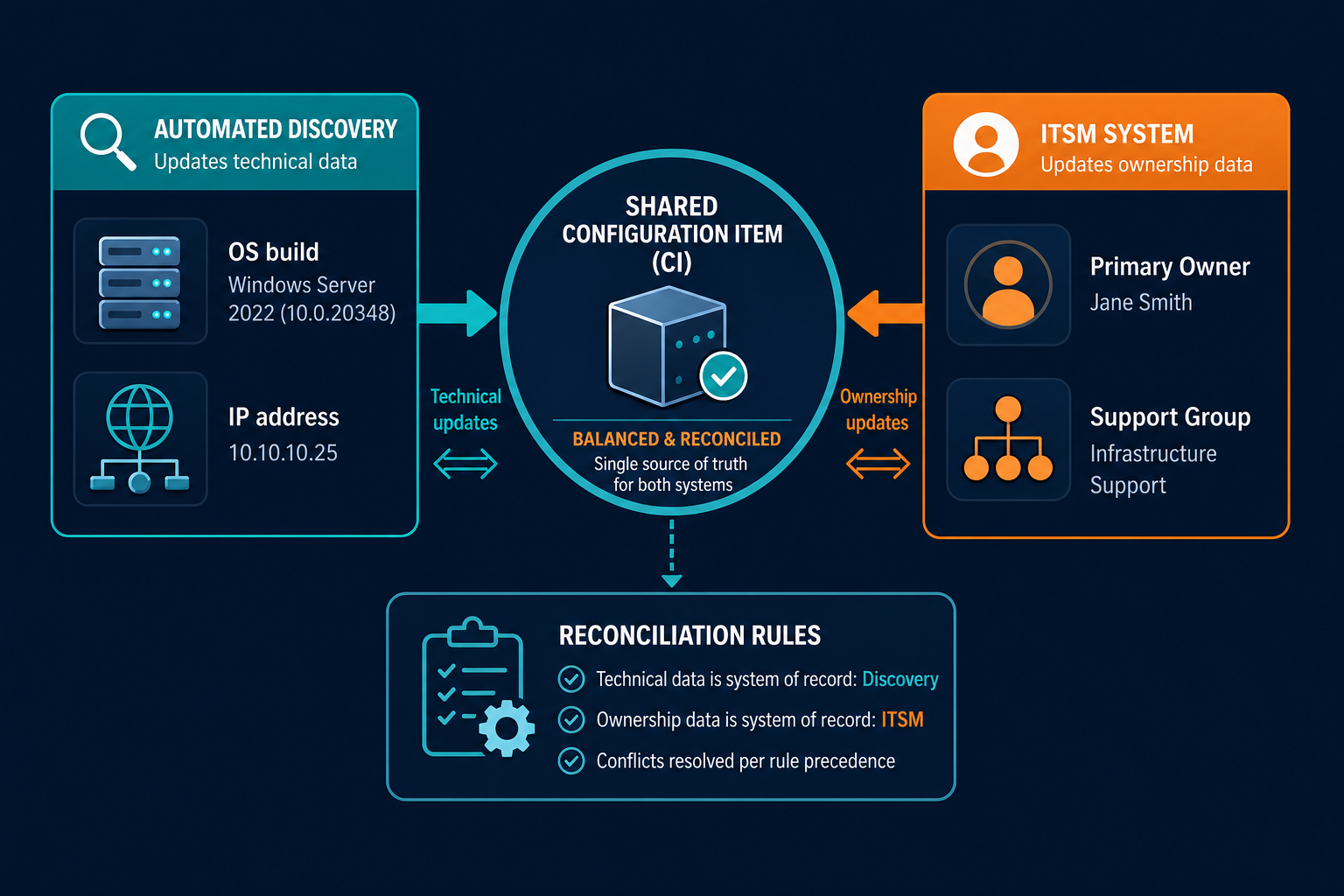
In a bi-directional synchronization model, Virima writes discovered infrastructure context into your ITSM platform while ingesting technical ownership assignments, change advisory records, and configuration classifications back into its core repository. Precedence rules evaluate disputes at the individual field level rather than across entire database rows. Every field points to an explicit system of record, logging rejected modifications with an audit trail that records the originating payload, timestamp, and active business rule. The core Virima CMDB architecture uses this authoritative structure across every managed asset.
| CI Attribute Group | Authoritative Source | Engineering Rationale |
|---|---|---|
| Hardware chassis, IP addresses, OS build, installed software packages | Automated Discovery | Empirical network facts validated on every scheduled discovery cycle |
| Primary owner, support escalation group, cost allocation center | ITSM / ERP Systems | Organizational relationships established by teams and business units |
| Lifecycle state, maintenance windows, planned decommissioning | ITSM Change Records | Intentional operational decisions tracked through approved change tickets |
| Business service dependency relationships | Multi-Source Discovery + ViVID™ | Topological connections observed across infrastructure and confirmed by owners |
A Worked Example: Reconciliation in Production
Consider a scenario involving an enterprise host that an engineer manually documented three years ago as running Windows Server 2019. The systems administration team upgraded the operating system to Windows Server 2022 during a planned maintenance cycle. On the subsequent scheduled discovery run, Virima identifies the Windows Server 2022 build string directly from the host. Because operating system attributes belong to the automated discovery tier within your governance matrix, the new build string is written to the ITSM database while logging the reconciliation event with its timestamp and authoritative rule ID.
Now evaluate the support escalation group on that same server. Following an internal engineering reorganization, your department reassigns operational responsibility to the Cloud Reliability group within your ITSM interface. Network discovery cannot infer departmental reorganization policies. Virima ingests the updated assignment record from the ITSM platform, synchronizing the new escalation path across operational views without manual intervention.
Attribute-level precedence governance operates as an intentional design configuration rather than a static default. Both platforms coordinate updates through scheduled batch intervals and platform business rules, allowing teams to tune synchronization windows around production change windows.
What Stays Untouched in Your ITSM
Deploying Virima alongside your primary service desk requires zero proprietary agent software across managed endpoints and zero custom scripting inside your target ITSM environment. Discovery sensors identify and correlate target assets across local subnets, AWS cloud instances, and Azure environments using native protocols, reconciling hardware serial numbers and cloud instance IDs to prevent duplicate CI creation.
Your existing incident workflows, change approval gates, self-service portals, and management dashboards continue operating without disruption. Virima populates the underlying configuration database and service dependency maps without altering your service desk processes. It provides operational context across dependencies while leaving approval enforcement and ticket lifecycle management entirely to your ITSM platform.
For the IT management team, this approach eliminates months of workflow migration overhead and administrative disruption. You can validate the operational impact directly by tracking your team’s weekly reconciliation hours before beginning your configuration pilot and reviewing that metric four weeks later.
Who Owns What on Your Team
A synchronization deployment fails when operational responsibilities remain unassigned, leaving the IT manager to resolve conflicting team requirements. Four defined operational roles provide complete governance across the lifecycle:
- CMDB Configuration Manager: Maintains the central attribute authority matrix and authorizes modifications to field-level precedence rules.
- Class Data Stewards: Review logged reconciliation exceptions within specific technical domains such as database clusters or network infrastructure.
- ITSM System Administrator: Manages table schemas, platform access credentials, and update schedules outside designated production freeze windows.
- Discovery Operations Lead: Manages network scanning scopes, automated credentials, and discovery agent schedules.
Asset retirement requires an explicit governance procedure. When a previously active host fails to respond during multiple discovery sweeps, the synchronization pipeline flags the asset record for review rather than deleting it automatically. Decommissioning represents an intentional business decision, and automated scripts cannot determine whether an unresponsive server was retired or temporarily powered down for scheduled hardware maintenance.
When Replacing the ITSM Is Still the Right Call
Bidirectional data synchronization repairs unreliable configuration repositories, but it cannot resolve commercial licensing disputes, poor user interface adoption, or platform architectures that conflict with corporate digital transformation goals. When organizational strategy requires evaluating replacement service management software, teams still require an authoritative configuration inventory to execute that future migration successfully. For organizations managing greenfield environments with no centralized ticketing architecture, Virima provides built-in incident and request management modules that establish foundational operational workflows immediately.
Seven Questions to Ask Before the Pilot
Review these architectural requirements with any vendor proposing configuration synchronization. Concrete technical answers reveal whether the software operates reliably in enterprise environments:
- Directional Flow: Which configuration fields synchronize bi-directionally on our specific ITSM platform, and which attributes remain restricted to one-way imports?
- Scan and Sync Intervals: What are the recommended intervals for scheduled discovery sweeps, and how frequently do delta updates commit to the ITSM database?
- Correlation Logic: Which durable hardware attributes match incoming assets against existing CI records when hostnames, subnets, or IP addresses change?
- Exception Handling: Where does the platform record reconciliation conflicts, which roles access those logs, and how long does the audit history persist?
- Missing Asset Protocol: What lifecycle status applies to an existing record when an endpoint stops responding across consecutive scheduled scans?
- Rollback Procedures: If an erroneous governance rule writes inaccurate data across a class, what automated process identifies and rolls back those specific attributes?
- Service Account Permissions: What explicit API scopes and role permissions does the integration connector require inside our production ITSM instance?
Vendors that supply specific, documented answers for your target ITSM platform demonstrate proven operational stability. Broad assurances without architectural specifics indicate significant implementation risk.
A Four-Week Pilot on Your Own Data
- Select One Critical Service and Supporting CI Class: Identify a single operational business service alongside its supporting server infrastructure. Evaluating dependencies tied to an active business application lets change managers assess blast radius during change reviews that typically rely on tribal knowledge.
- Establish Baseline CMDB Health: Export the target CI class from your active ITSM repository. Document total record volumes, the percentage of unassigned owner fields, and the proportion of records that have received no updates within the preceding ninety days.
- Finalize the Attribute Authority Matrix: Document class-level precedence rules across your selected assets, secure formal approval from designated data stewards, and validate the synchronization flow in a dedicated staging sandbox.
- Enable Scheduled Synchronization: Review the conflict-reconciliation queue weekly with technical leads. Practical evaluations frequently reveal that initial discovery sweeps identify unrecorded network assets, turning logged exceptions into actionable governance decisions.
- Measure Results Against Your Starting Baseline: At the conclusion of week four, review duplicate CI rates, ownerless asset counts, stale record frequencies, and engineering hours dedicated to manual data reconciliation.
Test It on Your Own CMDB
If your organization plans to retain its existing ITSM platform, the remaining challenge is ensuring the configuration repository provides reliable, actionable data for daily operations. Rather than evaluating generic platform overviews, request a personalized Virima demo using an export of your team’s configuration records. Review the attribute authority matrix, inspect the reconciliation conflict log, and verify field-level synchronization mechanics against your production data requirements.
Frequently Asked Questions
What is bi-directional CMDB sync?
Bi-directional CMDB synchronization enables a discovery platform and an ITSM repository to exchange configuration updates under defined precedence rules. Automated discovery delivers empirical hardware, software, and dependency context, while the ITSM system updates ownership, approval status, and business allocations without risk of unmanaged data overwrites.
Why is an accurate ITSM CMDB critical for IT operations?
Incident triage, change risk assessment, and regulatory audits require dependable configuration item context. When database records become stale or lack assigned owners, support tickets route to incorrect escalation groups and change managers approve modifications without visibility into underlying application dependencies.
Does Virima replace ServiceNow, Jira Service Management, or Ivanti?
Virima does not replace your core ITSM software. It enhances your existing deployment by integrating scheduled multi-source discovery, automated CMDB reconciliation, and dynamic ViVID™ service maps, allowing your organization to retain established workflows, reporting structures, and ticketing queues.
What happens when Virima and an ITSM disagree on a field value?
Attribute-level authority rules govern every field dispute. When an incoming scan encounters a conflicting value, the system checks whether discovery or the ITSM platform owns that specific attribute, commits the authorized value, and records the event in a timestamped audit log.
Does configuration data synchronize across systems in real time?
Synchronization occurs through high-frequency scheduled discovery cycles and defined platform batch schedules rather than instant event streaming. This scheduled execution model protects operational network bandwidth while maintaining predictable database update cadences across your IT estate.