One Server, Three Sources, One Record: A Configuration Manager’s Decision Test

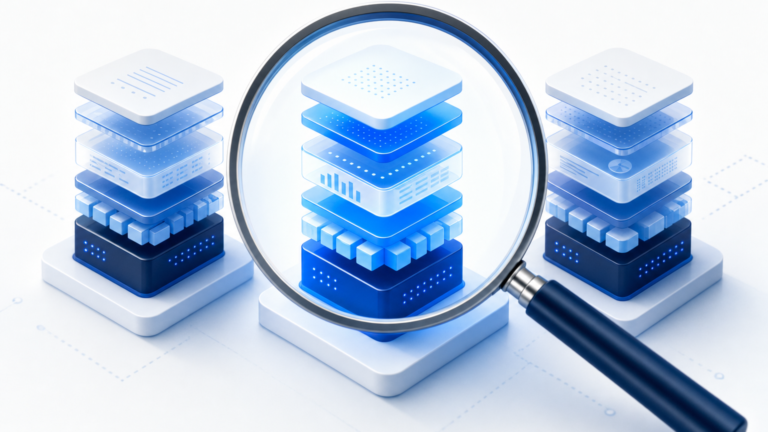
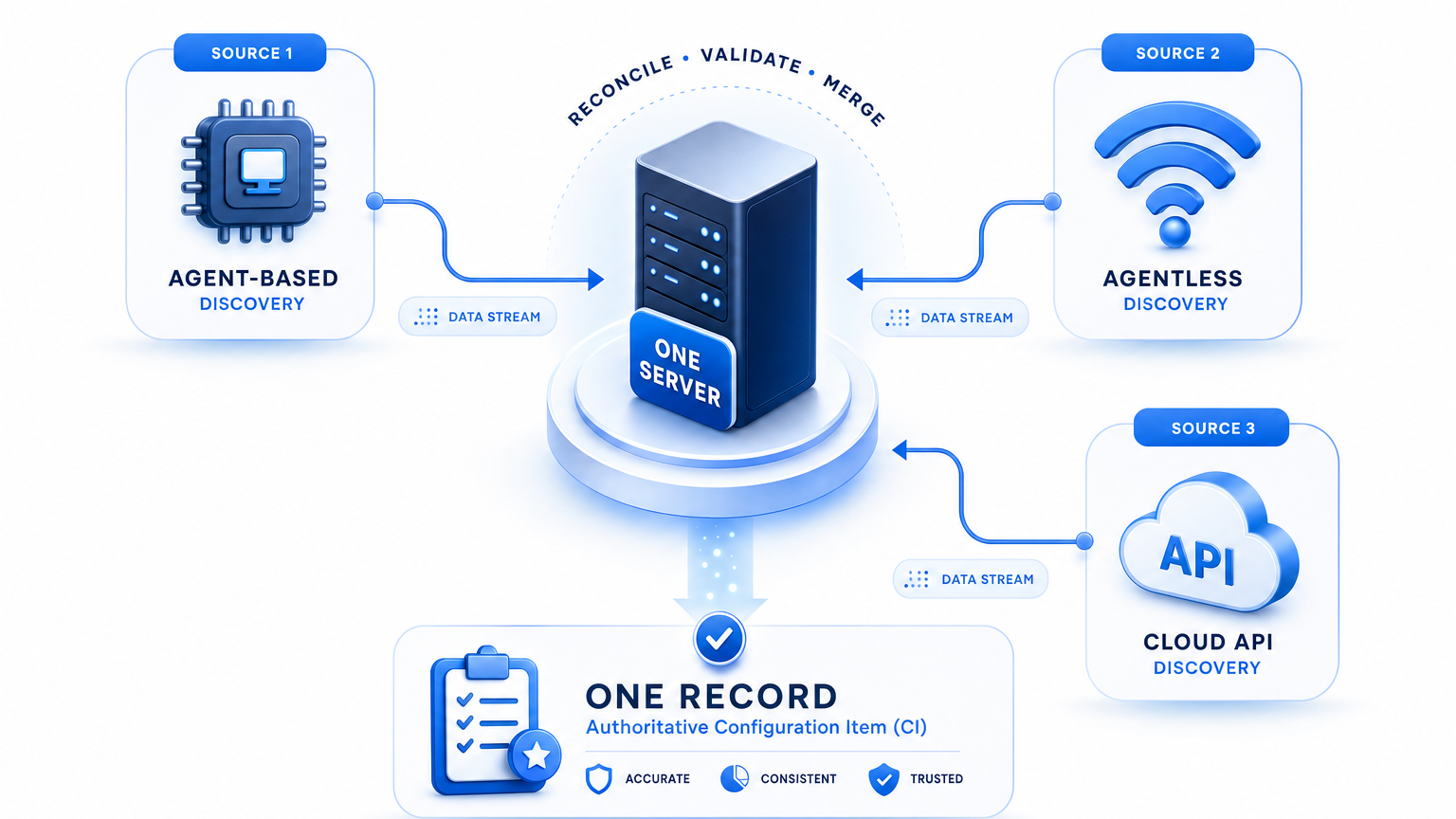
A configuration manager preparing for a change review may find three records for the same server. An agent reports its installed software. An agentless scan records network interfaces. A cloud API provides the instance identifier. Before the change proceeds, someone must establish which records belong together and which attributes the team can trust.
That work takes investigation across tools and teams. It also raises a practical buying question: can Virima populate and reconcile CIs from agent-based, agentless, and cloud sources into one authoritative record?
Virima describes multi-source reconciliation in its published material. The decision test below gives configuration managers a way to examine that capability against their own requirements and environment.
What One Authoritative Record Has to Mean
A configuration item (CI) record becomes useful for change and incident decisions when its identity and attributes can be explained.
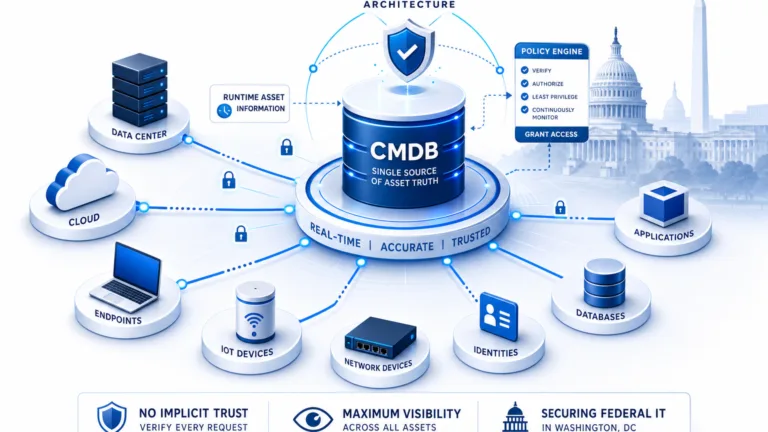
The NIST configuration management database definition describes a database containing information about configuration items and their relationships. For a configuration manager evaluating discovery tools, three questions sit behind that definition:
- Identification: Which incoming observations refer to an existing CI?
- Reconciliation: Which source should supply each attribute when values disagree?
- Explanation: Can the team see enough history to understand how the record was assembled?
A cloud identifier can help with identification when it refers to the same resource across observations. For example, AWS documentation on Amazon Resource Names explains how ARNs identify AWS resources.
The exact match depends on which identifiers each source supplies and how the platform applies its rules. Ask the vendor to show those rules against records from your environment.
What Each Discovery Source Observes and Misses
Different sources bring different views of the same estate. Their coverage also depends on credentials, configuration, and access.
| Source | What it can contribute | What to check |
|---|---|---|
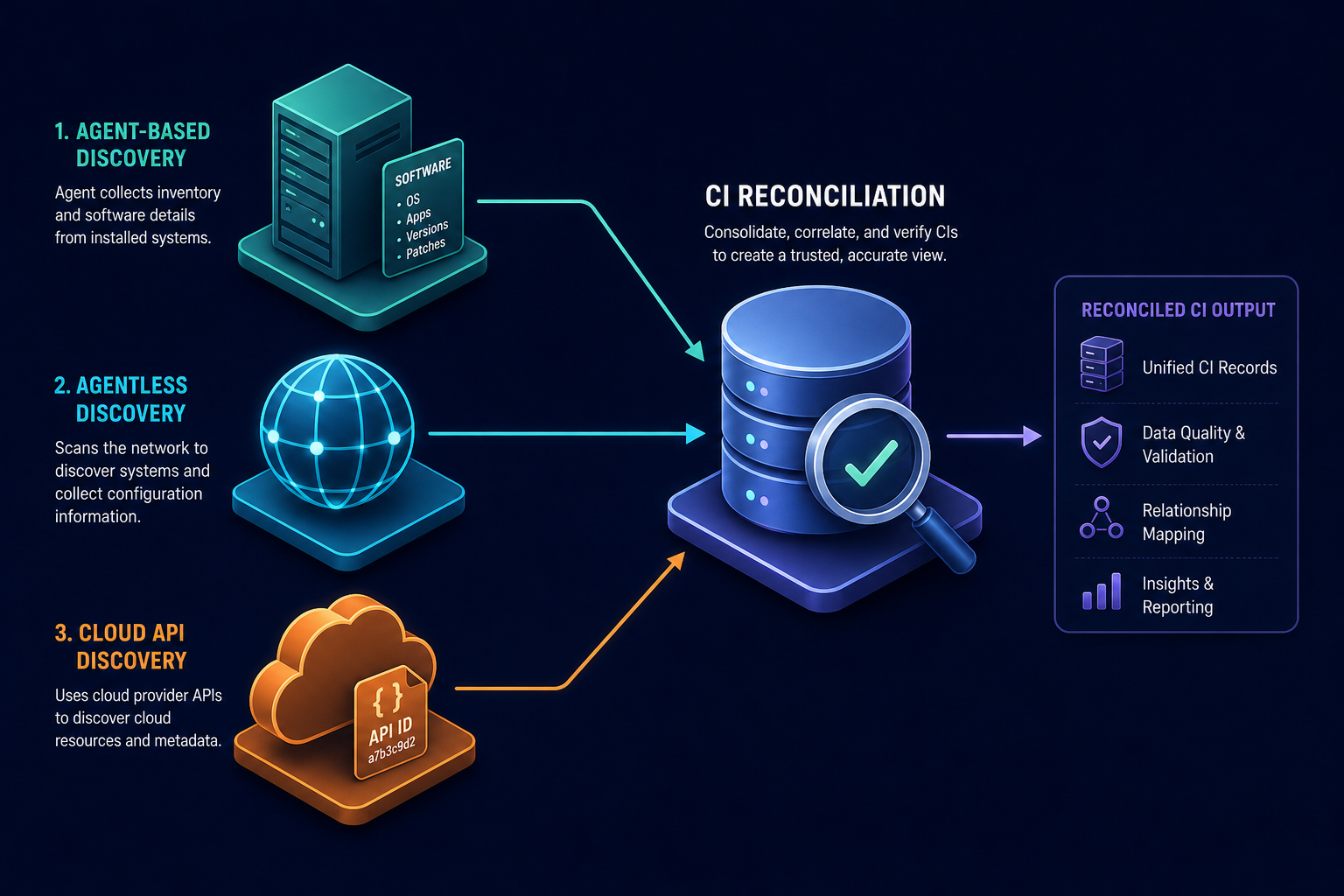
| Agent-based discovery | Host-level hardware and software details from systems where an agent is installed. | Which systems have an agent, and whether it is reporting on schedule. |
| Agentless discovery | Information collected through network protocols and authenticated access to reachable systems. | Whether credentials, network access, and protocol support provide the required depth. |
| Cloud API discovery | Cloud resource identifiers and metadata available through supported provider APIs. | Which accounts and resource types are included, and which host details need another source. |
Virima describes these methods on its IT discovery page. Review the coverage against the systems and accounts included in your evaluation.
Why the Merge Is Where a CMDB Earns or Loses Trust
Duplicate records leave configuration managers answering the same question repeatedly: which entry should the change team use? Resolving it can involve checking identifiers, contacting system owners, and comparing attributes across discovery tools.
A conflict may be less obvious than a duplicate. Two sources can report different software versions for one CI. A cloud record can arrive without an owner that the service desk recognizes. A record may also retain an old value after a source stops reporting.
Each situation calls for a different response. A matching rule addresses identity. An authority rule addresses competing values. A freshness indicator helps a reviewer identify observations that need checking.
Why Hybrid Estates Make It Harder
On-premises systems and cloud resources can expose different identifiers through different interfaces. Where sources use different keys, the evaluator needs to see how the platform connects their observations.
A hostname can help a person investigate a record, but it should not be treated as a durable join key. Ask which identifiers are used, how collisions are handled, and what happens when the available evidence is insufficient to match confidently.
Six Scenarios to Test Before You Decide
Use these scenarios during a proof of concept. Record the setup, the result, and the evidence the vendor shows for each one.
One server, three sightings. Choose a cloud-hosted server that an agent, an agentless scan, and a cloud API can each observe. Good result: The observations are associated with one CI, with their sources visible to the reviewer. Ask the vendor: Which identifiers matched the observations? What happens if one source supplies a conflicting or missing identifier?
One attribute, two answers. Arrange for two sources to report different values for an attribute, such as a software version. Good result: The selected value follows an authority rule that the configuration manager can inspect. Ask the vendor: Where is the rule configured, who can change it, and can the conflicting value and its timestamp be reviewed?
A source goes quiet. Disable a test agent or change a test credential, then run the remaining scheduled discovery cycles. Good result: The team can distinguish the last confirmed value from a newly observed one and identify information that needs review. Ask the vendor: What is retained, how is freshness displayed, and when does a missed refresh produce a flag?
A cloud resource has no agent. Select an AWS instance or an Azure virtual machine without an installed discovery agent. Good result: The cloud source produces a CI with the identifier and metadata available for that resource. Ask the vendor: Which resource types and attributes are supported? Which details require host-level discovery?
An asset is retired. Decommission a test machine through the organization’s normal approval process. Good result: The lifecycle status remains visible, and the team can find the approval record associated with the retirement. Ask the vendor: Where is the approver recorded, and what history remains available after retirement?
A reconciled record reaches the service desk. Send a test CI to the organization’s IT service management platform. Good result: The receiving platform associates the data with the intended record, without an unexpected duplicate or unwanted overwrite. Ask the vendor: How does matching work against the receiving platform’s identification rules? Which fields, directions, and schedules are configured?
Score each scenario as pass, partial, or fail. Keep the evidence beside the score, including the identifiers, rules, and screens shown during the test.
What One Merged Record Looks Like
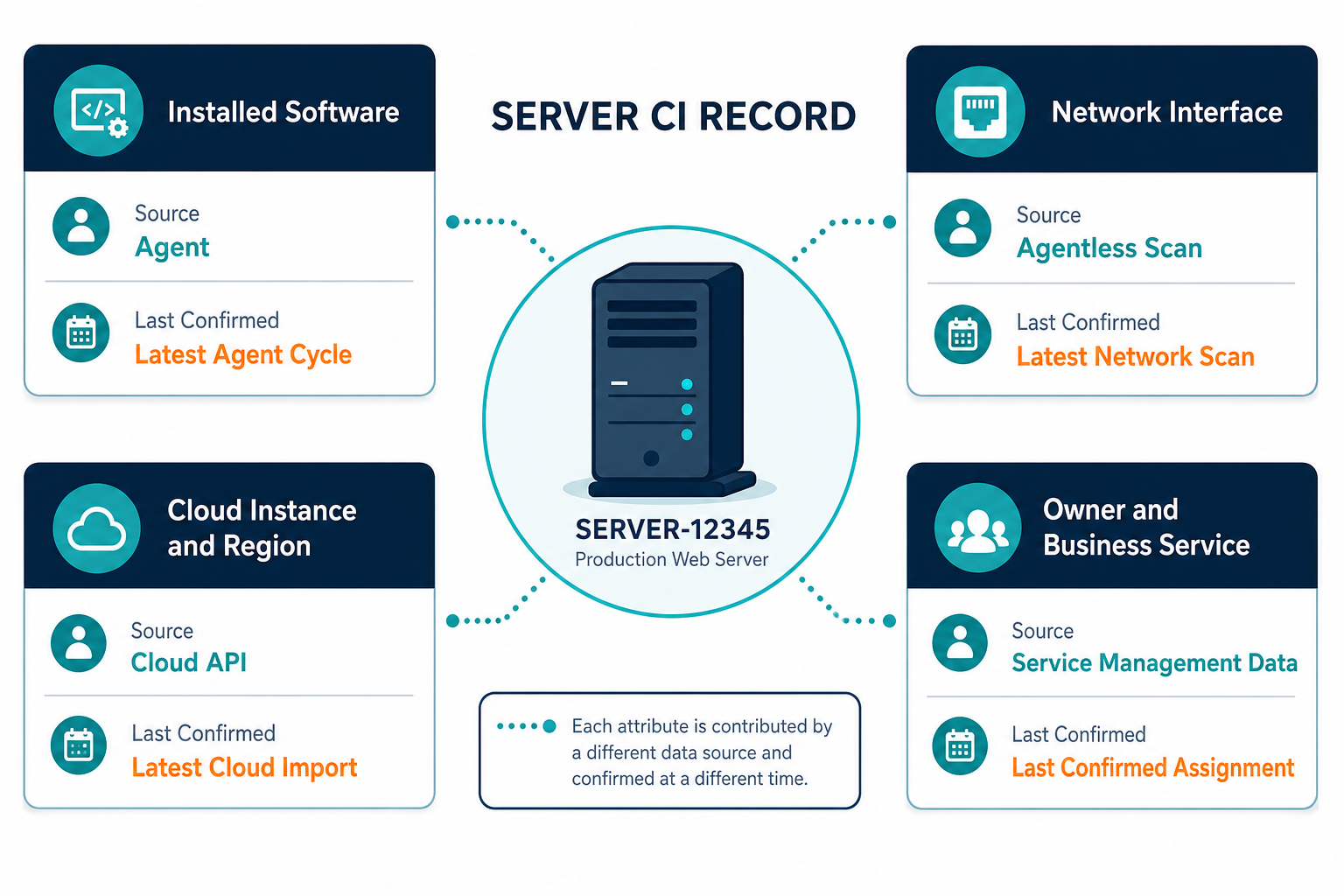
The following table is an illustrative target for a single server. It shows the questions a reviewer should be able to answer, rather than a guaranteed Virima screen or field layout.
| Attribute | Example value | Example source | Last confirmed |
|---|---|---|---|
| Installed software | Database package and version | Agent | During the latest agent cycle |
| Network interface | Interface address | Agentless scan | During the latest network scan |
| Cloud instance and region | Instance identifier and region | Cloud API | During the latest cloud import |
| Owner and business service | Operations owner and service name | Service management data | When the assignment was last confirmed |
The configuration manager can use the source and confirmation time to decide what needs investigation. People remain responsible for confirming ownership; the record provides a place to store and review that information.
Ask the vendor how discovery observations map to your CI classes and attributes. Also ask how software publisher, product, and version names are normalized before reporting. Check the resulting record against your own data model before accepting the example as proof.
Counting the Hours You Spend Reconciling by Hand
A configuration manager can use their own workload to establish a baseline before a proof of concept. Count resolution work separately from follow-up checks, so the same effort is not counted twice.
- Records reviewed each week: Enter the number of duplicate or conflicting records investigated.
- Minutes per initial review: Enter the average time spent identifying and resolving each record.
- Follow-up checks each week: Enter the number of additional checks after a change or audit, and the average minutes per check.
- Weekly hours: Calculate
(records × minutes per initial review + follow-up checks × minutes per follow-up check) ÷ 60.
Repeat the worksheet after the evaluation using the same scope and measurement method. Keep the underlying counts alongside the result so a CIO can see how the estimate was calculated.
The CMDB health scoring guide offers a separate way to assess record quality. A health score and a workload baseline answer different questions, so review both when building the business case.
Virima Merges Three Discovery Sources Into One Attributed Record
Virima’s published product information describes multi-source reconciliation as a way to combine CI data. Its discovery methods include agent-based and agentless collection, alongside cloud discovery for AWS and Azure.
That published description is a starting point for evaluation. The six scenarios give your team a way to inspect the result against its own identifiers, rules, and operational requirements.
Immediate Operational Impact
A scoped evaluation can reveal where source observations overlap and where they disagree. Select a small set of systems with known records in each source, then compare the resulting CIs with your baseline.
Ask the Virima team to show the match evidence and authority settings for each selected record. Document any records that require manual investigation, including the reason they could not be matched.
Long-Term Accuracy and Health Governance
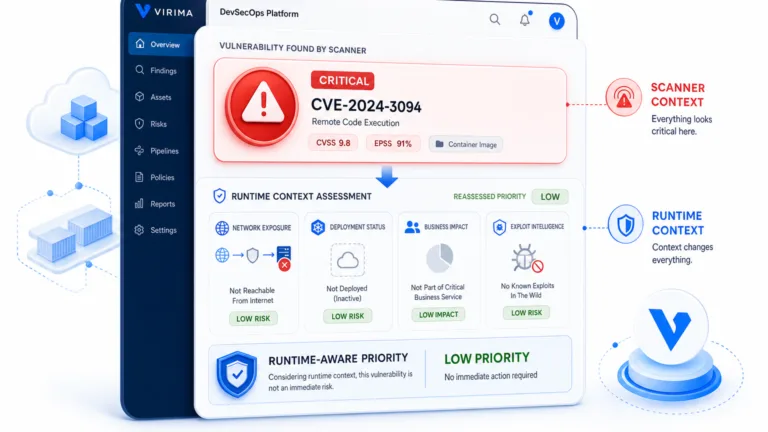
Scheduled discovery cycles give teams opportunities to refresh information and review changes. Virima’s CMDB feature description includes health scoring for data quality and staleness.
During the test, check which timestamps, source details, and owner fields are visible for your CI classes. Confirm how freshness is assessed and when a missed refresh is flagged. Those details determine how your team will review an aging record.
Integration with Existing Workflows
Reconciled data may need to reach a service desk or another operational system. Virima lists integrations with platforms including ServiceNow, Jira Service Management, Ivanti, HaloITSM, Xurrent, Hornbill, and TeamDynamix.
Review the available integration options, then test the fields and synchronization behavior required by your workflow. Confirm how the receiving platform identifies records before accepting a duplicate-prevention result.
Running the Decision Test in Your Environment
A controlled test gives your team evidence tied to its own infrastructure and data model.
- Choose a representative segment. Select an application and hosts with observations from agent, agentless, and cloud sources.
- Document the starting records. List which systems each source sees and note known duplicates or conflicts.
- Run the six scenarios. Record each result alongside the rules and evidence shown.
- Measure the manual work. Complete the worksheet before and after the test using the same scope.
- Review gaps with stakeholders. Share unresolved matches, missing attributes, and integration questions with the people responsible for the decision.
Where the test exposes a gap, ask whether it can be addressed through configuration, source coverage, or a documented process. Keep that answer with the scorecard.
Explore Trusted Runtime Truth for CMDB teams to see how discovery-sourced information supports decisions about what exists, how it connects, what changed, what could be affected, and who owns it.
Validate Reconciliation on Your Own Infrastructure
Bring a defined slice of your estate to the evaluation, along with the CI records your team currently uses. The most useful demonstration will show how those observations are matched, how conflicting attributes are handled, and which questions remain open.
Request a demo to discuss a scoped review of agent-based, agentless, and cloud discovery data with the Virima team.
Frequently Asked Questions
How can a CMDB match records from different discovery sources?
A CMDB can compare identifiers supplied by each source against its configured matching rules. Serial numbers and cloud instance identifiers are examples to investigate. Ask the vendor how the rules handle missing identifiers, collisions, and records that need human review.
How should a CMDB resolve conflicting CI attributes?
Teams can define which source has authority for a particular attribute. During evaluation, ask who can change that rule and whether reviewers can inspect the competing observations, their sources, and their collection times.
What should happen when a discovery source stops reporting?
Reviewers need to identify the last confirmed observation and determine whether it is still suitable for the decision at hand. Ask how the platform displays freshness, retains prior values, and flags a missed scheduled refresh.
Can Virima reconcile agent, agentless, and cloud discovery data?
Virima describes multi-source reconciliation and discovery methods that include agents, agentless scans, and AWS and Azure cloud sources. Test your own records to verify matching behavior, attribute authority, and the evidence available for review.
How does Virima identify stale CMDB information?
Virima lists CMDB health scoring that tracks data quality and staleness. Ask the product team to demonstrate how freshness is displayed for your CI classes and when a missed scheduled discovery cycle is flagged.