Change Management vs Release Management: The Split Everyone Gets Right, Then Breaks in Production

The CAB stamped the risk score. The release calendar showed green. The pipeline promoted on schedule. Ninety minutes later two services that never appeared on either ticket start timing out because a shared broker and a forgotten DNS alias still pointed at the old build.
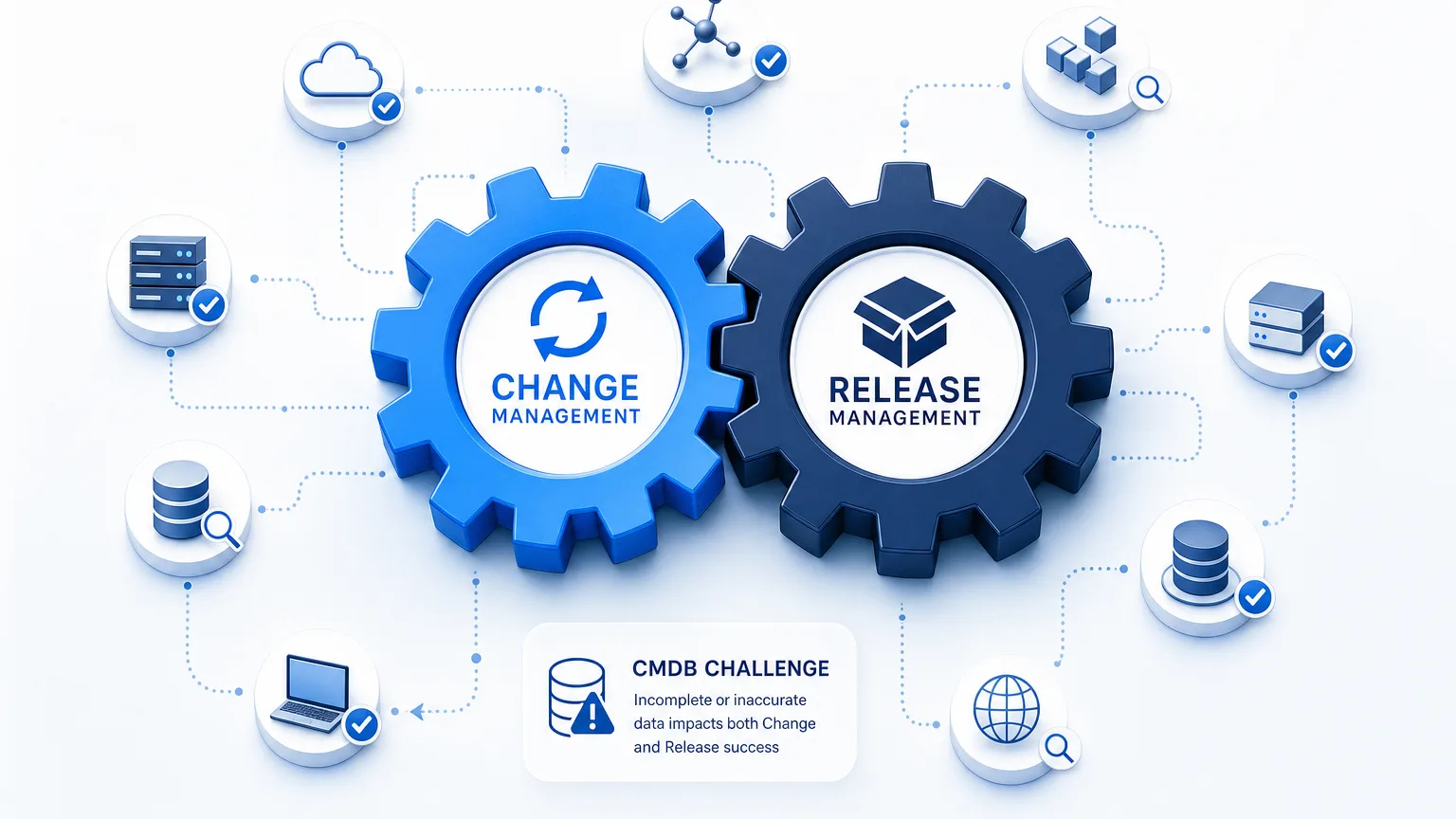
That is the everyday failure mode of change management vs release management debates. Teams argue which practice owns the window. Production fails because both practices trusted incomplete configuration items (CIs), owners, and dependency paths.
What each practice is supposed to own
ITIL keeps change enablement and release management separate on purpose — the ITIL change enablement vs release management split itself isn’t the ambiguous part. Change enablement here means ITIL’s process discipline, not organizational change management: the adoption, communication, and culture work tied to Prosci-style change programs. PeopleCert’s ITIL portfolio treats change enablement and release management as related practices with different control surfaces. Axelos publishes dedicated guidance for ITIL 4 change enablement and for the ITIL 4 release management practice.
Change management (change enablement)
Change management answers whether work should proceed under risk policy. It covers scope, risk and impact, authority paths, and evidence the organization can show after the window. In many enterprises that still means a Change Advisory Board or a delegated change authority reviewing a change record. In ITIL 4 terms, change enablement and release management are distinct practices sharing one goal: controlled change to services. Neither practice can approve or package changes it cannot see.
Release management
Release management answers how approved work becomes a controlled package available for use. It covers build, test, package, target environments, progressive rings, and post-release verification that the deployed unit matches the approved unit.
Deployment tooling sits under both
CI/CD automates promote steps. It does not invent missing hosts, owners, or shared tiers. A promote step can succeed cleanly against a target-host list that discovery already knows is short a server or two — the pipeline reports green because nobody told it the list was wrong.
What is the difference between change management and release management?
Change management decides whether a change should proceed under risk policy, including scope, impact, and authorization. Release management plans, builds, tests, packages, and deploys approved work so new or changed services become available under controlled conditions. Both fail when CI lists and dependencies lag the live estate.
One clarification worth stating plainly: change management in this ITIL/ITSM sense — change enablement — is a different discipline from organizational change management, the adoption, communication, and culture work found in Prosci-style programs. This article addresses process and CMDB accuracy under ITIL change enablement and release management, not workforce change adoption.
Why the textbook split still collapses after the vote
Commodity comparisons — including vendor pages that already connect change, release, and CMDB — stop at RACI charts and stale-data warnings. Operators need the specific failure mechanism: where the data goes stale, not just that it does.
Same estate, two stale snapshots
The change record freezes CI scope at intake. The release package freezes deployment unit membership at build time. Between those freezes, discovery may already have recorded a new cluster node, a rehomed replica, or a certificate on a different host. Change management vs release management meetings still look mature while both artifacts describe last quarter.
A deployment unit vs change record mismatch is exactly this pattern — one freezes at intake, the other at build, and nothing owns the gap between them. Change and release management fail for a structural reason, not a discipline reason: discovery can log a new node, a rehomed replica, or a moved certificate between those two freezes, and neither artifact updates to reflect it.
Self-declared risk meets incomplete packaging
This is the practical CAB vs release package gap: change boards often accept risk dropdowns the submitter filled from memory. Release teams version the artifact carefully and still promote against host lists that no longer match production. Neither practice invents the shared identity path that never entered either form.
Owners drift faster than either cadence
The technical owner on the change ticket left the squad. The release verification contact still points at the same stale CMDB row. Escalation after failure burns the first hour on people search, not rollback.
Emergency and standard paths share the blind spot
Fast-track changes skip long meetings. Automated standard changes skip theater. Neither skips dependency truth — speed without current inventory is still incomplete control.
DORA’s software delivery metrics treat change fail rate and related stability measures as core delivery health. Google’s 2025 DORA report keeps that research centered on how organizations ship and recover. Process maturity on both sides of change management vs release management still feeds failed changes when estate context is wrong.
A practical comparison operators can use
| Question | Change management | Release management | Shared break when inventory is wrong |
|---|---|---|---|
| Primary decision | Should this work proceed? | How do we package and introduce approved work? | Decision and package both use incomplete CI scope |
| Core artifact | Change record, risk score, approvals | Deployment unit, version, environments, rollback | Both artifacts omit shared tiers and owners |
| Success signal | Authorized under policy | Package matches approved unit in live use | Green tickets, red customer paths |
| Typical failure | Unknown blast radius after approve | Promote against drifted topology | Same missing relationship |
Service maps, release practice, and change practice each answer a distinct question — but none of those jobs replace discovery-sourced configuration truth. Service maps answer blast radius. Release practice answers packaging. Change practice answers authorization.
This change vs release ITIL comparison holds whether an organization runs a formal CAB or a lightweight delegated authority — the shared-break column is what a taxonomy chart never shows.
Related Virima coverage keeps the lanes clear. ITIL change management and CMDB accuracy covers process maturity without accurate configuration data. ITIL release management when deployment units lack runtime truth covers packaging without current CIs. CAB blast radius without tribal knowledge covers map-driven impact. This article owns the change management vs release management split itself and the shared data failure under both.
Why do change management and release management both fail with mature processes?
Mature agendas and release calendars still fail when risk scores, CI lists, owners, and deployment unit membership no longer match discovery-verified inventory. Authorization and packaging run on narratives built from memory. Production runs against the real topology regardless. Process compliance does not generate the missing relationship data on its own.
What both sides should require before the window
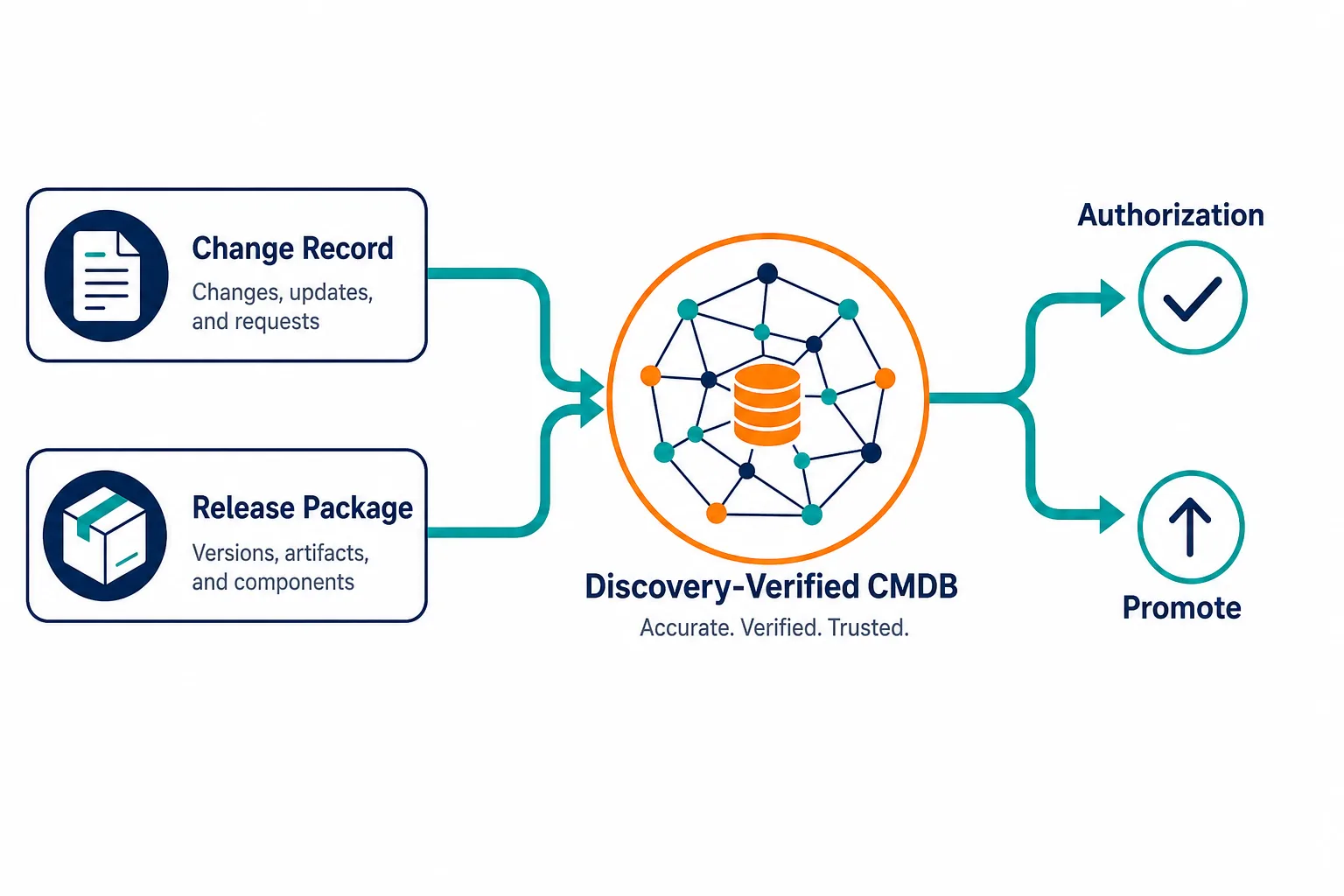
Treat the change record and the release package as evidence packs that must reconcile to the same estate. The next section lists the minimum fields both practices should refuse to skip on moderate and high risk work.
Minimum shared evidence
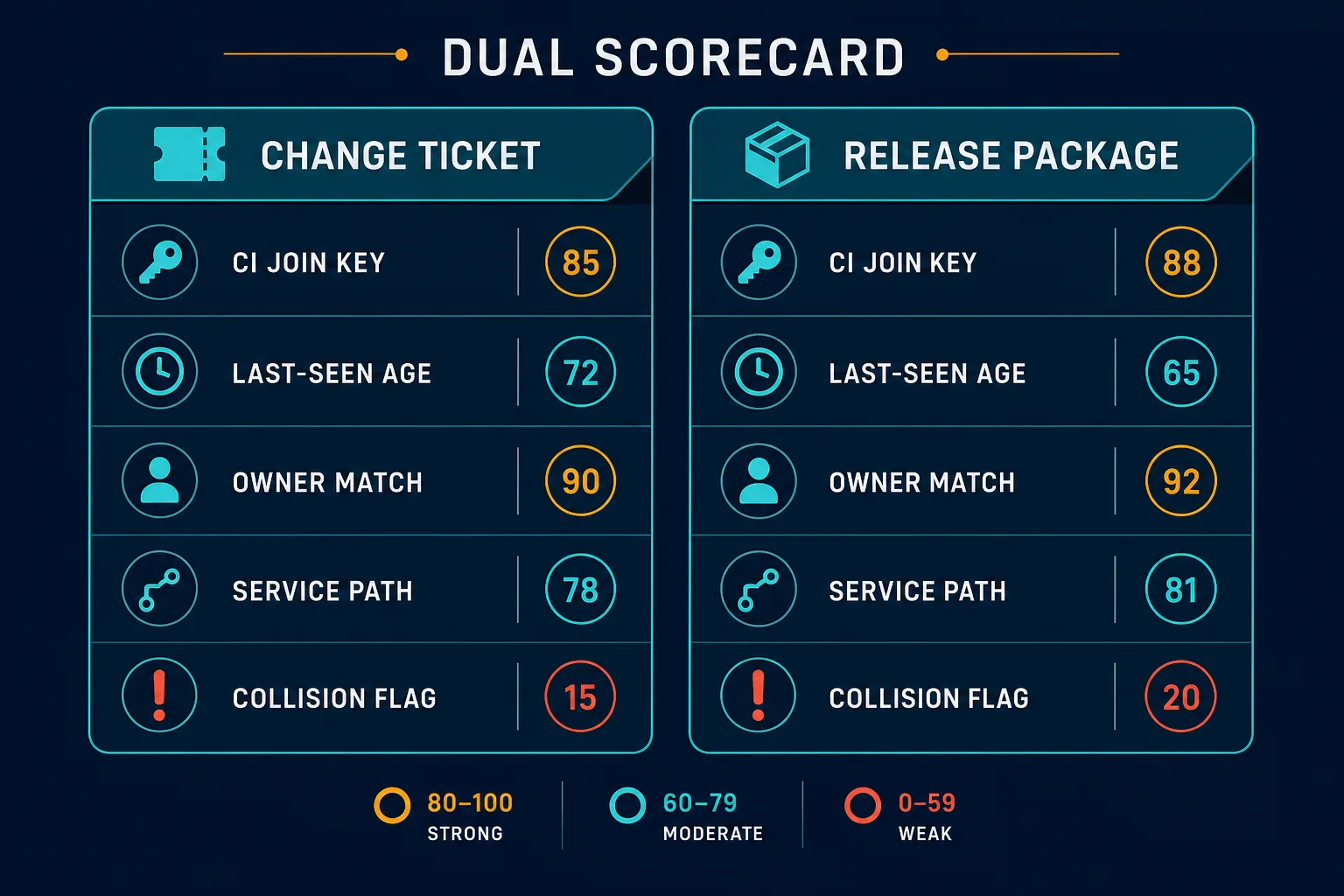
- CI join keys discovery can re-verify: serial, hostname, cloud resource ID, not free-text nicknames only.
- Last-seen freshness recent enough for the risk class.
- Owner and backup owner that still match CMDB and on-call.
- Service context when service definitions exist: which business path depends on the target CIs.
- Collision check on shared tiers booked in the same period.
- Post-change and post-release verification that walks the service path, not only package heartbeat.
CISA Binding Operational Directive 23-01 pushed federal civilian agencies toward complete asset visibility on a defined cadence. Commercial change and release programs that authorize or promote without comparable visibility inherit the same class of blind spot.
What Virima supplies under both practices
Virima is not a Change Advisory Board, not a release calendar product, and not a full ITSM suite. The lane is Trusted Runtime Truth under the change record and the deployment unit: what exists, how it connects, what changed, and who owns it.
High-frequency scheduled discovery with agent, agentless, and API methods refreshes presence and attributes in the CMDB. Those cycles keep CI scope and owners from rotting between board meetings and release trains. Event-driven streaming discovery remains roadmap territory rather than the current product surface.
When service definitions exist, ViVID™ service maps bind defined services to discovery-sourced edges so impact talk moves from memory to a path both teams can inspect. Maps do not invent service composition. They require definitions first, then automate the dependency view on the service mapping surface.
Virima integrates with ServiceNow, Jira, Ivanti, and many more through the Virima integrations hub. Change and release authorities keep working in the ITSM and pipeline tools they already use while discovery-sourced fields and maps feed the ticket. For teams running change and release inside ServiceNow or Jira Service Management with weekly or biweekly release trains, that means the CAB packet and the deployment record both start from the same discovery-verified inventory instead of two separately maintained spreadsheets. For workflow friction beyond the vs debate, see IT workflow management and change windows. Use-case framing sits on Virima change management.
That shared inventory layer is what lets authorization and packaging stop arguing past each other. Without it, change management vs release management remains a clean taxonomy and a messy outage pattern.
If change and release still green-light separate packets while discovery already contradicts both CI lists, see how discovery-sourced CMDB truth lands under the records both teams already run.
A joint checklist for the next release train
- Keep the RACI split. Do not merge change and release into one vague go-live role.
- Force a shared CI join key set on both the change record and the deployment unit.
- Show last-seen age on moderate and high risk packets.
- Reconcile owners weekly against HR and on-call before the board and the release freeze.
- Attach map or dependency evidence when service definitions exist for high-risk paths.
- Log collisions when two teams share a hypervisor, VIP, or database window.
- Measure change fail rate against inventory freshness, not only against meeting attendance or pipeline green.
Make change management vs release management vote on the same estate
Change management vs release management is a real process distinction. Authorization is not packaging. Packaging is not a risk vote. Both still fail when they authorize and promote against inventory the estate no longer matches.
Keep the split. Raise the bar on shared evidence. Bind every material change and every deployment unit to discovery-verified CIs, current owners, and service context where definitions exist. That is how organizations stop winning the taxonomy debate and losing the Sunday night outage.
If your calendars are green and post-release incidents still start with what else touched this host, start with the inventory and ownership layer both sides of change management vs release management depend on. Schedule a demo to see how Virima keeps change and release decisions honest after the stamp.
Frequently Asked Questions
What is change management vs release management in ITIL terms?
Change management (change enablement) decides whether work should proceed under risk policy. Release management makes new or changed services and components available for use through planned build, test, package, and deploy controls. They are complementary practices, not interchangeable labels.
Is release management part of change management?
Release work often executes after change authorization, and many organizations coordinate the two closely. ITIL still treats them as distinct practices with different primary questions: authorize under risk versus package and introduce under controlled conditions.
What data should both practices share before a production window?
Both should share discovery-verifiable CI keys, recent last-seen timestamps, current owners, and service context when definitions exist. Add collision checks on shared tiers and verification plans that watch the service path, not just the package heartbeat.
How does Virima fit into an existing ServiceNow or Jira change and release process?
Virima does not sit inside the change or release workflow itself. It feeds discovery-sourced CI data, current owners, and dependency context into ServiceNow, Jira Service Management, or the ITSM platform already running change and release, so the records those tools produce start from an accurate inventory.
Does Virima replace change or release management tools?
No. Virima supplies discovery-sourced CMDB and service mapping that feed change records and deployment context in ITSM and related platforms. Change authorities and release teams remain the governance and packaging owners. Virima improves the truth those teams review.