ITOM Solutions Compared: What Operations Teams Should Score in 2026

Most evaluations of IT operations management solutions start with a features checklist. Buyers compare dashboards, alert volumes, integration counts, and pricing tiers. What they rarely ask is the question that decides whether any of those features work in practice: what data will this platform act on? An ITOM solution that correlates events against a stale CMDB routes incidents to the wrong root cause. An AIOps engine that cannot see cloud workloads produces accurate alerts for 60% of the environment and blind spots for the rest. Before comparing features, the right evaluation starts with the data foundation.
What separates effective ITOM solutions from feature-rich ones
ITOM platforms have converged on a common feature set: infrastructure monitoring, event correlation, alert management, and some degree of AIOps. The differentiation isn’t in the features; it’s in the operational scope and data quality those features can act on.
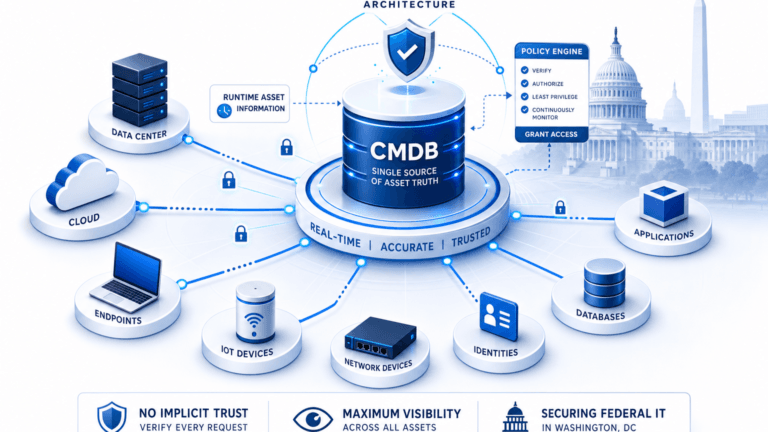
An ITOM solution only governs what it can see. If the asset inventory feeding the platform is incomplete, its event correlation, change impact analysis, and automated remediation all operate within that incomplete scope. The features work correctly on the data they have; the problem is what they don’t have.
According to the Flexera 2026 State of ITAM Report, only 31% of organizations report visibility into their AI asset spend — a narrower data point than general IT estate visibility, but one that signals a broader pattern: most IT asset inventories carry meaningful blind spots at exactly the layer ITOM automation depends on. Where that gap exists, every ITOM platform in the comparison below is working with partial data, unless the evaluation specifically tests discovery coverage and CMDB accuracy as a first-order criterion.
What should IT teams evaluate when choosing an ITOM solution?
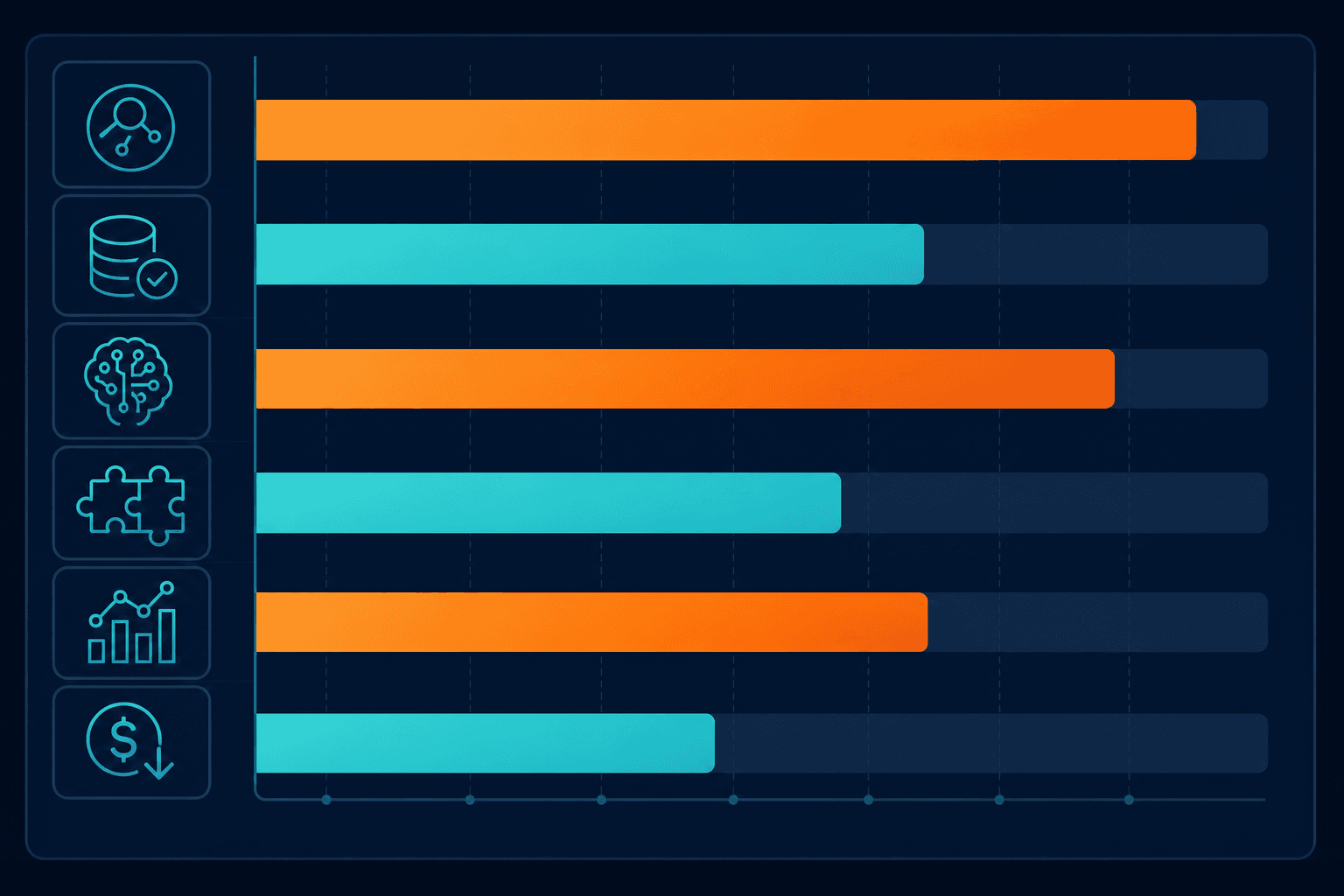
IT teams should evaluate ITOM solutions on six criteria: discovery coverage, CMDB accuracy, AIOps capability, ITSM integration breadth, change intelligence, and total cost of ownership. The most overlooked criterion is discovery coverage: the platform can only govern what it can confirm exists in the environment.
Six criteria for evaluating IT operations management solutions
Selecting the right platform means testing beyond the feature list, starting with these six criteria. See Virima’s breakdown of ITOM framework components for how these pieces work together operationally.
1. Asset and service discovery coverage
The platform should confirm what is running in your environment, not rely on a spreadsheet or a prior tool’s scan from six months ago. Evaluate whether discovery covers on-premises infrastructure, cloud workloads (AWS and Azure at minimum), virtual machines, endpoints, and network devices through agentless, agent-based, and API-based discovery methods.
Discovery frequency matters as much as coverage. A platform that discovers once a quarter produces an inventory that’s accurate for a few weeks, then drifts. High-frequency discovery keeps the operational data current as the environment changes.
2. CMDB accuracy and data currency
ITOM automation depends on the CMDB as its operational record. A stale or incomplete CMDB means event correlation assigns the wrong root cause, change impact analysis misses affected services, and automated remediation acts on wrong configuration states.
Evaluate whether the platform maintains its own CMDB, integrates with an existing one, or feeds a third-party CMDB from discovery data, and how often it’s reconciled against actual discovered state.
3. AIOps and event correlation capability
AIOps — the machine-learning layer within ITOM that correlates events, suppresses noise, and surfaces probable root causes — sits on top of the monitoring data. The quality of these outputs depends directly on the richness of the topology and dependency data the engine can reference.
An event correlation engine that cannot map service dependencies produces probable root causes without impact context. It tells you which component fired, not what services are affected, which teams own them, or what changed in the last 24 hours.
4. ITSM integration breadth
ITOM platforms that operate in isolation from ITSM workflows create a coordination gap: incidents detected by ITOM need to flow to the service desk, and change records approved in the ITSM need to be visible to the ITOM platform’s change intelligence layer.
Evaluate integration depth, not just whether a connector exists, but whether it passes the data needed for bidirectional context. A native integration with ServiceNow, Jira Service Management, Ivanti, HaloITSM, Xurrent, or Hornbill should carry CI relationships, change history, and service ownership, not just ticket IDs.
5. Change intelligence and blast radius analysis
Change is the leading cause of IT incidents. An ITOM platform that cannot analyze a proposed change’s impact before it executes, or identify what changed when an incident occurs, is missing a core operational capability.
Evaluate whether the platform can answer what a change will affect, who owns those services, and what the blast radius is if it fails. That requires a dependency map reflecting the environment’s current state, not its state at last quarter’s discovery run.
6. Total cost of ownership
Enterprise ITOM platforms from major vendors carry significant licensing costs and deployment complexity, with extended implementation timelines common where extensive professional services configuration precedes any delivered value.
Evaluate time-to-value alongside licensing cost. Platforms like Virima offer Business Pro for IT organizations seeking rapid deployment and predictable TCO without complex enterprise overhead, while maintaining a clear upgrade path as operational demands scale.
What is the most important criterion when evaluating ITOM software?
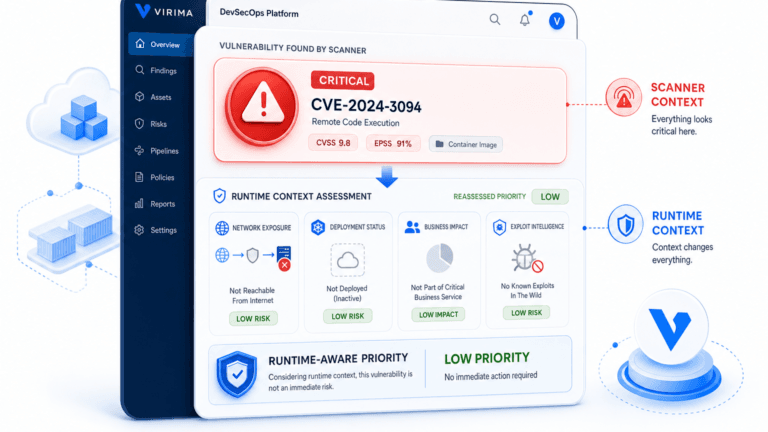
Discovery coverage and CMDB accuracy matter most because every other ITOM capability depends on them. Event correlation, change impact analysis, AIOps root cause identification, and automated remediation all operate on the asset and service data the platform can access. Strong features on incomplete or stale inventory data still produce unreliable operational outputs.
See how Virima scores against these six criteria. Explore Virima’s ITOM feature set — or keep reading to see how six named platforms compare against them.
Best IT operations management solutions in 2026
The table below summarizes how each platform approaches discovery, CMDB, and ITSM integration — the three criteria most “best ITOM tools” roundups skip. Full profiles, including where each platform fits and where it doesn’t, follow.
| Vendor | Best for | Discovery method | CMDB model | Key ITSM integrations |
|---|---|---|---|---|
| Virima | Discovery-sourced ITOM, agentic IT readiness | Agentless, agent-based, API (on-prem, AWS, Azure) | Continuously reconciled, discovery-fed CMDB | ServiceNow, Jira SM, Ivanti, HaloITSM, Xurrent, Hornbill |
| ServiceNow ITOM | Enterprises standardized on ServiceNow | Discovery via the Now Platform | Shared Now Platform CMDB | Native (single platform) |
| ManageEngine OpManager | Mid-market infrastructure monitoring | Network, server, virtualization monitoring | Limited CMDB depth | Varies by module |
| SolarWinds ITOM | Network-centric IT operations | Network, server, app, cloud monitoring | Less mature, topology-focused | Varies by module and version |
| BigPanda | AIOps and event correlation at scale | Ingests alerts from existing monitoring tools | Depends on external topology data | Multi-tool alert ingestion |
| BMC Helix ITOM | Enterprise AIOps with full-lifecycle ITSM | Discovery via the Helix platform | BMC Helix CMDB (shared with ITSM) | Native (BMC Helix ITSM) |
If you’re evaluating ServiceNow ITOM alternatives specifically, compare deployment complexity and CMDB portability first — the platforms above vary widely on both, more than they vary on feature checklists.
Virima: Best for discovery-sourced ITOM with agentic IT readiness
Virima is the strongest fit for organizations that want ITOM built on a continuously accurate, discovery-sourced CMDB rather than layered on top of one.
Virima approaches ITOM from the data foundation up. Its agentless and agent-based discovery covers on-premises infrastructure, AWS, and Azure environments, feeding a continuously updated CMDB that reflects what’s actually running, not what was last recorded manually.
ViVID™ service maps build dependency maps from discovery data, showing how infrastructure relates to the services it supports, giving the ITOM layer topology context that makes change impact and blast radius assessment accurate rather than approximated.
Virima integrates natively with ServiceNow, Jira Service Management, Ivanti, HaloITSM, Xurrent, and Hornbill, passing discovery-sourced CI data, dependency relationships, and change history into ITSM workflows. For organizations building toward agentic IT operations, Virima’s discovery-sourced runtime truth provides the data layer AI-driven automation needs to act safely. See why most CMDBs fail to deliver real source of truth.
Key capabilities: Agentless and agent-based discovery, CMDB population and reconciliation, ViVID™ service maps, change impact analysis, ITSM integrations. Learn more at Virima’s ITOM feature page.
Deployment & TCO: Unlike traditional enterprise ITOM platforms that require months of heavy professional services configuration, Virima offers modular, right-sized deployment options. Growing IT teams can start with Business Pro for core discovery, CMDB, and service mapping, while larger environments can scale seamlessly into Enterprise tiers.
ServiceNow ITOM: Best for enterprises fully committed to the ServiceNow platform
ServiceNow ITOM is the strongest choice for enterprises already standardized on the Now Platform.
ServiceNow ITOM combines infrastructure discovery, event management, and AIOps within the broader ServiceNow Now Platform. For organizations already standardized on ServiceNow for ITSM, ITOM is a natural extension, sharing a single CMDB, workflow engine, and data model across both functions.
ServiceNow’s AIOps capability (Service Graph and Event Management) is mature and feature-rich, and its strength is breadth: covering the full ITSM-ITOM lifecycle in one system. Its limitation is that value delivery typically requires significant configuration investment and ongoing administration.
ManageEngine OpManager: Best for mid-market infrastructure monitoring
ManageEngine OpManager is the practical choice for mid-market teams that need infrastructure monitoring without enterprise platform complexity.
ManageEngine OpManager covers network, server, and virtualization monitoring with a straightforward interface and pricing model that fits mid-market IT teams. It’s easy to deploy and covers a wide range of monitoring targets, but doesn’t match the CMDB integration or service dependency mapping depth of enterprise ITOM platforms.
SolarWinds ITOM: Best for network-centric IT operations
SolarWinds ITOM fits best where network performance monitoring is the primary requirement.
SolarWinds has a long history in network performance monitoring, and its ITOM portfolio covers network, server, application, and cloud infrastructure with a strong emphasis on topology visualization. It’s a practical choice where network operations drive the evaluation, though its CMDB capabilities are less mature than discovery-first platforms, and its ITSM integrations vary by module and version.
BigPanda: Best for AIOps and event correlation at scale
BigPanda is the strongest option for teams that need AIOps correlation layered above an existing monitoring stack, not another monitoring tool.
BigPanda specializes in the AIOps layer: ingesting alerts from multiple monitoring tools, correlating them into incidents, suppressing noise, and surfacing probable root causes as an event intelligence platform rather than an infrastructure monitor. Its event correlation is strong, but the quality of its root cause assignments still depends on the topology and dependency data it can reference — deployed on top of incomplete or infrequently updated CMDB data, its outputs stay accurate only where the dependency map is complete.
BMC Helix ITOM: Best for enterprise AIOps with full-lifecycle ITSM
BMC Helix ITOM is the strongest fit for large enterprises already invested in the BMC platform.
BMC Helix ITOM provides discovery, monitoring, event management, and AIOps within the BMC Helix platform, sharing a CMDB (BMC Helix CMDB) and workflow layer with BMC’s ITSM products. Its AIOps capability is enterprise-grade, with predictive analytics and automated remediation suited to large, complex environments, though implementation complexity and licensing cost reflect that enterprise positioning.
Which ITOM solution is best for hybrid cloud environments?
For hybrid cloud environments spanning on-premises infrastructure and cloud workloads, the most important capability is discovery coverage that spans both. Virima provides agentless and agent-based discovery across on-premises, AWS, and Azure environments, feeding a continuously updated CMDB that reflects the full hybrid estate. Platforms that cover only on-premises or only cloud infrastructure create visibility gaps that undermine every ITOM process that depends on complete asset data.
ITOM solution categories: matching the tool to the need
Not every ITOM need requires the same type of solution. Matching the category to the problem avoids over-investing in platform complexity that doesn’t address the actual gap.
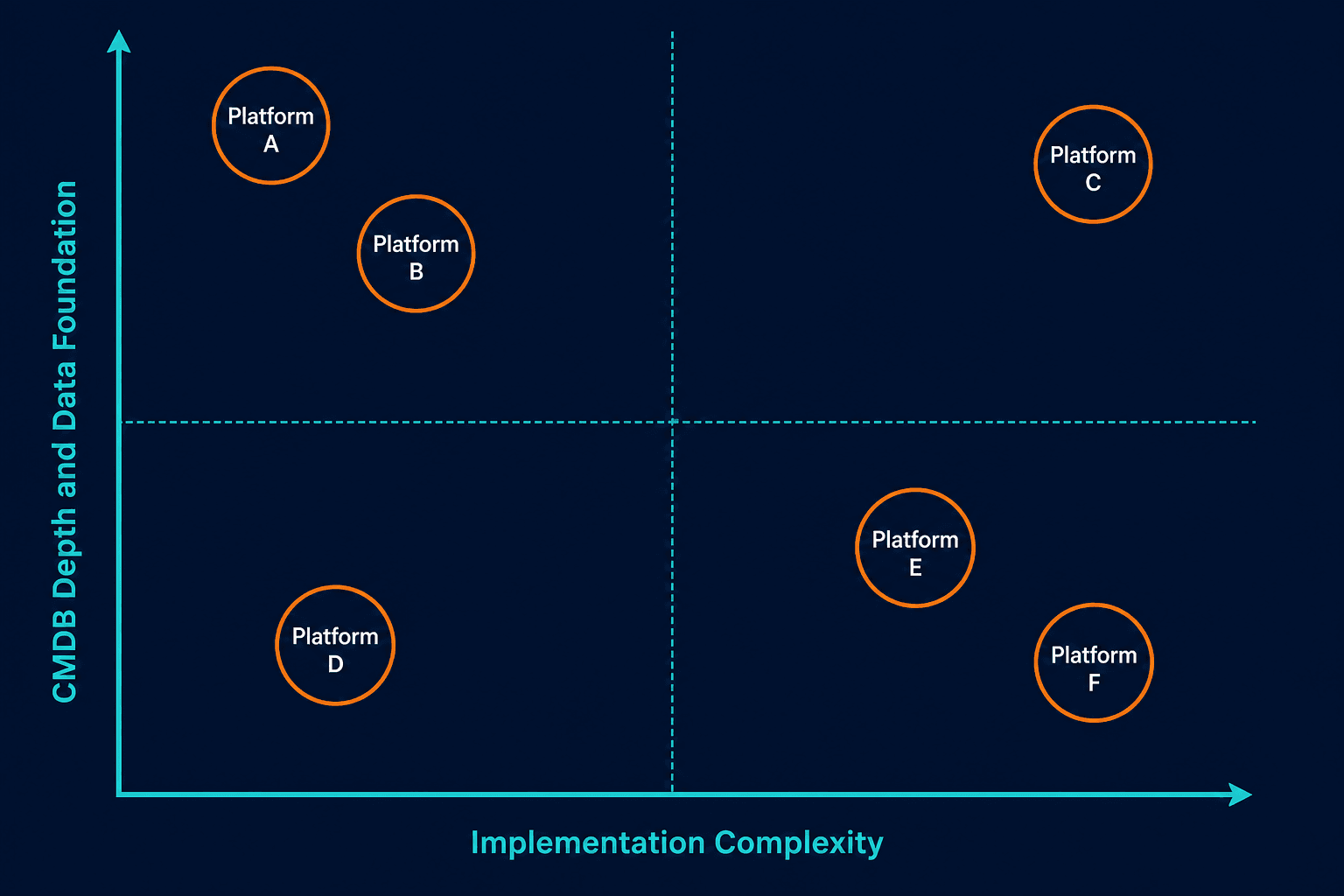
Discovery-first ITOM platforms (Virima) build operational capability on accurate, continuously refreshed asset and service data — the right fit where CMDB accuracy and dependency visibility are primary requirements.
Full-platform ITOM suites (ServiceNow, BMC Helix) deliver the broadest feature coverage for large enterprises with existing platform investments and the resources to maintain them.
Infrastructure monitoring tools (ManageEngine OpManager, SolarWinds) prioritize real-time network and server visibility over CMDB depth.
AIOps and event intelligence platforms (BigPanda) sit above existing monitoring tools, improving signal-to-noise ratio for organizations with mature monitoring stacks generating high alert volumes.
What is the difference between ITOM and AIOps?
IT operations management (ITOM) covers the full lifecycle of IT infrastructure operations: discovery, monitoring, change management, event management, and automation. AIOps is a subset capability within ITOM that uses machine learning to correlate events, reduce alert noise, and surface probable root causes. Most enterprise ITOM platforms include an AIOps layer. Standalone AIOps tools (like BigPanda) focus exclusively on event intelligence and sit above existing monitoring infrastructure.
Building your ITOM evaluation shortlist
The right starting point for an ITOM evaluation isn’t the vendor list. It’s the data foundation question. What asset and service data does your current environment make available? How frequently is it updated? What gaps exist between what your CMDB contains and what’s actually running?
The answers determine which solution categories can deliver value immediately and which require foundational data work first. A platform with strong AIOps features operating on incomplete topology data produces compelling demos and inconsistent production results. For a closer look at this modernization work, see Virima’s best practices for IT infrastructure and operations management.
For teams building toward agentic IT operations, where AI agents act on ITOM data to make routing, remediation, and change decisions, the data foundation question becomes a safety requirement. Agents that act on wrong configuration state don’t just produce incorrect outputs; they act on them.
Frequently Asked Questions
What should I look for in an IT operations management solution?
Prioritize discovery coverage and CMDB accuracy before evaluating feature sets, since incomplete or stale data limits every downstream capability, event correlation, change impact analysis, automated remediation, to those same gaps. After that, evaluate AIOps capability, ITSM integration depth, change intelligence, and total cost of ownership.
What is the difference between ITOM and ITSM?
ITSM (IT service management) covers the processes for delivering and supporting IT services: incident management, change management, service requests, and the service desk. ITOM covers the infrastructure and operations layer beneath those services: discovery, monitoring, event management, and operational automation. The two functions share data: ITSM needs accurate CI and dependency data from ITOM; ITOM needs change context and service ownership data from ITSM. See Virima’s complete ITOM vs. ITSM guide for a full breakdown.
How does incomplete CMDB data affect ITOM performance?
When the CMDB feeding an ITOM platform is incomplete or stale, event correlation assigns root causes without accurate context of what depends on them, change impact analysis misses services using undocumented CIs, and automated remediation acts on configuration states that no longer reflect reality.
How does Virima fit into an ITOM evaluation?
Virima provides the discovery-sourced CMDB foundation that makes every other ITOM capability reliable. Its agentless and agent-based discovery covers on-premises, AWS, and Azure environments, maintaining a continuously updated record of what is running, how components relate, and what changed. That inventory feeds ViVID™ service maps, change impact analysis, and ITSM integrations with ServiceNow, Jira Service Management, Ivanti, HaloITSM, Xurrent, and Hornbill.
Does Virima integrate with ServiceNow’s existing CMDB, or replace it?
Virima integrates directly with ServiceNow rather than replacing it. Discovery-sourced CI data, dependency relationships, and change history feed into the ServiceNow workflows and CMDB customers already use, enriching that platform with continuously current asset and service data rather than requiring a rip-and-replace.
What is the total cost of ownership for enterprise ITOM platforms?
TCO for enterprise ITOM platforms (ServiceNow ITOM, BMC Helix) typically includes licensing, implementation professional services, internal administration, and ongoing configuration work as the environment changes, with implementation timelines that can extend well beyond initial estimates at enterprise scale. Mid-market tools (ManageEngine OpManager, SolarWinds) carry lower licensing costs and faster deployment. Discovery-first platforms like Virima offer faster time-to-value by delivering accurate operational data from deployment, rather than requiring extensive configuration first.