Three Decisions I Made Differently Once I Had Trusted Discovery Data

| Discovery data CMDB accuracy shapes whether your decisions reflect current reality or outdated records. This article covers three real CIO decisions on vendor consolidation, cloud migration, and change windows. You will learn what CMDB data gaps cost in budget and risk. You will also see why pre-decision discovery validation is a governance standard worth building now. |
- CIO decisions on vendor consolidation, cloud migration, and change approvals depend on accurate infrastructure data.
- When that data comes from a manually maintained CMDB, the gap with reality often runs 20 to 40 percent.
- That gap is large enough to shift budgets, timelines, and change windows by a material margin.
- These are three decisions that went differently once discovery data CMDB accuracy replaced assumptions.
- Infrastructure state was pulled from live scan output with an explicit timestamp.
- That scan output became the authoritative input, not a CMDB record months past validation.
- Most CIOs treat data quality as an IT operations problem.
- They see it as something the infrastructure team handles or something that shows up in audit reports.
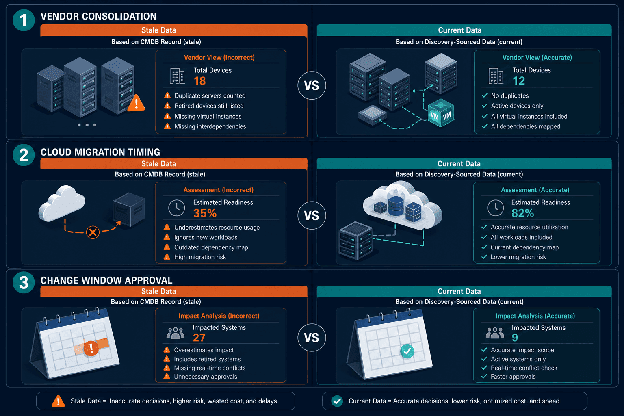
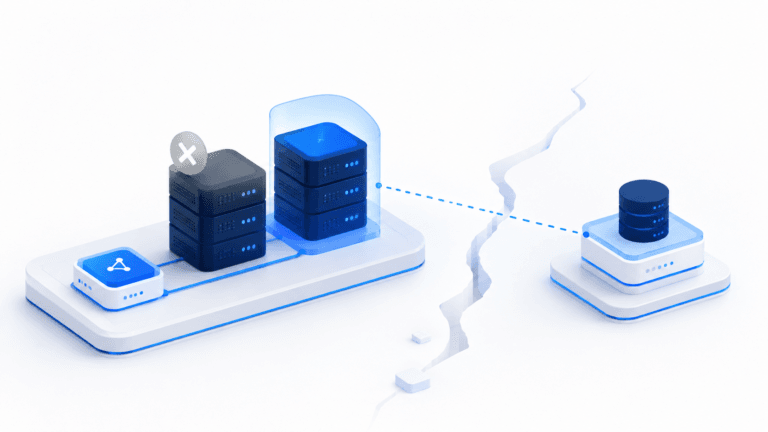
Conceptual diagram showing three decision points: vendor consolidation, cloud migration timing, and change window approval.
Decision One: Vendor Consolidation and CMDB Data Gaps (The $340,000 Difference)
In the first major vendor consolidation review I oversaw, my team pulled a CMDB report.
The report showed 340 devices running the endpoint management agent from a vendor we were decommissioning.
The migration budget was scoped around that number.
It covered contract termination, agent removal, transition testing, and a parallel run period.
Total approved budget: $1.4M.
How Discovery Surfaced the Real Scope
- Three months into the project, a senior engineer ran a fresh agentless discovery scan across the affected infrastructure segments.
- The actual device count running the agent was 218, not 340.
- The 122-device gap came from systems decommissioned over the prior two years.
- None of those decommissions had updated the CMDB.
- These phantom records had been included in every report generated from it.
- That scope contracted immediately.
- Migration testing dropped from 340 to 218 devices.
- The parallel run period shortened accordingly.
- The final project cost came in at $1.06M, or $340,000 below the approved budget.
- That budget reduction was not a win I could take credit for.
- The $340,000 of unnecessary scope had been in the plan from the beginning.
- Discovery surfaced it before we paid for it, not after.
- For teams managing IT costs across multiple asset classes, the Virima-Ivanti cost optimization integration connects discovery data directly to cost reduction workflows.
How does discovery-sourced data change IT vendor consolidation decisions?
Discovery scans identify actual devices versus CMDB records that may include phantom or decommissioned assets. The delta between the CMDB count and the discovery count determines true migration scope and cost. Projects scoped on stale CMDB data routinely overestimate or underestimate scope by 20 to 40 percent (Virima analysis).
Decision Two: Cloud Migration Timeline, From 12 to 18 Months
Cloud migration timelines depend on accurate dependency maps. When CMDB records miss undocumented interdependencies, migration sequences fail in production, not in planning. Discovery-sourced dependency validation before sequencing finds these gaps early. It gives your board a realistic timeline and your teams a workable plan.
The board approved a cloud migration targeting 60 percent workload migration within 12 months.
The target was aggressive but defensible.
It was based on a dependency map compiled from Confluence, architecture reviews, and the CMDB.
That map covered our top 30 workloads and their interdependencies.
Before finalizing the migration sequence, I asked for a discovery-sourced dependency validation.
I had learned from the vendor consolidation review that CMDB records and reality had a gap.
I wanted to measure that gap before committing the timeline to the board.
Four Dependency Gaps That Reshaped the Timeline
The discovery validation found four undocumented interdependencies not visible in the documented architecture:
1. A reporting workload planned for month 4 depended on an on-premises data warehouse.
Architecture documents marked it “scheduled for decommission.”
In reality, it served 14 applications with no confirmed decommission date.
2. A customer portal marked as cloud-ready had 11 hardcoded references to on-premises IP addresses.
None of those references appeared in the documented architecture.
3. Two workloads in the month-7 batch had bidirectional dependencies on each other.
Migrating them in the planned sequence would have broken both.
4. A batch processing service used by finance depended on a vendor-managed system.
That system had a contractual on-premises hosting requirement through month 16.
Migrating those four workloads in sequence would have triggered failures requiring a full stop.
The board would have seen a program failure within 90 days.
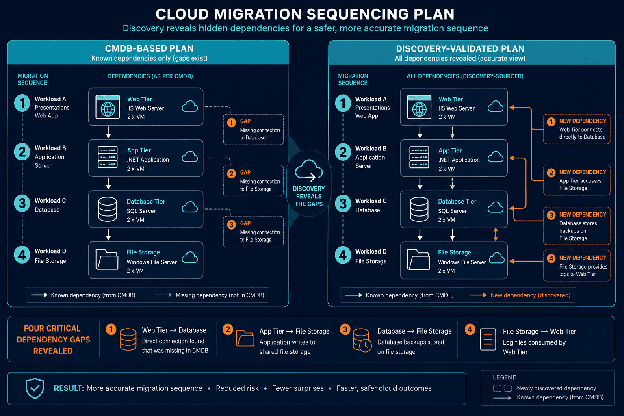
Conceptual diagram of a cloud migration sequencing plan with four highlighted dependency gaps.
What the Revised Timeline Delivered
I went back to the board with a revised timeline of 18 months instead of 12.
I explained the four interdependency issues the discovery validation had found.
The board approved the revision.
The migration completed on the 18-month schedule with no major incidents.
Teams planning cloud migrations can also use ViVID Service Mapping to build dynamic dependency maps before finalizing migration sequences.
Industry analysis consistently finds that dependency gaps are among the leading causes of cloud program delays.
My experience confirmed that pattern exactly.
Decision Three: Change Window, How a Saturday Became a Three-Day Maintenance
Change windows scoped from CMDB records often miss newly deployed systems. A pre-change discovery scan comparing live infrastructure against the CMDB dependency count reveals gaps early. That protects teams from unplanned outages and SLA breaches. Stale CMDB records would never have predicted those gaps.
The change involved replacing a storage array in a segment of the data center. The CMDB showed 47 dependent systems.
A Saturday maintenance window with four hours of planned downtime was approved.
All 47 system owners had been notified.
I had instituted a new policy six months earlier.
Before any tier-1 change window, run a fresh discovery scan of the affected segment.
Compare that scan against the CMDB dependency count.
If counts do not match within 10 percent, escalate to the change sponsor.
The Pre-Change Scan That Prevented 14 Unplanned Outages
- The pre-change discovery scan found 61 dependent systems, not 47.
- Fourteen had been deployed in the nine months since the CMDB was last updated for that segment.
- All were microservices built by product engineering teams.
- None of those teams had submitted CMDB update requests.
- The change window was redesigned from four hours to a three-day planned maintenance.
- All 61 teams were notified, not just the original 47.
- Rollback testing was added for the 14 new microservices.
- Three application owners with 72-hour SLA notice requirements received dedicated communication.
- Because Virima runs high-frequency discovery cycles on a recurring schedule, the pre-change validation took hours rather than days. For a deeper look, see ITIL Change Management and CMDB Accuracy for the full operational framework.
- No production incident resulted from the change.
- Without the pre-change discovery refresh, 14 teams would have lost storage access on a Saturday.
- None of them would have had advance notice or a rollback plan.
- How CMDB data supports each change management approval stage is covered in depth in CMDB for Change Management.
Why should a CIO require discovery validation before major change windows?
CMDB records of dependent systems are typically 20 to 40 percent incomplete in active development environments (Virima analysis). A change window scoped for 47 systems that actually affects 61 creates 14 unplanned outages. Pre-change discovery validation identifies that gap before the change executes, not after.
The Pattern Across All Three Decisions
All three decisions share the same pattern.
CMDB records accurately described the past.
Discovery-sourced ground truth described the present.
In each case, the decision I needed to make was about the present.
The vendor consolidation budget used a device count accurate in 2022 but not in 2024.
The migration timeline used dependency data accurate when the architecture was designed.
However, it was not accurate when the migration was ready to execute.
The change window used a dependent-system list accurate before 14 new microservices deployed.
None of those microservices had CMDB entries.
CMDB data drift, the gap from undocumented deployments and decommissions, made each record wrong.
Why the Gap Between CMDB Records and Reality Is a Common State
This is not an edge case.
Flexera’s 2024 State of ITAM Report found a critical data trust gap among IT leaders.
Fewer than half trust their CMDB data enough to align products or automate processes on it.
The gap between documentation and discovery is not a team-by-team anomaly.
It is a common state in environments with active development cycles.
CIOs tracking infrastructure health will find this overview of CIO IT service health dashboards useful for the metrics that matter.
The same pattern holds for compliance reviews.
CMDB records that miscount active systems by 15 to 30 percent surface as audit findings.
Finding that gap during an audit is the most expensive version of this problem.
A discovery scan run before audit preparation converts a potential finding into a planned remediation.
| Trusted Runtime Truth is a decision quality standard, not just an infrastructure one. |
The standard requires that data behind a decision reflect current infrastructure state.
It must carry an explicit discovery source and timestamp.
All three decisions above succeeded because the data was discovery-sourced, not documentation-sourced.
For CIOs building this capability, start with discovery scope and freshness thresholds.
Determine how often each infrastructure segment is scanned.
Match that frequency to the decision cadence of the teams that depend on it.
What is the relationship between IT discovery frequency and decision quality for CIOs?
Discovery frequency determines how current the data is behind each decision. In active development environments, CMDB data drifts by 15 to 25 percent per quarter (Virima analysis). A CIO making decisions on CMDB data more than 60 to 90 days old is working from last quarter’s infrastructure.
How Discovery-Quality Data Protects Your Next Major IT Decision
Discovery data CMDB accuracy is a decision quality standard, not a technical nicety.
Vendor budgets, migration timelines, and change windows all depend on data that reflects current state.
When that data comes from high-frequency discovery cycles, your decisions rest on verified ground truth.
Run a discovery validation against it.
That single scan is often enough to make the gap, and the business case, visible.
| See how Virima delivers live, explainable discovery data across your full IT estate. Schedule a demo. |
Frequently Asked Questions
How do CIOs build the case for investing in discovery-sourced data infrastructure without a prior incident?
Run a single discovery scan on one critical infrastructure segment. Compare the output against the CMDB record for that segment. Present the delta, such as phantom records, undocumented dependencies, and missing assets. Frame it as a sample of what the rest of the estate likely contains. That gap is the risk exposure the board is currently unaware of. For context on sustaining CMDB accuracy after that initial gap analysis, see CMDB governance best practices for the operational framework.
Should CIOs require discovery validation for all major decisions or only change-related ones?
At minimum, require discovery validation for three decision classes. First, any change with a service impact exceeding tier-2. Second, any migration scoped against a CMDB device count. Third, any vendor consolidation using CMDB asset records for scope estimation. These are where CMDB inaccuracy most directly translates into cost or outage risk. Budget and planning decisions become a secondary priority once those three are addressed.
What does a pre-decision discovery scan require from the IT organization?
You need a defined infrastructure segment to scan. You also need a discovery tool with current credentials for that segment. Finally, you need an analyst who can compare scan output against the CMDB record. For most organizations, the scan itself takes hours. The comparison and delta analysis takes a day. The decision quality improvement is permanent because the process becomes repeatable.
How does a CIO communicate CMDB accuracy risk to peers without creating alarm?
Frame it as a data freshness question, not a data quality failure. Say: “Our CMDB is accurate as of the last discovery validation. Here is when that was and what segments were covered.” That framing makes the risk visible without implying the current data is wrong. It signals only that the data reflects a specific point in time. Peers engage with that framing far more constructively than with “our CMDB has errors.”
How does Virima’s discovery integrate with an existing CMDB without replacing it?
Virima’s agentless and agent-based discovery populates and refreshes a CMDB alongside existing platforms. This includes ServiceNow, Jira Service Management, Ivanti, and others. It does not require replacing the existing CMDB. The integration surfaces the gap between the current CMDB record and live discovery output. Teams can reconcile on demand rather than waiting for an annual audit cycle.
How does discovery data CMDB accuracy help with software license compliance and vendor audits?
CMDB records that miscount active software deployments create direct audit risk. A discovery scan run before a vendor audit surfaces the true installation count. It includes licenses on systems that were never formally documented. Identifying that delta before the audit gives teams time to remediate or adjust licensing. That prevents penalty fees. Discovery data CMDB accuracy converts audit preparation from a reactive scramble into a managed process.