Servicenow Cmdb Governance: Best Practices For Maintaining A Healthy And Accurate Cmdb

A ServiceNow CMDB is only as reliable as the accountability structures behind it. Discovery keeps CI records current. Governance determines who is responsible when they aren’t — and whether you can prove it to an auditor.
Virima’s CMDB automation and IT discovery capabilities give organizations the discovery foundation that governance policies need to stick. Tooling alone does not govern a CMDB. This guide covers the processes, policies, and accountability structures that keep ServiceNow CMDB data accurate and complete — plus the framework assets that IT and GRC leaders use to defend the program when auditors come asking.
👉 If you are an IT Director or ITAM lead reading this: this is the framework your CIO and GRC counterparts will recognize. Use it as the agenda for your next CMDB governance review — and the case for closing the ownership, lineage, and agentic-readiness gaps your team has been carrying alone.
This post walks through ServiceNow CMDB governance best practices for 2026, including a section on agentic IT requirements that most governance frameworks have not yet addressed. Use the quick-reference checklist below to assess your current program at a glance, then work through each section to close the gaps.
This guide covers the governance framework: ownership accountability, RACI structures, audit KPIs, policy templates, and agentic readiness. For technical implementation — discovery configuration, IRE rules, and CMDB schema setup — see our ServiceNow CMDB best practices guide →
Quick Reference: CMDB Governance Checklist
| Governance Area | Task | Frequency |
|---|---|---|
| Ownership | Assign and verify CI class owners across all CI classes | Quarterly |
| Ownership | Resolve unowned CIs flagged by discovery or health checks | Monthly |
| Data Standards | Review and update naming conventions and required attribute rules | Semi-annually |
| Data Standards | Validate CI attributes against defined data quality thresholds | Monthly |
| Discovery Config | Verify discovery scans cover all network segments, cloud environments, and remote endpoints | Quarterly |
| Discovery Config | Review discovery scan schedules and reconcile against CMDB freshness targets | Monthly |
| ITSM Integration | Audit CI data sync between Virima and ServiceNow for accuracy and completeness | Monthly |
| ITSM Integration | Confirm change and incident workflows consume current CI data from the CMDB | Quarterly |
| Health & Audits | Run CMDB health dashboard review and remediate stale, orphaned, or duplicate CIs | Monthly |
| Health & Audits | Conduct full governance audit against defined policies and data standards | Quarterly |
| Agentic IT 2026 | Verify governance policies are embedded directly in CI records as readable attributes | Quarterly |
| Agentic IT 2026 | Audit unowned CIs and block them from agentic action until ownership is confirmed | Monthly |
What is CMDB Governance?
What is ServiceNow CMDB governance?
ServiceNow CMDB governance is the set of policies, ownership structures, and audit processes that keep configuration item data accurate and defensible. It defines who is accountable for each CI class, how data quality is measured, and what controls govern both human and AI agent actions against CMDB records.
CMDB governance is the set of processes and policies that control how a configuration management database gets managed, maintained, and used. Governance gives both business and technical teams access to accurate data on IT assets and the relationships between them. In practice, it keeps CMDB data current and consistent instead of slowly decaying into a data swamp.
ServiceNow’s CMDB stores and manages records about an organization’s IT assets, their attributes, and how they relate. Think of the CMDB as a library with thousands of books, where each book is a CI: a server, a network switch, a software application, or a user account. The library catalog organizes and tracks every book, shows what is available, where it sits, and how items connect. Your governance program determines how accurate that catalog stays.
The distinction worth getting right: CMDB management is the day-to-day work of keeping records clean — discovery scans run, reconciliation rules merge sources, stewards remediate stale CIs. CMDB governance is the accountability structure that makes management defensible — who has authority to decide what enters the CMDB, who answers when that data drives a wrong outcome, and what policy bounded the decision. Management answers “Is the data right?” Governance answers “Can you prove it, and can you defend it?”
Where ServiceNow’s built-in governance leaves gaps
ServiceNow provides the platform. Governance requires more than the platform can deliver on its own. These are the patterns that appear consistently in governance audits where teams relied on native ServiceNow tooling alone:
- Discovery doesn’t assign ownership. ServiceNow Discovery finds assets. It cannot determine who is accountable for each CI class — that is a governance process, not a platform feature. Unowned CIs accumulate silently until an audit surfaces them.
- Health dashboards score quality; they don’t enforce freshness gates for agentic action. Native health scoring flags stale CIs but doesn’t block AI agents from acting on them. The enforcement layer has to be built into governance policy and CI attributes.
- IRE resolves duplicates from known sources; it doesn’t evaluate cross-source lineage confidence. When an AI agent needs to know whether to trust a CI value, it needs attribute-level source attribution and a scan timestamp — not just a merged record. IRE doesn’t produce that signal natively.
- Policy lives in runbooks, not in CI records. ServiceNow’s native CMDB schema doesn’t enforce embedding governance attributes (blast radius classification, change approval tier, maintenance window) directly into CI records. Those constraints live in external documentation that agentic architectures cannot read.
These aren’t platform failures — they’re scope boundaries. Governance is the discipline that fills them.
Key Aspects of CMDB Governance
CMDB governance covers six areas.
1. Data quality sets standards for entry, verification, and validation so the CMDB contains information teams actually trust.
2. Change management defines how CMDB changes get reviewed and approved, including updates to CI attributes, relationships, additions, and deletions.
3. Security and access control assigns roles and permissions that determine who can view, modify, or delete CMDB data.
4. Lifecycle management tracks CIs from acquisition through retirement, including decommissioning and disposal.
5. Auditing and compliance runs periodic audits to verify the CMDB meets governance policies, industry regulations, and internal standards.
6. Reporting and analytics builds reports and analyzes CMDB data to spot trends, surface risks, and support decision-making.
Who owns CMDB governance? The RACI matrix
The most common root cause of CMDB audit failures is undefined ownership at a decision point — not missing data, but missing authority. When auditors ask “who approved this,” and three different people point at each other, the finding writes itself.
The RACI matrix below is the operating model that fixes this. Rows are decisions and activities. Columns are roles. Cells are Responsible, Accountable, Consulted, or Informed. Lift this into your governance charter and adapt the role names to your org structure — but the decision rows should not change.
| Decision / Activity | Data Steward (per CI class) | CI Class Owner | CMDB Process Owner | CAB (Change Advisory Board) | CISO | CIO | AI Governance Board | Internal Audit |
|---|---|---|---|---|---|---|---|---|
| CI class scope definition (which CI classes are in CMDB) | C | R | A | C | C | I | C | I |
| CI ownership assignment (named steward per class) | I | R | A | I | I | I | I | I |
| Data quality standards & thresholds | R | C | A | I | C | I | C | I |
| Discovery scope & frequency configuration | R | C | A | I | C | I | I | I |
| Identification & Reconciliation Engine (IRE) rules | C | C | A/R | I | I | I | I | I |
| CI creation / modification / retirement approval | R | A | C | C | I | I | I | I |
| CMDB schema changes (new attributes, new classes) | C | C | R | C | C | A | C | I |
| CSDM alignment policy | C | C | R | I | I | A | I | I |
| Governance policy authoring & ratification | C | C | R | I | C | A | C | C |
| Agentic action authorization policy (which agents can act on which CIs) | I | C | C | C | C | C | A/R | C |
| CI source lineage standards | R | C | A | I | C | I | C | C |
| Audit evidence capture & retention | R | I | A | I | C | I | I | C |
| Exception handling & governance disputes | I | C | R | C | C | A | C | I |
| Quarterly governance audit execution | C | C | R | I | C | I | C | A |
R = Responsible (does the work) |
A = Accountable (signs off, owns the outcome) |
C = Consulted (input required) |
I = Informed (kept in the loop)
Lift this RACI into your governance charter. The policy templates and audit checklist are in the sections below.
A few cells generate the most disagreement when teams adopt this matrix. They are worth calling out:
Agentic action authorization sits with the AI Governance Board, not the CISO or CMDB Process Owner.
This is new in 2026 and trips most orgs up. Agent authorization is a policy decision that crosses security, operations, compliance, and business risk — no single function owns it cleanly. Stand up an AI Governance Board with representation from each, or your CMDB will be the bottleneck the first time an agent does something nobody approved.
The CIO is Accountable for governance policy ratification, not the CMDB Process Owner.
Process owners draft the policy and run the program. The CIO signs. If your CIO has never seen your CMDB governance charter, you do not have governance — you have a procedure manual.
Internal Audit is Accountable for the quarterly audit, not the Process Owner running the program.
Self-audit is not audit. Internal Audit should run the quarterly governance audit independently, with the Process Owner Responsible for evidence production. This separation is what passes SOX scrutiny.
Data stewards are Responsible for CI source lineage standards, but Accountable rolls up to the CMDB Process Owner.
Source lineage is technical work at the CI level — where each attribute came from, when it was last verified, and the confidence in that value. The standard itself is a program-level decision.
Note: If your current state has the Data Steward role unfilled for any CI class, that is your single highest-impact remediation. Unfilled steward = ungoverned class = audit finding waiting to happen.
Why is ServiceNow CMDB Governance Necessary?
ServiceNow CMDB governance keeps the configuration management database accurate, current, and aligned with business goals. With proper governance, organizations manage IT assets and services more effectively and make better decisions about where to invest and what to change. Governance also supports regulatory compliance and reduces the risk of security breaches and IT incidents — which is why CIOs, CTOs, CISOs, VPs, GRC leaders, and compliance leaders all have a stake in the program.
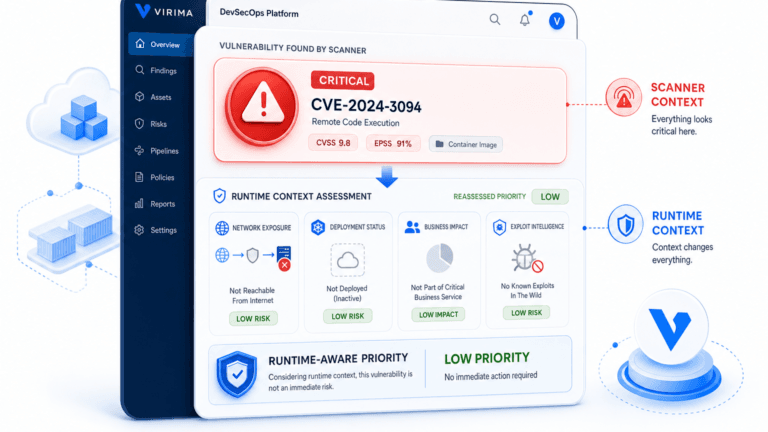
In 2026, the stakes are higher. AI agents operating inside ServiceNow and other ITSM platforms now query CI data to make autonomous decisions about change management, remediations, and resource allocations. When those agents act on stale or unverified CI records, the consequences extend well beyond slow ticket resolution. The question for enterprise AI agent adoption is no longer whether agents belong in IT operations — it is how far and fast organizations can safely deploy them, and that depends on the quality of the data agents consume.
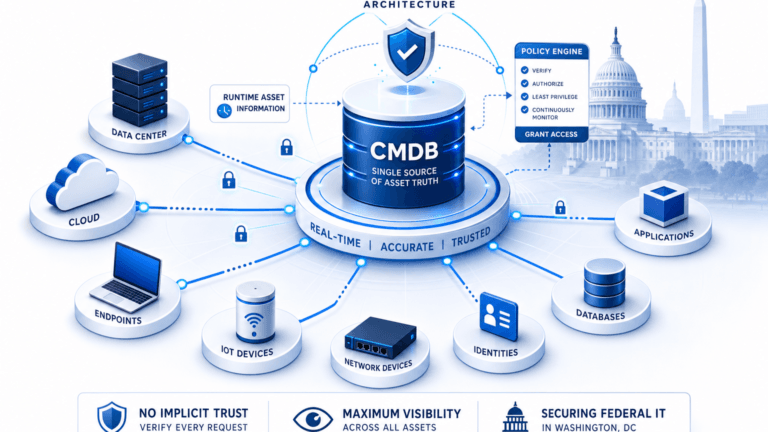
Virima’s IT discovery and ViVID™ service mapping help organizations gain visibility into their IT environments, reduce manual work, and improve CMDB data accuracy.
Establishing and maintaining your CMDB governance framework
With the foundation in place, the next step is establishing and maintaining the governance practices that keep CI data trustworthy over time.
Establish CMDB ownership accountability
Assign clear roles and responsibilities for everyone who touches the CMDB: IT staff, business users, and external partners. Designate CI class owners who are accountable for data accuracy within their domain. The network team owns network device CIs. The applications team owns application CIs. This distributed ownership model scales far better than one configuration manager trying to govern all data alone.
Discovery captures hardware configurations, software inventories, and relationships, but it cannot identify who owns an asset, how critical it is to the business, or what SLAs apply.
Virima addresses this through high-frequency discovery cycles that continuously surface CI records with missing attributes — lifecycle status, business criticality, policy assignments. Configurable business rules route each gap to the appropriate team based on CI class, asset type, and prior assignment patterns. Ownership gaps that surface through discovery are tracked to resolution, not left to the next audit to catch.
Define and enforce CMDB data quality standards
Set clear guidelines for data entry: naming conventions, data types, required attributes, and how relationships between assets get recorded. Then establish policies for how data gets updated, deleted, and archived over time. Without written standards, every team invents its own rules, and the CMDB fragments across inconsistent schemas.
Virima supports enforcement through configurable business rules that handle CMDB maintenance tasks. You can set rules to promote certain types of discovery updates to the CMDB while requiring others to go through manual review. This gives governance teams granular control over what data enters the CMDB and under what conditions, reducing manual workload and the risk of unvetted changes slipping through.
When your governance program requires a health audit
Conduct regular assessments to confirm the CMDB stays accurate and aligned with business goals. Run audits to check that data standards and policies are being followed. Health dashboards and quality checks catch issues early — far better than waiting for a quarterly review to discover six months of data drift.
Virima’s CMDB health scoring surfaces completeness, accuracy, and staleness across all CI classes in a single dashboard view.
Best practices for ServiceNow CMDB governance
Configure your IT discovery process accurately
Discovery is the founation of CMDB accuracy. Without it, organizations rely on humans to manually update records every time something changes, and that approach never scales. Configure your discovery tools to scan all network segments, cloud environments, and remote endpoints. Discovery foundation (see the full technical setup in our CMDB best practices guide →)
Prioritize critical IT services first
Do not try to model every CI at once. Start with services that matter most to the business: revenue-generating applications, customer-facing platforms, and critical infrastructure.
Integrate CMDB data with your ITSM platform
A CMDB is only valuable when it feeds the processes that depend on it. Connect CMDB data to incident, problem, and change management workflows.
Six CMDB governance KPIs mapped to your audit framework
A governance KPI without a framework anchor is a vanity metric. The six below are the ones that actually appear in audit work papers — and the frameworks they satisfy.
| KPI | Target | What it measures | Audit framework |
|---|---|---|---|
| CI ownership coverage | 100% of CI classes have named, active data steward | Whether every CI class has a human accountable for its quality | SOX ITGC (IT General Controls), ISO 27001 A.8.1, NIST CSF 2.0 ID.AM-1, FedRAMP CM-8 |
| Data quality score by CI class tier | Tier 1: 95%+ · Tier 2: 85%+ · Tier 3: 75%+ | Composite of correctness, completeness, and compliance — weighted by CI class business impact | ISO 27001 A.8.1.1, NIST CSF 2.0 ID.AM-2, COBIT BAI09 |
| Stale CI rate (CIs not verified by discovery within threshold) | <5% for Tier 1 · <15% for Tier 2 | The freshness signal AI agents need to act safely | NIST CSF 2.0 ID.AM-3, FedRAMP CM-8(3), HIPAA §164.308(a)(1)(ii)(D) |
| Governance policy compliance rate | 100% of CIs in scope conform to documented policy | Whether the policies you wrote are actually being followed | SOX ITGC, ISO 27001 A.5, NIST CSF 2.0 GV.PO |
| Audit evidence retrieval time | <5 minutes for any in-scope CI’s change history | How quickly you can produce auditor-required evidence | SOX ITGC, ISO 27001 A.5.28, FedRAMP AU-6 |
| Agentic readiness score | 100% of agent-eligible CIs carry source lineage, policy, and ownership metadata | Whether AI agents can act safely on the CI without violating governance | NIST AI RMF (AI Risk Management Framework) GV-1.4, EU AI Act Art. 9 (where in scope), internal AI governance policy |
A few patterns worth knowing about these KPIs.
Tier your CI classes before you set targets. A 95% data quality target for every CI class in the CMDB is a recipe for missing all of them. Tier 1 is business-critical, revenue-affecting, audit-scoped, and customer-facing CIs. Tier 2 is internal but production. Tier 3 is supporting infrastructure. Allocate governance attention proportionally — most teams overinvest in Tier 3 and underinvest in Tier 1 because Tier 3 is louder.
Audit evidence retrieval time is the most under-tracked KPI on this list. Most CMDB programs can produce evidence eventually. Few can produce it under audit conditions in under five minutes. If your evidence retrieval involves SQL queries against ServiceNow or asking the discovery vendor for export, you will fail the auditor’s stopwatch test. Build evidence retrieval into the bi-directional sync between Virima and ServiceNow so attribute-level lineage is queryable from either side without engineering involvement.
Agentic readiness is the KPI that did not exist in 2024. It is the KPI that determines whether you can safely turn AI agents on against your CMDB without inheriting their failures. If you are not measuring it, you are not ready.
💡 Pro tip: Pull your KPI thresholds from your audit framework, not from a vendor benchmark. Auditors test against the framework. Vendor benchmarks are marketing.
CMDB automation: closing the governance gap
Manual governance does not scale. As environments grow more complex — hybrid cloud, containerized workloads, distributed teams — the gap between the infrastructure that exists and the CMDB data representing it widens without automation. Virima closes that gap through several connected mechanisms.
High-frequency discovery cycles feed normalized CI data into ServiceNow. Multi-source reconciliation merges CI data from agent-based and agentless sources into a single authoritative record per CI. CMDB health scoring evaluates completeness, accuracy, and staleness continuously, and governance teams can configure thresholds that trigger remediation workflows when data quality drops below acceptable levels.
IT asset management extends governance coverage from configuration items into the full hardware and software lifecycle. Virima’s ITAM capabilities track physical assets from procurement to disposal, manage software license compliance, and flag end-of-life or end-of-support dates before they create security or compliance exposure. Connecting asset lifecycle governance to CMDB governance means policy enforcement covers both the technical record and the financial and contractual context around it.
For a closer look at how Virima compares to alternative governance approaches in heterogeneous environments, see our comparison of Virima, Device42, and ServiceNow.
2026 Additions: Agentic IT Governance Requirements ServiceNow’s Built-in Framework Doesn’t Cover
AI agents inside enterprise IT platforms change what ServiceNow CMDB governance needs to deliver. Governance is no longer only for human decision-makers. It must make CI data legible, trusted, and policy-constrained for autonomous agents that execute changes without a human in the loop.
Policy-embedding in CI records
Governance policies must live inside CI records, not only in external documentation or governance portals. When an AI agent queries a CI to determine whether it can safely restart a service, decommission a host, or reconfigure a network policy, that agent needs to read the applicable governance constraints directly from the CI record.
What happens if you skip this: The agent executes against the CI using only operational data — discovery state, relationships, attributes. It has no way to know the CI is in a maintenance freeze, classified as Tier 1 critical, or subject to a 48-hour change approval window. The action completes. The audit finding comes later.
What the CI attribute looks like in practice:
Attribute Example value Agent reads as u_change_approval_tier Tier 1 — CAB required Do not execute — escalate to CAB u_blast_radius_class High — >500 downstream CIs Pause, surface impact estimate before acting u_maintenance_window Sat 02:00–06:00 UTC Queue action; do not execute outside window u_data_classification Regulated — PII in scope Require CISO notification before change u_governance_scope SOX, FedRAMP Log action to audit trail with full lineage
Data lineage requirements for AI agents
An AI agent needs to know more than what a CI record says. It needs to know where that data came from, when it was last verified, and how confident the system is in its accuracy before acting on it.
What happens if you skip this: The agent treats a CI last scanned 90 days ago with the same confidence as one scanned six hours ago. In a fast-moving environment — cloud instances being spun up and torn down daily — the agent acts on a record that no longer reflects reality. The CI it’s modifying may not exist anymore, or may now be hosting a different workload.
Lineage attributes Virima’s multi-source reconciliation engine assigns per CI value: discovery source, scan timestamp, reconciliation method, confidence tier (High / Medium / Low based on source authority and recency). These become readable attributes on the CI — not just metadata in a separate log.
Ownership accountability as a prerequisite for agentic action
Unowned CIs are ungoverned CIs. When no team holds accountability for a CI record, there is no authority to escalate to when an agent makes an error, no one to validate the governance policies embedded in that CI, and no one to confirm the discovery data reflects reality. Any CI without a confirmed owner should remain outside the scope of autonomous agent action until the ownership gap closes.
Virima’s discovery pipeline resolves ownership gaps by surfacing incomplete CI records and routing them to the appropriate owner based on CI class, business context, and configured assignment rules. Completion is tracked; ownership gaps do not persist in the CMDB indefinitely. Organizations preparing for agentic operations should treat any CI that fails the ownership check as off-limits for autonomous action.
What happens if you skip this: An agent executes a change against an unowned CI. The change produces a downstream incident. Your incident review asks: who was accountable for that CI? The answer is nobody. That is not a governance gap — it is a governance absence. It writes itself as a material finding on any audit that touches the change.
What auditors will ask in 2026
The questions below have started appearing in audit interviews for organizations operating AI agents against ServiceNow CMDB data. Use them as a pre-audit dry run.
“Can your CMDB prove which AI agent made which change?” Yes, if every agentic action is captured in a change attribution log that includes the agent identity, the CI acted upon, the policy attributes that authorized the action, and the timestamp. No, if your log records the action without the policy authority. The second answer fails the audit.
“How is governance policy embedded in CI records?” Through CI attributes such as change approval tier, blast radius classification, maintenance window, data classification level, and regulatory scope. Policies stored only in external documentation require a lookup that agent architectures often skip — and that auditors will not accept as governance evidence.
“What is your blast radius classification system, and where is it documented in the CMDB?” Blast radius is the documented downstream impact threshold beyond which an agent must pause and escalate. It must be both defined in policy and present as a CI attribute on every agent-eligible CI. If it lives only in a runbook, it does not govern agent behavior.
“Who is accountable when an agent acts on stale data?” The CI Class Owner is accountable for data quality within their class. The Agentic Action Authorization Policy defines the freshness threshold below which agent action is not permitted. If an agent acted on data older than the threshold, the question is whether the policy was enforced — not whether the data was right.
“How do you handle CI ownership gaps before granting agent access?” Unowned CIs are out of scope for agent action by default. Discovery-driven ownership routing closes ownership gaps by surfacing unowned CIs to the appropriate team based on CI class and business context.
“Where is the evidence trail for agentic actions, and how long is it retained?” The evidence trail lives alongside CMDB change history, retained per the documented retention period (typically seven years for SOX-relevant CI classes, longer for regulated industries). It must be queryable by Internal Audit without engineering involvement.
“Has the Agentic Action Authorization Policy been reviewed by the AI Governance Board in the last 12 months?” The honest answer should be yes — and the meeting minutes should be available. Policies that have not been reviewed against current agent capabilities are out of date. Agents evolve quickly; governance has to keep pace.
Policy template language you can ship
Three policies make up the core of a defensible CMDB governance program. The language below is starter text you can adapt — replace bracketed sections with your organization’s specifics, and route the final version through legal and compliance review before ratification.
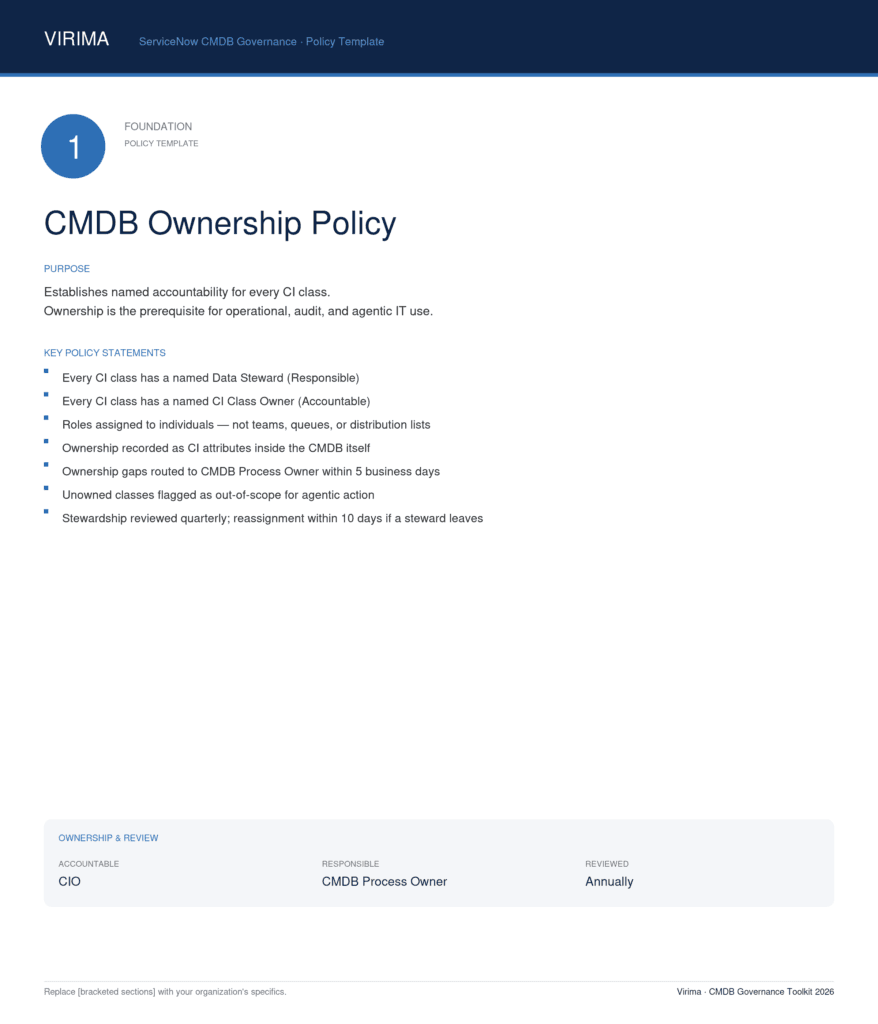
1. CMDB Ownership Policy
| Policy ID | [ORG]-CMDB-OWN-001 | Version | 1.0 |
| Owner | CMDB Process Owner | Accountable | CIO |
| Review cadence | Annual, or after any restructure affecting IT ownership | Effective date | [Date] |
Purpose
To ensure every CI class in the ServiceNow CMDB has a named, accountable owner responsible for data accuracy, governance compliance, and audit evidence within that class.
Scope
Applies to all CI classes within the ServiceNow CMDB in scope for [ORG]’s governance program, including Tier 1 (business-critical), Tier 2 (internal production), and Tier 3 (supporting infrastructure) classes as defined in the CI Class Registry.
Policy statements
- Every CI class must have a named Data Steward and a named CI Class Owner assigned in the CMDB itself — not in a separate spreadsheet or document.
- The CI Class Owner is accountable for the accuracy, completeness, and freshness of all CI records within their class. Accountability cannot be delegated.
- Unowned CI classes are non-compliant by default. Any CI class without a named, active owner within [30] days of identification must be escalated to the CMDB Process Owner for emergency assignment.
- CI Class Owners must be verified as active employees or contractors on a quarterly basis. Departures must trigger an ownership reassignment within [10] business days.
- Any CI that lacks a named owner is ineligible for autonomous AI agent action until ownership is confirmed and recorded.
- The CMDB Process Owner maintains the CI Class Registry, which lists every in-scope CI class, its assigned Data Steward, its CI Class Owner, and the date ownership was last verified.
Enforcement
Non-compliance is reported monthly to the CMDB Process Owner. CI classes remaining unowned beyond the [30]-day remediation window are flagged in the governance KPI dashboard and escalated to the CIO. Persistent non-compliance (beyond [60] days) is reported to Internal Audit as an open finding.
Exceptions
Exceptions require written approval from the CMDB Process Owner and must be logged with a target remediation date. No exception may exceed [90] days.
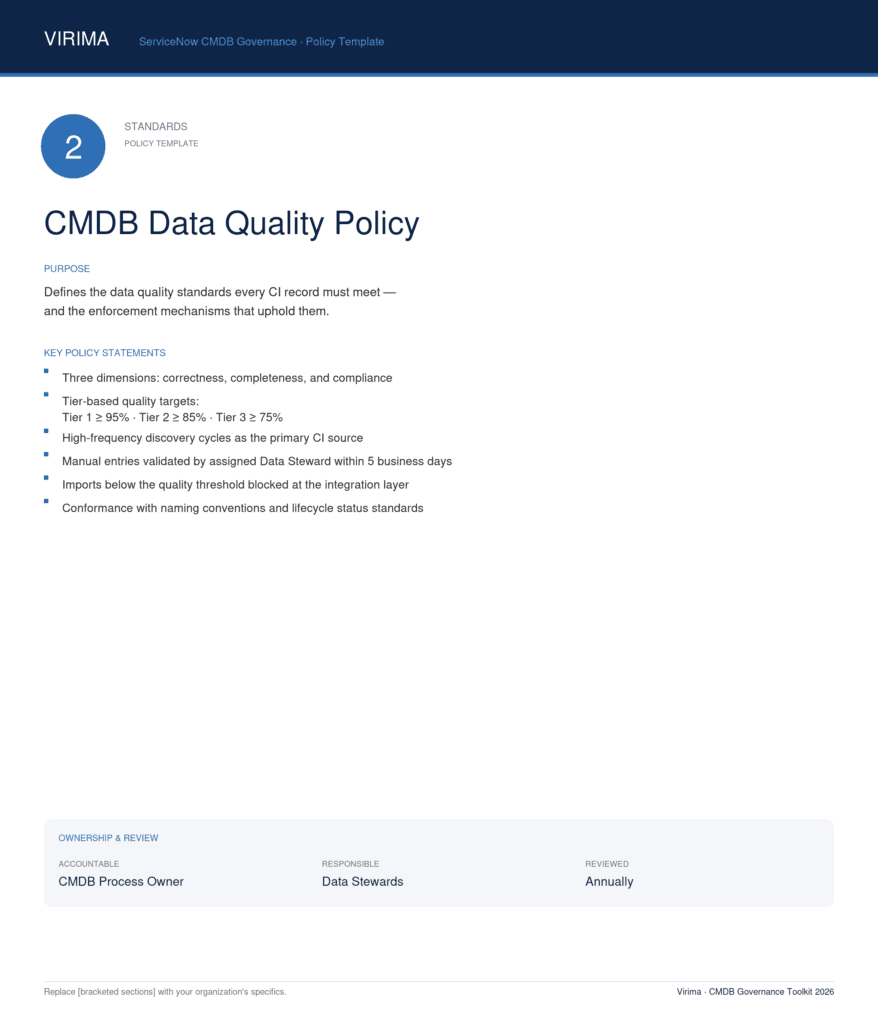
2. CMDB Data Quality Policy
| Policy ID | [ORG]-CMDB-DQ-001 | Version | 1.0 |
| Owner | CMDB Process Owner | Accountable | CIO |
| Review cadence | Annual, or following any significant change to discovery tooling or CI class scope | Effective date | [Date] |
Purpose
To define the minimum data quality standards that CI records must meet to be considered trustworthy for operational use, audit evidence, and — where applicable — agentic IT action.
Scope
Applies to all CI records in the ServiceNow CMDB. Quality thresholds are tiered by CI class business impact as defined in the CI Class Registry.
Definitions
- Completeness: All mandatory CI attributes are populated for the CI class, as defined in the attribute standards for that class.
- Accuracy: CI attribute values match the verified state of the asset, as confirmed by the most recent discovery scan or manual verification.
- Freshness: The CI was last verified by discovery within the threshold defined for its tier (Tier 1: [30] days; Tier 2: [60] days; Tier 3: [90] days).
- Relationship integrity: CI-to-CI relationships reflect actual dependencies as confirmed by discovery or service mapping, with no orphaned or broken relationship records.
Quality thresholds
| CI Tier | Completeness | Accuracy | Freshness | Relationship integrity |
|---|---|---|---|---|
| Tier 1 — Business-critical | ≥ 95% | ≥ 95% | Verified within 30 days | ≥ 95% |
| Tier 2 — Internal production | ≥ 85% | ≥ 85% | Verified within 60 days | ≥ 80% |
| Tier 3 — Supporting infrastructure | ≥ 75% | ≥ 75% | Verified within 90 days | ≥ 70% |
Policy statements
- CI records that fall below the completeness threshold for their tier are flagged as non-compliant and must be remediated within [30] days of identification.
- No CI record may be promoted to the CMDB from a discovery source without passing the mandatory attribute validation rules configured for its CI class.
- Stale CI records (those not verified within the freshness threshold for their tier) are surfaced in the monthly health dashboard and assigned to the relevant Data Steward for remediation.
- CI records failing the freshness threshold for Tier 1 classes are automatically excluded from the eligible pool for agentic action until re-verified.
- Data quality scores by CI class are reviewed monthly by the CMDB Process Owner and reported quarterly to the CIO.
- Any proposed change to mandatory attribute standards or quality thresholds must be approved by the CMDB Process Owner and logged as a governed change.
Enforcement
Monthly quality scorecards are distributed to CI Class Owners. Classes below threshold for [2] consecutive months trigger a corrective action plan with named owner and [30]-day close target. Persistent breach (3+ months) is escalated to the CIO and reported to Internal Audit.
3. Agentic Action Authorization Policy
| Policy ID | [ORG]-CMDB-AAP-001 | Version | 1.0 |
| Owner | AI Governance Board | Accountable | AI Governance Board (joint: CIO, CISO, Head of Risk) |
| Review cadence | Every 12 months, or following any significant change to agent capabilities, scope, or CI class eligibility | Effective date | [Date] |
Purpose
To define the conditions under which AI agents are authorised to take autonomous action against CI records in the ServiceNow CMDB, and to establish the accountability, audit trail, and escalation requirements that govern such action.
Scope
Applies to all AI agents — internal, vendor-supplied, or embedded within the ServiceNow platform — that query, modify, create, or retire CI records in the CMDB or execute actions based on CI data (including change management, incident response, and resource allocation).
Eligibility criteria: what makes a CI agent-eligible
A CI is eligible for autonomous agent action only when all of the following conditions are met and verifiable as attributes on the CI record at the time of action:
| Condition | Required CI attribute | Acceptable value |
|---|---|---|
| Ownership confirmed | u_ci_class_owner (populated, active) | Named individual, not a team queue |
| Freshness within tier threshold | u_last_discovery_scan | Within [30] days for Tier 1; [60] for Tier 2; [90] for Tier 3 |
| Source lineage recorded | u_discovery_source, u_reconciliation_confidence | Populated; confidence tier = High or Medium |
| Change approval tier embedded | u_change_approval_tier | Tier defined; agent action authorised for that tier |
| Blast radius classification present | u_blast_radius_class | Low or Medium (High requires human-in-the-loop approval) |
| Maintenance window defined | u_maintenance_window | Populated; current time falls within window (or action is non-disruptive) |
| Regulatory scope recorded | u_governance_scope | Populated; agent action complies with all listed frameworks |
Policy statements
- No AI agent may take autonomous action against a CI that does not meet all eligibility criteria above. Any agent that cannot read a required eligibility attribute must treat the CI as ineligible and escalate to a human operator.
- CIs with a blast radius classification of High require human-in-the-loop approval before any agentic action is executed, regardless of other eligibility conditions.
- Every agentic action must be logged in a change attribution record that includes: agent identity, CI acted upon, eligibility attributes read at the time of action, action taken, timestamp, and outcome. This log must be retained for [7] years for SOX-scoped CI classes, and per applicable framework requirements for other regulated classes.
- Agent action logs must be queryable by Internal Audit without engineering involvement within [5] minutes for any in-scope CI.
- If an agent acts on a CI whose eligibility attributes change between the eligibility check and action execution (race condition), the action must be rolled back and flagged as a policy exception for review within [24] hours.
- The AI Governance Board is Accountable for this policy. It must meet at least annually to review agent capabilities, CI eligibility criteria, and any policy exceptions logged in the prior period. Meeting minutes must be retained and available to Internal Audit on request.
- Any new agent type, agent capability expansion, or change to CI eligibility criteria requires AI Governance Board approval before deployment. Unapproved deployments are a policy violation and must be reported to Internal Audit within [5] business days of discovery.
- Unowned CIs, CIs with stale discovery data, or CIs missing any required eligibility attribute are off-limits for agentic action by default. This restriction cannot be overridden by an individual team — only by a documented AI Governance Board exception with a named remediation owner and close date.
Escalation path for ineligible CIs
When an agent identifies a CI it requires but cannot act on due to eligibility failure: (1) the agent logs the blocked action and the specific failed condition; (2) the Data Steward for that CI class is notified automatically; (3) the CMDB Process Owner receives a weekly summary of blocked actions by CI class; (4) if the same CI blocks agentic action for [3] consecutive weeks, the CI Class Owner is escalated and a corrective action plan is required within [10] business days.
Exceptions
All exceptions must be approved in writing by the AI Governance Board, logged with a named owner and target remediation date, and reviewed at the next Board meeting. No exception may remain open beyond [90] days without Board reapproval. Exception log is reviewed by Internal Audit at each quarterly governance audit.
☝️ Replace all bracketed values with your organisation’s specifics. Route through legal, compliance, and Internal Audit before ratification. The Agentic Action Authorization Policy should be signed by each member of the AI Governance Board, not just the CMDB Process Owner.
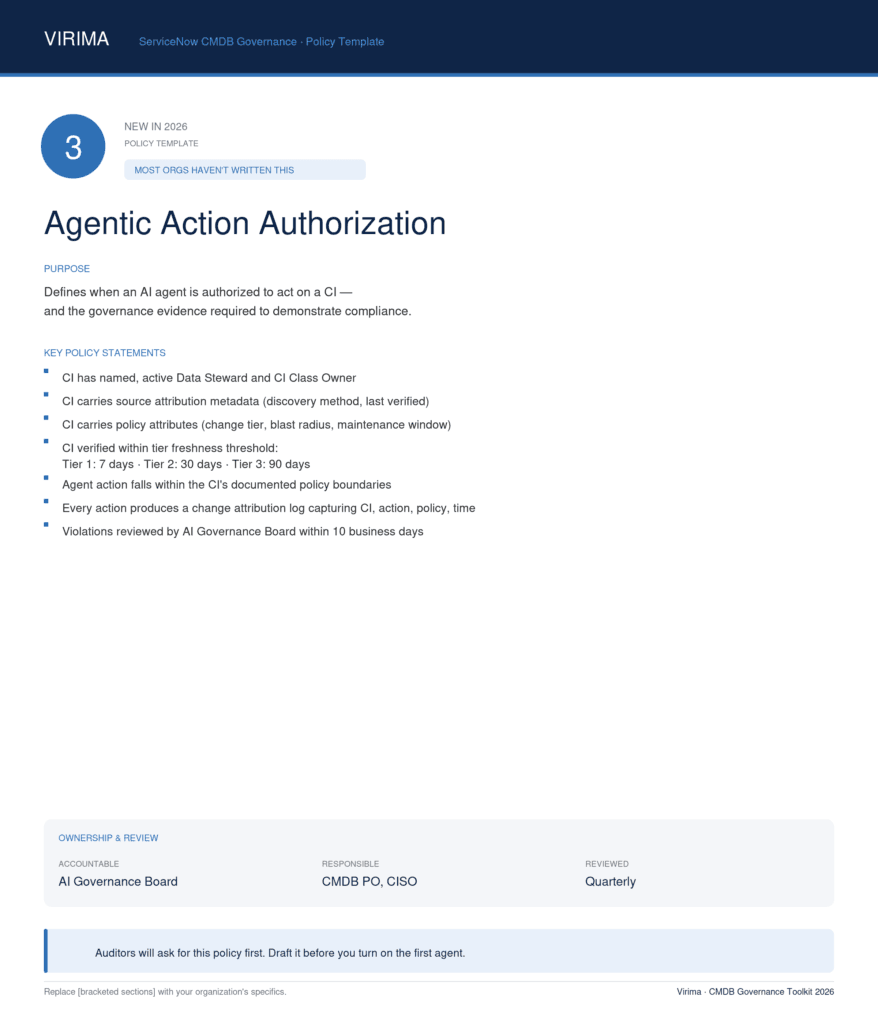
☝️ The third policy is the one most organizations have not written yet. It is also the one auditors will ask for first when they discover you have agents acting on CMDB data. Draft it before you turn on the first agent — not after.
The CMDB Governance Maturity Model
Every governance program sits somewhere on a maturity curve. The five stages below are the ones that map to audit outcomes — and to whether you can safely operate agentic IT against your CMDB.
| Stage | Characteristic | Audit risk | What blocks the next stage |
|---|---|---|---|
| 1. Ad-hoc | No documented ownership, manual data entry, no quality standards, no audit trail. CMDB exists but no one defends it. | Severe — material weakness likely on any audit touching configuration controls. | Assign a CMDB Process Owner. Document CI class scope. Stand up basic ownership. |
| 2. Defined | Roles documented, basic policies in place, ownership coverage for Tier 1 classes, quality standards written. Inconsistent enforcement. | High — audit findings likely on completeness, evidence retrieval, and stale data. | Implement high-frequency discovery cycles. Stand up quality gates. Begin KPI tracking. |
| 3. Measured | Quality scores tracked per CI class, high-frequency discovery cycles in place, governance KPIs reported monthly, audit trail captured. Reactive remediation. | Moderate — clean on ownership and data, but reactive evidence production. | Independent audit cadence. Policy compliance rate measurement. CSDM alignment program. |
| 4. Governed | Internal Audit runs independent quarterly governance review. Policies enforced through enforcement automation. Evidence retrievable on demand. CSDM-aligned. Exceptions logged and time-bounded. | Low — clean audit cycles, with findings concentrated in scope expansion rather than control failures. | Stand up AI Governance Board. Implement agentic readiness metadata. Author agentic action authorization policy. |
| 5. Agentic-ready | All Governed-stage controls, plus: source lineage metadata on every CI, policy attributes embedded in CI records, agentic action authorization policy ratified and enforced, agent action logs captured and reviewable, freshness validation enforced by tier. | Audit-defensible across human and agentic actions. | This is the bar for 2026. |
If you cannot pass the agentic-readiness bar, you cannot safely turn on AI agents against your CMDB. Many enterprise CMDB programs sit at Stage 2 or Stage 3 today, based on EMA ServiceOps research on CMDB maturity. The work to reach Stage 5 is real — but it is process work, not platform replacement. The platforms are already capable; the governance has to catch up.
The quarterly CMDB governance audit checklist
This is the checklist Internal Audit should run against your CMDB every quarter. If you cannot answer “yes” to all of these, you have governance gaps your next external audit will surface. Score each line yes/no — and treat any “no” as a corrective action with a named owner and a 30-day close window.
Ownership and accountability
Data standards and quality
Discovery and reconciliation
Lifecycle and change control
Integration and dependency
Read more: For the operational practices that produce the data this checklist evaluates, see the ServiceNow CMDB best practices guide.
How does CSDM relate to CMDB governance?
The Common Service Data Model (CSDM) is ServiceNow’s framework for structuring data inside the CMDB. It standardizes how services, applications, and infrastructure connect inside the ServiceNow platform. As ServiceNow’s CSDM guidance makes clear, a strong data model foundation is the prerequisite for effective CMDB governance and AI-ready operations, because the data model determines whether every CI fits into a service context that ITSM workflows can use.
Running ServiceNow CMDB governance without CSDM alignment creates inconsistent data models that break service-aware automation. Align your CI classes, service models, and relationship types with CSDM before scaling your governance program. Virima’s pre-built blueprints map directly to ServiceNow CSDM table structures, which reduces the alignment work required when syncing discovery data into ServiceNow.
ServiceNow CMDB governance in 2026 requires more than clean data. It requires runtime truth, ownership accountability, policy-embedded CI records, and the lineage signals that let AI agents act safely. Organizations that build governance programs around these principles move faster through incident response, change management, and agentic operations — without the risk of acting on data they cannot verify.
Get audit-ready CMDB governance with Virima — Schedule a demo →
Move faster. Act safely.
FAQ
How do you measure CMDB data quality?
CMDB data quality comes down to four metrics: completeness (are required CI attributes filled in?), accuracy (do CI records match the actual state of the asset?), freshness (when did discovery last verify the CI?), and relationship integrity (do CI-to-CI relationships reflect real dependencies?).
Track these through health dashboards and set thresholds that trigger remediation. If CI freshness drops below 90% within 30 days, flag the data source for review. Continuous monitoring outperforms manual spot-checks for catching drift before it causes incidents.
How do I improve CMDB health in ServiceNow?
Start with ownership: every CI class needs a named data steward accountable for quality within that class. Unowned CIs are the single most common root cause of health score failures. Once ownership is in place, configure discovery to cover all network segments, cloud accounts, and remote endpoints, and set freshness thresholds by CI tier so stale records surface in the health dashboard before they affect incident or change workflows.
From there, enforce data quality gates at entry — block CI records that fail mandatory attribute validation from entering the CMDB at all. Run a monthly health scorecard review by CI class and assign remediation owners to any class that falls below threshold. Reactive spot-checks after incidents are not a substitute for a monthly cadence tied to documented thresholds.
What KPIs should you track for CMDB health?
Focus on KPIs that link CMDB quality to business outcomes: CI completeness rate, stale CI percentage, orphan CI count, duplicate CI rate, and incident mean time to resolution (MTTR) for cases where CMDB data was involved. Review them monthly and align thresholds with governance goals.
Virima’s health dashboards and ViVID™ service maps give teams visibility into relationships, risks, and key KPIs without manual report-building. NIST National Vulnerability Database overlays add vulnerability context so teams can prioritize governance effort on CIs with the highest risk exposure.
What tools automate CMDB governance?
Native ServiceNow tools — including Discovery, the Identification and Reconciliation Engine (IRE), and CMDB Health dashboards — provide a baseline for ServiceNow CMDB governance. Organizations with hybrid or multi-cloud environments often reach the limits of native tooling when their environments span on-premises infrastructure, remote endpoints, and multiple cloud providers.
Virima extends discovery coverage across on-premises, cloud, and hybrid infrastructure using agentless scanning and optional agents for Windows, macOS, and Linux. It maps service dependencies through ViVID™ and feeds CI data into ServiceNow through the codeless Virima-ServiceNow integration with over 100 pre-built blueprints. For teams evaluating alternatives, our Virima vs. Device42 vs. ServiceNow comparison covers key capability differences in governance and discovery.
What is a ServiceNow CMDB governance framework?
A ServiceNow CMDB governance framework is a documented set of ownership assignments, data standards, discovery configurations, ITSM integration policies, and audit cadences that together keep CI data accurate, current, and trustworthy. It defines who owns what, how data enters the CMDB, how it gets validated, and what happens when quality drops below threshold. A working framework covers human decision-making and — in 2026 — agentic decision-making.
What is the difference between CMDB governance and CMDB management?
CMDB management is the day-to-day work of keeping CI data clean: running discovery, reconciling sources, remediating stale records. CMDB governance is the accountability structure that makes management defensible — the policies, roles, KPIs, and evidence that prove configuration data is trustworthy enough for operational, audit, and agentic IT use. Management is reactive. Governance is the framework that makes management auditable.
What audit framework covers CMDB governance?
There is no single CMDB-specific framework, but configuration management controls appear across most major frameworks: SOX ITGC (for financial-impact CIs), ISO 27001:2022 Annex A.8 (Asset Management), NIST CSF 2.0 (Identify function, ID.AM subcategories), FedRAMP CM-8 (Information System Component Inventory), HIPAA §164.308 (administrative safeguards including asset accountability), and COBIT BAI09 (Manage Assets). For organizations operating AI agents, NIST AI RMF and the EU AI Act add agentic-specific controls on data lineage, accountability, and human oversight that map directly to CMDB governance requirements.
What is an AI Governance Board and why does it matter for the CMDB?
An AI Governance Board is the cross-functional body Accountable for authorizing AI agent action against operational data — including the CMDB. It typically includes IT, security, compliance, internal audit, and business risk representation. It matters for the CMDB because agentic action authorization is a policy decision that crosses every one of those functions, and no single function can own it cleanly. Without a Board, agent authorization defaults to whoever turned the agent on — which is exactly the accountability gap auditors are now testing for.
Get audit-ready CMDB governance with Virima. Our team will walk through this framework against your current state, identify the governance gaps your next audit will find, and map a path to agentic readiness. Schedule a demo →
Move faster. Act safely.