Software License Compliance Audit: A Step-by-Step Guide

A software license compliance audit is one of those tasks IT teams know they should do regularly but rarely complete with full confidence. The gap between what you have purchased and what is actually deployed is rarely zero, and when a vendor audit notice lands in your inbox, that gap becomes an urgent financial liability. This guide walks IT managers, IT directors, and procurement teams through a structured approach: what to prepare, how to execute each step, and how to make sure you are not starting from scratch the next time one is needed.
What Is a Software License Compliance Audit?
A software license compliance audit is a formal process that compares the number of software licenses your organization owns against the number of active installations or authorized users across your environment. The goal is to confirm you are neither over-licensed (wasting budget on unused entitlements) nor under-licensed (exposed to vendor penalties and legal risk).
License audits fall into two categories:
Internal audits: self-initiated reviews run by IT, ITAM, or procurement to stay ahead of compliance gaps before vendors come knocking.
Vendor-initiated audits: formal audit requests from software publishers such as Microsoft, Oracle, IBM, or SAP, typically triggered by contract renewal periods or usage anomalies.
Both types require the same foundational data: a complete, accurate software inventory matched to verified license entitlements.
What is a software license compliance audit?
A software license compliance audit compares the number of licenses an organization holds against active installations or authorized users. The goal is to identify over-deployment (more installs than licenses) or under-deployment (unused licenses wasting budget) before a vendor audit creates financial or legal exposure.
Why Software License Compliance Audits Matter
The financial stakes of non-compliance have grown. A 2024 IDC analysis of software asset management practices found that enterprise organizations routinely discover a 15-30% gap between licensed entitlements and actual deployments during formal audits. For large Microsoft or Oracle estates, that gap can translate to settlements in the hundreds of thousands of dollars — a related Virima analysis walks through a real 340-seat licensing shortfall that carried a $280,000 exposure at renewal, the kind of gap a scheduled internal audit would have caught months earlier.
Three operational reasons make a scheduled audit worth the effort: procurement cannot negotiate renewals confidently without knowing which licenses are actually in use, so over-licensed products waste budget while under-licensed products carry unquantified risk; IT and procurement teams that track licenses in separate systems drift apart quickly, and a shared audit process forces alignment before it becomes a compliance problem; and vendor audits rarely come with long lead times, so organizations running quarterly internal audits already have documentation ready while others scramble to produce evidence from incomplete records.
Before You Start: Building the Right Foundation
A software license compliance audit is only as good as the data behind it. Before running the audit itself, confirm these foundations are in place:
A centralized software inventory. You need a single record of every software application deployed across your estate, including cloud-hosted SaaS products, on-premise installations, and virtual machine images. Without this, the audit starts with guesswork.
License entitlement records. Purchase orders, contract agreements, and vendor license certificates must be accessible in one place. This is the supply side of the compliance equation.
Ownership and cost center mapping. Each software deployment should map to a business unit, cost center, or named owner. Without this, remediation decisions (terminate, reassign, or buy more licenses) lack accountability.
A defined scope and owner. Not every audit needs to cover the entire estate — scoping by publisher, product category, or department makes the process manageable, and naming a cross-functional owner across IT, procurement, and legal up front prevents remediation decisions from stalling on accountability gaps later.
What data do you need before a software license compliance audit?
Before starting a software license compliance audit, IT teams need three data sets: a complete software installation inventory across all environments, a record of purchased license entitlements from contracts and purchase orders, and ownership mapping that ties each deployment to a business unit or cost center. Without all three, the audit produces findings but no actionable remediation path.
Step-by-Step: How to Conduct a Software License Compliance Audit
Step 1: Build a Complete Software Inventory
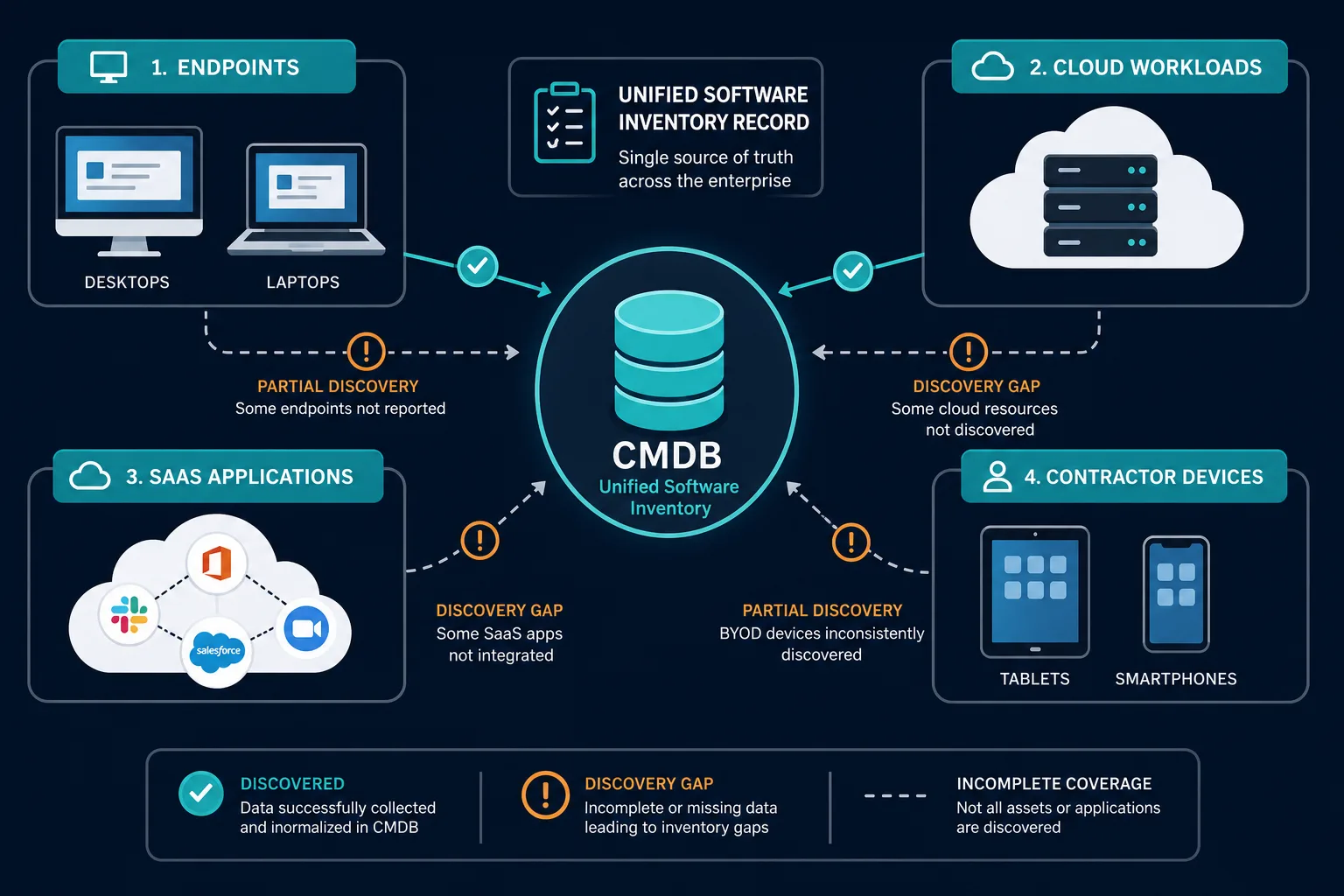
Discovery is the first and most critical step. Run your discovery tools across all endpoints, servers, virtual machines, and cloud-hosted workloads to capture every installed application, version number, and installation path.
This is where most audits stumble. Shadow IT, contractor-owned devices, and cloud-hosted SaaS subscriptions often fall outside standard discovery scopes. Close these gaps by cross-referencing endpoint discovery data with Active Directory or Azure AD to confirm every managed device is included, checking procurement records for SaaS subscriptions that bypass IT, and pulling cloud provider inventories for software running on AWS or Azure instances outside traditional endpoint management.
Step 2: Map Licenses to Entitlements
Once you have an accurate inventory, pull your entitlement data and begin matching. For each product in scope, confirm the license metric (per device, per user, per processor, per core), count active installations or authorized users against that metric, and flag any product where installations exceed entitlements.
License metrics are where enterprise software audits become technically complex. Microsoft, Oracle, SAP, and IBM each use different licensing models, and a per-processor license behaves differently from a per-named-user license. Matching the wrong metric type against the wrong installation count produces incorrect compliance findings.
Step 3: Identify Compliance Gaps
Produce a gap analysis that shows, for each product in scope: entitlements owned, installations or users counted, net position (surplus or shortfall), and financial exposure if a shortfall is not remediated before a vendor audit. Sort by financial exposure to prioritize remediation effort — a 10-license shortfall on a $50,000-per-seat enterprise product is a higher priority than a 50-license shortfall on a $10-per-seat subscription.
| Product | Entitlements Owned | Installs/Users Counted | Financial Exposure |
|---|---|---|---|
| Enterprise ERP Suite | 340 | 380 | $280,000 |
| Endpoint Security Agent | 1,200 | 1,150 | $0 (surplus) |
| Design Collaboration Tool | 85 | 110 | $62,500 |
What does a software license gap analysis look for on each product?
A software license gap analysis records, for every product in scope, the entitlements owned, the installations or users counted, the net position, and the financial exposure if the shortfall isn’t remediated before a vendor audit — sorted by dollar exposure rather than unit count, so the highest-risk gaps get remediated first.
Step 4: Remediate Before the Auditor Arrives
Remediation takes one of three forms:
Reclaim unused licenses. Identify installations on decommissioned machines, former employees, or inactive accounts — reclaiming these first often closes the gap without additional spend. Licenses running below roughly 30% utilization are also reclamation candidates even when the seat is technically assigned to an active user; low usage is a signal to right-size before renewal, not just a decommissioning check.
Reassign entitlements. Some license agreements allow transfers between users or departments. Check contract terms before purchasing new licenses.
Purchase additional licenses. When reclamation and reassignment are insufficient, procure additional entitlements before the audit window closes.
Document every remediation action taken. Vendor auditors will ask for evidence that your compliance position changed intentionally, not coincidentally.
Software License Audit Readiness Checklist — the same reclaim-reassign-purchase framework in a worksheet you can run against your own estate before the next renewal.
Step 5: Document and Report
The final step is producing the audit record: a structured report showing the starting position, the gap findings, the remediation actions taken, and the final compliance position. This documentation demonstrates good faith to vendor auditors, provides procurement with data for renewal negotiations, and establishes a baseline for the next internal audit cycle.
How long does a software license compliance audit take?
A software license compliance audit typically takes two to six weeks for a mid-size enterprise, depending on the number of publishers in scope and the quality of the existing software inventory. Organizations with a maintained CMDB and regular discovery cycles often complete focused audits in under two weeks. Those starting from an incomplete inventory require additional time to close data gaps before entitlement matching can begin.
Common Pitfalls That Derail Software License Audits
Stale discovery data. A six-month-old inventory snapshot reflects an estate that no longer exists — high-frequency discovery cycles keep records current instead of historical.
Ignoring virtual environments. Software running on VMs is often overlooked in traditional endpoint scans, even though many license agreements set separate terms for VMs and cloud instances.
License metric mismatches. Counting per-device installations against a per-user entitlement produces a false sense of compliance — confirm the metric type for every product before running the gap analysis.
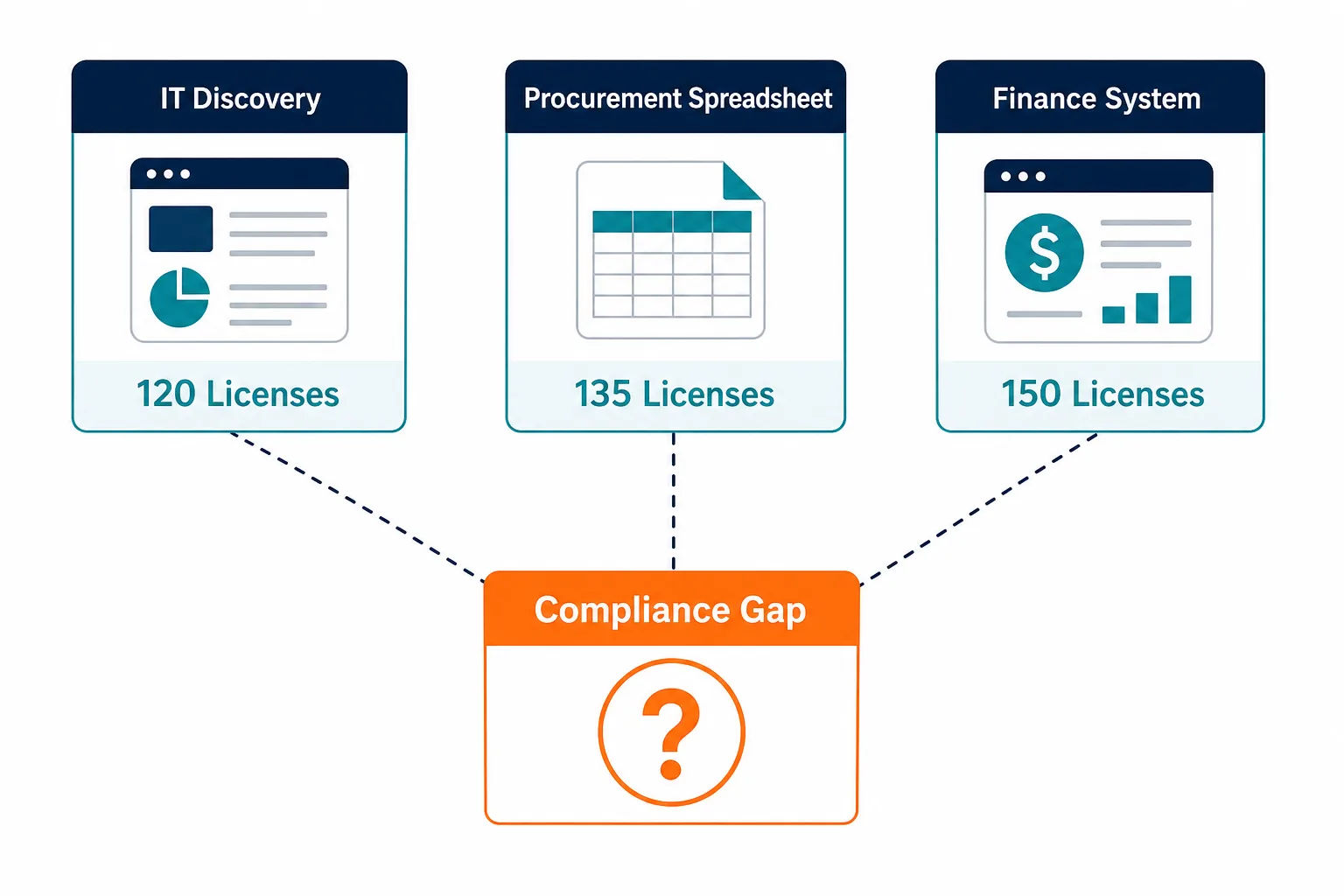
No single source of truth. When procurement tracks licenses in a spreadsheet, IT uses a separate discovery tool, and finance keeps its own spend record, the numbers never match. One authoritative data source is what makes the audit credible.
The Role of CMDB and Discovery in License Compliance
A configuration management database (CMDB) is the connective tissue of a software license compliance audit. When it’s fed by high-frequency discovery cycles and integrated with procurement data, it becomes the single source of truth the audit requires — normalizing vendor-specific product names and edition variants into one canonical record (so “Microsoft Office 365 ProPlus” and “Microsoft 365 Apps for Enterprise” aren’t counted as two separate products) and linking each software CI to the hardware or VM it runs on, the users assigned to it, and the cost center that owns it. The result is audit-ready reporting on demand, instead of a manual assembly job from disconnected sources.
Virima’s IT discovery and CMDB capabilities support this with continuously refreshed software inventory records across on-premise endpoints, virtual machines, cloud workloads, and network devices, with license entitlements tracked alongside installation data. Virima’s IT Asset Management capabilities extend this to hardware and software lifecycle data together, so a shortfall on one side of the estate doesn’t get lost tracking the other.
Learn how Virima delivers trusted runtime truth for IT asset compliance.
How does a CMDB support software license compliance?
A CMDB supports software license compliance by providing a normalized, continuously updated record of every software installation across the IT estate, linked to entitlement data, hardware ownership, and cost center assignments. This gives IT and procurement teams a single source of truth for entitlement matching, gap analysis, and audit documentation, reducing the time and manual effort required to complete a software license compliance audit.
Building an Audit-Ready Software License Practice
A software license compliance audit is not a one-time cleanup project. The organizations that handle vendor audits with the least disruption schedule internal audits quarterly or semi-annually rather than waiting for a vendor notice to force the issue — the first audit is always the hardest, and every audit after it is an incremental check against an established baseline. They also integrate ITAM and procurement workflows so new purchases are automatically matched against existing entitlements, which prevents over-buying and keeps an audit trail that never has to be reconstructed from scratch, and they keep the underlying software inventory current with high-frequency discovery cycles between formal audits so there are no surprises when the next one begins.
That starts with discovery. Without a continuously refreshed, normalized software inventory tied to your CMDB and entitlement records, every audit begins with a data gap that eats into the same timeline the audit is supposed to run on. Virima supports this model through native software license tracking and ITAM capabilities that surface license position across all discovered assets, with entitlement records stored alongside configuration data in the CMDB.
Virima’s discovery-sourced ITAM capabilities give IT and procurement teams the inventory accuracy and license visibility needed to run internal audits confidently and respond to vendor audits without scrambling. Software License Audit Readiness Checklist to run this same five-step framework against your own estate before your next renewal cycle.