ServiceNow for Small Business: Too Heavy for Lean IT?

Six to twelve months after a ServiceNow go-live, a familiar gap opens in growing IT shops: tickets flow fine, but the CMDB underneath stays thin, outdated, or hand-updated. A five-to-fifteen-person team inherits a platform built for dedicated administrators, and every discovery schedule or module update becomes a job nobody has hours for. ServiceNow for small business isn’t a question of whether the platform is good – it’s whether lean IT can carry its platform weight and CMDB upkeep once the sales demo ends.
When a growing mid-market company or an ambitious small enterprise first evaluates ServiceNow, the pitch is compelling. You get enterprise-grade incident management, structured request fulfillment, and a workflow engine that can scale to thousands of employees. What the sales deck doesn’t show is the specialized expertise a small team needs to keep that engine fed with accurate CMDB data. According to CISA Binding Operational Directive 23-01, operational risk increases exponentially when organizations lack complete, continuous visibility into active network assets and configuration dependencies.
Understanding when ServiceNow becomes too heavy for lean IT helps you determine whether to stay and augment the platform or lighten your discovery and CMDB scope before platform complexity stalls your operations.
The lean IT reality: why ServiceNow feels heavy
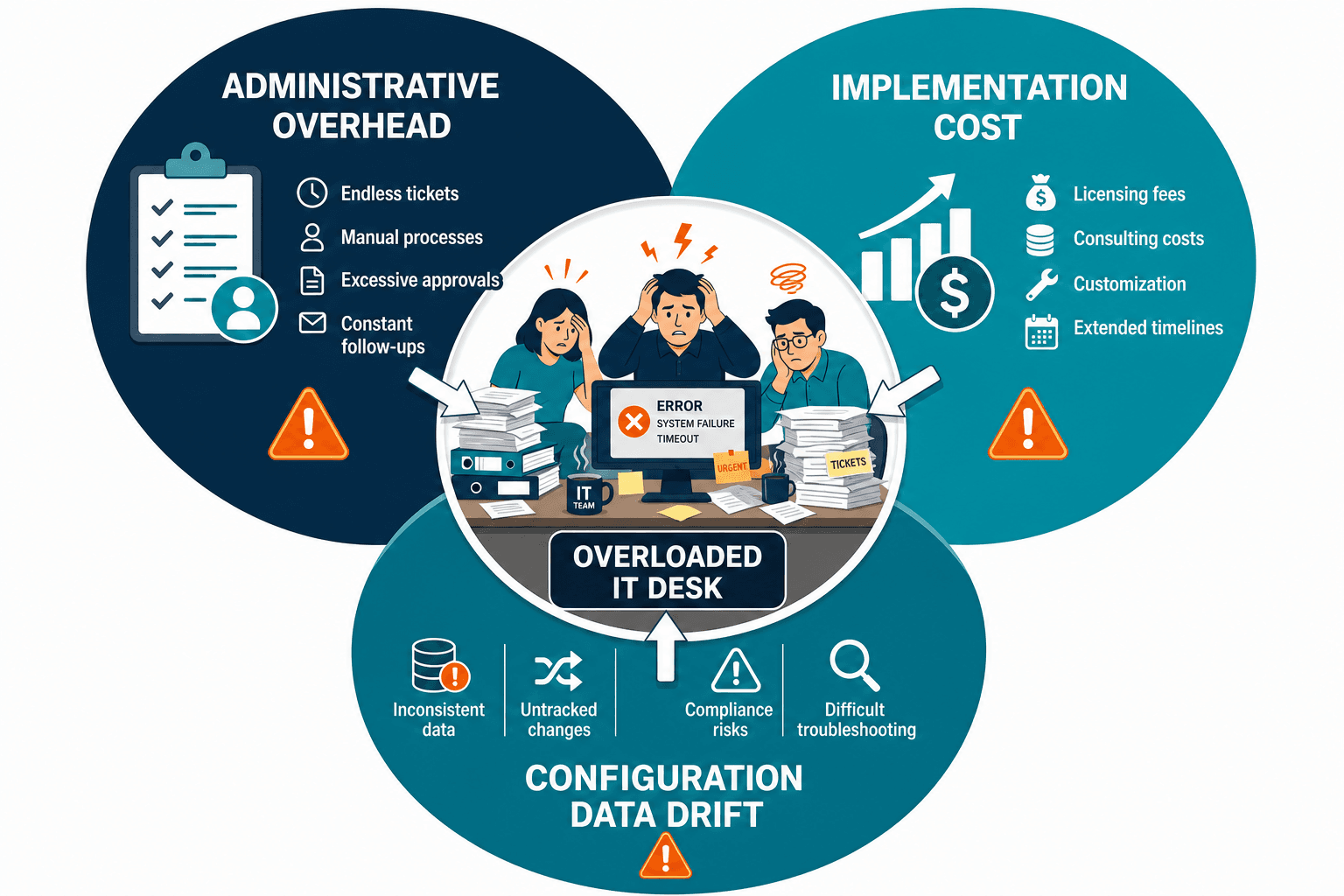
ServiceNow was architected for enterprise environments with dedicated platform administrators, specialized CMDB owners, and full-time ITOM engineers. When brought into a lean IT environment, three specific pressure points emerge quickly.
1. Administrative overhead and specialized skill requirements
Administering ServiceNow requires specialized training. Configuring advanced workflows, maintaining CSDM (Common Service Data Model) alignment, and managing update sets demands certified ServiceNow administrators or expensive third-party consultants. When a small IT team handles everything from helpdesk tickets to cloud architecture, dedicating twenty hours a week to ServiceNow platform administration means other critical infrastructure projects stall. Even routine work like patching a discovery pattern or approving a CSDM class change often has to route through a change advisory board before it goes live. That adds days to work a specialist team could otherwise finish in an afternoon.
2. Implementation cost vs. delivered value
The initial license cost of ServiceNow is only the starting point. ServiceNow’s own pricing page publishes no rate for any tier – only a sales-qualified quote request – leaving buyers to estimate total cost without a public baseline number. Implementation partners routinely quote six-figure services engagements on top of that to configure the platform for mid-market use cases. For a small business, spending twice as much on professional services as on software licenses creates immediate ROI pressure. That pressure gets worse when advanced discovery features or ITOM modules stay locked behind higher pricing tiers. The pressure isn’t just anecdotal: Virima’s CMDB TCO analysis found that inaccurate or incomplete CMDB data drives measurable rework across change approvals, incident triage, and license audits, on top of whatever the platform and services already cost.
3. The CMDB maintenance trap
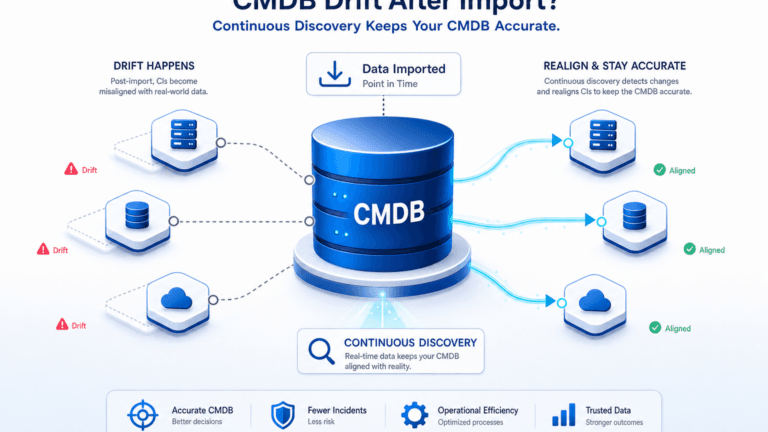
A CMDB is only as valuable as the accuracy of its CIs and relationships. In an enterprise, dedicated configuration managers run governance routines to clean up duplicate records and reconcile conflicting data. In a small business, IT engineers are forced to manually update configuration items or rely on basic spreadsheet imports. Within months, drift sets in, tickets link to dead assets, and the CMDB becomes an unreliable archive rather than a live operational system.
Why does ServiceNow feel heavy for small businesses?
ServiceNow requires dedicated platform administration, complex CSDM governance, and specialized skills that lean IT teams rarely have. Without full-time CMDB management, discovery gaps and data drift quickly make the platform costly and difficult to maintain.
What still works on ServiceNow without full ITOM scope
Recognizing that full-scale ServiceNow ITOM is too heavy for your current staff does not mean you have to abandon ServiceNow entirely. Many small and mid-sized businesses derive significant value from ServiceNow’s core ITSM capabilities while strategically limiting platform footprint.
Keep the ticketing layer
If your organization has already invested in ServiceNow ITSM, keeping ticket workflows, service portals, and incident management inside ServiceNow makes operational sense. The platform excels at tracking user requests, managing SLA escalations, and providing a unified helpdesk interface for employees.
This matters most when ServiceNow arrived through platform consolidation rather than a clean-slate rollout. If your team inherited ServiceNow after merging ITSM tools post-acquisition, or after retiring a legacy help desk, the ticketing layer is usually the easiest piece to keep stable. Rebuild the CMDB underneath it instead of replacing the whole platform – ripping out a working service desk to chase a lighter CMDB strategy trades one disruption for another.
Where native CMDB breaks down
The operational breakdown happens when teams attempt to build an enterprise-grade CMDB and service mapping practice natively inside ServiceNow without the dedicated staff to support it. Native ServiceNow Discovery requires complex MID Server setup, custom credential management, and extensive tuning across dynamic cloud and on-premises networks. That difficulty shows up at the industry level too. Complete IT asset visibility fell to just 36% in 2026, down seven points from the year before, as environments grew faster than manual reconciliation could keep pace (Virima’s IT asset management statistics).
That gap is where most native ServiceNow CMDB builds start to strain. Instead of forcing a lean team to manage enterprise ITOM modules, smart IT leaders freeze native CMDB expansion and evaluate lighter ways to supply reliable configuration data into their existing ServiceNow ITSM tables.
The lighter path: feed ServiceNow with authoritative discovery
Rather than ripping out ServiceNow or drowning in platform administration, growing companies often adopt an augmentation architecture. In this approach, ServiceNow remains your primary system of engagement for ITSM, while a lighter, dedicated discovery and CMDB engine is the system of record for asset infrastructure. This distinction matters because fewer than 25% of organizations report high confidence in their CMDB data, and a native, understaffed CMDB build is usually how that gap forms.
By offloading network discovery, hardware inventory, software asset tracking, and application dependency mapping to a platform built for rapid deployment, lean IT teams gain four immediate advantages:
- Minimal MID Server friction – deploy lightweight, agentless discovery that runs out of the box without requiring weeks of custom scripting or specialized MID Server management.
- Automated CI hygiene – normalize and reconcile asset data before pushing clean, deduplicated CIs directly into ServiceNow’s standard CMDB tables via bi-directional integration.
- Pre-built service maps – generate dynamic application dependency maps that visualize infrastructure relationships without forcing your team to master complex CSDM modeling rules.
- Predictable total cost of ownership – reduce surprise module costs and heavy consulting fees by using a unified discovery-and-mapping engine designed for lean operating budgets.
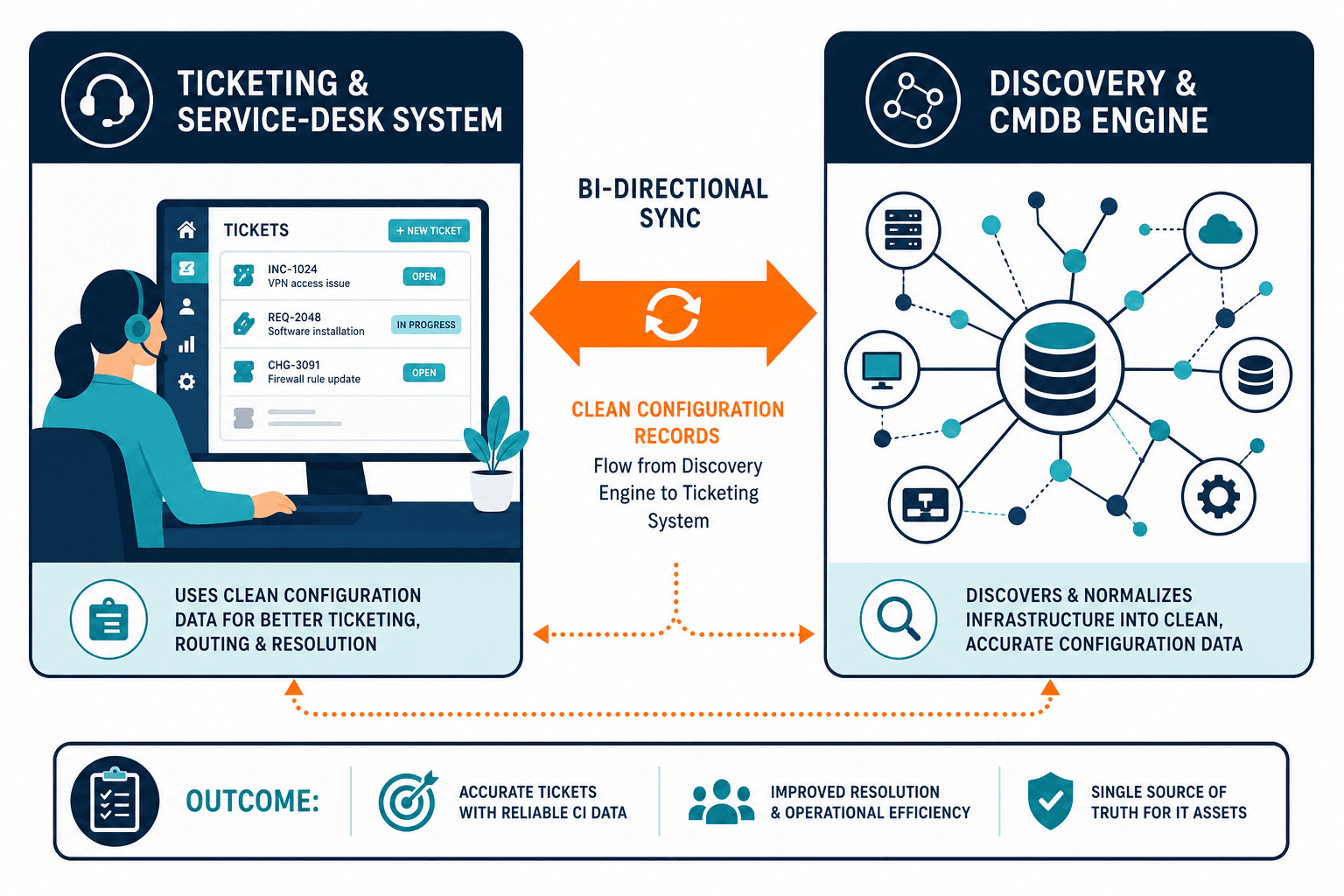
You can feed clean data into an existing ServiceNow environment through our integrations hub, or use Virima as a standalone discovery and CMDB engine. Either way, when your service desk agents open a ticket in ServiceNow, they see accurate, live asset details and service context – without your team having to manage an enterprise-scale ITOM suite to get there.
To learn how maintaining continuous accuracy across assets and dependencies protects service delivery, explore Virima’s Trusted Runtime Truth framework.
Can you use ServiceNow without buying ServiceNow Discovery?
Yes. Many mid-market organizations run ServiceNow for ITSM ticketing while using a dedicated third-party discovery engine like Virima to automatically populate and update the ServiceNow CMDB via API integration at a fraction of the operational cost.
What lean teams can start with: Virima Business Pro
For growing organizations that need enterprise-grade asset visibility without the complexity of full enterprise platform suites, Virima provides a specialized entry point tailored for lean IT.
Virima Business Pro delivers full enterprise discovery, CMDB, ViVID™ service maps, ITAM, and Vulnerability Insights through an operating model designed for lean teams. Instead of stripping down features into a “lite” product, Virima packages its complete capability set into a right-sized offering for growing IT estates. For a five-to-fifteen-person IT team already running ServiceNow ITSM, Virima Business Pro is built as the lightest-weight CMDB and discovery layer for a team that size.
Need enterprise CMDB and service mapping without platform complexity?
Business Pro gives a lean team a native CMDB, ViVID™ service maps, ITAM, Vulnerability Insights, full API access, standard integrations and a contact-led onboarding motion. See how Virima Business Pro fits your team.
Whether you choose to feed clean data into an existing ServiceNow environment or use Virima as your standalone discovery and CMDB engine, you get complete infrastructure truth without platform bloat.
Making the decision: stay, augment, or scope down for ServiceNow for small business
When determining your path forward with ServiceNow for small business, evaluate your current operational state against three core criteria:
| Evaluation Axis | Full Native ServiceNow | Lighter Discovery Augmentation Layer |
|---|---|---|
| Admin Resources Needed | Dedicated full-time admins | Minimal ongoing administration |
| Deployment Timeframe | 6 to 12+ months | Days to weeks |
| CMDB Data Currency | High risk of drift without manual cleanup | Automated agentless reconciliation |
| Budget Predictability | High ongoing services and module costs | Packaged for growing IT estates, with contact-led scoping |
Team size is the fastest way to place yourself on this table. A five-to-fifteen-person IT team rarely has the headcount to run enterprise ITOM modules well, regardless of budget. Once you have dedicated CMDB or platform administrators on staff, and an estate well into the tens of thousands of assets, native ServiceNow Discovery and CSDM investment starts to pay for itself. Most lean teams evaluating ServiceNow for small business sit well below that threshold, which is why an augmentation layer, not a rip-and-replace, is the more defensible starting point.
If you’re evaluating a full ServiceNow replacement rather than an augmentation layer, the same discovery-and-CMDB engine works standalone – see how it compares directly in Virima’s ServiceNow CMDB alternatives guide.
If your team is struggling to keep ServiceNow CIs accurate, do not try to solve the problem by adding more native modules. Start by fixing the underlying discovery layer. For most lean teams weighing ServiceNow for small business against a lighter build, the fix isn’t more native modules – it’s a more reliable discovery layer underneath the one you already have. By pairing ServiceNow’s ticketing strength with a lightweight, authoritative discovery platform, lean IT teams achieve complete visibility, faster incident response, and predictable costs.
Frequently Asked Questions
Is ServiceNow suitable for small businesses?
ServiceNow can work for small businesses primarily needing structured ITSM ticketing, but its CMDB and ITOM modules often prove too complex and resource-intensive for small teams to maintain natively without specialized staff or high consulting spend.
How does Virima integrate with ServiceNow?
Virima integrates with ServiceNow via API to automatically populate and update CMDB tables with discovery-sourced CIs, software inventory, and ViVID™ service maps data, ensuring ticket workflows always have accurate asset context.
How do I keep a ServiceNow CMDB accurate without a dedicated administrator?
Automated, agentless discovery can reconcile configuration items on a schedule and push clean, deduplicated data into ServiceNow’s CMDB tables, so accuracy doesn’t depend on manual updates or a full-time configuration manager.