Runtime Dependency Context AI Agents Need Before Production

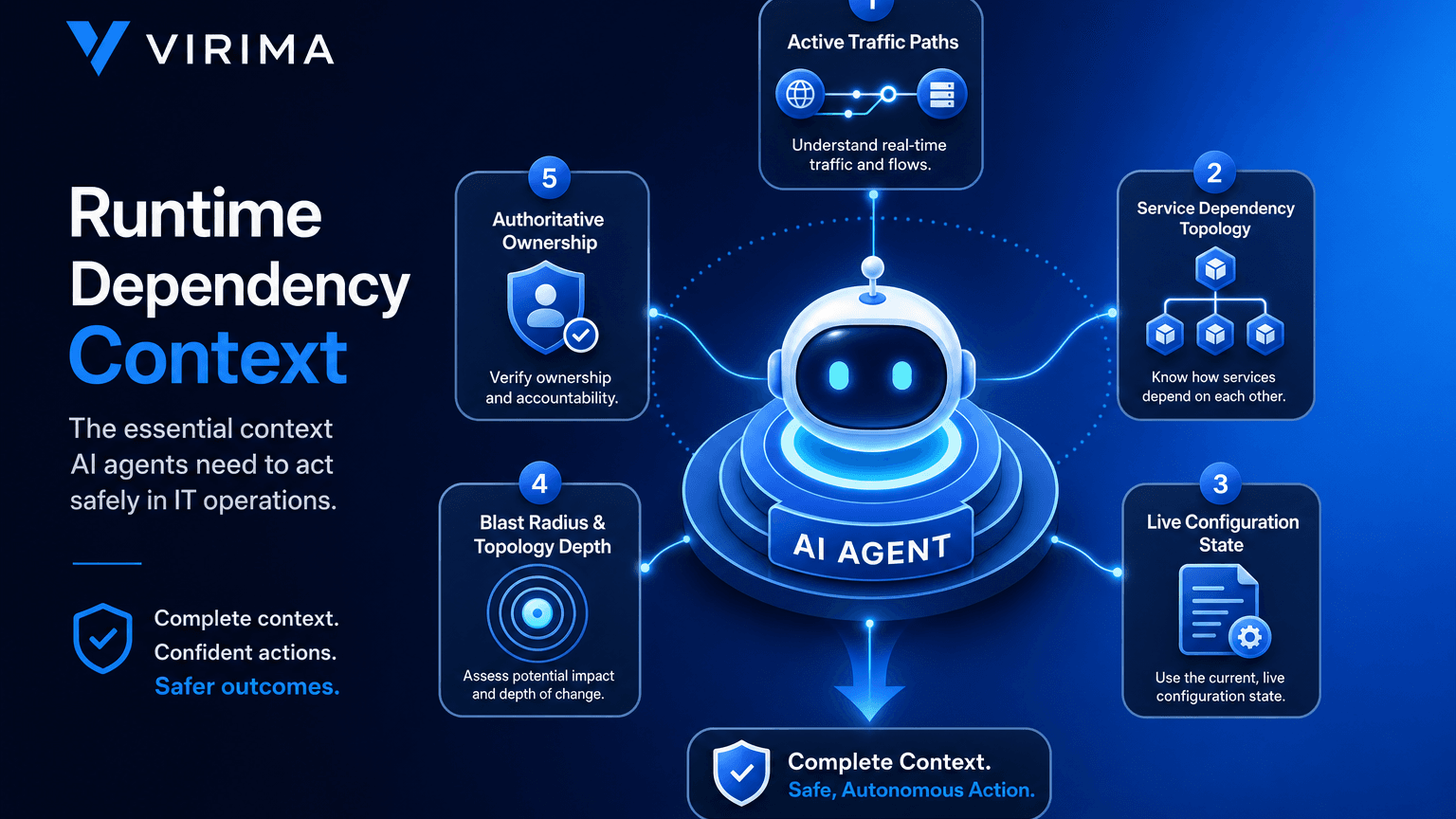
AI agents require five core layers of runtime dependency context before executing production changes: active network communication paths, upstream and downstream business service mappings, real-time configuration baselines, infrastructure blast radius, and verified service ownership. Without this explicit operational context, autonomous remediation scripts or LLM-driven agents evaluate individual configuration items in isolation, creating cascade outages across unmapped dependencies.
Automated discovery and runtime dependency mapping transform static configuration databases into governed execution boundaries. When an AI agent attempts to restart an unresponsive database node, clear a message buffer, or adjust an autoscaling group, it cannot rely on scheduled batch snapshots or manual architecture diagrams. Modern distributed environments shift continuously across hybrid cloud footprints, containerized microservices, and third-party APIs.
To prevent autonomous tools from breaking revenue-generating workflows, IT operations teams must supply agents with machine-readable, discovery-sourced runtime truth. Grounding agents in verified topological maps ensures that every programmatic decision accounts for live operational constraints, compliance boundaries, and business criticality.
The five mandatory context layers for autonomous execution
Autonomous execution in IT operations requires deterministic boundaries. While an engineer brings tribal knowledge and cross-team communication to a change ticket, an autonomous agent executes strictly against the telemetry, APIs, and schema it can access. Gartner projects more than 40% of agentic AI projects will be canceled by the end of 2027, citing escalating costs, unclear ROI, and inadequate risk controls as the leading causes, not model quality. Delivering trustworthy automation demands five distinct structural context layers instead of one connected data feed.
What context layers do AI agents require before executing production changes?
AI agents need live multi-hop dependency maps, active network communication sockets, verified business service criticality tiers, recent configuration change deltas, and authoritative service ownership records. Supplying these five layers prevents autonomous tools from isolating single configuration items and triggering unpredicted downstream outages.
| Context Layer | Operational Question Answered | Data Source | Production Failure Risk Without Context |
|---|---|---|---|
| Active Sockets & Traffic Paths | Which adjacent components actively communicate with this asset right now? | High-frequency discovery cycles, OS socket inspection | Agent restarts a silent dependency, dropping live transaction threads. |
| Service Dependency Topology | Which core business workflows depend on this database, container, or VM? | Service dependency mapping | Agent reboots a shared tier-1 authentication cache during peak operational hours. |
| Live Configuration State | Has this configuration item drifted from its approved baseline? | Discovery-sourced ground truth | Agent overwrites an emergency hotfix or misreads an intended failover state. |
| Blast Radius & Topology Depth | If this asset is modified or isolated, what breaks two or three hops away? | Dynamic relationship graphs | Agent isolates a compromised endpoint, inadvertently severing API gateway clusters. |
| Authoritative Ownership | Who owns the upstream business service and who must authorize failover? | CMDB relationship mapping | Agent triggers automated remediation with zero human escalation path during audit windows. |
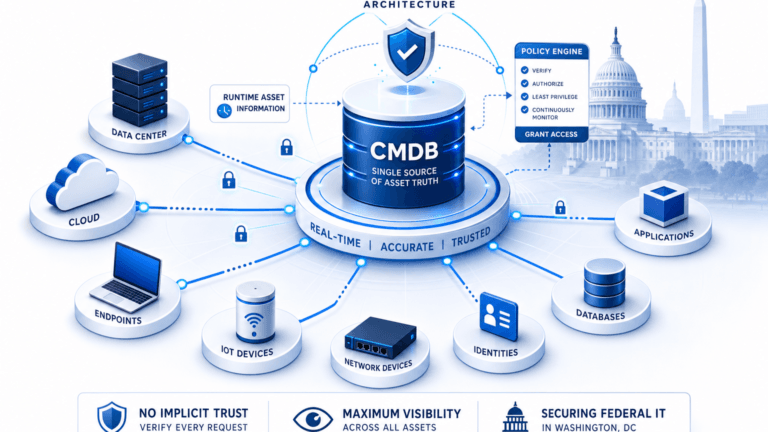
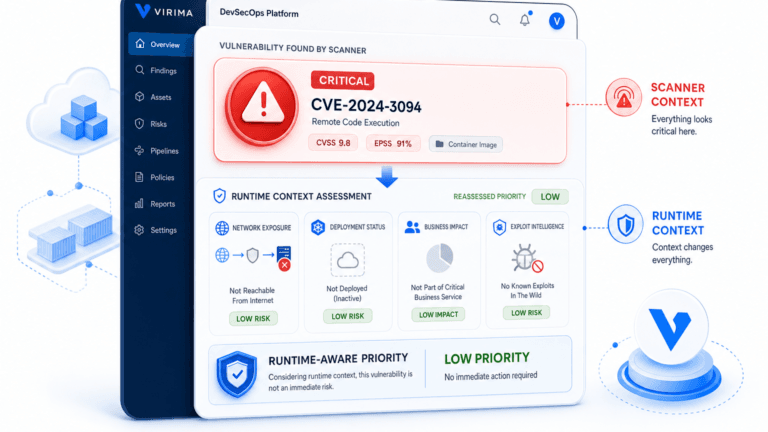
Virima establishes this foundation by unifying multi-source discovery with dynamic dependency visualization. Rather than forcing agents to parse raw log streams or unverified CMDB tables, Virima surfaces complete dependency structures directly to IT workflows. By feeding autonomous tools structured operational context via Virima Trusted Runtime Truth, organizations ensure agents act strictly within known, safe parameters.
Why static CMDB data fails agentic automation
Most configuration management databases were constructed for human change advisory boards operating on weekly release cycles. A human engineer reading a stale record can cross-reference communication channels, check monitoring dashboards, and verify server state manually. AI agents do not pause to verify assumptions unless an explicit programmatic check forces them to halt.
When enterprise teams connect autonomous IT agents to legacy configuration repositories, three fundamental points of failure emerge:
- High-Frequency Drift: Cloud workloads, serverless routines, and Kubernetes pods spin up and terminate across hours or minutes. Static asset inventories updated on monthly or weekly batch schedules miss transient infrastructure entirely.
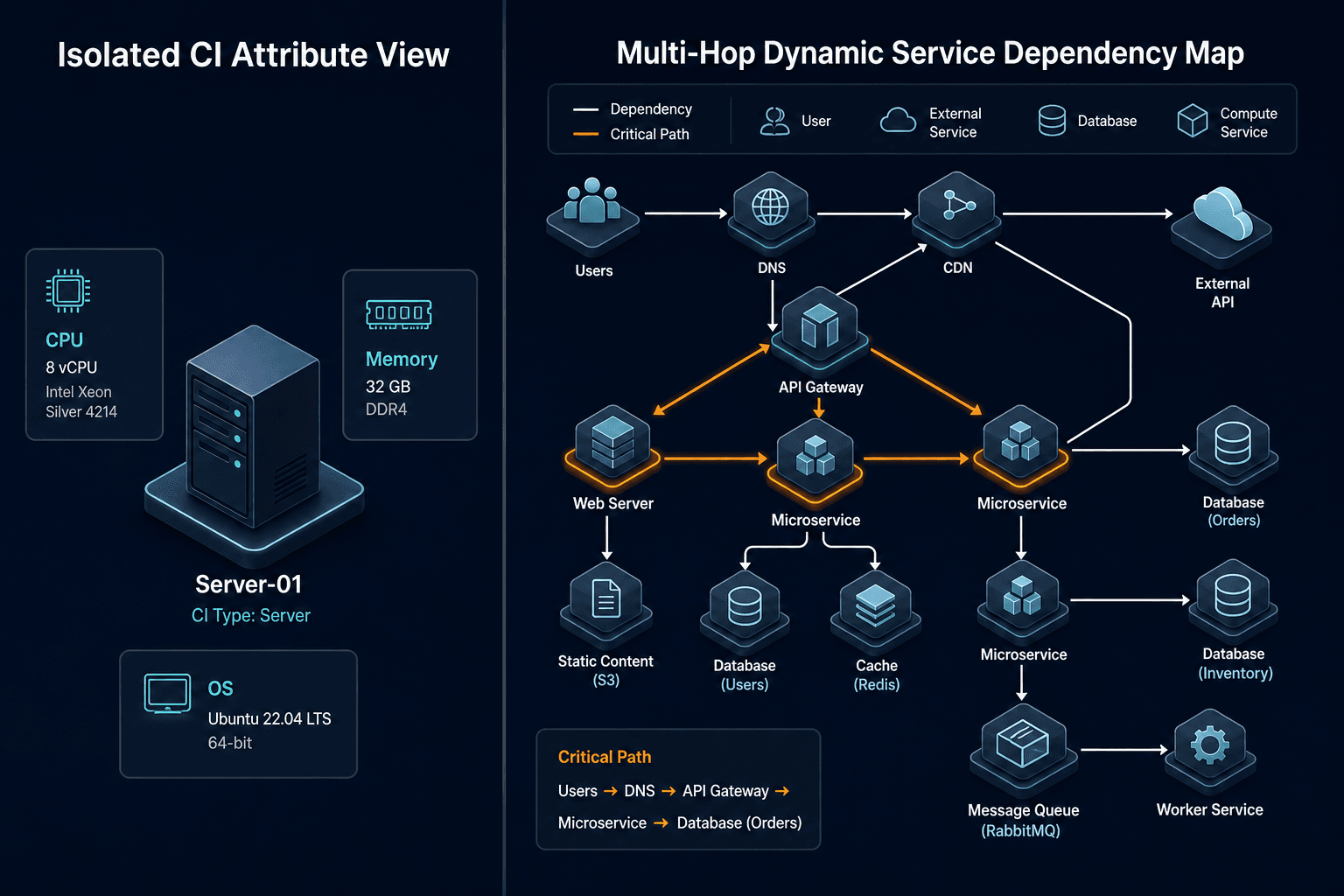
- Invisible East-West Communication: Traditional IT asset inventories capture device attributes such as operating system version, CPU allocation, and IP address. They routinely fail to track dynamic east-west network connections between internal application components.
- Missing Service Ownership Context: An asset record might register a running PostgreSQL database, but fail to record that it underpins the core checkout pipeline. An agent programmed to recycle memory-saturated processes will take that checkout pipeline down without warning.
Virima’s IT Discovery eliminates these data gaps through scheduled, high-frequency discovery cycles that reconcile physical, virtual, and cloud assets. By comparing discovered runtimes against historical baselines, Virima confirms whether an asset is safe for autonomous intervention before programmatic execution begins. Building that discovery-sourced foundation before granting write access is exactly the gap Virima’s guide on what a trustworthy CMDB needs before you scale AI automation walks through in more detail — alongside the related breakdowns of whether your CMDB is ready for AI agents and how CMDB data becomes the control layer for AI agents.
Multi-hop blast radius: calculating impact beyond step one
The primary failure mode of generative and agentic AI in IT operations is linear reasoning. An agent notices that an API gateway node is throwing 502 errors and concludes that restarting the local process will restore service. But if that gateway node acts as the primary ingress route for microservices distributed across AWS and Azure environments, restarting it abruptly drops active sessions across four downstream teams.
Recent major enterprise outages demonstrate the severity of latent, unmapped paths. In the AWS summary of the DynamoDB disruption in US-EAST-1, an internal DNS race condition impacted DynamoDB endpoints, exposing that over 140 downstream AWS services silently relied on DynamoDB for internal state management. Similarly, Cloudflare reported during their November 18, 2025 outage postmortem that a routine permissions change cascaded into a global network outage due to an unmapped latent dependency in bot-management configuration parsing. When autonomous agents operate without multi-hop dependency maps, they reproduce this exact class of failure at machine speed. CTOs are increasingly pricing unknown dependencies as unpriced release risk for exactly this reason, and multi-hop blast radius mapping is how that risk gets quantified before a change ships.
Calculating multi-hop blast radius requires traversing relationship graphs in real time:
- Step-Zero Verification: The agent identifies target asset host, IP, and assigned application roles.
- First-Hop Inspection: The agent checks immediate parent hypervisors, clustering peers, and direct storage attachments.
- Multi-Hop Dependency Traversal: The agent traces active network sockets to evaluate every application service consuming data from the target asset.
- Business Policy Validation: The agent matches the resulting topology against active change freeze windows, peak transaction hours, and regulatory boundaries.
How is blast radius calculated for an AI agent’s proposed change?
Blast radius is calculated by traversing the target asset’s relationship graph in four steps: verifying the asset itself, inspecting first-hop parents and storage attachments, tracing active network sockets to every downstream consumer, and validating the resulting topology against change freeze windows and business-criticality policy. Skipping any step leaves the agent reasoning about the asset in isolation.
Using Virima Service Mapping, organizations convert complex operational topologies into machine-readable, multi-hop dependency maps that surface relationships across hybrid cloud, containerized, and virtualized environments. ViVID™ service maps dynamically map dependencies between applications, infrastructure, and supporting services once service definitions are supplied. This gives operations teams and integrated automation platforms a verified map of exactly what exists, how assets connect, and what will break if a component changes. Detailed change impact analysis requires this level of structural fidelity to prevent silent cascade failures.
Integrating autonomous agents into governed IT environments
Enterprise IT infrastructure does not run in a single, unified environment. IT leaders maintain complex portfolios across ITSM platforms, cloud providers, and observability stacks. For an AI agent to operate safely, it must retrieve consistent dependency context regardless of where execution occurs.
Connecting agents directly to disparate monitoring point solutions creates conflicting signals. Observability tools report real-time transaction traces, but lack configuration baselines or ownership data. Legacy asset managers record serial numbers and purchase orders, but rarely surface active dependency relationships. Gartner’s own governance research found that most enterprises still lack a mature AI agent governance model, which is exactly the gap that makes explicit runtime dependency context non-negotiable rather than a nice-to-have.
Virima bridges this architectural divide by centralizing discovery-sourced truth and feeding it across your operational environment. Rather than replacing existing systems, Virima links directly with leading service management platforms through the Virima Integrations Hub. By enriching platforms such as ServiceNow, Jira Service Management, and Ivanti with verified runtime dependencies, your IT automation workflows run on authoritative, contextual infrastructure data.
Operational verification: pre-flight checklist for AI actions
Before granting an AI agent write permissions or autonomous execution rights in production environments, IT operations and enterprise architecture teams evaluating autonomous remediation tooling should enforce a strict runtime context validation routine. This checklist assumes discovery has already populated and continuously refreshes the underlying CMDB — an agent can’t validate freshness against a baseline that doesn’t exist yet:
- Asset Discovery Freshness: Trigger a discovery re-scan if the target CI’s last-verified timestamp exceeds your change-window SLA.
- Active Socket Validation: Pull current active socket data before executing — don’t rely on a cataloged port list that may be stale.
- Service Criticality Check: Confirm the asset’s service-criticality tier is populated and current, not inherited from a default classification.
- Change Window Concurrency: Check adjacent dependencies against active maintenance windows, emergency hotfixes, and change freeze states before executing.
- Multi-Hop Impact Clearance: Run the multi-hop blast radius traversal and resolve any flagged upstream interruption risk before granting execution.
- Escalation Route Verification: Confirm an authoritative owner is mapped and reachable for automated alerts and human handoff.
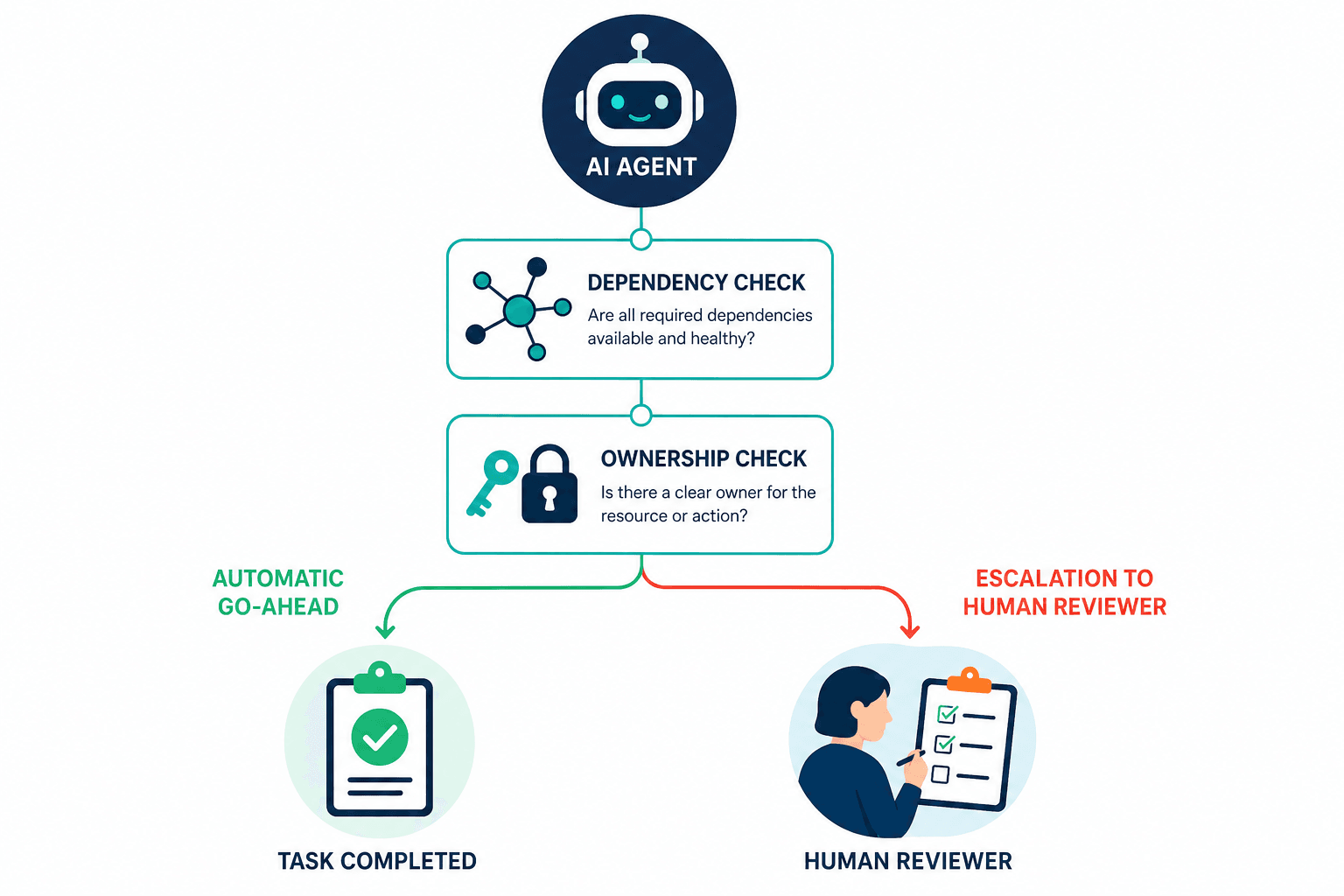
This checklist exists because the escalation-route failure is not hypothetical. It is the same gap the Cloudflare and AWS postmortems cited above trace back to: a change proceeded because no step forced a pause for missing context. Virima supplies the continuous discovery telemetry and dependency intelligence required to satisfy these pre-flight gates, allowing organizations to scale automation while safeguarding operational availability.
Frequently Asked Questions
How does runtime dependency context differ from traditional static CMDB data?
Traditional CMDB data stores point-in-time configuration attributes such as operating systems, hardware versions, and assigned locations. Runtime dependency context captures live, active network communication sockets, running service paths, and multi-hop relationships between infrastructure components and business applications. This dynamic visibility reveals how components interact under real production workloads.
Can observability traces replace service dependency mapping for AI agents?
APM and distributed tracing reveal active transaction paths across instrumented code, but they do not provide complete infrastructure visibility. Tracing tools routinely miss uninstrumented legacy databases, network appliances, virtualization hosts, and configuration drift. Service dependency mapping couples physical and virtual asset inventory with active dependency relationships, delivering a comprehensive operational foundation for AI decision-making.
How does Virima deliver runtime dependency context to external AI systems?
Virima integrates across enterprise ITSM, ITOM, and automation environments via direct APIs and certified connectors. By populating and refreshing service relationships within platforms such as ServiceNow and Jira, Virima ensures AI workflows, automated runbooks, and remediation agents query verified, multi-hop operational context prior to executing changes.