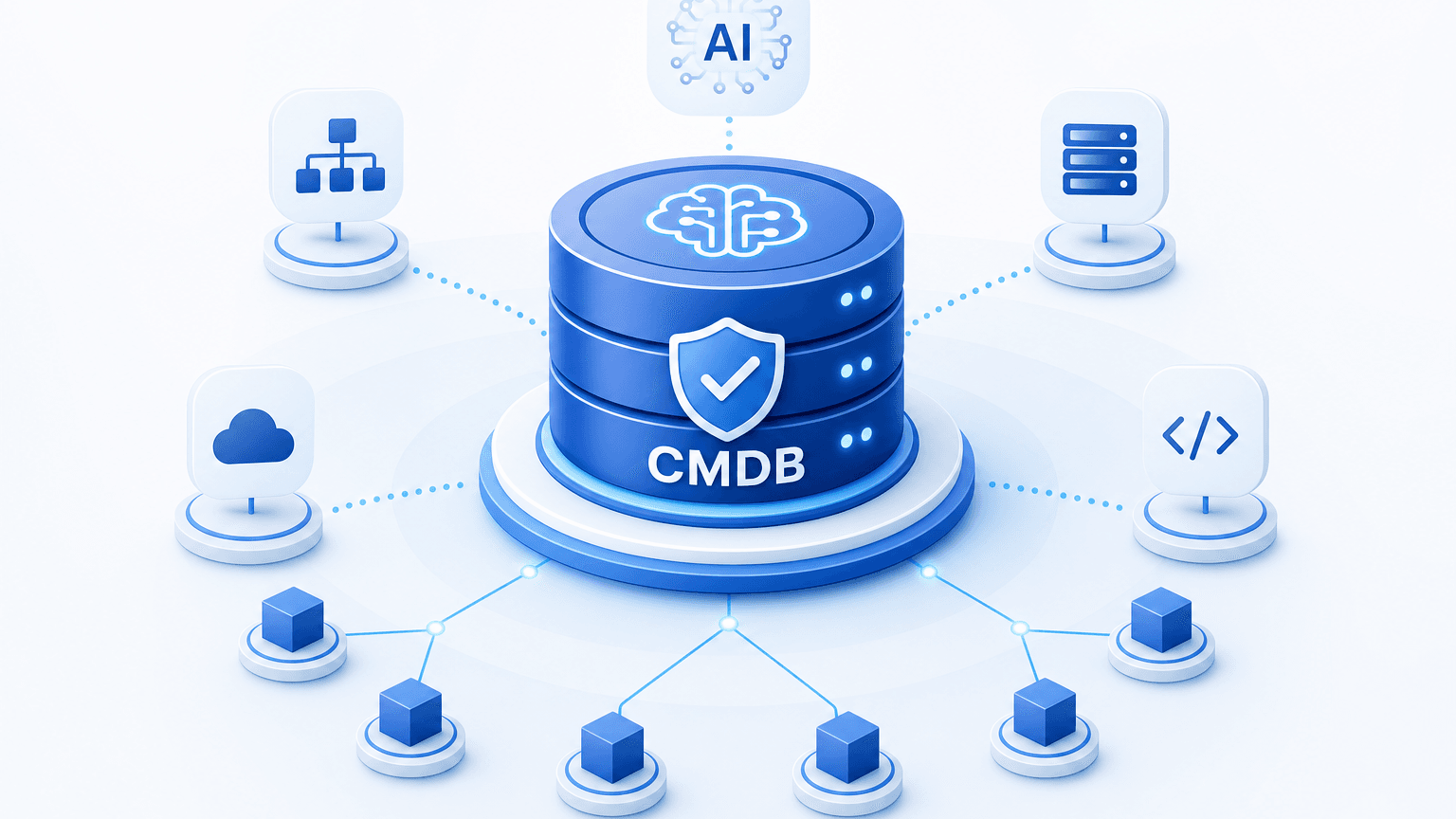
What a Trustworthy CMDB for AI Automation Needs Before You Scale

An automation owner expands a change-assist playbook from one service line to three. Leadership signs off on the throughput story. The first production week looks fine until a remediation job targets a configuration item still showing last quarter’s owner and a relationship map that never recorded a jump path added during a cloud migration. The job completes, and the ticket closes. The blast radius shows up in a customer-facing service two hops away: the clearest sign yet that this was never a trustworthy CMDB for AI automation to begin with.
Ops teams feel that miss as overnight cleanup and lost trust in every script running afterward. Leadership feels it as a stalled scale plan and a board question about whether AI spend is under control. Both groups are looking at the same root condition: the configuration management database (CMDB) was never built to the discovery-sourced, ownership-mapped standard that AI automation now requires.
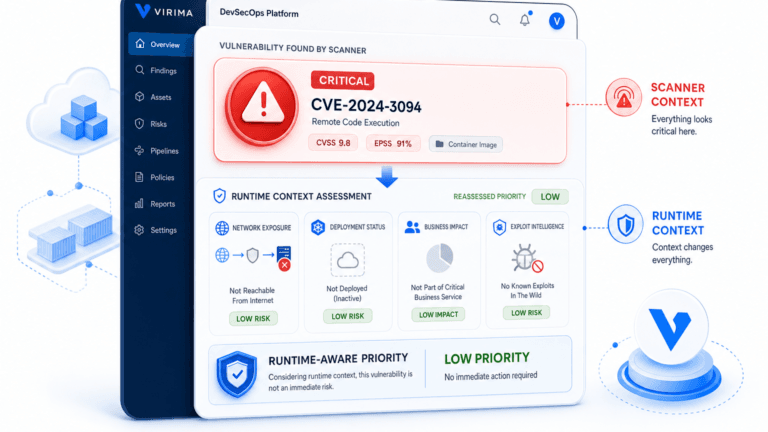
The agentic IT era runs on runtime truth, not ticket history or spreadsheet confidence.
See Virima Trusted Runtime Truth →
What is a trustworthy CMDB for AI automation?
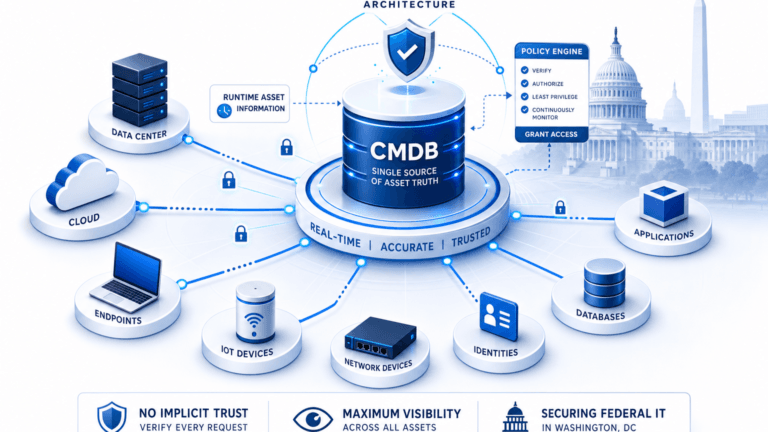
Under ITIL-aligned configuration management practice, a CMDB holds controlled information about services and the infrastructure that supports them. The record set should answer what exists, how it is configured, who owns it, and what depends on it before anyone changes production. That discipline is older than agentic IT. What changed is the cost of being wrong when software executes the next step without a human reading the same packet.
A trustworthy CMDB for AI automation extends the classic baseline with one extra test. Every configuration item (CI) and relationship an agent or runbook will touch must be current enough, complete enough, and attributable enough that a machine action is defensible after the fact. Completeness outside the automation boundary can wait. Completeness inside the next wave cannot.
Core requirements stay practical:
- Discovery-sourced CI coverage for environments inside automation scope
- Relationship and dependency data a change board or agent policy can read
- Ownership, criticality, and lifecycle state on records the automation path will use
- Reconciliation rules that prevent duplicate and last-scan-wins corruption
- Audit history that shows when the record last matched discovery
- A governance cadence that treats accuracy as an operating metric, not a cleanup project
The hidden problem before scale
| Situation | What happens |
|---|---|
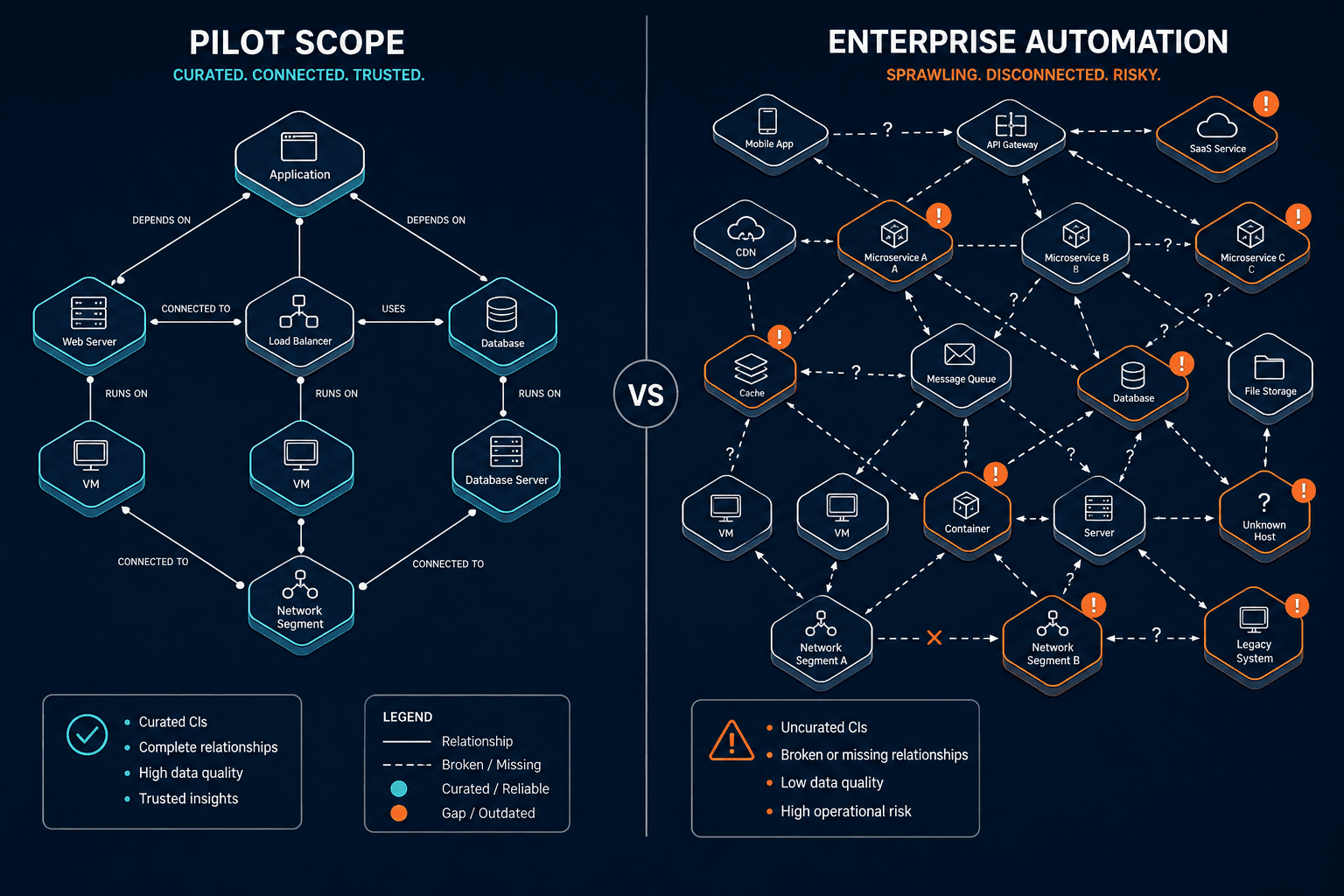
| Pilot automation runs on a hand-curated CI slice | Scale multiplies the uncurated remainder; agents inherit gaps the pilot never saw |
| CMDB looks complete in dashboards | Relationships, owners, and cloud CIs lag; impact paths stay tribal knowledge |
| Teams add agents before discovery scope expands | Automation velocity rises while the record set stays launch-day thin |
Trustworthy does not mean perfect across the whole estate on day one. It means the classes and services inside the automation boundary meet a documented bar before that boundary widens. CMDB data quality for AI is a scope problem first and a model problem second. Ops and leadership CMDB readiness fail together when the gate is informal.
When is a CMDB trustworthy enough for AI automation scale?
A configuration management database (CMDB) is scale-ready when every configuration item (CI) and relationship inside the automation boundary is discovery-backed, owned, and reconcilable on a stated cadence. Pilot-curated slices fail that test the moment scope leaves the curated set, because agents apply the same confidence to incomplete paths that humans would escalate.
Why this matters before AI or automation scales
Scaling AI on CMDB data means scaling whatever data quality already exists, good or bad, at agent speed. Automation multiplies whatever the CMDB already holds. Incomplete CIs become blind spots in impact analysis. Duplicate CIs become conflicting targets. Missing relationships become silent blast-radius errors. Industry research keeps landing on the same foundation story rather than on a better model alone.
IBM’s analysis of poor data quality cites a 2025 IBM Institute for Business Value finding that 43% of chief operations officers name data quality as their top data priority. More than a quarter of organizations estimate annual losses above USD 5 million from poor data quality, and 7% report USD 25 million or more. The same piece notes that nearly half of business leaders (45%) flag data accuracy or bias concerns as a barrier to scaling AI. Those figures are not CMDB-only, but they describe the cost shape automation inherits when configuration records are wrong.
Scale pressure is not abstract. Technology leaders are asked to raise agent and automation counts while visibility lags. Business units ship tooling faster than central IT can inventory it. Governance models built for slower change windows struggle when software proposes the next step in minutes. The CMDB is where that mismatch becomes visible, because every automated action still needs a defensible target and a defensible path.
Four ways pre-scale CMDB gaps threaten ops and leadership CMDB readiness
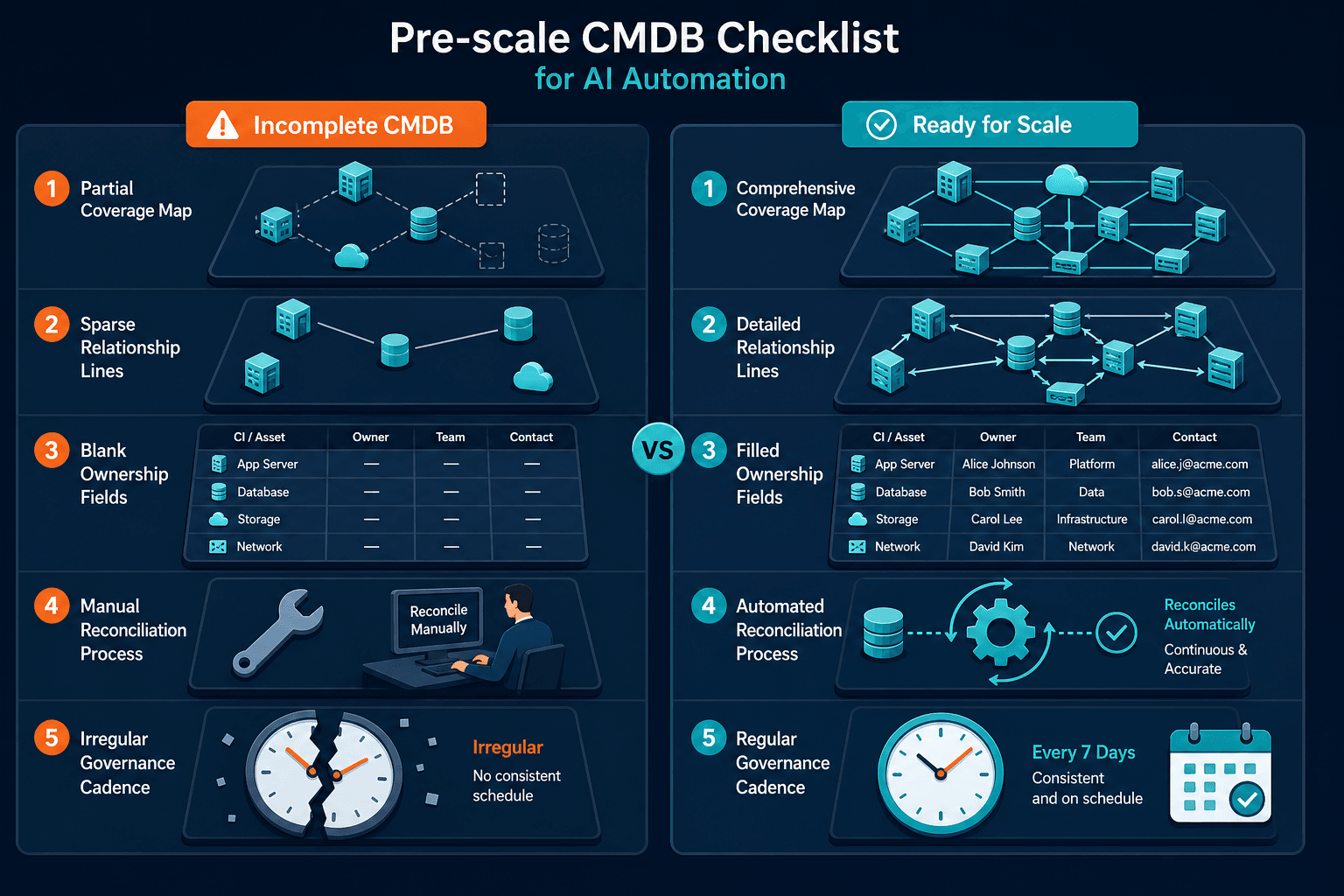
- Coverage stops at corporate LAN or one cloud account. Result: agents never see multi-account or edge CIs on the real path.
- Relationships are sparse or stale. Result: remediation logic cannot prove blast radius, so humans re-enter after every surprise.
- Ownership and criticality fields are empty or outdated. Result: automation cannot route exceptions, and leadership cannot assign accountability.
- Reconciliation is last-scan-wins or manual. Result: duplicates and thrash destroy trust faster than any model upgrade can restore it.
Language matters for product honesty. High-frequency scheduled discovery is the operating model teams can defend today. Claims of passive always-on or event-stream CMDB sync overstate what most stacks can prove in production. Scaling AI on CMDB data only stays safe when freshness matches how fast the estate changes. Publish that cadence so ops and leadership argue from one definition of current.
Why do AI automation pilots stall after the first production expansion?
Expansion moves the agent or runbook onto configuration items (CIs) that were never inside the pilot’s curated set. Practitioners writing for independent ITSM publications describe the pattern as agents scaling bad decisions with unearned confidence when the CMDB is incomplete or full of duplicates. The model stays the same; the data boundary is what changed.
Who pays when the CMDB is not ready
For ops and automation owners
You inherit overnight jobs that fire on stale CIs. Every false target becomes a credibility problem for the next automation request. You reconcile cloud consoles, CMDB exports, and tribal runbooks before leadership asks why the scale plan slipped. Automation-safe configuration data is what lets you defend the next wave without another war room.
For configuration managers and CMDB owners
You become the most-questioned person in the room when an automated change hits an undocumented dependency. Without discovery coverage and reconciliation discipline, you cannot keep the record set current at automation pace. A formal gate checklist turns that work into a leadership decision instead of a private firefight.
For CIO- and CTO-adjacent leaders
You carry board pressure to scale AI while control models still assume slower, human-gated change. A weak CMDB turns the control gap into repeat incidents. CMDB prerequisites for automation are a control investment, not a tooling vanity project. Spend narratives collapse when incident write-ups keep starting with missing inventory.
An IBM Institute for Business Value study of technology executives (2,000 tech CxOs across 33 geographies) found that only 11% feel fully prepared for AI agent scale. Seventy percent say teams deploy faster than IT can track. Surveyed organizations averaged 54 AI agent incidents needing human correction in the prior year, and two-thirds of surveyed leaders said they are accountable for AI systems they do not fully control.
For regulated and audit-heavy environments
Frameworks governing inventory and configuration evidence expect a picture that maps to real systems. The CMDB does not replace GRC tooling. It supplies the infrastructure picture those programs request on demand. When that picture is reconstruction work, audit prep and automation scale collide on the same missing records. Map automation scope to the same CI set you would hand an auditor. Deloitte’s 2026 State of AI in the Enterprise report found that 74% of organizations plan to adopt agentic AI within the next two years. Only 21% currently have a mature governance model for those agents. Those questions land on the CMDB long before they land on model choice.
Who feels an untrustworthy CMDB first when automation scales?
Automation owners feel it first as false targets and rollback nights. Configuration managers feel it next as CAB credibility loss on records they cannot refresh fast enough. Executives feel it last as incident volume and a control narrative that no longer matches the agent count the board was promised.
What a trustworthy CMDB needs before you widen scope
Treat this section as the six-row CMDB scale gate. If a row fails for services inside your next automation wave, keep humans on those actions until the row passes. That is the practical heart of CMDB prerequisites for automation and the shared language ops and leadership can both sign.
1. Discovery coverage that matches the automation boundary
Agentless, agent-based, and API-based methods should feed one CI model for on-prem, AWS, and Azure resources in scope. Without discovery, the CMDB remains a database of intentions (see A CMDB Without Discovery Is Just a Database). Scale plans that skip discovery expansion automate last quarter’s estate. Cloud accounts added after the last inventory project are the usual silent gap.
2. Relationships that support blast-radius questions
Service definitions still need a human or enterprise-architecture source. Once those definitions exist, dependency maps can show infrastructure paths agents and CAB members both need. Without relationships, automation can only act on isolated nodes. Ops and leadership CMDB readiness both fail if impact paths stay tribal.
3. Ownership, criticality, and lifecycle state
Automation that cannot find an owner cannot escalate cleanly. Leadership that cannot see criticality cannot set policy for which actions stay human-gated. Lifecycle state keeps decommissioned CIs out of live runbooks. Empty owner fields are a scale blocker because exception handling is part of safe automation.
4. Reconciliation that survives multi-source input
Cloud APIs, network scans, and agents disagree. Last-scan-wins logic creates thrash. Governed identification and reconciliation keep one authoritative CI when sources conflict. Multi-source noise is one of the fastest ways a pilot-grade CMDB loses trust after the first expansion wave.
5. Freshness cadence tied to change rate
Cloud projects and branch changes move on different clocks. A single annual CMDB project cannot serve either. Scheduled high-frequency discovery cycles, with exception review, are the honest control. Many teams gate production CIs at a discovery-verification age of roughly 30 days, and cloud CIs at roughly 7 days, before allowing agent action on them. This is a directional industry pattern, a reasonable starting control for teams that have not set one yet. Publish the cadence so ops and leadership share one definition of current before anyone argues about agent count.
6. Governance metrics ops and leadership both read
Completeness, compliance to data standards, and correctness should sit on the same operating review as automation success rate. Stabilize the slice the automation touches before you widen that slice. Measure task success and bad-target rate like any critical system. A narrow agent on trustworthy data beats a broad agent on shaky records.
Ian Cox, writing for the independent ITSM publication ITSM.tools, frames completeness, compliance, and correctness as the difference between a productivity tool and a liability with a friendly interface in his essay on ITSM AI agents and CMDB data quality. Use that framing in internal reviews even when the essay is not open on the projector.
| Not ready to scale | Trustworthy CMDB gate met | |
|---|---|---|
| CI coverage | Pilot-curated list | Discovery-backed classes in automation scope |
| Relationships | Tribal or spreadsheet | Mapped paths for in-scope services |
| Ownership | Blank or stale | Named owners and escalation paths |
| Reconciliation | Manual or last-scan-wins | Governed multi-source rules |
| Cadence | Project cleanup | Scheduled discovery with review |
| Leadership view | Dashboard vanity completeness | Shared accuracy and incident metrics |
If any row fails for the next wave, hold scope. Publish the score on a shared page. Review it on the same cadence as automation success metrics. When the score slips, freeze expansion until discovery and reconciliation catch up. That single operating habit prevents most post-pilot trust collapses and keeps CMDB data quality for AI from becoming a quarterly cleanup theater.
How teams close the gap without a rip-and-replace
Three mechanisms matter. None require throwing away the ITSM platform that already owns tickets and changes. The goal is a trustworthy CMDB for AI automation feeding those workflows, not a second inventory nobody opens during a Sev-1.
1. Discovery that feeds one authoritative record set
Combine methods so hybrid estates land in shared CI records. Coverage without reconciliation still fails the trustworthy test. Discovery has to reach the accounts the next automation wave will touch, including AWS and Azure resources that never lived on the original corporate LAN scan. Agentless, agent-based, and API methods each cover different blind spots. Virima IT discovery is built for that multi-method feed into a CMDB teams already trust. For the automation-stack-specific version of these requirements, see CMDB for AI Agents: What Your Automation Stack Needs.
2. Service maps after definitions exist
Once service composition is supplied (manual entry, spreadsheet, or an EA feed), service maps can surface infrastructure dependencies. Agents and humans then share the same path view. Maps do not invent service composition on their own; definitions come first. Virima ViVID™ service maps follow that order so CAB packets stay honest.
3. ITSM integration where work already happens
Bidirectional sync with platforms such as ServiceNow, Jira Service Management, and Ivanti puts discovery-sourced context into queues people already use. Teams running agents directly inside ServiceNow face this same readiness question; see Before You Run AI Agents on ServiceNow, Answer These 5 Questions About Your CMDB. Partner names stay plain text. When you need connector scope, use the Virima integrations hub rather than a chain of partner pages.
Map your automation-scope CMDB gaps before the next scale wave →
What this looks like on the floor
- An ops lead expanding auto-remediation freezes new services until discovery covers those accounts, then turns automation back on per class, cutting the overnight-rollback rate instead of just documenting it.
- A configuration manager facing a scale mandate publishes a gate scorecard leadership accepts before agent count rises, turning CAB credibility from a recurring argument into a standing agreement.
- Where hybrid infrastructure sits with a CTO-adjacent owner, the ITSM platform stays in place, and discovery-sourced CMDB truth gets added so control stories match the estate IT can see, closing the gap between the agent count promised to the board and the agent count IT can actually defend.
- In a regulated business unit, inventory evidence becomes the same record set automation reads, so audit prep stops being a separate reconstruction project.
These scenes are illustrative patterns, not named customer cases. Hold scope until the gate passes, then widen. That is how automation-safe configuration data becomes an operating habit.
Where Virima fits in the pre-scale gate
Virima is a discovery and CMDB foundation that sits beside the ITSM platform you already run. It does not require you to discard ServiceNow, Jira Service Management, or Ivanti to get trustworthy CI data for automation scope. The CMDB product surface is discovery-sourced records and relationships, not a rip-and-replace of your system of engagement.
What changes in the first scheduled cycles
High-frequency discovery starts closing cloud and hybrid blind spots without a multi-month manual rebuild. Teams see net-new CIs and stale records inside the automation boundary first. Early cycles should also expose owner gaps and relationship holes before anyone raises agent concurrency.
What stays accurate as the estate shifts
Scheduled discovery cycles keep refreshing CI records as accounts and connectivity change. The CMDB stops being a launch-day snapshot that automation outgrows in a quarter. Freshness becomes a published control leadership can ask for next to open incident counts.
Where maps and workflows fit
Once service definitions exist, ViVID™ service maps surface infrastructure dependencies for services inside scope. Integrations deliver CI context into existing ITSM queues. IT asset management views can sit on the same discovery-backed truth for lifecycle questions. Leadership gets a shared accuracy picture; ops gets fewer false targets.
Product boundaries stay clear. Virima maps infrastructure and relationships. Service composition still needs definitions before maps stay useful. Virima does not replace GRC platforms, model gateways, or runbook engines. When a CI leaves service, the IT team decommissions the record after confirming no active dependencies remain.
What should ops and leadership expect from discovery-backed CMDB work before AI scale?
Ops should expect missing and stale configuration items (CIs) inside the next automation wave to surface within the first scheduled discovery cycles. Leadership should expect a shared gate scorecard (coverage, relationships, ownership, freshness) before agent or runbook scope expands. Neither outcome requires replacing the ITSM platform already in production.
Moving from pilot confidence to scale confidence
| From | To |
|---|---|
| Hand-curated pilot CI lists | Discovery-backed classes in automation scope |
| Automation success measured only on ticket deflection | Automation success plus CMDB gate metrics on the same review |
Runbooks and agents act on records that matched recent discovery, so false targets drop. Ownership and criticality fields make human handoff explicit, so exception paths stay clear. Ops and leadership argue from one scorecard instead of competing anecdotes, so scale decisions become shared rather than contested.
Getting started
- Freeze the next automation expansion wave and list every CI class it will touch.
- Score coverage, relationship density, owner fill rate, and last discovery age for that set. Virima’s CMDB health score breaks down a scoring mechanism if you need a starting model rather than building one from scratch.
- Expand discovery to the accounts and ranges those classes live in.
- Connect discovery output into the ITSM platform already in use.
- Set a review cadence that blocks scope growth when gate metrics slip.
If your team still treats the CMDB as a static inventory project, rebuild the mental model first. A CMDB is a controlled configuration record set, not a warehouse of aspirational diagrams. Foundations content helps after the gate decision, not as a substitute for it. When you need that refresher later, start from Virima’s complete guide on what a CMDB holds for IT teams, then return to the six-row gate before you raise automation scope.
Scale only on records you can defend
A trustworthy CMDB for AI automation is not a slogan. It is a pre-scale gate: discovery-sourced coverage, relationships, ownership, reconciliation, freshness, and shared governance metrics for the services you are about to put under machine action. Ops teams need that gate to keep automation credible. Leadership needs it to keep AI control claims honest as agent and runbook counts rise.
Hold the next wave until the gate passes. Then scale on purpose. Shared scorecards beat heroic cleanups. Ops owners should leave the room with a frozen scope list and a discovery expansion plan. Leadership should leave with a date when gate metrics must clear before agent count rises. Configuration managers should leave with authority to block expansion when owner fill rate or relationship density drops. That three-way agreement is the operating model in plain language. Without it, every new agent is a bet against last quarter’s inventory. The demo path is for teams ready to map automation-scope gaps against live discovery rather than teams still debating whether inventory matters.
See your automation-scope CMDB gaps mapped in a demo →
Frequently Asked Questions
What makes a CMDB trustworthy enough for AI automation?
Discovery-backed configuration items, usable relationships, current ownership and criticality, governed reconciliation, and a freshness cadence that matches how fast the estate changes inside the automation boundary.
Should teams scale AI agents before fixing CMDB data quality?
No. Widen scope only after the CI classes the next wave will touch meet an agreed gate. A narrow agent on trustworthy data beats a broad agent on incomplete records.
How do ops and leadership share one CMDB readiness view?
Publish a short scorecard for automation-scope classes: coverage, relationship density, owner fill rate, last discovery age, and automation incident rate tied to bad targets. Review it on the same cadence as scale decisions.
Does Virima replace ServiceNow or other ITSM platforms for AI automation?
No. Virima supplies discovery-sourced CMDB and relationship truth that can sync into ServiceNow, Jira Service Management, or Ivanti so automation and humans read the same records without a platform rip-and-replace.
Does Virima’s discovery cadence meet the freshness bar AI automation needs?
Virima runs scheduled, high-frequency discovery cycles across agentless, agent-based, and API methods rather than claiming continuous or real-time sync. That cadence is built to keep pace with cloud and hybrid change rates, though teams should confirm it matches their own automation-scope freshness requirement before scaling.