CTOs: Unknown Dependencies Are Unpriced Release Risk

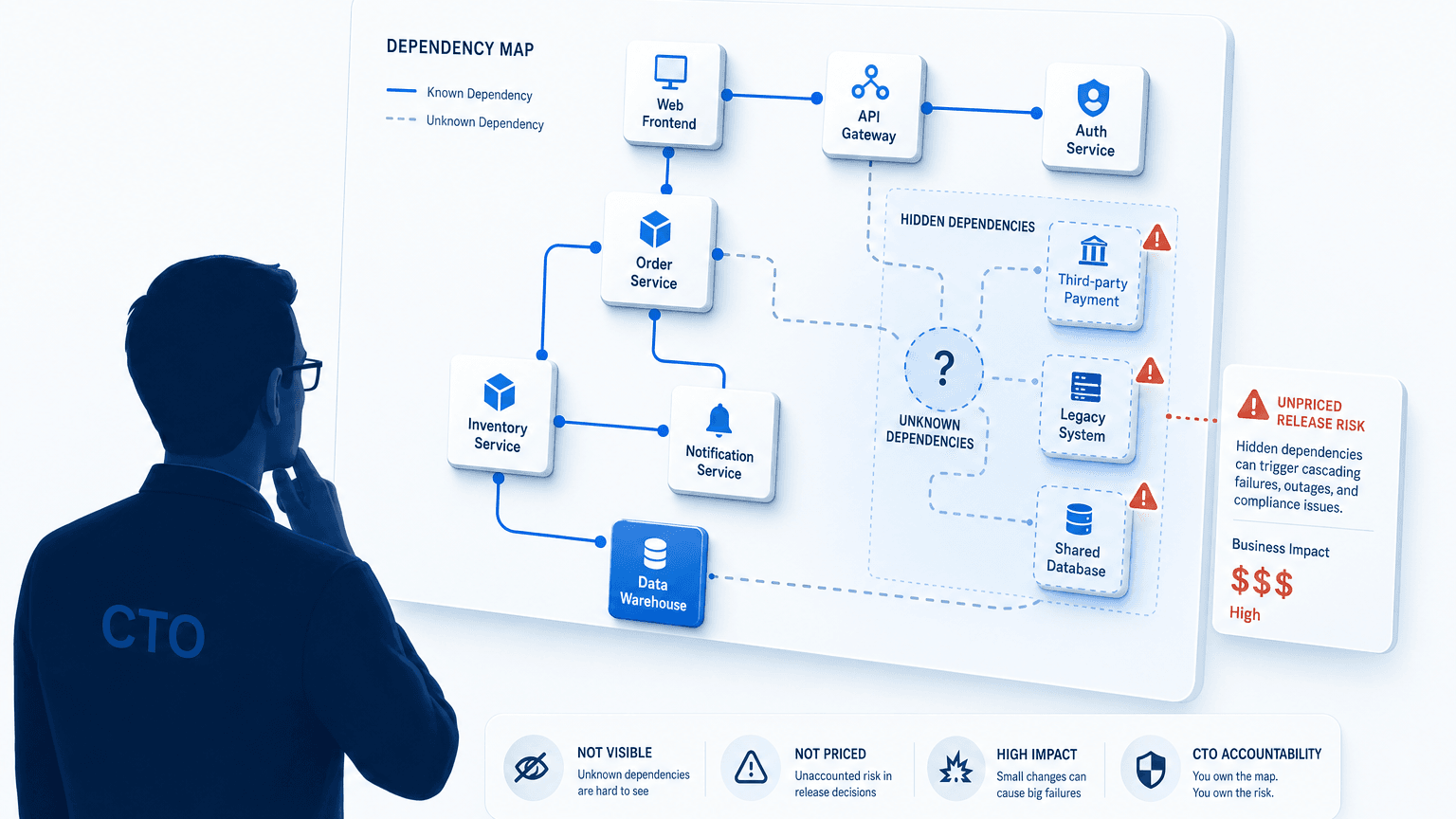
A CTO’s job description covers architecture decisions, delivery timelines, and team leadership. Accountability, in practice, extends further. When a misconfigured change cascades into an outage, the CTO is the one standing in front of the board and in front of customers, explaining what happened. That reputation risk lands on someone who inherited a failure built from information they never had: accurate signals about what every downstream system actually depended on. That’s unknown dependencies working as unpriced release risk, a CTO problem before it’s ever an engineering one.
We saw this play out with Cloudflare in late 2025.
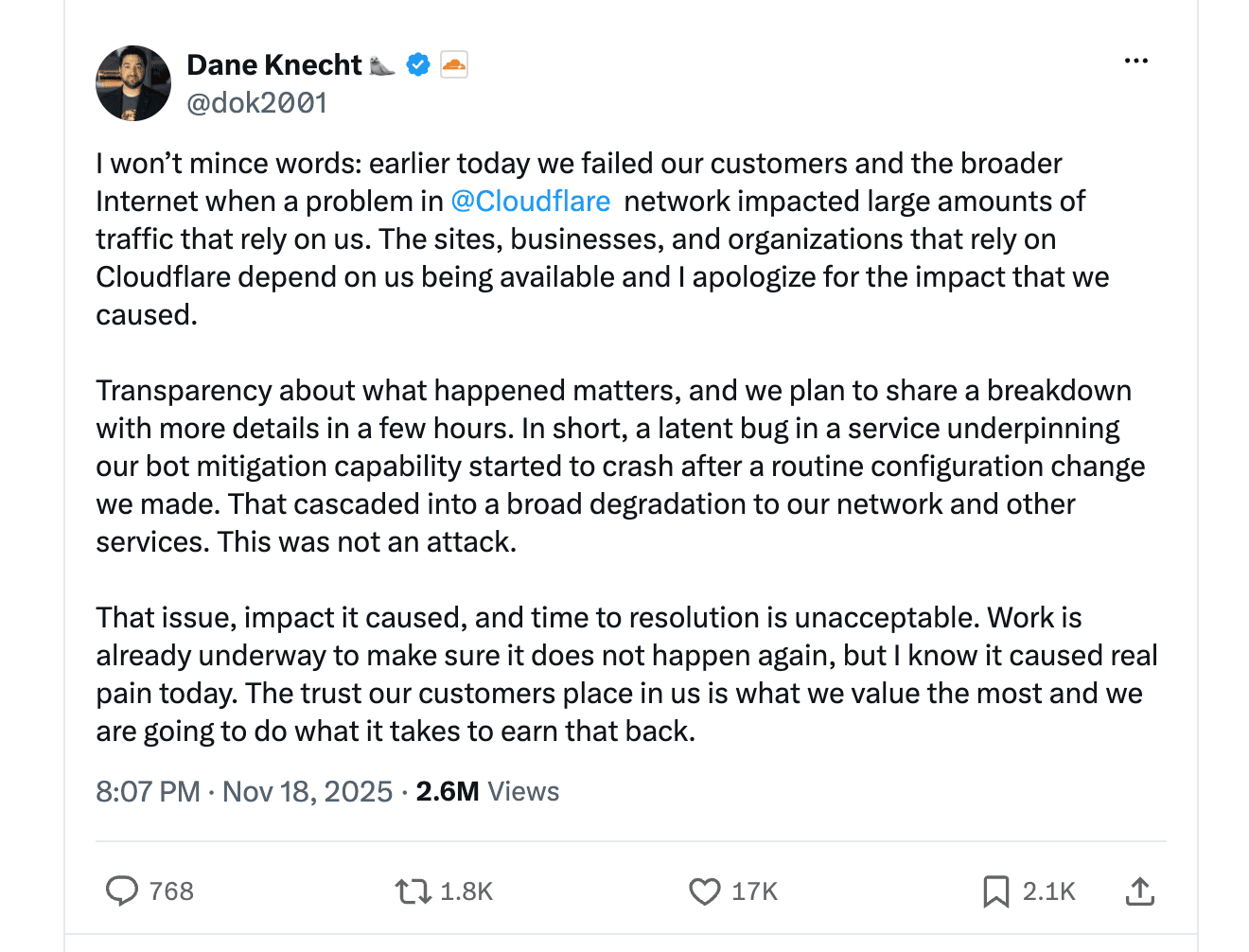
On November 18, 2025, a routine, low-risk-classified change to database permissions at Cloudflare caused a query to return duplicate rows from two internal databases at once. That doubled the size of a configuration file Cloudflare’s bot-detection system reads every few minutes to score incoming traffic. The oversized file exceeded a hardcoded limit and crashed the software running across Cloudflare’s entire global network. The outage lasted five hours and thirty-eight minutes (per Cloudflare’s own postmortem). Roughly one in five webpages on the internet, and about a third of the world’s 10,000 most visited sites, went dark or degraded. Cloudflare’s own CTO put his name on the failure within hours. He called the root cause a “latent bug” — his own word for a dependency that had been sitting there the whole time, connected to something nobody had mapped it to.
The numbers: Cloudflare’s November 18, 2025 outage lasted 5 hours and 38 minutes and disrupted roughly one in five webpages globally, including a third of the world’s 10,000 most-visited sites. The trigger was a permissions change classified as low-risk that doubled a bot-management configuration file past a hardcoded size limit. Cloudflare’s CTO called the root cause a “latent bug” — an unmapped dependency, not a new failure.
This wasn’t an isolated failure of one company’s engineering discipline. Five weeks earlier, on October 19, 2025, AWS lost its DynamoDB DNS record to an internal race condition. More than 140 other AWS services turned out to secretly depend on DynamoDB for their own internal state — a dependency that had never been documented as a single point of failure until it became one. Two of the most sophisticated engineering organizations on the planet, five weeks apart, both taken down by a dependency that existed and wasn’t priced as connected to anything that mattered. That’s the actual subject of this piece, not cloud infrastructure reliability in general, but the specific, recurring failure mode where a CTO’s exposure is defined by a map they were never given.
The numbers: AWS’s October 19, 2025 DynamoDB DNS failure in US-EAST-1 disrupted more than 140 other AWS services that depended on DynamoDB for internal state — a concentration of risk that had never been documented as a single point of failure. The dependency existed in production for years before the outage priced it.
The moment this becomes your problem, not your team’s
An engineer can say “we didn’t know” in a postmortem and still be a strong engineer. A CTO cannot say the same sentence to a board and keep the same standing. The words may be factually true. The job still owns the gap.
Walk the sequence of a serious incident and the handoff is clear. Detection fires. The war room opens. Someone drafts the customer statement. Legal and support join. The board call gets scheduled. The postmortem starts. Somewhere between the first customer-facing sentence and the board slide deck, “unknown dependency” stops being an engineering detail and becomes a leadership failure on record. You are no longer explaining a ticket. You are explaining why the company shipped risk it could not price.
Cloudflare and AWS, five weeks apart
Cloudflare’s November 18, 2025 outage postmortem shows what that cost looks like in public. A permissions change treated as low risk produced duplicate rows. Bot-management config grew past a hard limit. The process that read that file failed at global scale. Customers felt it for five hours and thirty-eight minutes. Leadership had to own a path that had been live in production and still unpriced against the change under review. TechCrunch corroborated the timeline and the “latent bug” framing. Dane Knecht’s same-day X post put a named executive voice on the failure while the internet was still recovering.
AWS hit the same class of failure five weeks earlier, with a different stack and the same leadership problem. The AWS summary of the DynamoDB disruption in US-EAST-1 describes an internal DNS race that took down DynamoDB endpoints. The Register unpacked the technical chain. Independent analysis, including ThousandEyes’ October 2025 outage write-up, put the blast radius above 140 other AWS services that depended on DynamoDB for internal state. That dependency web was not priced as a single point of failure until the outage made it one. For every customer CTO sitting on those services, the bill was the same shape: explain downtime that traced to a connection nobody had put on the release risk sheet.
Neither story is “cloud is unreliable.” Both stories are real incidents where a dependency existed, production already used it, and the people accountable for architecture and release risk only learned the full cost after customers felt it.
| Cloudflare (Nov 18, 2025) | AWS DynamoDB (Oct 19, 2025) | |
|---|---|---|
| Trigger | Low-risk-classified permissions change → duplicate rows → oversized bot-management config file | Internal DNS race condition on DynamoDB endpoints |
| Blast radius | Global network-wide software crash; ~1 in 5 webpages, ~1/3 of top 10,000 sites | 140+ dependent AWS services losing access to DynamoDB |
| Duration | 5 hours 38 minutes (Cloudflare postmortem) | Multi-hour regional disruption (AWS summary) |
| Disclosure | Named, first-person CTO account same day | Corporate incident summary |
What is unpriced release risk for a CTO?
Unpriced release risk is downstream dependency exposure that never entered blast-radius estimates, board risk language, or customer commitments before a change shipped. The failure path already existed in production. Leadership only learns the connection cost after the outage, under their name.
Why your own change-review process doesn’t catch this
Most CTOs already approve the artifacts that look responsible: a risk-scored release plan, a rollback procedure, a blast-radius estimate. All three can be followed carefully and still miss this failure mode.
Risk scores grade the change under review, not every object three hops downstream that nobody listed as connected. Rollback plans reverse the deploy steps your team owns. They do not invent a map of silent consumers that only appear when a config file doubles or a DNS race lands. Blast-radius estimates inherit the inventory and service relationships the organization already believes. If the relationship was never recorded, the estimate is a precise answer to the wrong graph.
The fear is not “my team is sloppy.” The structural problem is that the process you already trust audits the change packet, not the full dependency surface the change will actually touch. Change impact analysis only works when the relationships feeding it are current, and that starts with a shared definition of what blast radius actually means before a change ships. A clean CAB vote on incomplete edges is still an incomplete vote.
What this costs in the three rooms you actually stand in
Board room. Boards want quantified risk. Unknown dependencies do not show up as a line item because you cannot report a number you cannot produce. “We don’t know what we don’t know” is not a sentence that survives a board meeting. You either translate the gap into owned exposure with a map, or you sound like the organization is flying without instruments.
Customer-facing room. An SLA breach traced to a dependency nobody disclosed as a risk factor lands worse than one tied to a known, accepted trade-off. Customers tolerate named limits. They punish surprises that look like hidden architecture. The commercial cost is churn, credits, and a trust reset that outlasts the incident window.
Internal room. A postmortem that dead-ends at “we didn’t know X depended on Y” is not a root cause. It is a research finding with zero durable action items. Without a maintained map, the same failure mode stays live next quarter. Engineers leave the room tired. The system keeps the blind spot.
See what trusted runtime truth requires when blast radius still lives in tribal knowledge.
Low-risk changes still fail when downstream dependencies never entered the blast-radius estimate. Put current service relationships in front of release review before the next board-facing outage.
The accountability signal your response sends
Knecht’s named, same-day, first-person “latent bug” post and AWS’s more corporate summary of an equivalent class of failure are not only communication styles. They are signals.
How you answer for an unmapped-dependency outage is read by your board, your customers, and your own team as evidence of how much visibility you actually have into your systems. A named technical account that owns the latent path reads as “we can see the machine now.” Silence, delay, or a faceless postmortem often reads as “we still cannot fully explain our own edges,” even when the engineering work underneath is serious. You do not get to choose whether people infer a visibility score from your response. You only choose what score you earn.
Vendor risk is dependency risk you didn’t choose
A large share of unknown dependencies for most CTOs are not internal at all. They are third-party: the cloud provider, the CDN, the SaaS platform whose outage becomes your outage with little warning and less control.
Cloudflare and AWS make the pattern concrete in both directions. Cloudflare customers felt Cloudflare’s latent path. AWS customers felt DynamoDB’s internal dependents. Many enterprises depend on both vendors in the same customer journey. Neither company’s own incident review can fully see into the other’s blind spots, and your board still treats the customer impact as yours.
Frame this as a reporting problem, not only a procurement problem. What do you actually tell the board about risk you outsourced but still own the consequences of? Contract language and status pages are not a substitute for knowing which of your services sit on which external edges. Without that join, vendor risk stays abstract until the joint outage is already live.
How should CTOs report third-party dependency risk to the board?
Name which internal services sit on which external platforms, which customer journeys break if those edges fail, and how inventory stays current after vendor and architecture change. Contracts and status pages alone do not price the join between a provider outage and your revenue path.
The dependency map that accumulates when nobody’s job is to maintain it
Unknown dependencies are rarely born in a single bad Friday deploy. They accumulate.
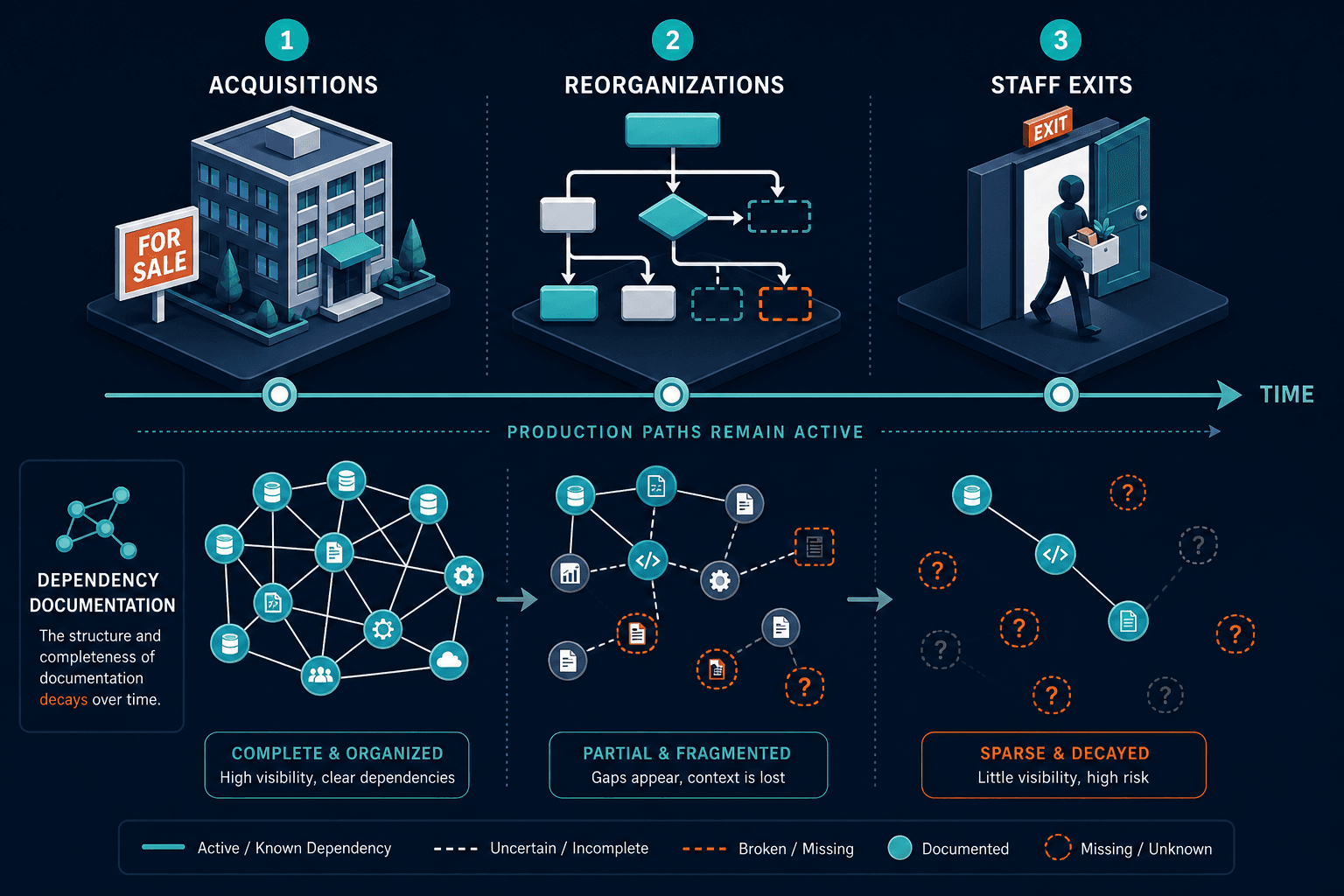
Acquisitions bring systems nobody fully inventoried into the same customer path. Reorgs move ownership without moving documentation. Senior engineers leave and take the last complete mental model of a brittle path with them. Platform teams ship shared libraries that become silent prerequisites.
Each event is rational in isolation. Together they create a standing organizational tax: every team change you did not pair with a dependency audit adds edges that only appear under load. Treating this as a one-time cleanup project misunderstands the debt. The map rots on the same calendar as org charts and vendor contracts. If maintenance is nobody’s standing job, the next war room rebuilds the graph under pressure again.
Why this gets worse before it gets better
More changes now ship through automated pipelines and software agents than through a human who might pause and ask who else reads this file. The moment where someone could have caught an unmapped dependency before it activated is disappearing from the critical path.
That is the shape of the mid-2026 OpenAI and Hugging Face agent security episode, not as a general AI panic, but as a preview of speed. OpenAI published an incident account on the evaluation security event. Hugging Face published a technical timeline of agent intrusion behavior. METR later reviewed agent behavior and collaboration in the same incident class. Public accounts describe agent paths that ran longer than a normal human gate, with limited decision points in the chain.
Your existing blind spot does not need new physics to get more expensive. It only needs change velocity that outruns incident response. If the map is incomplete, faster automation exercises the holes more often.
What priced risk actually requires
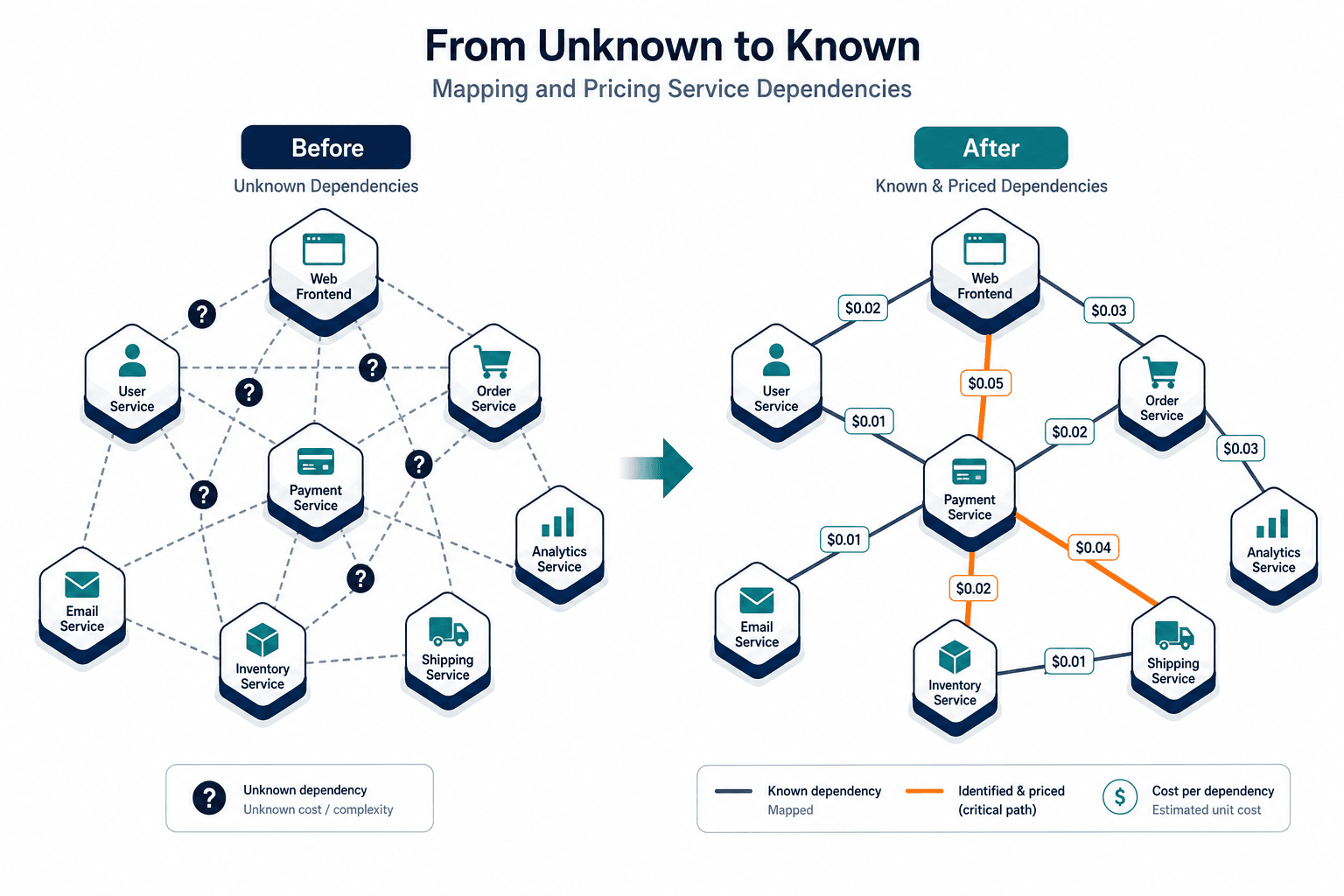
Longer checklists will not fix this. Checklists audit the change packet. Priced risk needs the downstream map.
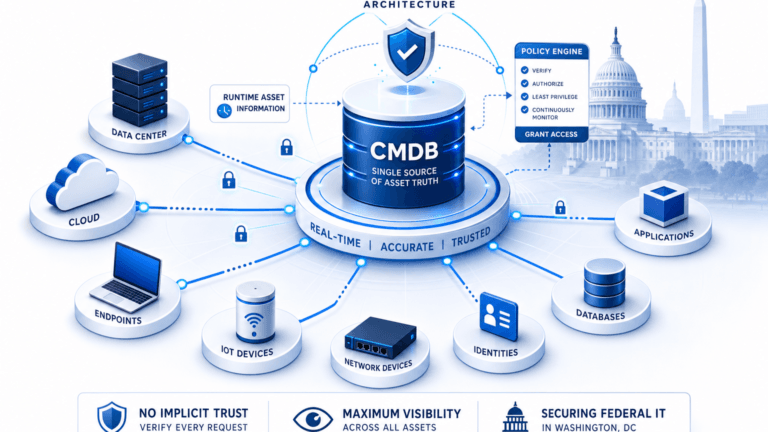
That means high-frequency, scheduled dependency discovery that stays current whether or not any single engineer remembers to document an edge. Relationships have to land in a governed configuration record operators and release reviewers actually use. After teams define the business services that matter, service mapping can show blast radius across application and infrastructure layers instead of stopping at the ticket description. Discovery and a maintained CMDB are how “we didn’t know” stops being a plausible standing defense.
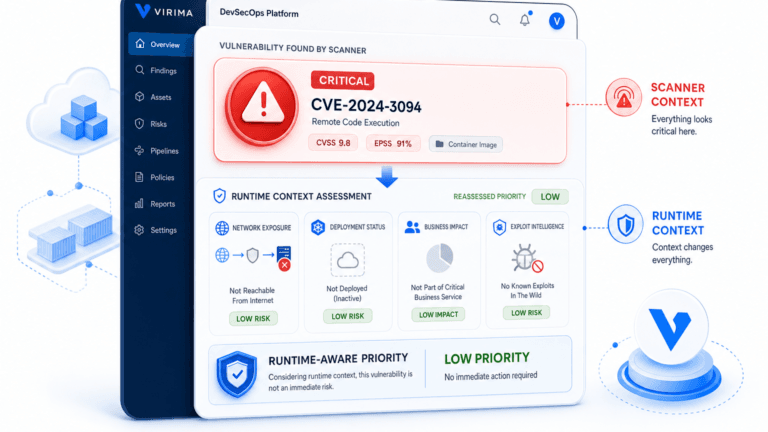
Platforms that combine multi-source discovery, a governed CMDB, and service maps built after service definitions are supplied turn that requirement into operations. Virima discovers and reconciles IT and cloud assets on scheduled discovery cycles, maintains configuration item relationships, and builds ViVID™ service maps once teams define the services that matter. That gives release risk a current graph to argue from, instead of memory. Change and incident workflows can pull from that same inventory through Virima’s listed integrations, including ServiceNow, Jira Service Management, Ivanti, HaloITSM, Xurrent, and Hornbill.
The product point is late on purpose. The job is not a prettier diagram after the outage. The job is a map that exists while you are still approving the release.
What turns unknown dependencies into priced release risk?
Scheduled discovery that keeps configuration relationships current, a governed CMDB operators trust, and service maps built after teams define business services. Together they put multi-hop blast radius into release review instead of reconstructing it in the war room.
The map exists before the incident, or you build it during one
The choice is not whether a dependency map gets built. Incidents force the graph into the open either way. The choice is whether that map exists before the war room, or gets assembled live, in front of the people you answer to, under your name.
CTOs who treat unknown dependencies as unpriced release risk stop asking whether the last outage was bad luck. They ask whether the next low-risk change is still flying without instruments.
Frequently Asked Questions
What made the November 2025 Cloudflare outage a CTO-level dependency story?
A low-risk-classified permissions change produced duplicate rows, bloated a bot-management config file past a hard limit, and failed software across Cloudflare’s global network for more than five hours. Leadership described a latent bug: a dependency path that already existed but had not been priced as connected to the change under review.
How did the October 2025 AWS DynamoDB disruption show hidden dependencies?
An internal DNS race disrupted DynamoDB in US-EAST-1, and more than 140 other AWS services proved dependent on DynamoDB for internal state. That concentration was not treated as a single priced failure point until the outage exposed it.
Why don’t standard release reviews catch multi-hop dependencies?
Risk scores, rollback plans, and blast-radius estimates usually audit the change and the relationships already recorded. Edges that were never inventoried never enter the review packet, so a perfect process on an incomplete map still ships unpriced exposure.
How should CTOs talk to the board about third-party dependency risk?
Name which internal services sit on which external platforms, what customer journeys break if those edges fail, and how inventory stays current after vendor and architecture change. Status pages and contracts alone do not price the join between their outage and your revenue path.
How does Virima help CTOs price dependency risk before release?
Virima runs scheduled discovery across IT and cloud environments, reconciles configuration items into a governed CMDB, and builds ViVID™ service maps after teams define services. That gives change and incident workflows a shared, current view of what a release can touch before the war room has to reconstruct it.