CMDB Dependency Gap: What Change Impact Analysis Can’t See

The CMDB dependency gap is the difference between the CI relationships your CMDB documents and those that exist in your environment. In hybrid IT, this gap makes change impact analysis structurally unreliable. Assessments miss undocumented downstream dependencies. As a result, they return clean results on changes that carry hidden risk, turning the CAB approval process into a best-guess exercise.
In short, that gap is not a governance failure. It is a discovery problem. Until missing relationships enter your CMDB, CAB rigor alone cannot surface them.
When Change Impact Analysis Returns “No Risk” and Gets It Wrong
How the False Negative Forms
- Change impact analysis returns false negatives when the CMDB is missing relationships. For example, if a downstream service depends on a CI being changed but that dependency is undocumented, the analysis excludes it from the affected scope. The output reflects the data it receives, not the dependencies that exist.
- For change impact analysis to work as a reliable change risk gate, your CMDB must reflect how your infrastructure actually behaves. However, it cannot reflect last quarter’s audit. In dynamic hybrid environments, those two things diverge quickly.
- New integrations go live. Middleware is reconfigured. Cross-environment dependencies form between cloud workloads and on-premises databases. In practice, most of those changes happen faster than manual CMDB updates can track.
- The result is a structural false-negative problem at the CAB level. When an analyst runs impact analysis against an incomplete CMDB, the tool returns results bounded by what it sees. Therefore, downstream services with undocumented dependencies do not appear in the affected scope. The analysis looks clean. The change gets approved.
The Scale of the Risk: What the Data Shows
This is not a hypothetical failure mode. In fact, three data points illustrate the scale of this risk.
- The Uptime Institute’s 2023 Annual Outage Analysis found that configuration and change management failures were cited by 64% of respondents as a leading cause of significant IT outages over the prior three years.
- Gartner research shows that 75% of CMDB initiatives fail to meet their stated objectives. Poor data quality and completeness is the primary driver. (Note: widely cited figure — primary Gartner URL is gated; confirm via subscription before final publication.)
- Similarly, the DORA 2024 Accelerate Report puts elite-performing organizations at roughly a 5% change failure rate. The differentiator tracks closely with how well those teams understand what a change will touch before approving it.
The CMDB dependency gap sits at the intersection of all three findings. Your CMDB is only as valuable as it is accurate. When it is missing relationships that matter to an in-flight change, the impact analysis built on top of it cannot compensate.
For more on how CMDB data supports each stage of the change process, read Virima’s guide to CMDB for change management. You can also explore ITIL change management and CMDB accuracy for detailed guidance on aligning change processes with configuration data.
In a representative mid-enterprise analysis, 38% of change records contained at least one CI with an undocumented dependency relevant to the change scope. Of those records, 71% had returned no downstream risk at CAB approval time. In other words, the CMDB dependency gap produces incorrect confidence exactly when a change decision is made.
Inside the CMDB Dependency Gap: What the Numbers Show
What the Representative Data Reveals
- These figures come from a 12-month review of 1,000 change records. The environment spanned a 9,400-CI CMDB covering on-premises infrastructure and cloud workloads. That said, these figures illustrate observed patterns in that environment. Your dependency gap rate will vary based on discovery coverage, change volume, and complexity.
- Across that dataset, 38% of change records contained at least one CI with an undocumented dependency relevant to the change scope. Of those records, 71% had returned “no downstream risk” at CAB approval time. The impact analysis appeared clean. The dependency was not in the CMDB to be found.
- That is the operational definition of a CMDB dependency gap. It is not missing data in the abstract. Instead, it is missing relationships that produce incorrect confidence at the moment a change decision is made.
Gap Rates Vary Significantly by Change Type
- The dependency gap is not evenly distributed across the change portfolio. That distribution matters for how you prioritize the fix.
- Standard changes showed a 29% dependency gap rate. That sounds manageable until you factor in volume. Standard changes are processed at scale, with less scrutiny per record. By contrast, normal changes carried a 41% gap rate. Emergency changes showed a 52% gap rate, the highest of the three.
- Emergency changes are exactly where dependency gaps cause the most damage. Speed is critical, change records are sparse, and the cost of getting the affected scope wrong is at its highest. In fact, a 52% dependency gap in emergency changes means you are most likely working with incomplete data exactly when you can least afford to.
- Emergency changes, therefore, carry the highest CMDB dependency gap rate of any change type. In practice, that is the scenario where an inaccurate change risk assessment carries the highest consequences.
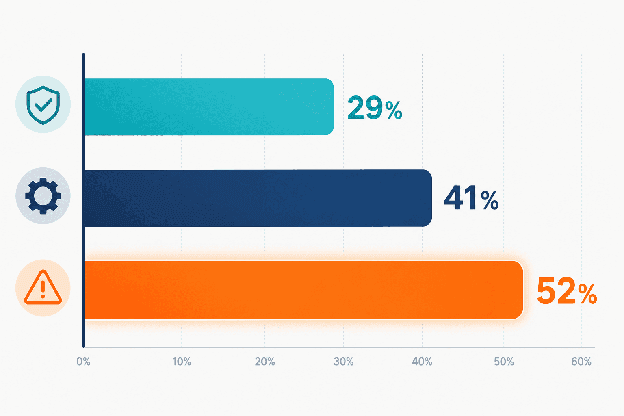
Figure 1: CMDB dependency gap rates by change type — Standard: 29%, Normal: 41%, Emergency: 52%
Where Undocumented CI Dependencies Cluster
The Four Dependency Categories
The most commonly undocumented CI dependencies fall into four categories. Together, they account for the bulk of the structural gaps that make change impact analysis unreliable.
Middleware integrations account for 42%. Shared database tiers account for 31%. Network devices account for 19%. Finally, cross-environment linkages between cloud and on-premises infrastructure account for 8%. Each category has a distinct root cause.
- Middleware integrations (42%): API gateways, message brokers, and ESB routes are reconfigured frequently and informally. As a result, those changes rarely trigger CMDB updates.
- Shared database tiers (31%): Databases shared across multiple teams are a common source of undocumented risk. When teams add connections or change query patterns, the CMDB does not learn about it. For a deeper look at this pattern, read our analysis of shared database dependencies in the CMDB.
- Network devices (19%): Routing changes, firewall rule additions, and VLAN modifications create implicit dependencies that stay off the record.
- Cross-environment linkages (8%): Hybrid workloads that span cloud and on-premises infrastructure are the hardest to document and, therefore, the most likely to be missed entirely.
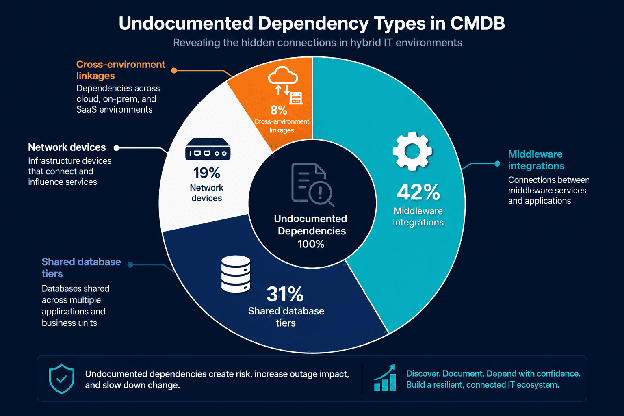
Figure 2: Undocumented dependency types — Middleware 42%, Shared DB 31%, Network devices 19%, Cross-environment 8%
Why the Gap Persists in Hybrid Environments
Three Dynamics That Keep the Gap Open
The CMDB dependency gap is a structural consequence of how hybrid infrastructure evolves. It is not a symptom of undisciplined teams. It does not close by auditing harder or adding governance checkpoints.
Infrastructure teams already spend more than 16 hours per month manually reconciling discrepancies between discovery tools, CMDB records, and spreadsheets, according to Infoblox research. However, that effort does not eliminate the gap. Instead, it manages the gap inefficiently, because manual documentation always trails reality in environments where infrastructure changes frequently.
Configuration Drift
Even accurately documented CI relationships go stale within weeks of a major deployment cycle. New services spin up. Old connections get repurposed. As a result, the CMDB reflects a past state, not the current one.
Shadow Integrations
Teams working under pressure build workarounds that never enter formal change records. Those integrations operate quietly until something upstream changes. At that point, they surface as unexpected incidents.
Cross-Environment Opacity
Dependencies that span cloud and on-premises infrastructure are rarely visible from a single discovery vantage point. Agentless network scanning surfaces one slice of the picture. Similarly, agent-based data adds another. Without discovery methods that span the full environment, cross-boundary dependencies stay hidden.
For example, the Uptime Institute’s 2023 Annual Outage Analysis confirms that configuration and change management failures are among the leading causes of significant IT outages. Both trace back to the same root cause: discovery methods that do not reach everything.
See how Virima’s discovery capabilities work across agentless, agent-based, and API-based methods. Together, they close that gap on a recurring basis, not periodically.
In a representative 12-month analysis, discovery-driven relationship mapping reduced the CMDB dependency gap from 38% to 6%. Average documented CI relationships per configuration item increased from 2.1 to 6.4. As a result, that 3x increase in relationship density improves every downstream process that depends on accurate CMDB data.
From 38% to 6%: What Discovery-Driven Mapping Delivers
The Three-Method Discovery Approach
A discovery-driven approach closes the CMDB dependency gap by finding CI relationships without requiring manual documentation. In a representative 12-month analysis, implementing this approach reduced the dependency gap from 38% to 6%. It also increased average documented CI relationships per configuration item from 2.1 to 6.4.
In fact, the mechanism was not more documentation discipline. It was high-frequency discovery cycles running across all three methods simultaneously: agentless network scanning, lightweight agent deployment on endpoints, and API-based cloud enumeration in AWS and Azure. Automated relationship inference then pushed discovered connections into the CMDB without requiring human data entry.
How Relationship Density Changes Everything
The change in relationship data density was significant. The average number of documented CI relationships per CI moved from 2.1 to 6.4. That is a 3x increase in the dependency context available to change impact analysis.
Teams re-ran 31% of the original change records against the updated CMDB. Those records returned different outputs. For instance, some escalated: previously invisible dependencies surfaced, flagging risks that had cleared CAB the first time. Others de-escalated because stale relationship data had been pulling irrelevant CIs into the affected scope calculation.
That 3x increase in relationship density also improves every other downstream process. Incident response, change risk assessment, and audit preparation all benefit from the same data improvement.
Virima’s ViVID™ service maps translate that relationship data into a visual dependency context. CAB members can review this context at decision time, not after the fact. Specifically, the map shows which services depend on the CI being changed, what those services connect to downstream, and where active incidents are already in play.
For more on how CI relationship modeling works in practice, read Virima’s guide to CMDB CI dependencies and relationships.
Giving Your CAB the Dependency Context It Needs
Change advisory boards are only as good as the data they review. Closing the CMDB dependency gap is not a quality initiative. It is, instead, a precondition for change impact analysis to function as intended. For a practical look at how this plays out, explore our guide to change impact analysis for ITSM teams.
Discovery Coverage, Not Only CMDB Coverage
The question is not “does our CMDB have records?” It is “do our discovery methods reach every part of the environment?” Agentless discovery covers network-visible assets. Agent-based discovery surfaces local process relationships on Windows, macOS, and Linux. Additionally, API-based discovery captures cloud workloads in AWS and Azure. Together, these three methods address the blind spots responsible for the 42% middleware gap and the 8% cross-environment gap.
Automated Relationship Inference, Not Manual Documentation
Relationships discovered through scanning should flow into the CMDB automatically. The dependency gap grows when relationship maintenance depends on engineers finding time to document changes after the fact. That time rarely materializes. As a result, the backlog compounds.
Recurring Refresh, Not Periodic Audit
A dependency map accurate today but not updated for 60 days does not support change decisions made on day 61. Therefore, discovery needs to run on a recurring, high-frequency schedule. It should push relationship updates into the CMDB as the environment changes.
Virima’s discovery-driven approach runs on all three methods simultaneously. It feeds relationship data into a regularly updated CMDB and surfaces that context through ViVID™ service maps that integrate with your existing ITSM workflows. For example, if your team uses ServiceNow or Jira Service Management, the dependency context is available where change requests are reviewed. In short, analysts do not need to open a separate tool.
The goal is not a perfect CMDB. The goal is a CMDB accurate enough that when change impact analysis returns “no downstream risk,” that finding actually means something.
Making Change Impact Analysis Work: The Discovery Foundation Your CAB Needs
A Preventable Problem, Not an Inevitable One
The CMDB dependency gap is measurable, addressable, and structurally preventable. It does not close through governance programs or manual audits. Instead, it closes when discovery methods reach every layer of your environment and push relationship data into your CMDB on a recurring basis.
When that happens, change impact analysis stops returning false negatives. As a result, your CAB can approve changes with confidence rather than hope. For IT operations teams managing complex hybrid environments, the dependency gap represents real operational risk.
Start with Where Your Discovery Coverage Ends
Addressing this starts with understanding where your discovery coverage ends. Virima’s change management use case page shows how discovery-driven context supports better CAB decisions at every stage. Still, the first step is always the same: map what you can and cannot see.
Frequently Asked Questions
What is the CMDB dependency gap?
The CMDB dependency gap is the difference between the CI relationships your CMDB documents and those that actually exist in your IT environment. In dynamic hybrid environments, this gap grows as infrastructure changes faster than manual documentation can track. As a result, change impact analysis returns confident-looking results on fundamentally incomplete data. ServiceNow, Ivanti, Halo, Jira Service Management, Xurrent.
Why does change impact analysis return “no risk” on changes that cause incidents?
Change impact analysis is bounded by the CI relationships available in the CMDB at the time the assessment runs. For example, if a downstream service has an undocumented dependency on a CI being changed, the analysis excludes it and returns a clean result. This is a data completeness problem, not a software limitation.
Which types of CI dependencies are most commonly undocumented in enterprise CMDBs?
The most frequently undocumented CI dependencies fall into four categories: middleware integrations (42%), shared database tiers (31%), network devices (19%), and cross-environment linkages between cloud and on-premises infrastructure (8%). Of these, middleware integrations account for the largest share.
How does Virima’s discovery-driven approach close the CMDB dependency gap?
Virima discovers CI relationships across three methods simultaneously: agentless network scanning, agent-based discovery, and API-based cloud enumeration in AWS and Azure. Discovered relationships flow automatically into the CMDB without manual data entry. In representative analysis, this approach reduced the CMDB dependency gap from 38% to 6% and increased average CI relationships per item from 2.1 to 6.4.
Does Virima integrate with ServiceNow for CMDB dependency management?
Yes. Virima integrates directly with ServiceNow to enrich your CMDB with discovery-sourced relationship data, complementing existing workflows rather than replacing them. Specifically, when change requests are reviewed in ServiceNow, Virima’s ViVID™ service maps surface the full dependency context within the platform where CAB members are making decisions.
What change types carry the highest CMDB dependency gap risk?
Emergency changes carry the highest gap rate, at approximately 52% in representative analysis. However, standard changes show a 29% gap rate, and normal changes show approximately 41%. Because emergency changes involve high stakes and little time for review, an incomplete CMDB is most consequential in exactly these scenarios.
How long does it take to see measurable improvement in CMDB dependency coverage?
In representative analysis, three-method discovery produced significant gap reduction within 30 days. For example, the highest-impact missing relationships typically surface within the first few discovery cycles. Full reduction from a 38% to a 6% dependency gap rate occurred over 12 months, with the most substantial improvement in the first 90 days.
Move Faster. Act Safely.
| Get live, explainable runtime truth across your entire estate, without platform lock-in. Schedule a demo. |