What ‘AI-Ready IT Data’ Actually Means: The 5-Point Checklist Before Automation

| An AI-ready IT data checklist is a five-point assessment that measures whether enterprise CMDB data can reliably support agentic AI decision-making before you deploy automation. Across environments we’ve assessed, the average first score is 3.1 out of 5 — with relationship coverage failing most often. Organizations that complete a structured IT data readiness assessment before deployment report 3.2x higher first-deployment success rates than those that skip it. |
The following five-point checklist is what we use before recommending any automation deployment. We build it around one principle: your data layer must be discovery-sourced, explainable, and governed before the model ever runs.
Why self-assessment almost always overstates readiness
CMDB accuracy is almost never self-evident. IT teams manage the data they actively touch — the configuration items that show up in incidents, in change requests, in audit queries. The rest of the CMDB drifts.
Self-assessed accuracy reflects the data your team interacts with. By contrast, discovery-measured accuracy reflects everything in your environment. That gap is where AI automation finds its vulnerabilities.
An environment scoring 5 out of 5 on self-assessment is not a guarantee that AI automation will perform well. In fact, an environment scoring below 4 out of 5 is a near-certainty that the first AI failure in production will be blamed on the model rather than the data underneath it. According to Deloitte’s 2025 agentic AI research, 40% of pilot deployments are canceled before they reach production, with the majority failing on data quality, not model limitations.
Start by understanding what Trusted Runtime Truth means for an AI deployment: a data layer that is discovery-sourced, explainable, and governed. Learn more at the Trusted Runtime Truth overview page.
CI accuracy rate above 90%, measured from discovery delta
What we measure
We measure the difference between what a live discovery scan finds and what your CMDB currently holds for the same assets. Self-reported accuracy is not a valid input here.
What we find
In our assessments, the average first-measurement across enterprise environments is 71%. Common sources of inaccuracy include decommissioned CIs your team hasn’t removed from the CMDB, virtual machines spun up outside the standard provisioning process, and cloud instances your last discovery cycle missed.
Why it matters for AI
Any AI model operating on CI data treats absence as a fact. For example, if your CMDB says a database doesn’t exist and a change request targets it, the model sees no risk. A CMDB accuracy rate below 90% compounds downstream — every check that depends on accurate CI records inherits the error rate. As a result, an AI agent making change decisions on stale asset data doesn’t fail gracefully; it fails with authority.
Relationship coverage above 85% for in-scope CIs
What we measure
We measure the percentage of CIs within your automation scope that have at least one mapped upstream and one mapped downstream relationship in your CMDB.
What we find
In our assessments, the average first-measurement is 58%. The most common gap: middleware and integration layer CIs your team added via manual import, where discovery never mapped their relationships.
Why it matters for AI
A CI with no mapped relationships returns a blast radius score of zero. For AI-driven change risk scoring or incident analysis, a zero blast radius on a middleware CI is almost always wrong. Worse, it trains the model to underestimate impact. Of the environments that fail this checklist on any check, 78% fail on relationship coverage first.
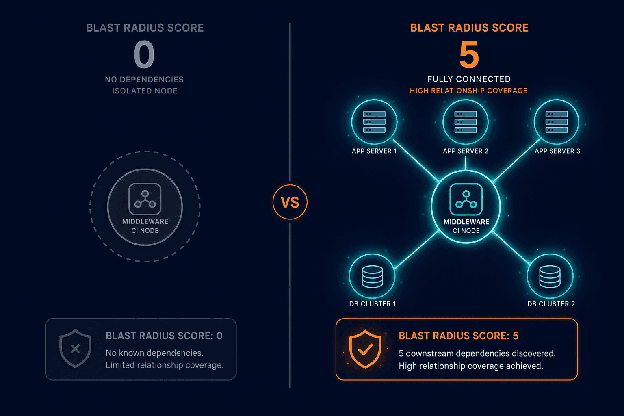
Conceptual diagram showing a middleware CI with no mapped relationships returning a blast radius score of zero, contrasted with a fully mapped CI showing upstream and downstream dependencies.
Relationship coverage is a control layer. Without it, your agent can’t see the blast radius of a change before approving it. Virima’s ViVID service maps build relationship records from discovery data — typically the fastest path from below 85% to compliant coverage we’ve seen in client environments.
Not sure if your relationship coverage is above 85%? See: What Is ViVID Service Mapping? How Virima Visualizes IT Service Dependencies
Owner assignment at 100% for Tier 1 and Tier 2 services
What we measure
We measure the percentage of CIs classified as Tier 1 or Tier 2 services that have a current, valid owner record — verified using Active Directory or your authoritative identity system, not self-reported in the CMDB. Where ServiceNow or another ITSM platform holds the owner record, that connection is the right validation source.
What we find
In our assessments, the average first-measurement is 74%. Gaps concentrate around infrastructure components that predate the current team’s tenure or that the team migrated from a legacy system without carrying over owner records.
Why it matters for AI
In AI-driven change workflows, the owner record is the escalation target when the model flags a high-risk change. Blank or stale owner fields don’t cause AI errors — they cause AI recommendations that have nowhere to go. A model cannot escalate if it has no escalation target. In short, the owner field is how your data layer connects to human accountability.
Discovery freshness under 48 hours for managed endpoints
What we measure
We measure the configured discovery cycle time for each CI class within your automation scope the scheduled interval that determines how often your discovery engine refreshes that asset class.
What we find
In our assessments, 34% of environments have at least one managed CI class with a discovery cycle greater than seven days. Many of these are older infrastructure tiers or development environments that teams treat as lower-risk. Still, 66% of environments run at least some CI class under a seven-day cycle — but the 48-hour threshold for AI-ready freshness is a narrower bar than that.
Why it matters for AI
An AI model using CI data that was accurate six days ago is using historical data. In practice, the discovery cycle is the mechanism that keeps your data layer fresh between audits. If your agent relies on data that’s a week old, it’s making decisions in the past. According to IT Ops Today’s State of IT Discovery (2025), organizations running discovery cycles shorter than 48 hours show 2.3x lower incident-to-resolution time.
For agentic AI, this freshness is not optional — it’s the difference between safe automation and blind automation. Virima’s agentless discovery runs on a configurable cycle and can be set to sub-24-hour intervals for managed endpoint classes, meeting the 48-hour threshold without extra agent overhead.
See Active vs. passive IT asset discovery: which one works better? for a comparison of discovery approaches that can help you meet the 48-hour target.
A reconciliation source hierarchy that is defined and validated
What we measure
We measure whether your organization has a documented, enforced rule set that specifies which discovery or import source takes priority when multiple inputs return conflicting data for the same CI.
What we find
In our assessments, 61% of environments have no documented reconciliation source hierarchy. Instead, they run default recency-based rules — the most recently written record wins, regardless of source authority or data quality.
Why it matters for AI
Recency-based rules make your CMDB an unreliable data source. A stale spreadsheet import can overwrite a fresh discovery record for the same CI, with no audit trail. Your data layer becomes unpredictable.
An AI agent trained on that kind of data will make unpredictable decisions. A reconciliation source hierarchy is how you tell your system: a live discovery scan outranks a six-month-old asset import; a ServiceNow-owned relationship outranks a default inference. Without that rule set, there is no version of truth your agent can rely on.
See ServiceNow CMDB Workspace: Complete Setup & Best Practices Guide [2026] for guidance on defining a source hierarchy. Also refer to CMDB with Automated Discovery for Hybrid and Cloud Environments for how discovery-sourced records are typically ranked highest.
What the average first-assessment score tells you
Across environments where we’ve run this AI-ready IT data checklist, the average first-assessment score is 3.1 out of 5. The most common single failing item is relationship coverage — present in 78% of environments that fail any check. The second most common failure is the reconciliation source hierarchy.
ITSM.tools’ May 2026 analysis found that organizations running a structured IT data readiness assessment before deployment hit 3.2x higher first-deployment success rates (“The CTO Checklist for AI-Ready IT Operations in 2026,” ITSM.tools, May 2026). That translates directly to pilot survival vs. pilot cancellation.
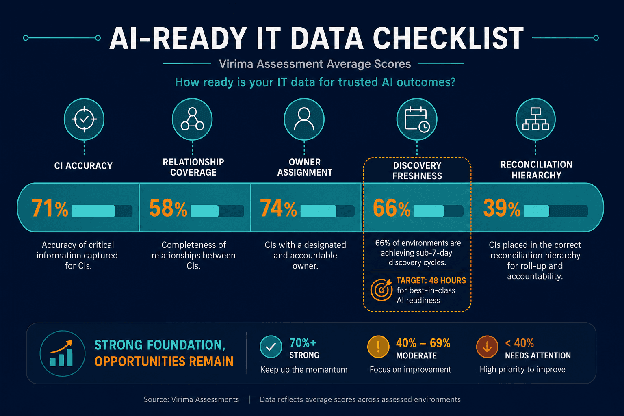
Conceptual diagram showing a five-point scoring framework displayed as a horizontal progress bar with five check categories and color-coded readiness indicators.
The check that determines what gets blamed when AI fails
At 3.1 out of 5, most enterprise environments are not AI-ready. However, the path forward is step-by-step, measurable, and finite. You don’t need to achieve 5 out of 5 — you need to move from 3.1 to 4.5 before deploying your first agent.
Start with relationship coverage. Of environments that fail any check, 78% fail here first — and it’s the gap most likely to cause AI decisions to underestimate blast radius. The second highest-impact fix is the reconciliation source hierarchy: no other check creates the same compounding effect across your entire data layer. Once those two reach 4+, CI accuracy and discovery freshness follow a more predictable path.
The AI-ready IT data checklist serves as a decision point: if your environment scores below 4 on any check, fix the gaps before you automate. If it scores 4+, your data layer can reliably support AI agent decisions.
Virima’s discovery-based assessment maps all five dimensions against your live environment — CI accuracy, relationship coverage, owner assignment, discovery freshness, and reconciliation hierarchy — and identifies which gaps to close first. See Customer Success Stories to see exactly where your CMDB stands before your first automation deployment.
Frequently Asked Questions
What CMDB accuracy percentage is required before deploying AI agents?
A CI accuracy rate above 90% — measured by comparing live discovery scan results to CMDB records — is the minimum threshold. Across enterprise environments we’ve assessed, the average first-measured accuracy is 71%. Below 90%, AI agent decisions inherit compounding error rates across every CI dependency chain. ServiceNow, Ivanti, Halo, Jira service management, Xurrent.
Why does relationship coverage fail most often in AI readiness assessments?
Relationship coverage fails first because middleware and integration-layer CIs your team added via manual import typically have no relationship discovery applied. Of environments that fail any AI readiness check, 78% fail relationship coverage before any other dimension.
What is a reconciliation source hierarchy and why does it matter for AI?
A reconciliation source hierarchy is a documented rule set specifying which data source takes priority when multiple inputs return conflicting records for the same CI. Without one, recency-based defaults allow stale imports to overwrite fresh discovery scans — making the CMDB unreliable as an AI data source.
How does Virima measure AI data readiness?
Virima’s discovery-based AI readiness assessment measures all five dimensions — CI accuracy, relationship coverage, owner assignment, discovery freshness, and reconciliation hierarchy — against live scan results, not self-reported data. The assessment identifies which gaps are causing the score to lag and shows the order in which to fix them.
Can Virima improve CMDB relationship coverage automatically?
Yes. Virima’s agentless, agent-based, and API discovery maps CI relationships — including middleware and integration-layer assets that manual imports typically miss. Virima updates relationship records on each discovery cycle, keeping coverage current without manual effort.
| Move faster. Act safely. Get live, explainable runtime truth across your entire estate — without platform lock-in. Schedule a Demo. |