ITSM Incident Management: How Discovery-Sourced Runtime Truth Reduces Resolution Time

What Is ITSM Incident Management?
ITSM incident management is the ITIL-aligned practice of restoring normal service operations as quickly as possible after an unplanned interruption. It covers the full lifecycle of a disruption: detection, logging, classification, prioritization, investigation, resolution, and closure.
The goal is to minimize the impact on end users and business services while building the knowledge base needed to prevent the same incident from recurring. Most IT service management platforms provide workflow automation, ticket routing, escalation rules, and reporting to support this process.
What those workflows cannot provide on their own is the asset context required to diagnose root causes quickly. That context lives in the configuration management database (CMDB), and it is only useful if it reflects the current state of the IT environment.
| What is ITSM incident management? ITSM incident management is the practice of restoring normal IT service after an unplanned disruption. It spans detection, classification, prioritization, and resolution. Teams that combine ITSM workflows with a discovery-sourced CMDB trace dependencies faster, reduce diagnostic time, and close incidents before they escalate into broader outages. |
Why Incident Resolution Time Is a Business Priority
Slow incident resolution carries measurable costs. The SolarWinds 2025 State of ITSM Report, which analyzed more than 2,000 ITSM systems and 60,000 anonymized incident records, found that organizations using generative AI in their ITSM workflows resolved tickets 17.8 percent faster than those that did not, saving an average of 4.87 hours per incident. Organizations in the top ten percent of AI adoption reduced mean time to resolution from 51 hours to 23 hours, a 54.3 percent drop.
The HappySignals Global IT Benchmark 2026 found that outsourced first-line teams resolve 60 percent of incidents on first contact, compared to 44 percent for internal teams. Yet despite higher first-contact resolution rates, employees still report 45 percent more lost time per incident when support is handled externally.
These numbers point to a consistent gap: resolution speed is not only about automation. It depends on whether the engineer responding to an incident has accurate, complete context about the affected assets, their owners, and their dependencies from the start.
For organizations managing hundreds of services and thousands of configuration items, that context must come from the CMDB. A CMDB that has not been refreshed since the last scheduled scan gives engineers stale data at the moment they need accuracy most.
Core Capabilities of ITSM Tools for Incident Management
ITSM tools structure the incident lifecycle so IT teams can respond consistently across all service disruptions. The capabilities that most directly reduce resolution time include:
Centralized Incident Tracking
A centralized ticketing system gives every team member a single view of all active incidents, their current status, assigned owner, and target resolution time. This prevents duplicate effort, avoids ownership gaps, and ensures continuity during shift handovers or major incidents involving multiple teams.
Automated Workflows and Prioritization
ITSM platforms automate incident categorization, priority scoring based on severity and business impact, and assignment to the correct team or individual. This removes manual triage steps that add minutes or hours to incidents that should have been resolved on first contact.
Team Communication and Collaboration
Incident management generates significant communication overhead, particularly during major incidents. ITSM tools create a shared workspace where engineers, managers, and stakeholders exchange updates, share diagnostics, and track progress without switching between email, chat, and ticketing. This keeps resolution timelines shorter and audit records complete.
Knowledge Base and Historical Data Access
Well-maintained ITSM platforms store resolutions from previous incidents and surface them when similar symptoms appear. Engineers who can reference a resolution pathway from a prior incident avoid duplicating diagnostic work. Over time, this institutional memory accelerates closure rates across common incident patterns.
High-Frequency Monitoring and Progress Tracking
ITSM dashboards give IT managers visibility into open incident counts, average resolution time, SLA adherence, and escalation rates across teams and time periods. This operational view enables early identification of trends, bottlenecks, and teams that need support before individual incidents become systemic service quality problems.
| How do ITSM tools reduce incident resolution time? ITSM tools reduce incident resolution time by automating triage, routing tickets to the right engineer, and surfacing historical resolution data. The most effective deployments pair ITSM workflow automation with discovery-sourced asset data, so engineers see not just the ticket, but the current state of every configuration item linked to the affected service. |
Where ITSM Tools Fall Short Without Accurate Asset Data
Most ITSM platforms resolve straightforward incidents efficiently. The problem arises when an engineer opens a ticket and the configuration items linked to the affected service are outdated, incorrectly mapped, or missing dependency relationships entirely.
This happens more often than most IT leaders expect. Configuration drift, shadow IT, untracked cloud workloads, and assets added outside of change management all create gaps in the CMDB that surface during incident diagnosis. An engineer who believes a server is standalone may discover during an outage that it depends on a database cluster that was migrated months ago. That discovery adds hours to resolution time.
The same gap affects change-driven incidents. When a deployment triggers an outage and the service map does not reflect the current dependency topology, identifying blast radius takes longer than the fix itself. For more on how CMDB accuracy affects change-driven outages, see the guide on CMDB for change management.
| Why do ITSM tools struggle without accurate CMDB data? ITSM tools cannot compensate for inaccurate CMDB data. When configuration items reflect a past state of the environment rather than the current one, engineers spend diagnostic time discovering what exists rather than diagnosing what failed. Discovery-sourced CMDB data closes this gap by keeping CI records current between change windows. |
How Virima Strengthens ITSM Incident Management
Virima is not a standalone ITSM platform. It works alongside ServiceNow, Jira Service Management, Ivanti, HaloITSM, Xurrent, Hornbill, and TeamDynamix to give those platforms accurate, discovery-sourced data about what exists in the IT environment, how assets are connected, and what is likely to break if a specific CI is affected.
This is the layer that most ITSM deployments are missing. The workflows are in place. The ticketing functions. But the data feeding those workflows is often weeks or months old by the time an incident arrives.
Discovery-Sourced CMDB for Accurate Incident Context
When an incident ticket opens in an ITSM platform integrated with Virima, the responding engineer sees configuration item data sourced directly from the environment through high-frequency discovery cycles, not from a manual import completed at a quarterly audit.
Virima’s CMDB records each CI’s current attributes, ownership, and relationships. Ownership is a detail that ITSM platforms routinely lack but incident management depends on. Knowing who owns an affected asset immediately drives the correct escalation path.
For a broader look at how accurate CMDB records reduce incident and problem resolution times, see Elevating IT incident management with Virima’s root cause analysis.
ViVID Service Maps for Dependency Visibility
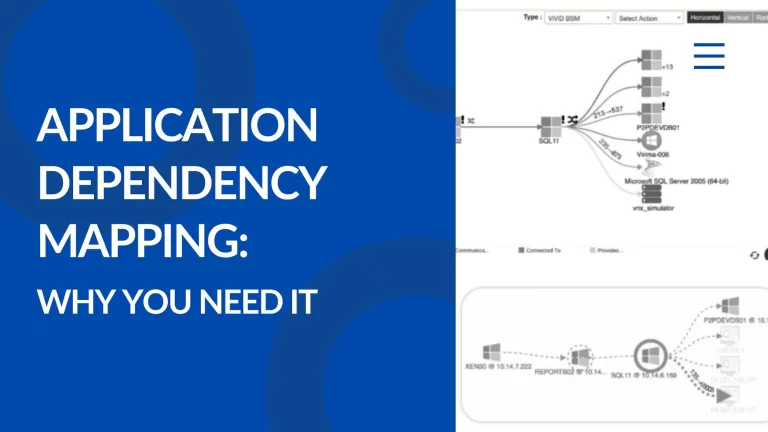
Virima’s ViVID™ service mapping builds dependency maps from discovery data after service definitions are provided by the IT team. These maps show every CI that a service depends on, including upstream and downstream relationships that may not appear in the ITSM platform’s incident form.
During an incident, engineers can view the service map to see which other CIs and services share the affected component. This view of blast radius prevents engineers from closing an incident that has downstream effects still in progress, a common source of reopened tickets.
ViVID also pulls live ITSM records directly onto the map. Incidents, changes, and vulnerabilities appear as overlays on the dependency visualization, giving engineers the full context of what is active, what recently changed, and where vulnerabilities exist on the affected path. See the ViVID™ feature page for a full breakdown of its visualization capabilities.
Vulnerability and Risk Discovery for Proactive Incident Prevention
Virima’s IT discovery identifies configuration changes, newly detected assets, and vulnerability data from NIST NVD lookups across the IT environment. Security and IT operations teams can use this data to address known risk conditions before they trigger service disruptions.
This proactive layer is distinct from reactive incident management. When teams know which assets carry unpatched vulnerabilities or have drifted from their baseline configuration, they can prioritize remediation during maintenance windows rather than respond to incidents after the fact.
Virima’s IT asset management capabilities provide the asset lifecycle view that supports this prioritization, tracking ownership, contract status, and software entitlement alongside discovery data.
For context on how ITOM and ITSM align around incident and problem management, see IT operations enhanced with Virima and ServiceNow. For an ITIL 4 perspective on problem identification through ITOM, see Implementing ITIL problem management.
| How does Virima improve ITSM incident management? Virima strengthens ITSM incident management by delivering discovery-sourced CI data, dependency maps, and ownership records to the ITSM platforms teams already use. Engineers responding to incidents in ServiceNow or Jira Service Management see current asset relationships without switching tools, cutting diagnostic time and reducing reopened ticket rates. |
Putting Discovery-Sourced Trusted Runtime Truth Into Your Incident Workflow
ITSM incident management tools are most effective when the data they operate on reflects the current IT environment. High-quality ITSM workflows built on outdated CI records still produce slow, error-prone resolutions. High-frequency discovery cycles, accurate dependency mapping, and ownership data at the CI level close the gap between what an engineer sees in the ticketing system and what is actually running in the environment.
Virima provides the discovery, ITOM, CMDB, and service mapping capabilities that convert that gap from a recurring operational constraint into a solved problem. For IT teams managing complex environments across multiple platforms and cloud workloads, that foundation is what turns good ITSM processes into consistent, measurable resolution performance.
To see how Virima’s discovery-sourced Trusted Runtime Truth improves your incident management workflow, schedule a demo at virima.com/request-demo.
Frequently Asked Questions
What is ITSM incident management and how does it differ from problem management?
ITSM incident management focuses on restoring normal service operations as quickly as possible after an unplanned disruption. Problem management identifies and eliminates root causes so the same incident does not recur. Incident management is reactive; problem management is investigative. The two practices work together: incidents generate the data that problem management analyzes.
How does CMDB data affect incident resolution time?
CMDB data directly determines how quickly an engineer can identify the root cause of an incident. When CI records reflect the current state of the environment, engineers trace affected assets, dependencies, and ownership in minutes. When records are stale, diagnostic time expands to account for manual verification. A discovery-sourced CMDB eliminates the verification step.
What ITSM platforms does Virima integrate with?
Virima integrates with ServiceNow, Jira Service Management, Ivanti, HaloITSM, Xurrent, Hornbill, and TeamDynamix. These integrations push discovery-sourced CI data, service maps, and vulnerability information into the ITSM platform’s incident and change records so engineers have current context at the point of response.
Can Virima work alongside an existing ITSM platform without replacing it?
Yes. Virima provides the discovery, CMDB, and service mapping layer that feeds into ITSM platforms teams already use. Organizations do not need to change their ITSM tooling to gain the benefit of discovery-sourced CI data in incident workflows.
What does mean time to resolution (MTTR) measure in incident management?
Mean time to resolution (MTTR) measures the average time from when an incident is logged to when the affected service is confirmed restored. Reducing MTTR requires both workflow efficiency (automated triage, correct routing) and data accuracy (current CMDB records, dependency maps). Improvements in either dimension reduce MTTR independently; the largest gains come from addressing both.