Network Inventory Management: Closing the Visibility Gap

Network inventory management is the practice of discovering and maintaining an accurate record of every switch, router, firewall, and access point on a network, including how they connect. Unlike endpoint inventories, network devices rarely run agents and rarely get updated after unplanned changes, which is why the record usually drifts out of date within months, not years. That drift is also why a network inventory and a CMDB fall out of sync: the CMDB can only be as current as the discovery feeding it.
What Network Inventory Management Actually Covers
If you already run an IT asset management (ITAM) program, you might assume network inventory management is a subset of the same work. It isn’t, and that distinction matters more than it sounds.
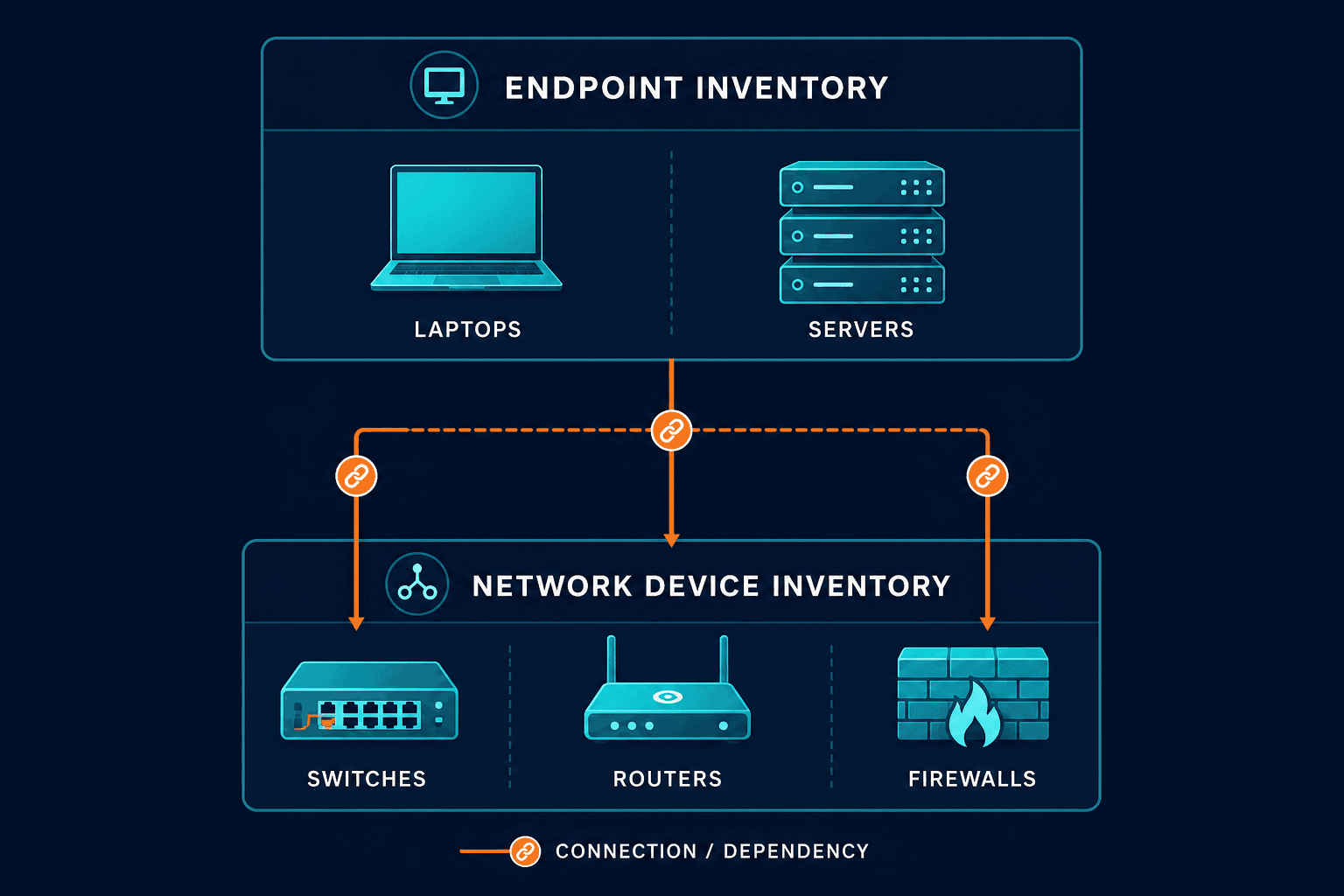
General ITAM tracks endpoints, laptops, software licenses, and the people or departments assigned to them. Network inventory management tracks the infrastructure layer underneath all of that: the switches, routers, firewalls, wireless access points, load balancers, and the physical and logical connections between them. These devices rarely get reassigned to a person, they rarely run standard operating systems, and they almost never show up in a spreadsheet someone remembers to update.
That’s why practitioners searching this term already understand ITAM basics and want the network-specific answer instead. A network asset management program that stops at endpoints leaves the infrastructure layer as a blind spot, and that blind spot is exactly where outages and unauthorized access tend to start. A complete inventory ties both layers together: the endpoints ITAM already tracks, and the network devices that connect them.
In practice, a network inventory record needs to capture more than “a switch exists at this IP.” It needs the model and firmware version, the physical location or rack, the uptime and end-of-support date, and every neighboring device it connects to. Miss any one of those fields and the record stops being useful the moment someone needs it, whether that’s during an outage at 2 a.m. or an auditor asking for proof of what’s actually deployed. A spreadsheet can hold that data for a week. It can’t keep holding it once a team is managing hundreds or thousands of devices across data centers, branch offices, and cloud-adjacent infrastructure.
Why Network Devices Are Uniquely Hard to Track
Network devices break three assumptions most inventory tools are built on: they can’t run agents, their topology changes constantly, and vendor implementations differ enough that no single tool sees them all. Add a fourth complication that’s easy to miss: discovering a device isn’t the same as understanding what depends on it, and answering a blast-radius question during an incident means tying that discovery data to a CMDB, not just listing hardware.
They Can’t Run Agents
You can’t install an agent on a Cisco switch, a Juniper router, or a Fortinet firewall the way you would on a Windows server, because their operating systems are purpose-built and closed. Any tool that relies on agent-based discovery alone will never see these devices, no matter how well it tracks everything else.
This gets harder in a mixed-vendor environment, which is the norm rather than the exception. A mid-size network might run Cisco switches at the core, Juniper routers at the edge, Aruba or Meraki access points for wireless, and Fortinet firewalls for perimeter security. Each vendor exposes device data slightly differently, so a discovery approach built around one vendor’s tooling often can’t see the others at all.
Topology Never Holds Still
Network topology changes constantly: a new access point goes up, a firewall rule gets added during an incident, a switch gets swapped after hours. Gartner estimates that more than 60% of enterprise network changes are still made manually, and a major network outage costs more than $500,000 per hour, with 38% of surveyed organizations reporting costs above $1,000,000 when one happens (NetBrain, citing Gartner). Manual, ad hoc changes at that volume are exactly what causes an inventory to drift out of sync with reality.
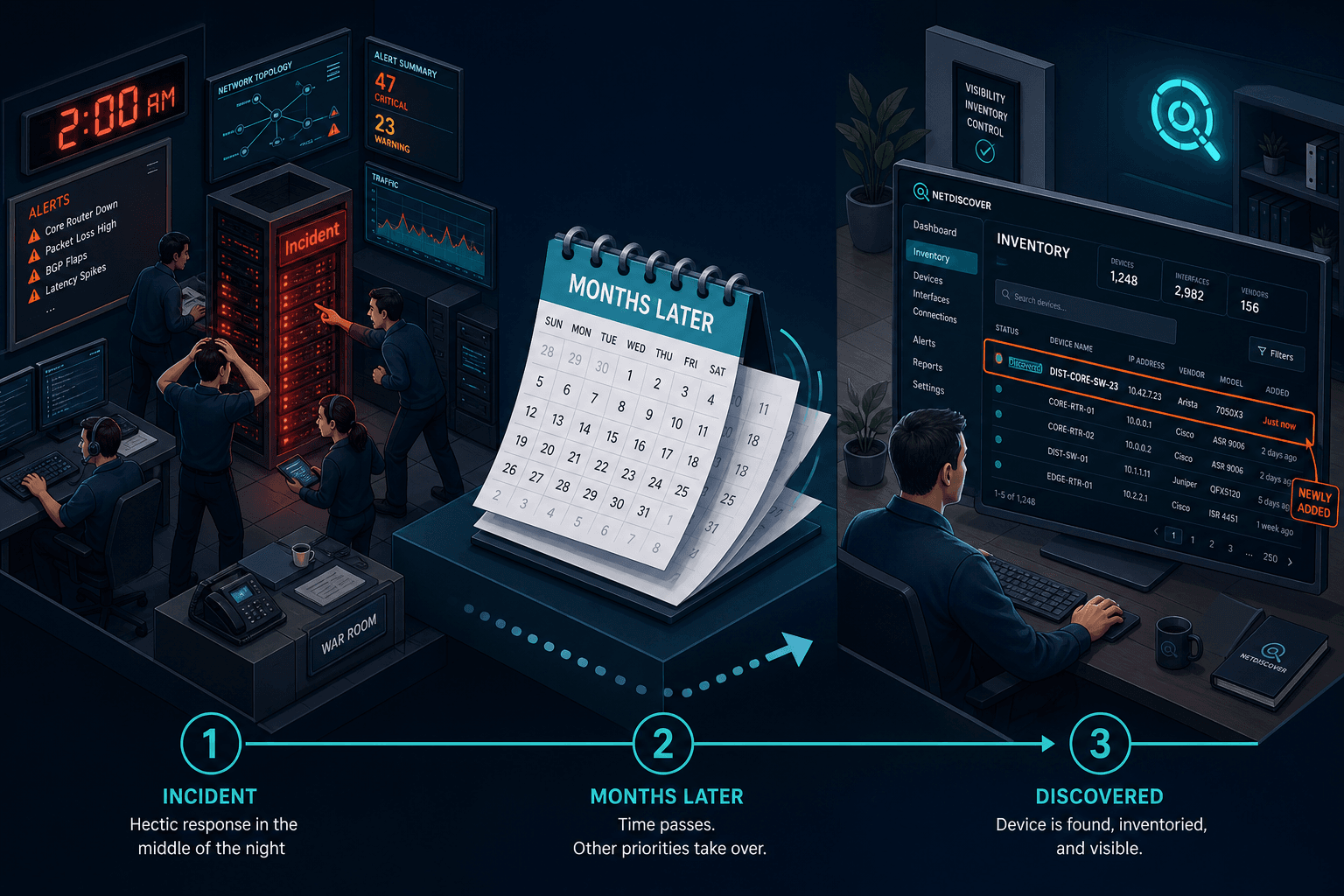
Human error compounds the problem. A change made under pressure, during an active incident, rarely gets documented with the same rigor as a planned maintenance window. That single undocumented swap is often the one that matters most, because it’s the device nobody thought to check six months later when something else on the network breaks.
See what a network topology gap actually costs. 6 Network Topology Types (with Diagrams) and How to Map Yours
How Automation Closes the Accuracy Gap
This is where most inventory practices break down, and where automation actually earns its keep.
Why Agent-Based Discovery Falls Short for Network Devices
If agent-based discovery can’t see switches, routers, or firewalls, then any automation strategy built only on agents will always miss the infrastructure layer. That’s not a minor gap. It’s the layer where blast radius and dependency questions live: if a switch goes down, what depends on it? Agent-based tools can’t answer that question for devices they can’t reach in the first place, so teams relying on them are left doing exactly the manual tracking that automation was supposed to replace. This is the gap ViVID™ service maps are built to close — they turn discovered network devices into visual dependency context, so the blast-radius question has an answer before an incident call even starts.
Agentless Discovery: SNMP, CDP/LLDP, and Passive Traffic Analysis
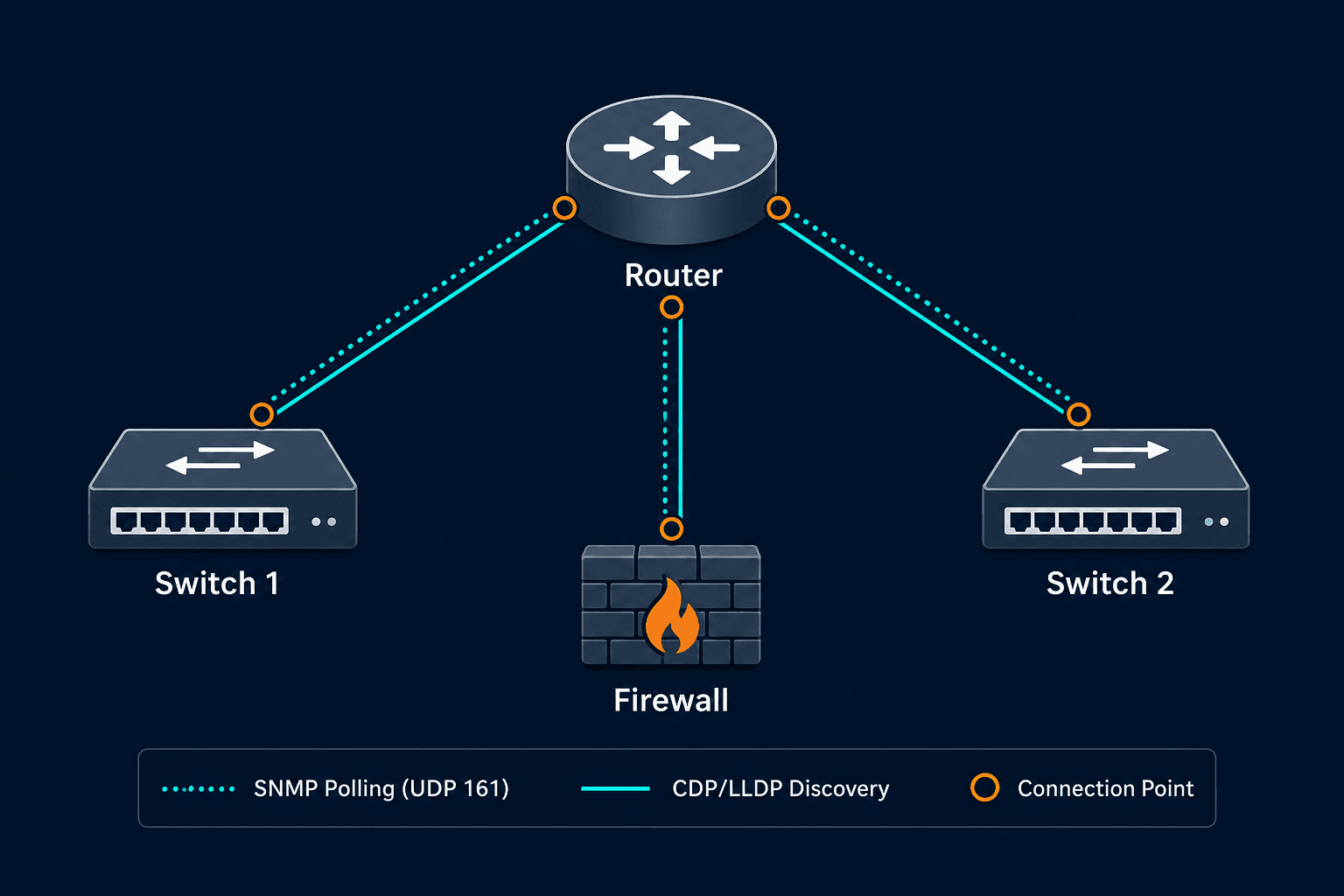
Agentless discovery methods solve this by talking to network devices in the protocols they already speak. SNMP polling queries a device directly for its configuration, interface status, and uptime, and it works across Cisco, Juniper, Aruba, and Fortinet gear alike because SNMP is a shared standard rather than a vendor-specific tool. CDP and LLDP are neighbor-discovery protocols that let a switch or router announce itself to directly connected devices, which is how automated tools map physical topology without anyone drawing a diagram by hand. Passive traffic analysis adds a third layer: instead of asking a device for its status, it watches real traffic flows across the network and infers a device’s presence from the packets it sends and receives. That catches devices that don’t respond to polling at all, such as an unmanaged switch with SNMP turned off or a rogue access point sitting behind a segment the scanner can’t directly reach — which is also why agentless discovery isn’t purely “ask and wait”: when a device won’t answer, watching the traffic it generates is the fallback.
Cloud-adjacent network infrastructure adds a fourth angle: API-based discovery. Virtual routers, load balancers, and security groups inside AWS or Azure don’t expose SNMP the same way physical hardware does, so pulling their configuration through the cloud provider’s own API is what keeps a hybrid network’s inventory complete instead of stopping at the data center’s edge.
Where Agentless Discovery Fits
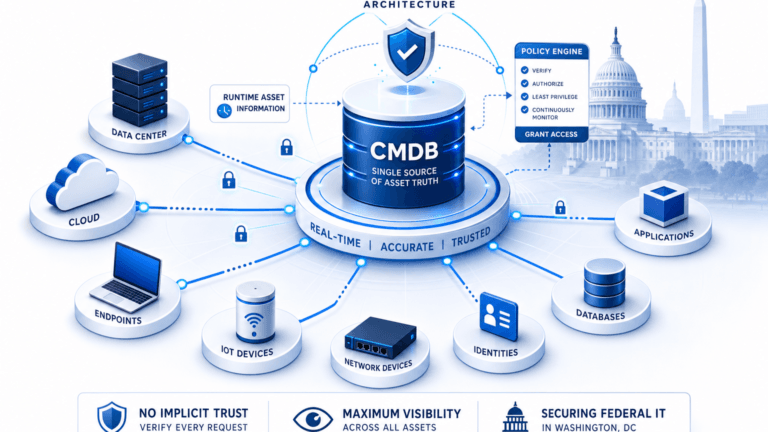
Once you understand why network devices resist agent-based methods, agentless discovery stops looking like a nice-to-have and starts looking like the only reliable option. Virima’s agentless IT discovery uses SNMP, CDP, and LLDP scanning across multi-vendor environments, including Cisco, Juniper, Aruba, and Fortinet devices, to build and refresh a network device inventory automatically. That data feeds straight into the CMDB so records stay current without someone manually re-auditing the network every quarter, closing the CMDB drift that happens when discovery and inventory fall out of sync. For a deeper look at how this data flows into CMDB relationships, see this breakdown of network device discovery and CMDB dependency.
What a Well-Maintained Network Inventory Enables
An accurate, current network inventory is more than a compliance checkbox. It changes how your team operates day to day.
When an incident hits, an up-to-date inventory tells you immediately which devices are involved and what else connects to them, cutting the time spent guessing before you can start fixing anything. During an audit, it gives you a defensible record of what hardware exists, where it sits, and when it was last seen, instead of a spreadsheet nobody trusts. And on the security side, the stakes are real: 74% of organizations have experienced a security incident directly caused by an unknown or unmanaged asset (Auvik, 2024 Shadow IT Statistics). A network device nobody knows about is exactly that kind of unmanaged asset, sitting on your network with no owner and no visibility.
Lifecycle tracking benefits the same way. A switch that quietly reaches end-of-service doesn’t send an alert. Without a current inventory tied to vendor lifecycle data, those devices surface the way one Virima customer found 23 of them: four weeks before a budget cycle closed, forcing an unplanned scramble instead of a routine refresh line item. That’s the operational cost of a stale network inventory in a single sentence: not a security breach, but a budget planning cycle turned into a fire drill because nobody had a current record to check against.
Related reading: this guide on choosing a network asset discovery tool and this walkthrough of automated network topology discovery both cover adjacent pieces of this same visibility problem.