How to Minimize the Cost of Asset Management in 2026

IT teams know they are overspending on assets. They cannot always prove where the money goes. Software licenses that nobody uses keep renewing. Hardware that was decommissioned on paper is still drawing support contracts. SaaS tools purchased by one department duplicate tools purchased by another. When an audit letter arrives, teams spend weeks, and sometimes millions, building a compliance position they should have had all along. The goal of minimizing the cost of asset management is not to spend less on ITAM tools. It is to stop paying for assets the organization no longer needs, risks it could have measured, and penalties it could have avoided.
Where IT asset management costs actually come from
Most ITAM cost conversations focus on tooling budgets. The larger cost categories sit elsewhere.
Software license overspend. Organizations purchase more licenses than they deploy, deploy more than users actively use, and renew at last year’s seat counts without checking current utilization. The Flexera 2025 State of ITAM Report found that 30% of desktop software spend was wasted even at organizations with advanced ITAM programs. In environments where SaaS purchasing has moved to business units, that figure climbs higher.
Audit penalties. Software publishers audit their customers to find compliance gaps. According to the Flexera 2026 State of ITAM Report, 48% of organizations were audited in the past year and 44% spent more than $1 million on software audits over three years. Microsoft conducted audits for 64% of audited organizations; Oracle audit activity jumped from 24% to 38% year over year. These costs are avoidable for teams that maintain accurate compliance positions before the audit letter arrives.
Ghost assets. Hardware that appears active in asset records but has been physically decommissioned, lost, or repurposed without documentation continues to generate support contract costs and inflated refresh budgets. Ghost assets are invisible overspend: the organization keeps paying for something that no longer delivers value.
SaaS sprawl. According to the Zylo 2026 SaaS Management Index, the average organization spends $55.7 million annually on SaaS across a portfolio of 305 applications. Much of that spend is approved and renewed directly by business units rather than IT, which is why duplicate tools, unused subscriptions, and ungoverned AI software accumulate without a central inventory record.
AI software waste. The Flexera 2026 State of ITAM Report found that only 31% of organizations have visibility into AI software, while 59% say wasted AI spend increased year over year. AI-native tools use consumption-based pricing rather than per-seat models, making overrun costs harder to detect until the invoice arrives.
What are the biggest sources of IT asset management costs?
The largest ITAM cost categories are software license overspend (unused and over-provisioned licenses), software audit penalties, ghost hardware assets drawing support contracts, SaaS sprawl from decentralized purchasing, and wasted AI software spend. Each category grows when IT teams lack accurate, current visibility into what is actually running in their environment.
Why visibility is the root cause, not budget discipline
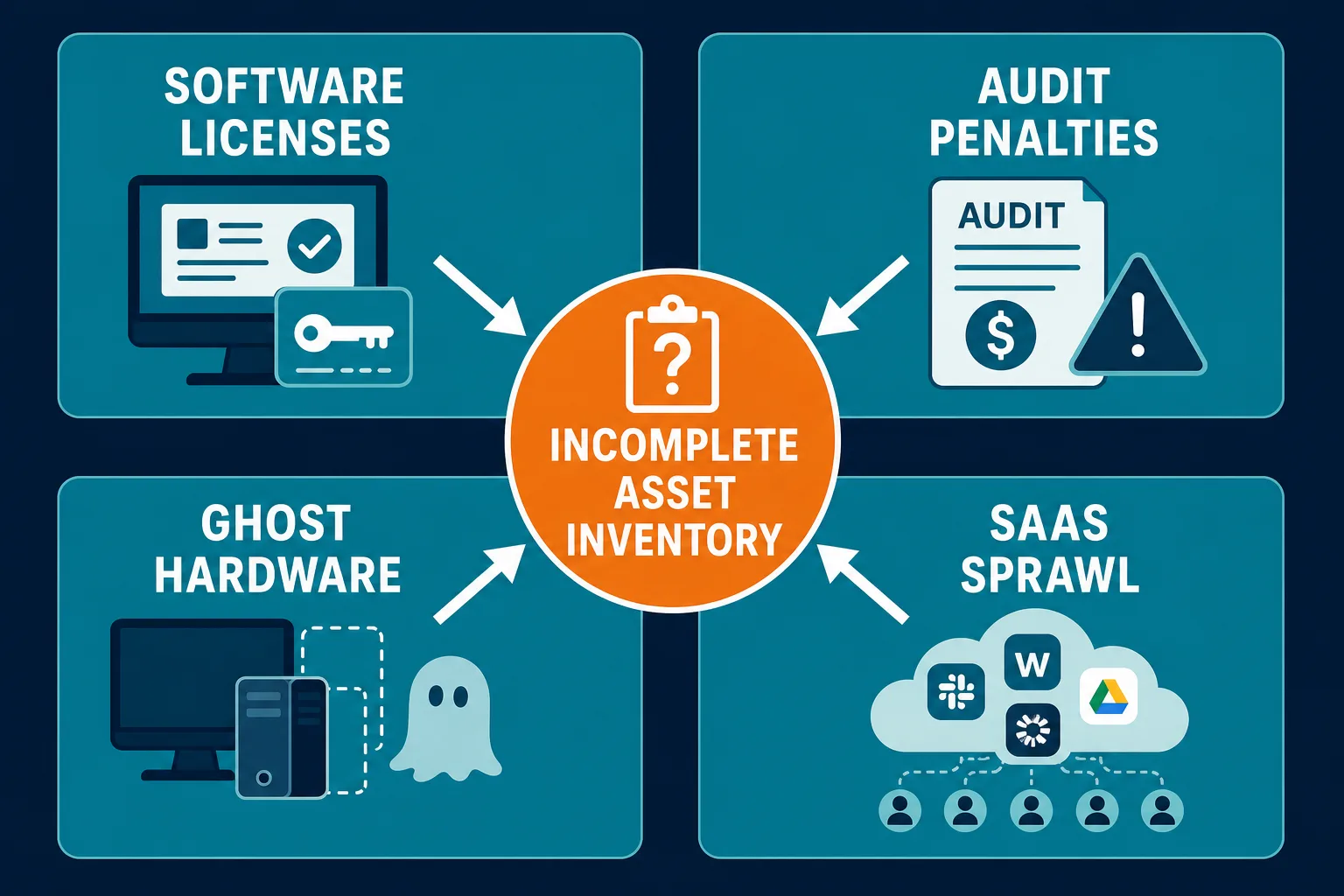
Every major ITAM cost category has the same underlying driver: incomplete asset inventory.
You cannot reclaim a license you do not know is unused. You cannot eliminate a support contract on hardware you believe is still active. You cannot govern SaaS spending when most purchases happen outside IT’s view. You cannot prepare a defensible audit position when your software inventory was last updated six months ago.
The Flexera 2026 State of ITAM Report found that only 36% of organizations have complete visibility into their IT estate, and that figure has declined year over year as SaaS, cloud, and AI environments expand faster than manual inventory processes can track. ITAM teams broadly treat inventory accuracy as a top operational priority, even as that visibility gap widens. Getting that inventory accurate and keeping it current is the prerequisite for every cost reduction strategy that follows.
Why is IT asset management expensive?
IT asset management becomes expensive when asset inventory is incomplete or outdated. Organizations overpay for unused licenses they cannot identify, face audit penalties for compliance gaps they did not measure, and maintain support contracts on hardware they cannot confirm is still in use. Visibility is the prerequisite for every cost reduction strategy in ITAM.
Six ways to minimize the cost of asset management in 2026
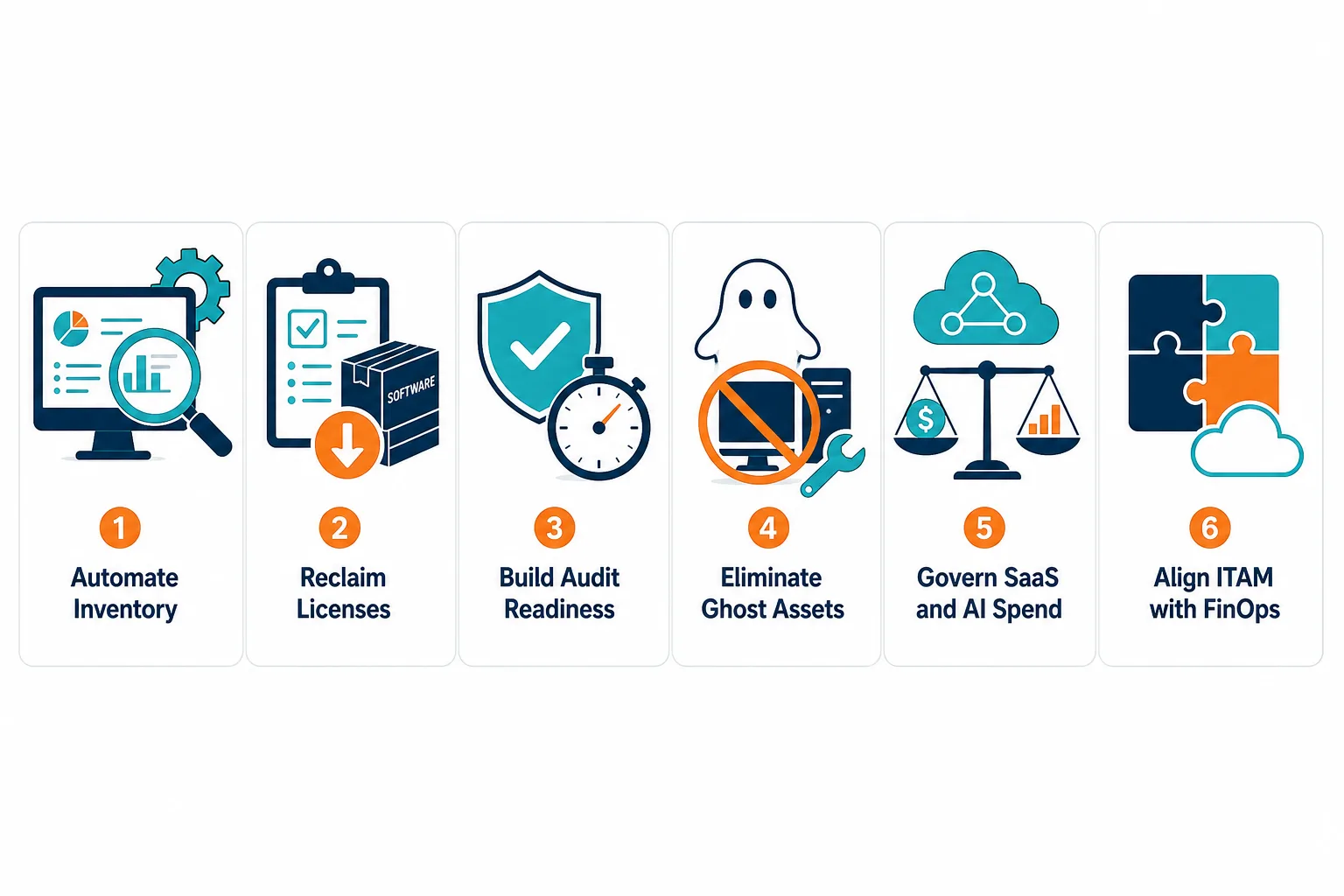
1. Automate software inventory: stop relying on manual entry
Manual inventory processes produce point-in-time snapshots that age immediately. Every software deployment, license reassignment, and SaaS subscription purchased by a business unit creates a gap between what the inventory says and what is actually installed. Automated discovery tools scan endpoints, servers, cloud workloads, and network infrastructure on a scheduled basis, surfacing what is actually present rather than what someone recorded last quarter.
Discovery-sourced inventory is the data foundation for every downstream cost reduction activity. Reclamation, optimization, and audit readiness all depend on it being accurate. Virima’s IT discovery runs both agentless and agent-based discovery across on-premises, AWS, and Azure environments, keeping software inventory current as the estate changes. For a deeper walkthrough, see Virima’s guide to IT asset inventory management.
2. Reclaim unused software licenses before renewal
License reclamation is the fastest path to reducing software spend. Usage monitoring identifies applications that have not been launched within a defined period, typically 30 to 90 days. Those licenses are reclaimed and returned to an available pool or removed from the renewal count before the next contract cycle locks in the current seat volume.
The Flexera 2026 State of ITAM Report identified reducing licenses as the most effective strategy for reducing costs. The mechanism is straightforward: accurate usage data drives reclamation, reclamation reduces the license count at renewal, and the renewal saves the cost of seats that were not being used. This is also the fastest way to demonstrate measurable ITAM ROI to budget stakeholders — the savings show up in the next renewal invoice, not a multi-quarter program. Virima’s ITAM platform ties usage monitoring directly to this reclamation workflow, so the savings case builds itself from discovery data already being collected.
3. Build an always-on audit-readiness posture
Reactive audit preparation is the most expensive way to respond to a software publisher’s request. When an audit arrives with no standing compliance position, ITAM teams spend weeks reconciling install data against entitlements under time pressure, often with external consultants, legal review, and potential settlement costs layered on top.
Organizations that maintain a continuously reconciled compliance position, updated as discovery refreshes their install data, can respond to audit requests from a prepared position. The preparation cost is lower, the risk of penalties is lower, and the time-to-response is measured in days rather than weeks. Given that 44% of organizations have spent over $1 million on audits over three years (Flexera, 2026), the investment in continuous audit readiness pays back quickly.
4. Eliminate ghost assets from hardware inventory
Ghost assets are hardware recorded as active that has been decommissioned, relocated, or lost. They generate support contract costs, inflate hardware refresh budgets, and create inaccurate CI data for every downstream ITSM process. Eliminating them requires physical reconciliation between asset records and actual deployed inventory, ideally driven by discovery scans that confirm what is reachable on the network versus what the CMDB believes is there.
Regular hardware reconciliation cycles catch ghost assets before they complete another contract renewal period. Discovery-sourced hardware inventory that flags assets as “not seen since” a defined date gives ITAM teams a prioritized reclamation list rather than requiring a full physical audit. For more on identifying and eliminating ghost assets, see ghost asset elimination and CMDB accuracy.
5. Govern SaaS and AI software spend at the procurement stage
Retroactive SaaS rationalization, finding and canceling unused subscriptions after the fact, recovers some waste but does not address the process that created it. Organizations that achieve sustained SaaS cost reduction establish lightweight procurement governance that requires new SaaS purchases to be checked against the existing portfolio before approval.
This does not require a slow procurement process. It requires a current SaaS inventory and a simple check against it. When IT has an accurate picture of what is already deployed, duplicate tool requests are visible before a second subscription is purchased rather than after both have renewed for a year.
For AI software specifically, consumption-based pricing means governance needs to happen at the usage level, not only the subscription level. The 59% of organizations reporting increased AI waste have tools they approved but not usage patterns they monitor.
6. Align ITAM with FinOps for cloud license optimization
The Flexera 2026 State of ITAM Report found that responsibility for cloud software savings is now nearly evenly split between ITAM and FinOps teams. Organizations that keep these functions siloed leave optimization opportunities on the table. Cloud software licenses, including bring-your-own-license (BYOL) arrangements, cloud-hosted applications, and SaaS tools provisioned through cloud marketplaces, require both ITAM’s license visibility and FinOps’ cloud spend data to optimize fully.
Virima’s ITAM platform connects discovery-sourced asset and license data across on-premises, AWS, and Azure environments, giving ITAM and FinOps teams a shared data foundation for cloud cost optimization decisions.
How do you reduce software license costs in IT asset management?
The most effective way to reduce software license costs is to identify unused licenses through usage monitoring and reclaim them before renewal. This requires accurate, discovery-sourced software inventory that reflects what is installed and actively used. Organizations that maintain continuous license reconciliation spend less at renewal than those relying on static inventory records.
What prioritization looks like in practice
Not every organization can tackle all six strategies at once. A practical sequence for teams building toward lower ITAM costs, informed by Virima’s ITAM best practices guide:
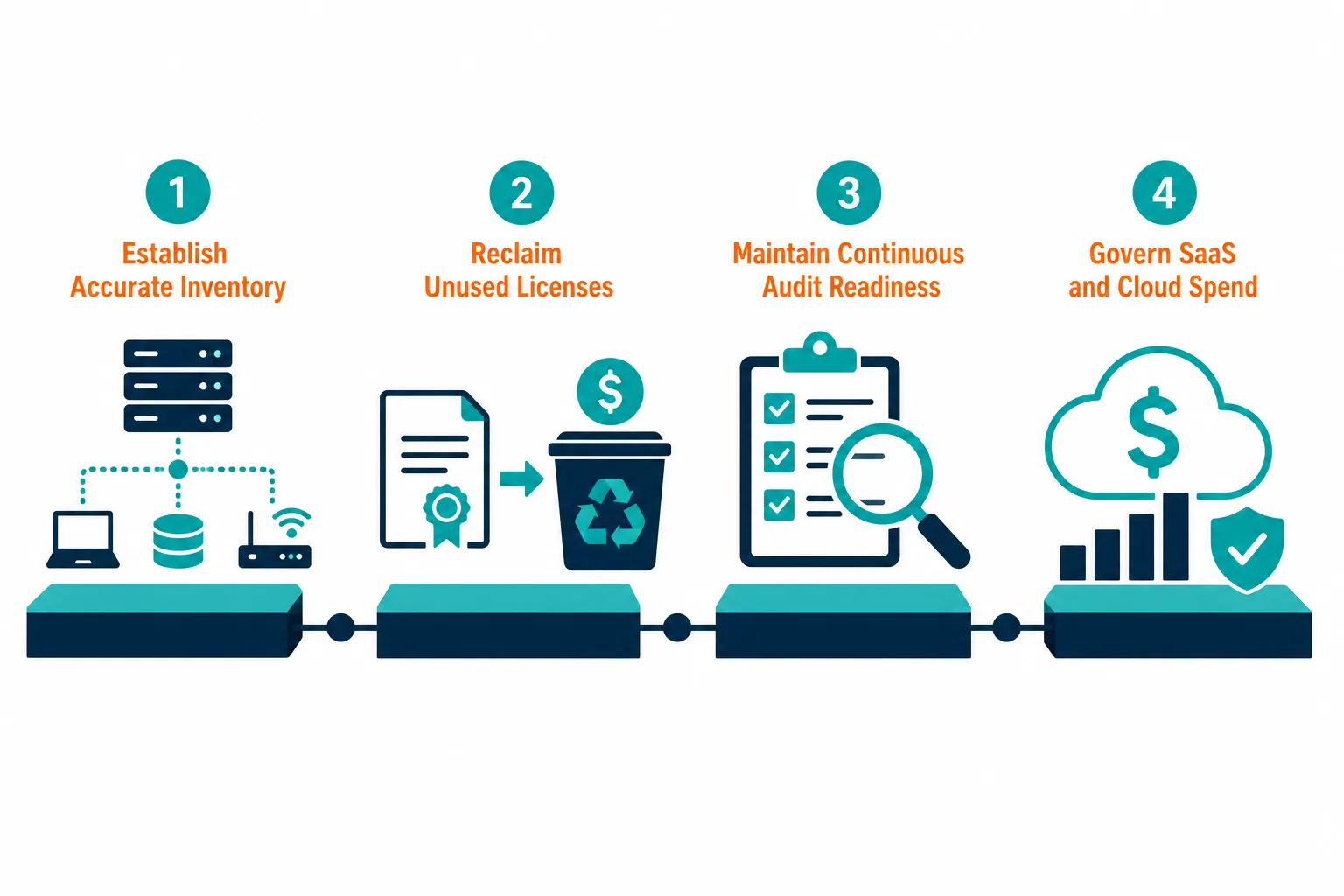
Start with inventory accuracy. Before any cost reduction strategy can work, the organization needs to know what it has. Automated discovery that covers the full estate, including cloud workloads and endpoints, establishes the baseline. This is a one-time investment with compounding returns as all downstream activities draw from accurate data.
Target software reclamation next. Once usage data is flowing, unused license identification and reclamation produces direct, measurable savings in the first renewal cycle. This is the highest-ROI activity for most ITAM teams and the fastest to produce a visible number.
Build audit readiness as an operational standard. Once the inventory is accurate and license positions are reconciled, maintaining continuous audit readiness requires a fraction of the effort that reactive preparation demands. The audit preparation investment shifts from episodic and expensive to ongoing and low-cost.
Tackle SaaS governance and hardware reconciliation in parallel. These activities draw on the same accurate inventory foundation and can run concurrently without significant additional resource investment.
For teams evaluating how to structure their ITAM program to support these priorities, Virima’s IT audit and compliance use cases cover how discovery-sourced data connects to audit preparation and compliance reporting workflows.
What is the fastest way to reduce IT asset management costs?
The fastest path to reducing IT asset management costs is software license reclamation. Usage monitoring identifies licenses that have not been launched in 30 to 90 days. Those licenses are reclaimed before the next renewal cycle, cutting seat counts and renewal costs directly. This requires accurate, up-to-date software inventory as its data foundation.
The discovery foundation that makes cost reduction sustainable
The organizations that achieve lasting ITAM cost reduction share one structural characteristic: their asset inventory stays current without requiring manual effort to maintain it. Automated discovery refreshes the inventory on a scheduled basis, surfacing changes as they happen: new software deployments, decommissioned hardware, SaaS tools purchased outside IT procurement, and cloud workloads spun up without central tracking.
A stale inventory is a cost in itself. Every renewal cycle that proceeds without current usage data produces overspend. Every audit that arrives without a maintained compliance position produces penalty risk. Every hardware refresh budget built on ghost-asset-inflated counts produces waste.
The cost reduction strategies in this guide are not conceptually complex. They depend on one thing: knowing what is actually running in the environment, updated often enough to make decisions on.
See how Virima’s discovery-sourced runtime truth gives your ITAM program the accurate inventory it needs to drive real cost reduction. Explore the Trusted Runtime Truth approach.