Reclaim the Hours ITAM Teams Lose to CSV Reconciliation

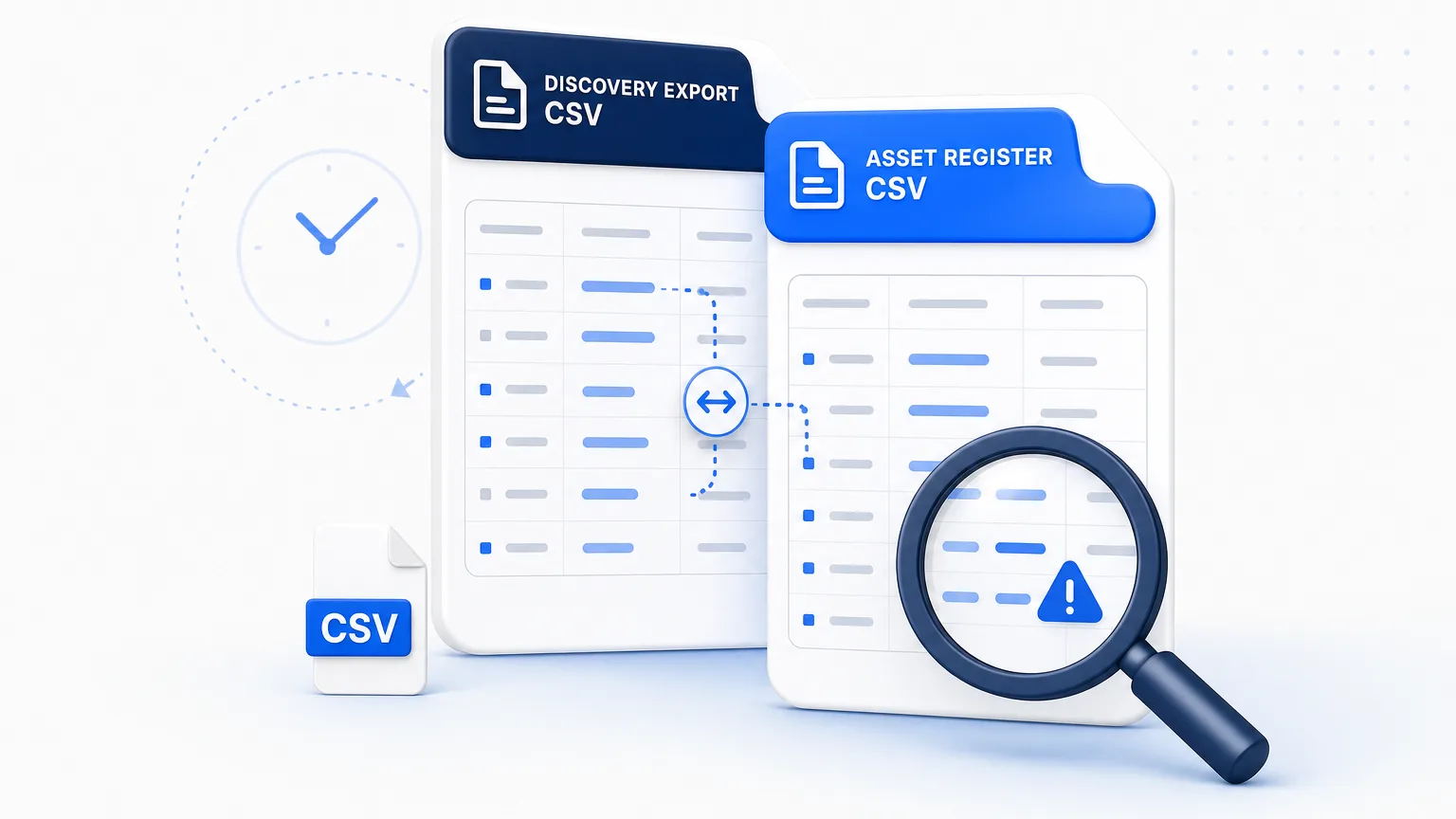
Two files sit open on the same desk. One is a discovery export: hostnames, serials, last-seen timestamps, and a few columns the scanner invented last quarter. The other is the asset register the team still treats as the official list: purchase records, assigned owners, tags that never matched a serial cleanly. Someone is matching rows by eye, by hostname, or by a serial that almost lines up if you ignore the extra hyphen. ITAM CSV reconciliation is the manual process of matching asset records across discovery exports, registers, and finance systems that don’t share a common key.
That ITAM CSV reconciliation work is not a one-off cleanup. It returns every audit cycle, every discovery refresh, and every time two systems need to agree again. Most ITAM teams never put a line item on it. The hours disappear into “part of the job.”
This piece maps where those hours go, why a better spreadsheet rarely ends the cycle, what the task is standing in for, and what removes the match work instead of only speeding it up. Where a full tooling change is not on the calendar yet, it also lists a practical starting point you can run this quarter.
Where the Hours Actually Go
CSV reconciliation looks like one task on a calendar. On the ground it is a chain of sub-steps that rarely finish in a single sitting.
Export, normalize, match, investigate, repeat
First comes export from each source. Discovery tools, procurement sheets, endpoint managers, and finance registers rarely share one schema. Column names drift. Date formats disagree. One file stores serials with spaces; another strips them.
Normalization follows. Someone renames columns, trims whitespace, forces case rules, and decides which hostname field is “real” when three candidates exist. Matching comes next: join on hostname, serial, asset tag, or a fragile composite key. Clean joins finish in seconds. The rest of the shift goes to rows that almost match.
Investigation is the expensive middle. A hostname changed after a rebuild. A serial was typed with one wrong character at intake. A laptop moved between two exports and appears twice under different owners.
Each messy row can cost many minutes of ticket searches, vendor portals, and hallway questions. After fixes, the match often reruns, since correcting one side changes the join set.
Clean matches are cheap; dirty rows own the clock
Most of the time is not spent finding perfect pairs. Perfect pairs are boring and fast. The clock belongs to exceptions: near-duplicates, missing serials, retired assets still on a register, and live devices missing from the register entirely.
That pattern compounds. The same exception classes return on the next cycle because nothing upstream removed the drift. Audit season, a discovery refresh, or a “systems need to agree” request each restarts it. Teams feel busy and current while the underlying disagreement keeps regenerating.
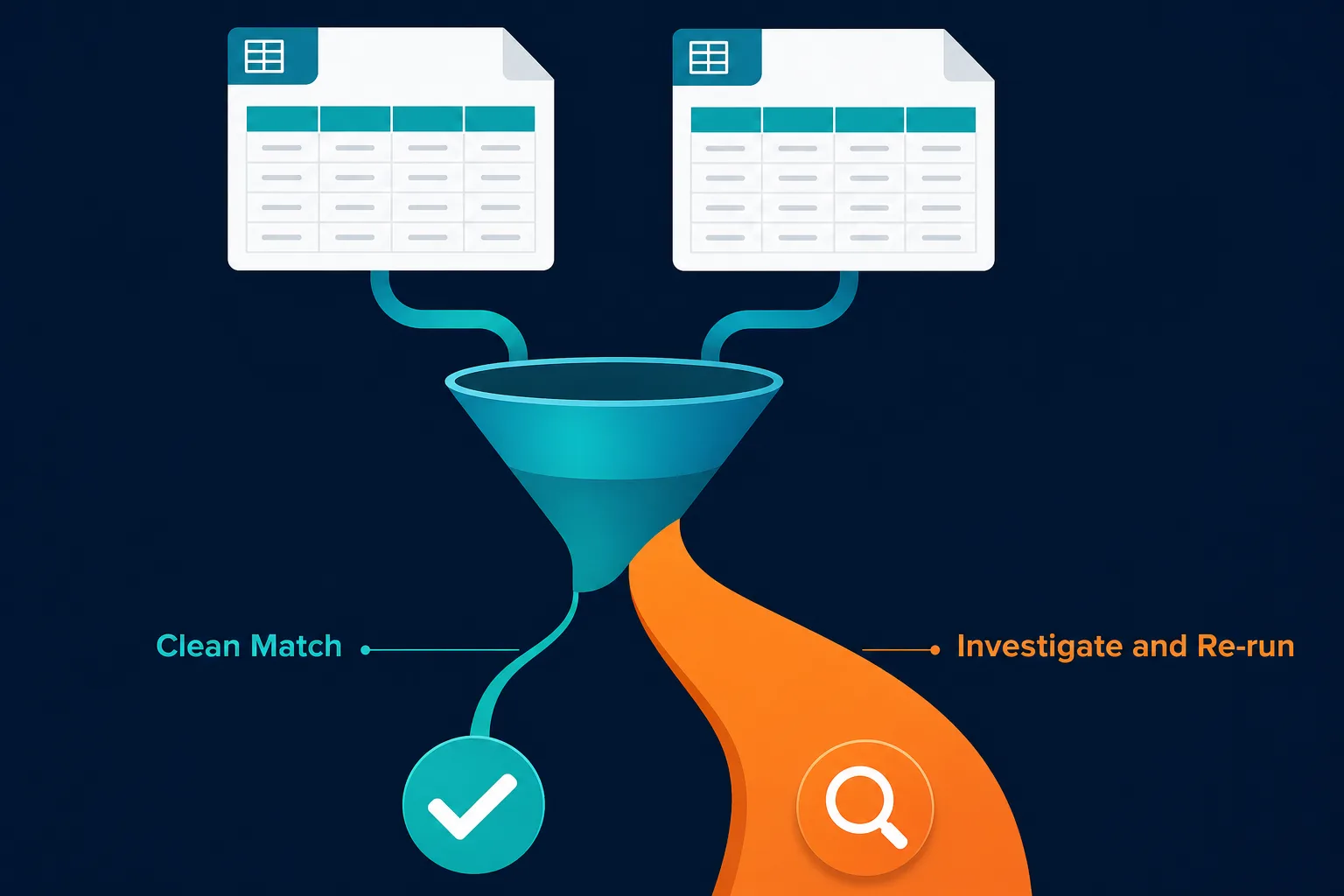
Where do ITAM teams lose the most time during CSV reconciliation?
Most hours go to exception rows, not clean matches. Exporting, normalizing formats, matching on hostname or serial, investigating near-misses, and re-running the join after fixes dominate the cycle. Clean pairs take seconds. Dirty rows can take many minutes each and return every audit or discovery refresh.
If you want a durable picture of what the estate holds between those cycles, start from Trusted Runtime Truth rather than another one-time export ritual.
Why a Better Spreadsheet Doesn’t Fix CSV Reconciliation
The natural first fix is a better workbook. Teams build VLOOKUP or INDEX-MATCH templates, add helper columns, lock a “golden” sheet, and train everyone on one matching recipe. That work helps. It does not end the class of problem.
Exact-match tools meet non-exact asset identity
Spreadsheet lookups excel when both sides already agree on the key. Asset records often do not. Naming conventions differ by team and by tool. Hostnames change after rebuilds or cloud migrations. Serials pick up typos at receiving. Tags go missing when a device leaves the cage without a scan. Two exports of the “same” device can disagree on what to call it.
A formula compares values that already line up. It cannot invent a shared identity when the sides disagree on the name of the thing. Fuzzy matching add-ins and manual review queues push more exceptions into human judgment. They do not create a single current record that both systems already trust.
Structure improvements still reset between cycles
A cleaner sheet reduces formatting chaos. Macros can re-run the same join faster. A dedicated reconciliation analyst can clear a backlog with fewer errors. Each of those investments shortens one cycle. None of them stop the next cycle from starting at zero when two point-in-time snapshots diverge again.
The hard limit is plain: spreadsheet logic only reconciles agreement that already exists. ITAM CSV work is full of records that don’t agree yet, so speeding the comparison never removes the disagreement that created the pair.
Why can’t a better spreadsheet template fix ITAM CSV reconciliation permanently?
Templates and lookup formulas solve exact-match joins. Asset rows often disagree on hostname, serial formatting, tags, or ownership after moves and rebuilds. A formula cannot reconcile records that do not share a stable key. It only compares rows that already match, so exception investigation returns every cycle.
What the Task Is Actually Standing In For
CSV reconciliation is often mistaken for an inventory skill problem. The deeper pattern is governance of truth across systems.
Multiple systems claim the record; none stay aligned
Discovery holds a scan-time view. The asset register holds purchase and assignment history. An endpoint tool holds agent presence. Finance holds cost centers.
Each store is useful. Each can be treated as “the” list for a different meeting. When two of those lists must agree for an audit or a renewal, someone exports both and forces a temporary peace.
That peace is a snapshot truce, not a standing process. Between cycles, each system records updates on its own schedule. Hostnames change in one place. Ownership changes in another. Decommission flags lag. The next export pair shows the drift again, and the manual match restarts.
Recurring reconciliation is evidence, not proof of diligence alone
Every recurring reconciliation cycle is evidence that no single source is trusted as current for the fields that matter. Work resets between cycles instead of compounding toward one stable, current record. Teams can still be diligent and skilled at spreadsheets without that diligence removing the exception pile.
CISA BOD 23-01 (2023 directive) pushes federal civilian networks toward accurate, timely asset visibility and vulnerability detection. The directive is domain-specific, yet the operating lesson travels: inventory that only becomes true during a manual match window is hard to defend when the next request arrives on a short clock.
Adjacent research on spreadsheet labor is worth reading carefully, without pretending it measures ITAM specifically. Coverage of DOSS Research 2026 findings, summarized in industry write-ups such as Asset Panda’s note on spreadsheet tracking costs, puts the number at about 3.6 hours a week fixing spreadsheet errors, or roughly 22 workdays a year in that framing. That is broad operations research, not an ITAM reconciliation benchmark, and it is worth citing only as a reminder that spreadsheet exception work is expensive in general. No verified public figure isolates hours lost only to IT asset CSV reconciliation.
When CMDB and register data go stale after a cleanup pass, the same reset pattern shows up in configuration work. See how CMDB data goes stale after cleanup when discovery authority is missing between projects.
What root problem is ITAM CSV reconciliation compensating for?
CSV matching compensates when two or more systems each act as a record of truth with no standing process keeping shared fields aligned. Each cycle produces a temporary truce between exports. Between cycles, drift returns, so work resets instead of compounding into one current asset record.
What Actually Removes the Hours, Not Only Shortens Them
Shortening the manual task and removing the need for it are different goals. Confusing them keeps teams funding the wrong fix.
Speed the match, or retire the match
Better templates, macros, and dedicated analysts still assume two competing snapshots must be forced into agreement on a schedule. Removing the hours means changing the data path so periodic export-and-match is no longer the way truth is produced.
What actually removes ITAM reconciliation hours instead of just shortening them?
High-frequency, multi-source discovery changes the path. Asset identity and key attributes refresh from the estate on a schedule the team controls, instead of waiting for two human exports to line up. Field-level rules can decide which source wins for serial, hostname, owner, and status when sources disagree. The operational record stays current between audit events rather than only during them.
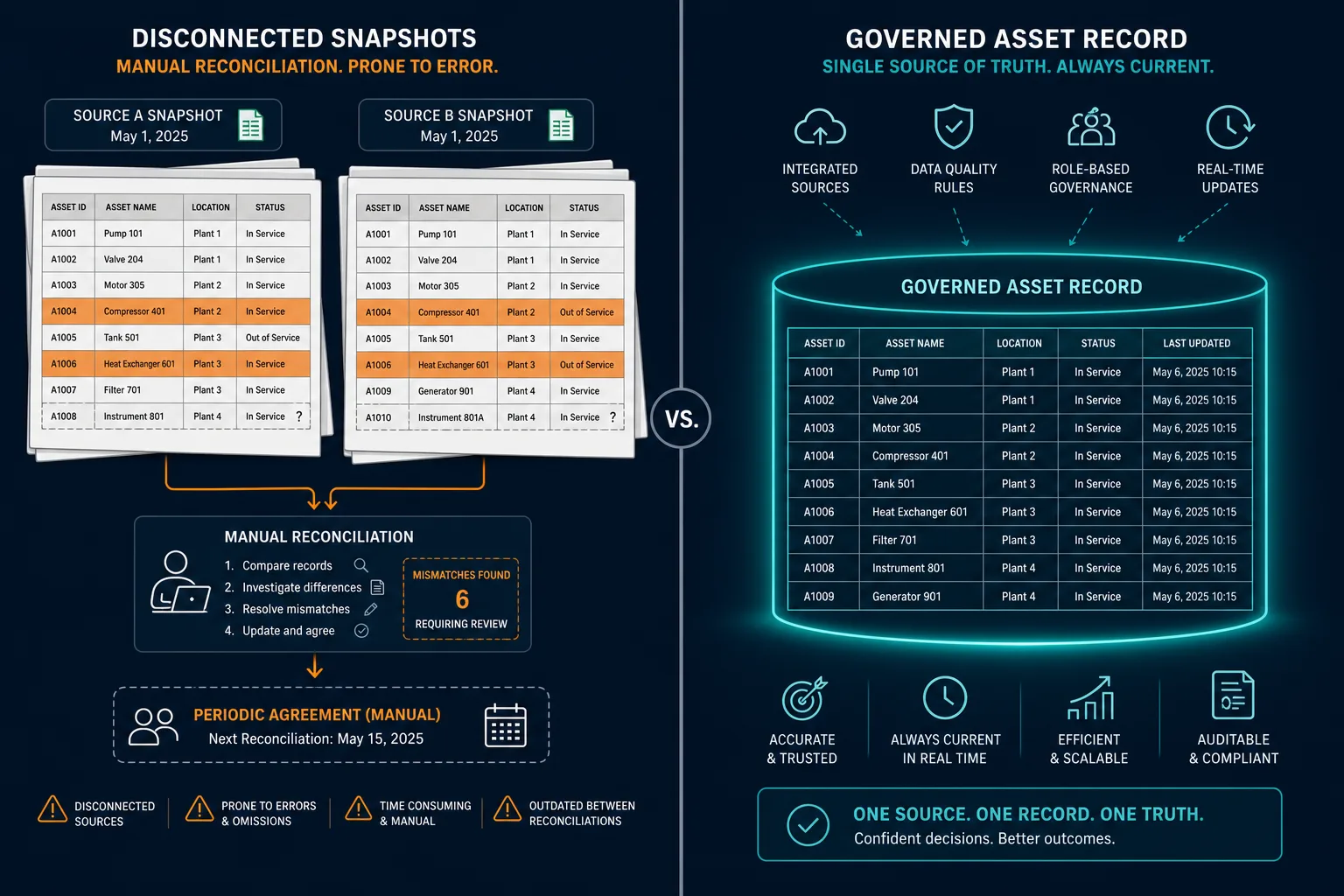
One current record beats two reconciled snapshots
When inventory is maintained through ongoing discovery into a governed store, teams stop treating “reconcile last week’s CSVs” as the primary accuracy ritual. Exceptions still exist. They surface as data-quality queues against a living record, not as a full-file match from zero every time two tools disagree. That shift is what improves CMDB data accuracy without adding a new matching cycle to maintain it.
Virima sits in that discovery layer: agent, agentless, and API collection on high-frequency scheduled cycles, feeding CMDB and ITAM views teams already use. Handoffs into ITSM platforms such as ServiceNow, Jira, and Ivanti happen through a single integrations hub. The point is not a faster VLOOKUP. The point is fewer reasons to run the CSV duel at all. For how discovery approaches differ in hybrid estates, see the major approaches of IT asset discovery and Virima’s IT discovery capability set.
A Practical Starting Point If a Full Switch Isn’t Happening Yet
Not every team can add high-frequency discovery or change platforms this quarter. You can still shrink wasted hours without pretending a template is a permanent architecture.
Standardize export fields before matching starts
Agree hostname format, serial format, and required columns before anyone opens the match workbook. Fixing format drift after the join multiplies investigation. Fixing it at export cuts whole classes of false mismatches.
Measure reconciliation time for one quarter
Track hours per cycle, even roughly: export, normalize, match, investigate, re-run. Turn “this is annoying” into a number leadership can weigh against tooling or process change. Without a measured line item, the work stays invisible and unfunded. Multiply that per-cycle number by a loaded hourly rate and the cycles run each year, and the audit-prep cost most teams never track becomes a figure leadership can weigh against a tooling decision.
Attack the top recurring mismatch fields first
List which fields fail most often: serial typos, hostname renames, missing tags, owner lag after moves. Fixing the top one or two sources of drift often removes a disproportionate share of manual investigation. Pair that list with intake and decommission checklists so new errors stop entering the register.
These steps reduce pain inside the old model. They do not replace high-frequency discovery authority. Treat them as bridge work while you plan the path off recurring snapshot wars. For audit-facing ITAM practice that still depends on trustworthy inventory, see how Virima simplifies IT asset management audits and the ITAM feature path.
Stop Paying the CSV Tax Every Cycle
ITAM CSV reconciliation absorbs hours because teams treat competing exports as normal. Spreadsheets speed exact matches. They do not create shared identity when records disagree. The recurring task is a symptom of multi-system truth without a standing discovery-fed record. Measure the hours, standardize the fields, and retire the dual-snapshot habit when you can. Start with the field-format and mismatch-field checklist above if a full switch isn’t scheduled yet. When you are ready to replace the cycle with discovery-sourced inventory your ITAM and CMDB work can trust, request a demo.
Frequently Asked Questions
Why can’t a better spreadsheet template fix CSV reconciliation permanently?
Lookup formulas solve exact matches. Most reconciliation time goes to rows that do not match exactly because of naming drift, serial typos, missing tags, or hostname changes. A template cannot invent a shared key when two systems disagree on what to call the same asset.
Is there a reliable industry figure for hours lost to ITAM reconciliation?
No verified public figure isolates hours spent only on IT asset CSV reconciliation. Adjacent operations research associated with DOSS Research 2026, summarized in industry coverage of spreadsheet-error costs, reports about 3.6 hours a week fixing spreadsheet errors among operations professionals broadly, not ITAM specifically. Treat that as context, not an ITAM benchmark. Measure your own cycle time for one quarter instead.
What’s the actual root cause CSV reconciliation is compensating for?
Two or more systems each act as a source of truth for asset fields, with no standing process keeping them aligned between events. Each export-and-match cycle produces a temporary agreement. Drift returns afterward, so the labor resets instead of compounding into one current record.
Does Virima’s discovery replace manual CSV reconciliation entirely, or work alongside it?
Virima’s agent, agentless, and API discovery replaces the periodic export-and-match cycle as the way asset data stays current, so most manual CSV reconciliation goes away for the fields discovery covers. Exceptions still surface as data-quality queues against a living record rather than a full-file match starting from zero.
How does Virima’s discovery feed CMDB and ITAM records without a CSV import step?
Virima’s discovery cycles write asset identity and attribute updates directly into CMDB and ITAM views on a scheduled cycle, with field-level authority rules deciding which source wins when hostname, serial, or owner disagree. Handoffs into ITSM platforms such as ServiceNow, Jira, and Ivanti happen through that same discovery-fed record, not a separate CSV import.