ITAM Practices for License Compliance Reporting Depend on One Habit Most Teams Skip

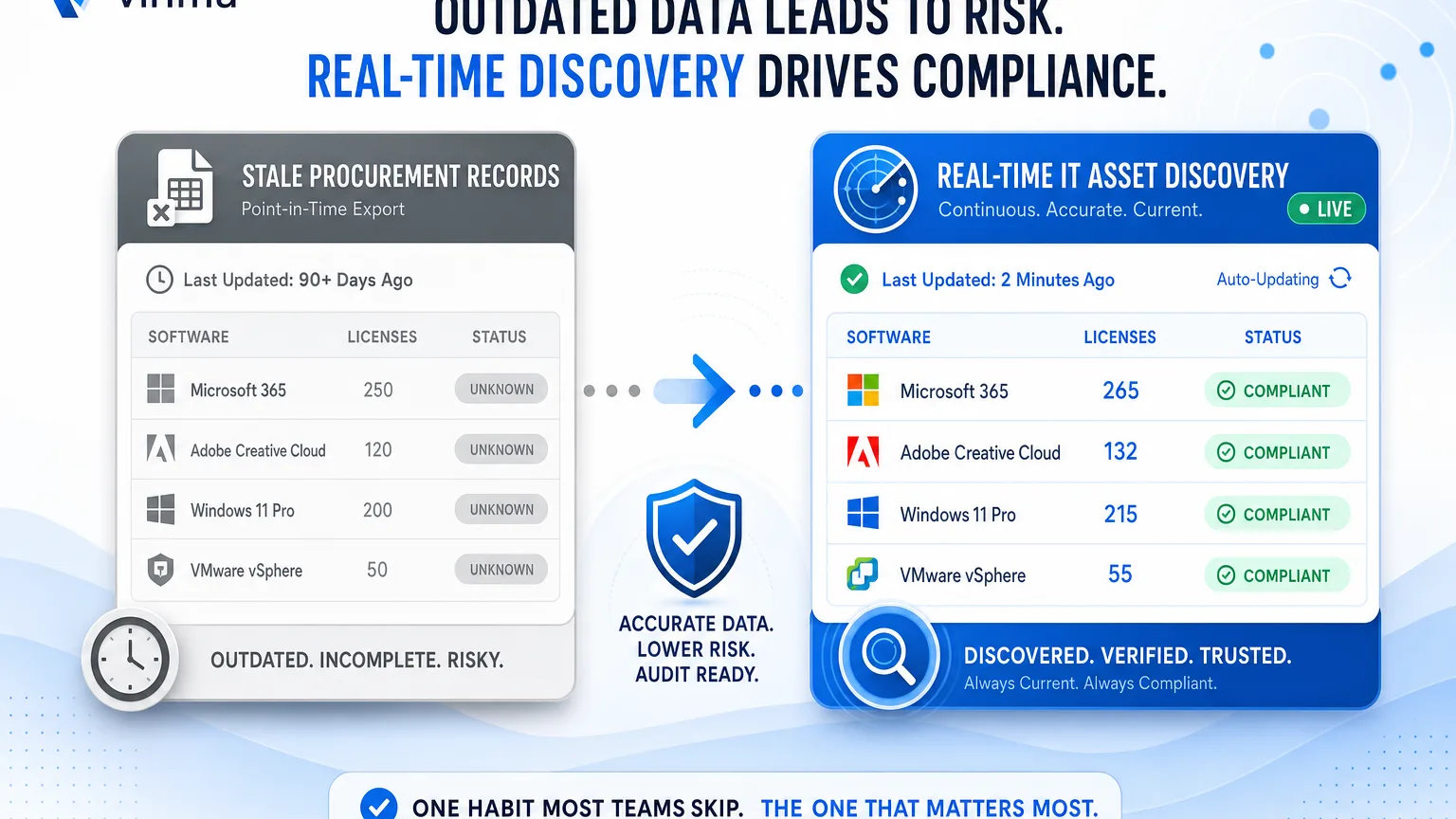
An IT asset management team finishes building a compliance report two weeks before a publisher review. The entitlement column draws from a procurement export. The installation column draws from a spreadsheet last updated when the prior renewal cycle closed. The report is formatted, column-complete, and wrong. Nothing in it reflects what is actually running in the environment today, and it exposes exactly why most ITAM practices for license compliance reporting fail before the audit even starts.
Nearly half (48%) of organizations were audited in the past year, and only 36% report complete visibility into their IT estate, according to Flexera’s 2026 State of ITAM Report. That gap between audit frequency and inventory accuracy is not a tooling problem in most cases. It is a reporting practice problem: teams generate compliance reports when audits arrive instead of maintaining a standing cadence tied to current discovery data.
Every section of this guide traces back to that one missing habit. What it means for reporting accuracy, what it costs by audience, and what a practice-based approach looks like in an environment where Microsoft, Oracle, and IBM audits are routine rather than rare.
What is the most common cause of license compliance reporting failure in ITAM?
Most reporting failures trace to stale data sources. Teams build compliance reports from procurement records or one-time exports rather than from discovery-verified installation counts. That gap between what was purchased and what is running leaves the effective license position outdated before the report reaches an auditor.
What Is License Compliance Reporting in ITAM?
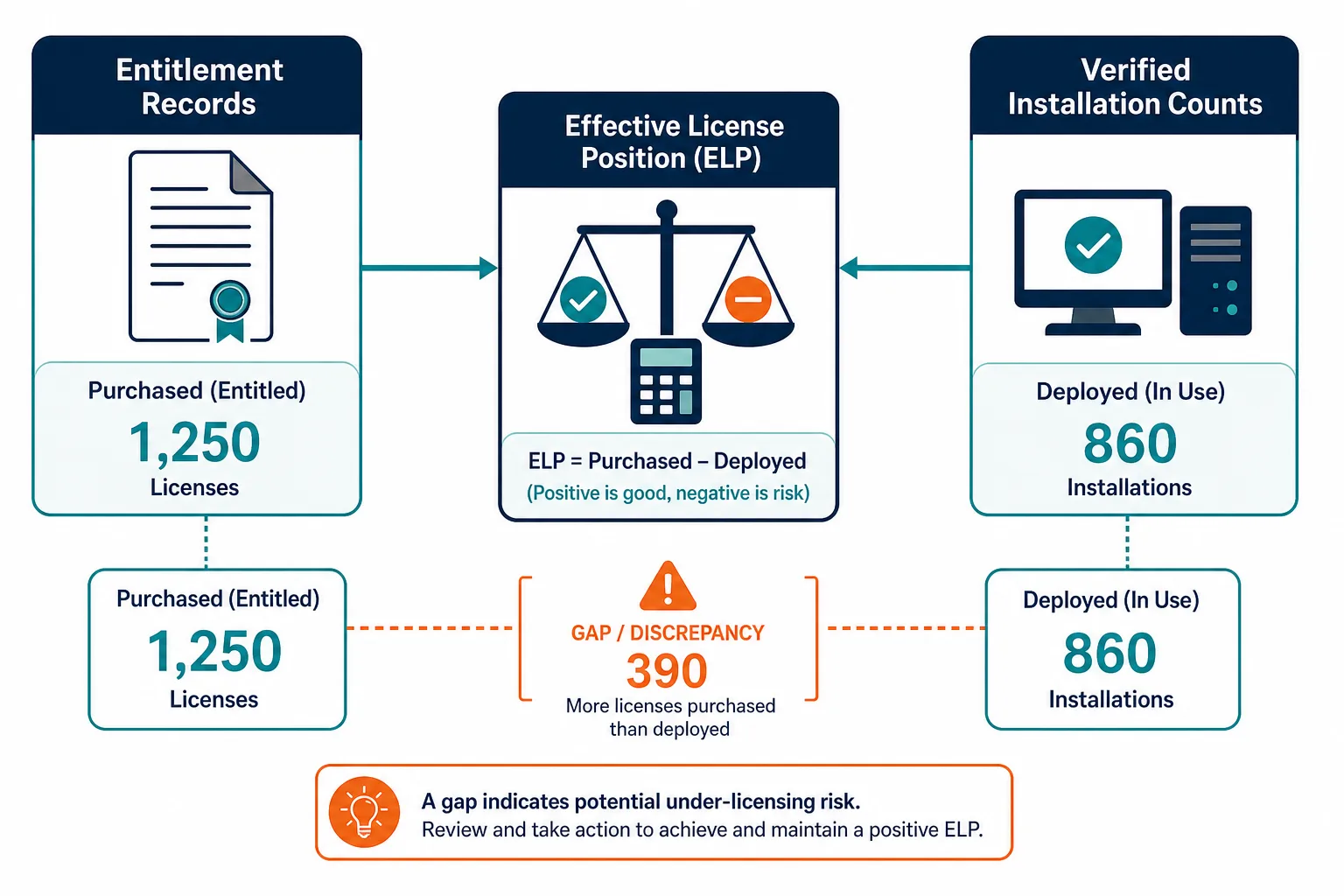
Software license compliance reporting is the practice of generating structured, defensible records that compare an organization’s software entitlement rights against its verified installation counts, producing an effective license position (ELP) that identifies gaps, surpluses, and unmanaged licenses across the IT estate.
IT asset management frameworks treat compliance reporting as an ongoing process area, not a point-in-time export. NIST Special Publication 1800-5 on IT Asset Management describes the requirement for organizations to maintain current, accurate asset records that support governance, audit response, and risk management, treating inventory currency as a baseline operating condition rather than a pre-audit step.
A defensible compliance report contains five components:
- Entitlement records: What the organization holds the contractual right to use, tied to purchase orders or license agreements
- Installation counts: What is actually deployed in the environment, verified by a recent discovery cycle
- Effective License Position (ELP): Calculated as total license entitlements minus total verified software deployments. A positive result means overlicensed; a negative result means underlicensed and exposed to true-up costs
- Ownership and assignment: Which business units or users hold which licenses
- Report date and source: When the data was pulled and from which discovery scan
Where Reports and Reality Diverge
Four patterns recur across audit-triggered reviews:
| Situation | What Actually Happens |
|---|---|
| Report states 2,200 seats deployed | Discovery finds 1,600 active installs and 600 orphaned licenses |
| Entitlement count matches purchase order | Three departments deployed additional instances outside procurement |
| Compliance status shown as green | 12% of installs run under a different license tier than reported |
| Report generated for the audit | Data draws from a procurement export 14 months old |
These patterns are not exceptions to a well-functioning process. They are the default outcome when compliance reports draw from purchase-record baselines rather than discovery-verified configuration item (CI) data. Procurement records what was bought; discovery records what is running.
Why License Compliance Reporting Matters
Audit activity is not occasional. Forty-four percent of organizations spent more than $1 million on software audits over the past three years, and 64% of audited organizations specifically faced a Microsoft audit, according to Flexera’s 2026 State of ITAM Report. Microsoft was also rated the most relevant vendor to active Software Asset Management (SAM) programs in the same survey, which means for most organizations, the question is not whether a Microsoft audit will arrive but whether the compliance position will hold when it does.
Where Compliance Reporting Breaks Down
- Reports built from purchase records, not discovery data
The entitlement side of most reports is accurate because purchase orders are archived and accessible. The installation side is not, because procurement records what was bought, not what is running. When the two are not reconciled on a standing cadence, the ELP reflects a historical state.
Result: The compliance report is internally consistent but externally indefensible. - Reports generated only when an audit letter arrives
Reactive reporting means reconciliation happens under compressed timelines, with limited access to the right stakeholders and no current baseline to compare against.
Result: Audit response consumes weeks of ITAM, legal, and procurement resources that a standing report would have reduced to days. - Audit scope conflated with survey scope
“Audited” and “surveyed” are different events. A publisher-initiated audit carries legal obligations and potential financial consequences. An internal license position survey is a planning exercise. Treating them as interchangeable verbs in compliance reporting obscures ownership and evidence standards at the exact moment governance clarity matters most.
Result: Accountability breaks down where it is most needed.
Teams that shift to discovery-verified license positions recognize these failure modes before they become audit exposure, because they hold a current ELP throughout the year rather than rebuilding one under deadline pressure.
What Skipping That Habit Actually Costs
The cost of reactive compliance reporting differs by role, and each role’s exposure is concrete.
For ITAM and Operations Teams
Reconciling a stale baseline against a publisher’s audit claim is manual work at a compressed deadline. An ITAM team that has not maintained a standing reporting cadence spends the audit preparation period rebuilding the inventory position from scratch: pulling discovery scans, cross-referencing spreadsheets against procurement records, and tracking down business unit contacts for ownership confirmation. That process typically runs three to six weeks. A current compliance report would reduce the same response to days.
For IT Leaders
A compliance report that cannot be defended in front of a publisher’s auditor becomes a board-level exposure. The audit settlement that follows a failed position is not only a budget line item; it is a signal to executives and external auditors that ITAM governance has a structural gap. According to Flexera’s audit readiness analysis, organizations without clean entitlement data lose negotiation leverage and may be forced to accept publisher claims at face value, removing the ability to challenge questionable findings.
For Regulated and Publisher-Heavy Environments
Microsoft, Oracle, and IBM each carry different audit cadences, different evidentiary standards, and different remediation expectations. Microsoft audits evaluate assigned versus active usage under specific licensing agreements. Oracle audits focus on processor counts and virtualization boundaries. IBM audits examine sub-capacity licensing and LPAR configurations. Collapsing those requirements into a single audit preparation workflow means the evidence standard for the most demanding publisher becomes the floor for all others.
Virima’s guide on software license compliance audits covers the evidence expectations and audit defense postures for major publishers, including how to prepare separate compliance positions for each publisher type.
How ITAM Practices Fix License Compliance Reporting
Three mechanisms separate practice-based compliance reporting from reactive compliance reporting. Each reflects a verifiable ITAM capability, not a process aspiration.
1. Entitlement Records Tied to Actual Installations
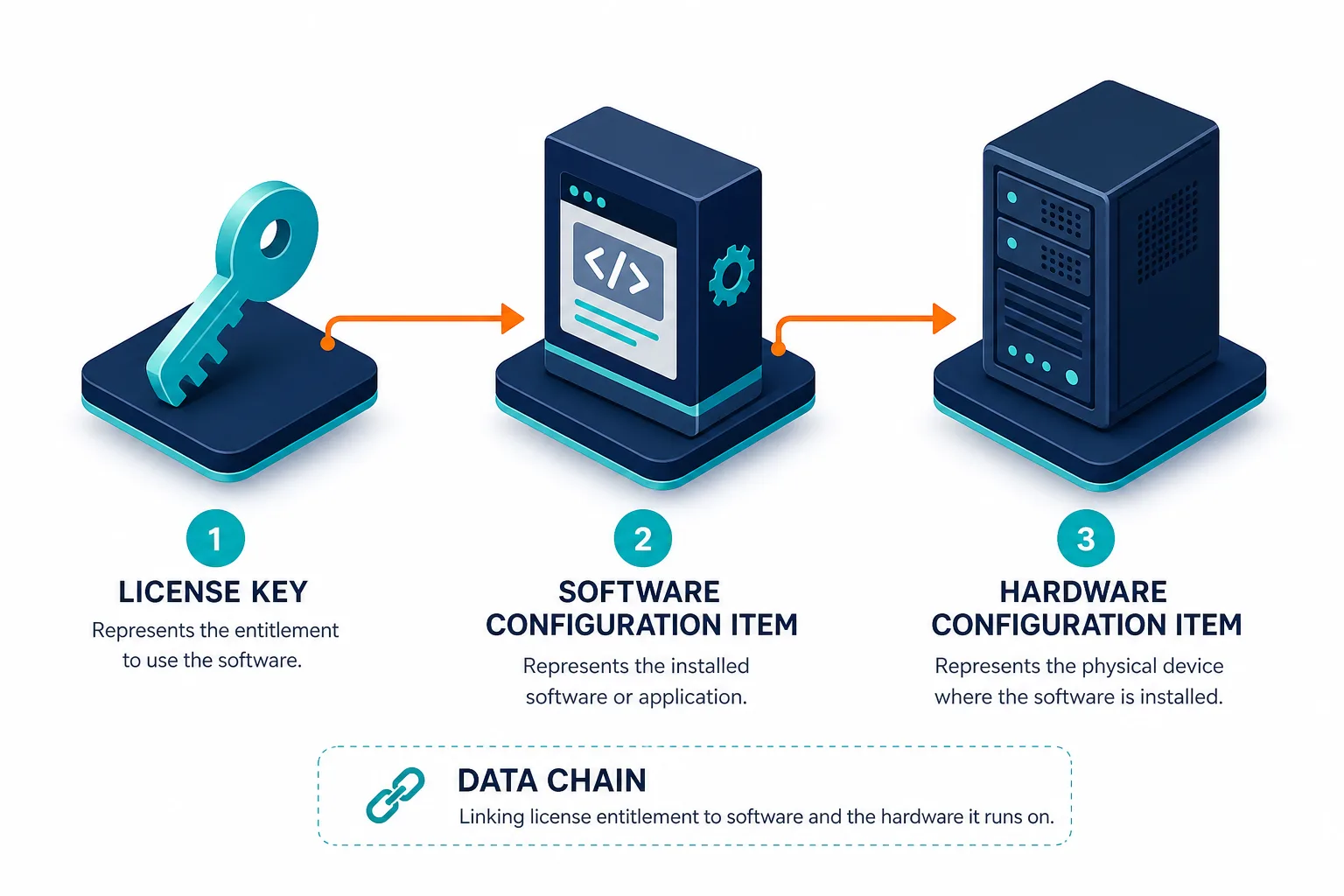
A compliance report is only as accurate as the join between what was purchased and what is running. The data chain runs: License Key to Software Configuration Item (CI) to Hardware CI. When that chain is maintained in a Configuration Management Database (CMDB) rather than a spreadsheet, entitlement data can be compared against installation counts without manual reconciliation at each report cycle.
Teams that maintain this join in ITAM tooling produce an ELP on demand rather than rebuilding it reactively. The software license management process in ITAM explains how that chain is established and maintained across discovery cycles, including how to handle license upgrades and entitlement reassignments between reporting periods.
| Dimension | Manual Reporting | Practice-Based Reporting |
|---|---|---|
| Data source | Purchase records and spreadsheets | Discovery-verified CI data |
| Refresh cadence | On-request or audit-triggered | Scheduled, recurring |
| Auditor defensibility | Limited; gaps in version and user assignment | High; timestamped and traceable to discovery source |
| Hours per cycle | 3 to 6 weeks of reconciliation | Days to generate from standing data |
2. High-Frequency Scheduled Discovery Keeps the Reporting Baseline Current
A compliance report reflects the estate at the moment it was generated. If the most recent discovery scan ran six months ago, the compliance report reflects a six-month-old environment. High-frequency scheduled discovery ensures the asset baseline the report draws from is current between audit events, not only at renewal time.
Virima’s IT Asset Management module supports license-to-CI linkage and scheduled discovery cycles that keep entitlement and installation records synchronized throughout the year, producing a reporting baseline that does not degrade between reporting cycles.
3. Reports Generated on Demand, Inside Existing ITSM Workflows
Compliance reports that live outside the ITSM tools teams already use create a reconciliation step at every reporting cycle. Reports exported from a standalone ITAM system and compared manually against a ServiceNow, Jira Service Management, or Ivanti record accumulate version drift over time. Embedding compliance reporting inside the ITSM workflow means the data the auditor sees matches the data the ITAM team and service desk work from day to day.
Maintaining that consistency across the software license procurement process is the upstream condition that keeps ITSM-native compliance reports from diverging from procurement reality between renewal cycles.
License Compliance Reporting in Practice
Practice-based compliance reporting changes specific outcomes in three recurring scenarios.
A quarterly ELP review that catches an overlicensed renewal before it auto-renews.
An ITAM team running quarterly compliance reports against current discovery data identifies 600 licenses with no active install recorded in the past 90 days. Before the renewal auto-executes, procurement renegotiates the seat count. The reduction is documented from the ELP comparison, not estimated after the fact.
A publisher audit request answered from a standing report rather than a scramble.
When a Microsoft audit request arrives, the ITAM team pulls the most recent compliance report, generated 18 days earlier from a scheduled discovery cycle. The effective license position is current and every version assignment is traceable to a CI record, so the response is a review of existing evidence, not a rebuild of it.
A shadow-SaaS reconciliation that surfaces licenses procurement never logged.
Business units have been subscribing to tools through departmental credit cards. A scheduled discovery cycle surfaces 14 SaaS applications in active use with no corresponding entitlement record. The ITAM team assigns ownership and adds the applications to the compliance reporting scope before a publisher — or an auditor — finds the gap first.
Managing that growing SaaS gap is an industry-wide challenge: Flexera’s 2026 State of ITAM Report on SaaS sprawl found wasted SaaS spend rising year over year, with only 31% of organizations reporting visibility into AI software spend.
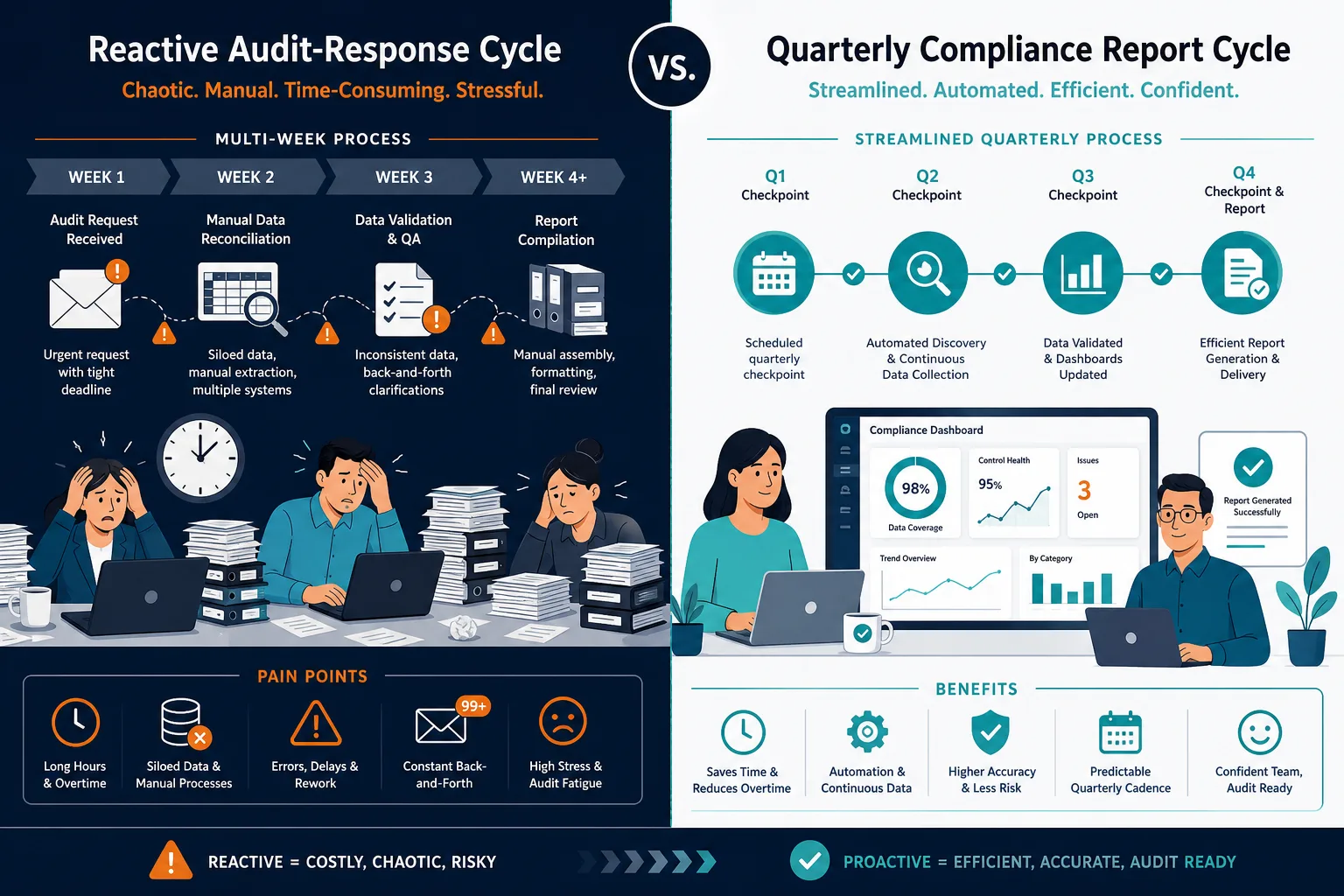
Each scenario describes what becomes routine when compliance reporting runs on a standing cadence rather than on audit urgency.
Virima’s Role in License Compliance Reporting
Virima’s IT Asset Management module supports license compliance reporting through three capabilities: exportable compliance reports linked to live CI data, license-to-CI linkage maintained across scheduled discovery cycles, and reporting workflows that operate inside ServiceNow, Jira Service Management, and Ivanti environments.
Immediate Reporting Impact
Virima connects license entitlement records to software CIs and hardware CIs, producing an ELP that reflects what the most recent scheduled discovery cycle found in the environment. Reports are exportable for internal review or auditor submission, with timestamps and discovery source attribution that support auditor defensibility.
For a detailed look at how these capabilities apply to live audit scenarios, Virima’s guide on simplifying IT asset management audits covers the audit evidence workflow from discovery scan to auditor deliverable.
Sustained Accuracy Between Cycles
Virima’s high-frequency scheduled discovery cycles maintain the software installation baseline between renewal and audit events, so the compliance position the team holds at the start of a quarter remains defensible at the end of it.
Fitting Into Existing ITSM Workflows
Virima integrates with ServiceNow, Jira Service Management, Ivanti, and other ITSM platforms, keeping license data in the same operational environment where change and incident workflows run. That alignment reduces the reconciliation cost of producing compliance reports and eliminates version drift between ITAM records and ticket-level asset data. For broader guidance on the license management operating model that Virima’s ITAM module supports, Virima’s software license management best practices guide covers the full sequence from entitlement ingestion through compliance reporting.
How often should software license compliance reports be generated in ITAM?
License compliance reports should run on a standing cadence aligned to discovery cycles, at minimum quarterly, and more frequently for publishers with high audit activity such as Microsoft, Oracle, and IBM. Generating reports only when an audit notification arrives leaves the effective license position stale and limits the organization’s ability to negotiate from a position of documented, current data.
Moving from Reactive to Practice-Based Compliance Reporting
Two changes define the transition from reactive to practice-based compliance reporting, and the benefit of each is measurable.
| From | To |
|---|---|
| Audit-triggered reporting | Standing reporting cadence |
| Purchase-record baseline | Discovery-verified baseline |
| Entitlement and install data held in separate systems | License-to-CI linkage maintained in ITAM tooling |
Fewer scramble hours. ITAM staff who would otherwise be pulled off other priorities during audit season stay on their regular workload, because the compliance position is already current when the request arrives.
Defensible board reporting. A compliance report backed by timestamped discovery data gives IT leadership a position they can present to a board or external auditor without qualification. The data is traceable to its source, versioned, and current.
Lower renewal overspend. Teams that hold a current ELP enter renewal negotiations with their actual position documented. Overlicensed seats are identified before auto-renewal executes. Underlicensed areas are addressed before a publisher identifies them first.
Getting Started: Five Steps
These five steps move a team from ad hoc exports toward audit-ready compliance reports:
- Audit current report sources. Identify what data currently feeds your compliance reports and how old it is at the time of generation.
- Reconcile against discovery data. Run a discovery cycle and compare the output against entitlement records. Document every gap.
- Set a reporting cadence. Establish a quarterly minimum schedule for compliance report generation, tied to your discovery cycle frequency.
- Assign ownership. Name the ITAM team member or business unit contact responsible for each publisher’s compliance reporting scope.
- Automate export and distribution. Configure your ITAM tooling to generate and distribute compliance reports on schedule rather than on request.
Virima’s guide on managing the software asset lifecycle effectively covers this transition across the full entitlement, deployment, and retirement sequence.
Frequently Asked Questions
What is license compliance reporting in ITAM?
License compliance reporting in IT Asset Management is the practice of comparing software entitlement records against verified installation counts to produce an effective license position (ELP). The ELP identifies whether an organization is underlicensed, overlicensed, or holding unmanaged licenses, and it forms the primary evidence base for any publisher audit response.
Does Virima’s ITAM module generate compliance reports inside ServiceNow or Jira Service Management?
Yes. Virima’s ITAM module operates inside ServiceNow, Jira Service Management, and Ivanti, so compliance reports draw from the same CI and license data the service desk already uses, rather than a separate export that has to be reconciled by hand.
How often should compliance reports be generated?
Compliance reports should run on a standing cadence, at minimum quarterly, and more frequently for publishers with high audit activity such as Microsoft, Oracle, and IBM. Reports generated only in response to audit notifications leave the effective license position stale and reduce the organization’s ability to defend its compliance status or negotiate from a position of documented fact.
What makes ITAM audit readiness different from audit response?
ITAM audit readiness describes a state maintained throughout the year: a current, discovery-verified license position with assigned ownership and a standing reporting cadence. Audit response is what a team executes when that readiness is absent, rebuilding an accurate license position from stale records under deadline pressure. The difference typically appears as several weeks of unplanned work and a weaker negotiating position with the auditing publisher.
How does Virima keep license entitlement data current between discovery cycles?
Virima links license keys to software configuration items and hardware configuration items, then refreshes that chain through high-frequency scheduled discovery. Entitlement and installation records stay synchronized between renewal and audit events, so the effective license position does not degrade in the months between reporting cycles.