Hybrid Cloud CMDB for London Fintech & Insurtech Scale-Ups

When AWS US-EAST-1 failed on 20-21 October 2025, a London fintech on-call engineer faced a question that should have been answerable in minutes: what of ours depends on this region? Payment rails, identity services, batch jobs, and customer portals sat across accounts spun up through two funding rounds. The dependency map lived in a wiki last updated before the Series B hire wave, and the hybrid cloud CMDB, the configuration management database (CMDB) that should have tracked all of it, still listed last quarter’s inventory.
That outage disrupted more than 2,000 companies worldwide, including major banks and stock exchanges. Faults at a northern Virginia data centre hub caused serious disruption for nearly 15 hours. Affected organisations included the London Stock Exchange Group, Lloyds, Halifax, and HMRC, according to Global Relay’s outage analysis. In the UK, the same event pushed a sharper policy question into view. The Treasury Committee pressed on why AWS had not been designated a critical third party despite concentration risk firms already felt in production, a regulatory angle also covered in Global Relay’s outage analysis.
This pattern is not limited to one cloud region on one Monday. Nine of the UK’s biggest banks and building societies accumulated at least 803 hours of unplanned tech outages over two years, with at least 158 incidents affecting millions of customers between January 2023 and February 2025, according to figures covered by The Guardian from Treasury Committee data. For growth-stage fintech and insurtech teams in London, hybrid estates scale faster than spreadsheet inventories. When the next provider event hits, the board will ask which important business services were exposed. A discovery-sourced hybrid cloud CMDB is how you answer with evidence instead of memory.
If your team is still reconciling cloud accounts by hand between audit cycles, start with the inventory and dependency layer production actually runs on: Trusted Runtime Truth.
What is a hybrid cloud CMDB?
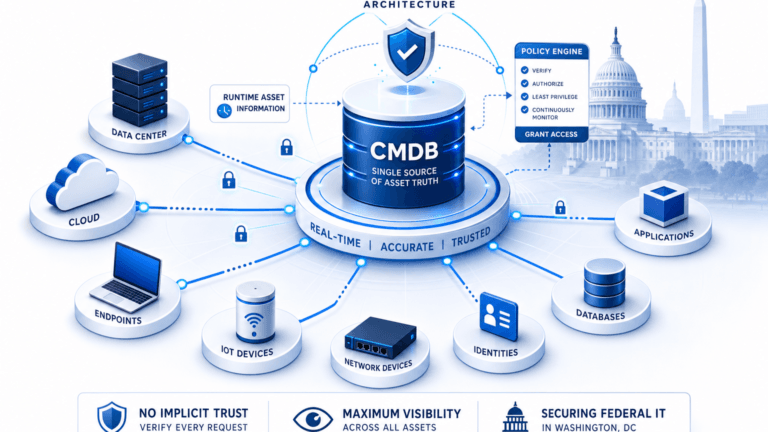
In ITIL 4 Service Asset and Configuration Management (SACM), a CMDB stores configuration items (CIs) and the relationships between them so change, incident, and release work can reference a shared record of the live estate. A hybrid cloud CMDB applies that discipline across on-premises systems, public cloud accounts, and the SaaS platforms beside them. It is not a cloud cost tool, a ticket system, or a one-time asset spreadsheet. It is the configuration record change and resilience work depend on when the estate no longer fits a single data centre diagram.
Core requirements stay practical:
- CI classification covering servers, network devices, cloud resources, applications, and the services they support
- Relationship and dependency mapping so a failed host or region points to the business path it can break
- Discovery-sourced population so the record tracks what is running, not only what someone remembered to type
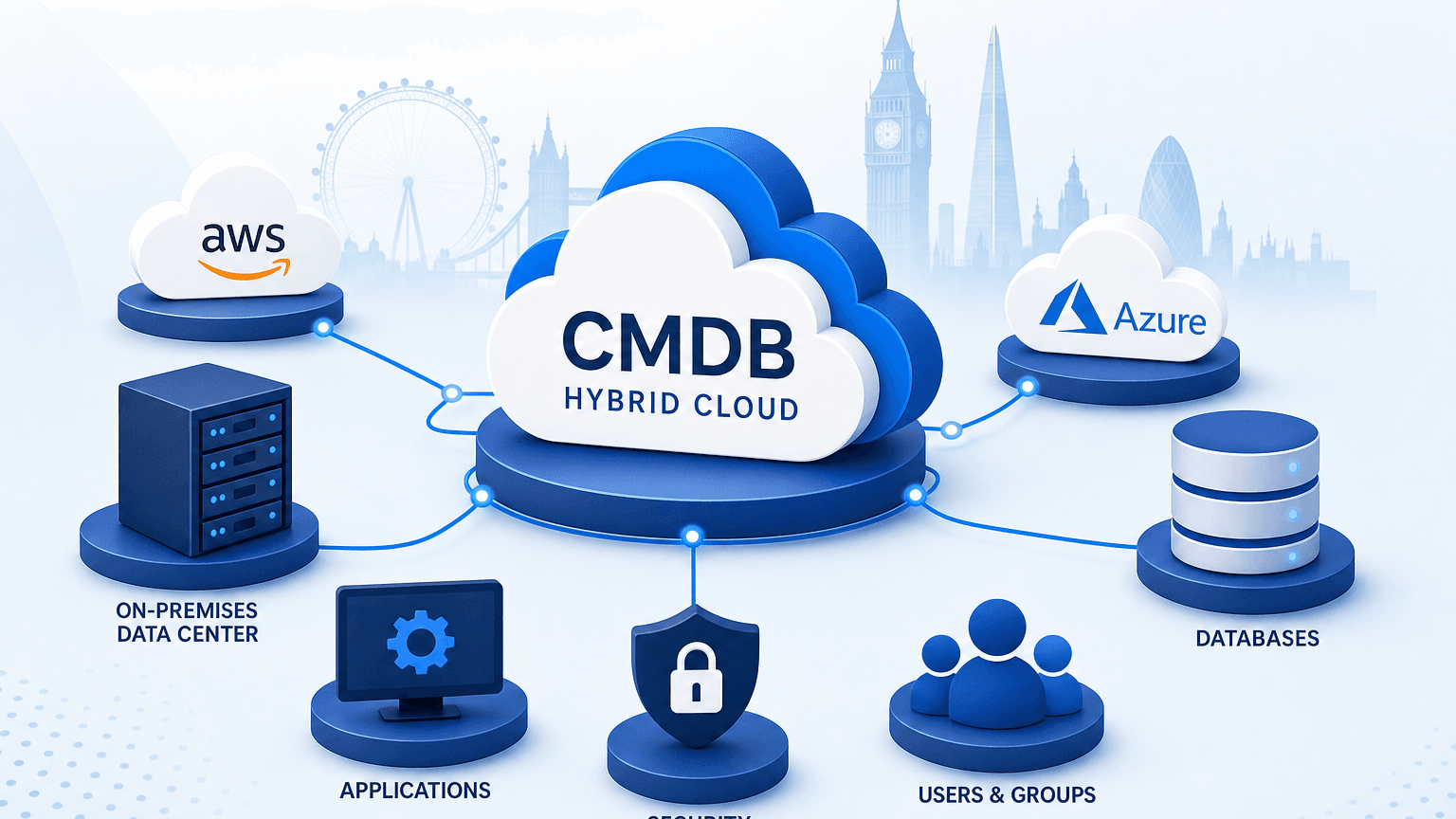
- A single logical record spanning on-prem, AWS, Azure, and connected SaaS rather than three disconnected inventories
London scale-ups hit the hybrid shape early. Core banking or policy cores often stay on controlled infrastructure while customer apps and new product lines land in AWS or Azure. Multiple accounts appear after each product squad ships. Without a CMDB designed for that mix, the source of truth becomes whichever spreadsheet the last engineer updated.
Where hybrid estates break the CMDB record
| Situation | What actually happens |
|---|---|
| Legacy policy admin stays on-prem while claims or underwriting moves cloud-native | The CMDB reflects one environment with care and the other barely at all |
| Engineering spins up new AWS resources between quarterly reconciliation cycles | CI records are stale before the next audit pack is assembled |
| Multiple AWS accounts or Azure subscriptions appear after rapid team growth | Assets fragment into account-level silos no single owner maintains |

Teams evaluating whether cloud estates still need a CMDB can see how the same gap appears when inventories stop at the hypervisor or account console: Do You Need a CMDB in Cloud Environments?. Cloud consoles list resources. They do not replace a configuration record that joins those resources to owners, services, and change history across the hybrid path.
What is a hybrid cloud CMDB in a fintech estate?
A hybrid cloud CMDB stores configuration items and relationships across on-premises systems, public cloud accounts, and connected SaaS in one logical record. Discovery keeps that record aligned to what is running so change, incident, and resilience work share the same estate baseline.
Why hybrid cloud CMDB matters for London’s fintech and insurtech scale-ups
Hybrid is the default posture, not a temporary phase. Gartner has forecast that 90% of organisations will adopt a hybrid cloud approach through 2027. For FCA-authorised and PRA-relevant firms, the infrastructure question sits under operational resilience rules that already moved from transition into full expectation. Under FCA PS21/3, firms had to complete mapping and scenario testing so they could remain within impact tolerances for important business services by 31 March 2025, after rules first came into force in March 2022.
Third-party concentration is now a standing board topic. The UK Critical Third Parties regime’s initial designations took effect on 13 July 2026, and the October 2025 cloud outage is cited as a case in point for provider concentration risk in Morrison Foerster’s CTP briefing. That briefing also notes material third-party reporting rules that require in-scope firms to maintain and annually submit registers of material third-party arrangements from 18 March 2027. A CMDB does not replace those registers or the firm’s resilience programme. It supports the infrastructure evidence layer underneath them: what exists, where it runs, how it connects, and which service path breaks when a provider region fails.
UK fintech firms raised around $1.8 billion across 181 deals in the first half of 2026 and held position as the world’s second-largest fintech investment market, according to Innovate Finance figures reported by Raconteur. Capital concentrates on firms that can show they scale with control. Inherited stacks, multi-account cloud growth, and dual-running legacy cores expand the configuration surface faster than a manual CMDB can track.
5 failure modes growth-stage fintechs hit when infra outruns documentation
These modes show up when growth-stage fintechs and insurtechs scale infrastructure faster than documentation and ownership keep up. They are not universal claims about every firm.
- Third-party and cloud concentration blind spot. The firm knows it uses a major cloud provider. It cannot show, under time pressure, which important business services and accounts sit in the affected region, and incident calls start with inventory work instead of recovery work.
- On-prem and cloud fragmentation in insurtech stacks. Policy administration remains on controlled infrastructure while claims, underwriting workbenches, and customer portals move cloud-native, and one half of the path has CI hygiene while the other lives in tribal knowledge until a change or outage forces a rebuild of the map.
- Manual CMDB decay during funding-driven scale-up. Headcount, product lines, and cloud accounts rise between quarterly reconciliations, and the CMDB stores last cycle’s snapshot while production has already moved.
- Audit and incident-reporting blind spots under the incoming third-party reporting regime. Material third-party registers and resilience evidence need a current view of which systems and services depend on which providers. So reporting teams assemble spreadsheets under deadline because the configuration record never held the join.
- M&A and consolidation sprawl. Scale-ups bolt on teams, products, or platforms and inherit accounts, agents, and unnamed dependencies. Due diligence and Day-1 operations inherit an estate the acquiring CMDB never recorded.
For teams building the AWS and Azure side of that record, discovery that covers hybrid estates beats a second manual project: AWS and Azure CMDB discovery. Automated population is what keeps the record from rotting between funding and M&A events: CMDB with automated discovery.
Why does FCA operational resilience need hybrid cloud CMDB accuracy?
FCA operational resilience expects firms to map important business services and stay inside impact tolerances. A current hybrid cloud CMDB supports the infrastructure evidence layer for those maps and third-party dependencies. It does not replace scenario testing or regulatory returns.
What incomplete hybrid cloud CMDB visibility costs London scale-ups
For leadership
Board accountability for operational resilience does not pause because the firm is still in scale-up mode. The sector-wide 803-hour and 158-incident figures are a scale signal for UK financial services, not a claim that every London fintech matches bank outage hours. They show how quickly technology disruption becomes a public and regulatory story. When a provider outage or failed change hits customer journeys, leadership is asked which important business services were inside impact tolerance and what evidence supports that answer. A stale hybrid inventory turns that conversation into reconstruction under stress.
After the October 2025 cloud event, CTP designation and third-party reporting moved from policy debate into operating reality. Firms remain responsible for their own third-party risk even when providers sit under direct oversight. Leadership that cannot see provider-to-service paths runs the resilience programme on partial instruments.
For ops teams
Ops feels the cost in hours and failed changes. Without current dependency data, mean time to restore stretches while engineers rebuild blast radius from chat threads. Decommissioning becomes risky because nobody can prove which batch jobs still call a legacy host. IT asset visibility for fintech scale-ups is the difference between opening an incident on the right CI and burning the first hour finding it.
For regulated environments
A CMDB supports the infrastructure evidence layer underneath resilience reporting, incident response, and material third-party registers. It is not itself the compliance mechanism, the FCA return, or a substitute for impact-tolerance testing. Auditors and risk teams still need process owners, scenario tests, and governance. What they also need is a configuration record that does not contradict the live estate when samples are pulled. When discovery is missing, evidence packs become point-in-time exports that age before the review ends. Teams that treat CMDB accuracy as part of security and risk work build fewer last-minute gaps: CMDB compliance in IT security and risk.
Market-scale challenge
The same $1.8 billion H1 2026 figure that confirms market depth also implies more multi-account estates, dual-running cores, and inherited stacks after growth transactions. Acquirers inherit infrastructure they have not mapped. Without a hybrid cloud CMDB that can extend discovery quickly, Day-1 risk sits in unnamed dependencies rather than in a governed CI record.
How a discovery-driven CMDB fixes this
People cannot type faster than cloud APIs create resources. Discovery-driven CMDB work reverses the order: the estate is scanned on a schedule, CIs and relationships are reconciled into an authoritative record, and ITSM workflows consume that record instead of inventing a parallel inventory.
Three mechanisms matter most for London fintech and insurtech scale-ups.
- High-frequency scheduled discovery across on-prem, AWS, Azure, and SaaS. Agent-based and agentless methods cover network-connected infrastructure and cloud accounts. API-based cloud discovery pulls resources that never appear on a traditional subnet scan. The cadence is scheduled and repeatable, not a one-off project and not a claim of passive event-stream discovery. See how IT discovery feeds the CMDB without turning every engineer into a data-entry role.
- Service mapping for dependency and blast-radius visibility. Once service definitions are provided, maps can be built from discovered relationships so a region, host, or database failure points to the business path it can break. ViVID™ service maps show hybrid paths and their visibility for change and incident decisions: service mapping.
- Native bi-directional ITSM integration. Scale-ups rarely want to rip out ServiceNow, Jira Service Management, Ivanti, or HaloITSM. They need the CMDB and discovery layer to feed the system of engagement they already run. Virima integrates with ServiceNow, Jira, Ivanti, HaloITSM, and more via the integrations hub.

Manual CMDB vs discovery-automated CMDB
| Manual CMDB | Discovery-automated CMDB | |
|---|---|---|
| Data freshness | Point-in-time; decays between cycles | Refreshed on a recurring schedule |
| Audit readiness | Reactive scramble before samples | Evidence trail exists across the year |
| Dependency map | Built in workshops; stale on arrival | Built from discovery-sourced relationships |
| M&A or scale event | Manual re-inventory of the new perimeter | Existing record extends as discovery covers new assets |
How does hybrid cloud asset discovery keep a fintech CMDB current?
Hybrid cloud asset discovery runs on a recurring schedule across on-premises networks and cloud accounts using agent, agentless, and API methods. It reconciles configuration items and relationships into the CMDB so records track what is running between audits, funding rounds, and change windows.
Hybrid cloud CMDB in practice
The following patterns are illustrative. They describe how growth-stage teams use discovery-driven CMDB and service maps. They are not named customer case studies.
- The pre-audit scramble becomes routine. Before discovery cadence exists, audit prep means freezing spreadsheets, chasing owners, and reconciling cloud consoles to CMDB rows that diverged months earlier. After high-frequency scheduled discovery and ownership assignment, the same samples pull from a record that already tracked drift. Gaps still appear, but they are exceptions with owners and timestamps rather than a full rebuild.
- Third-party outage response. Return to the AWS scenario. With account, region, and dependency context in the CMDB and service maps, the incident commander can list affected important business services in minutes instead of rebuilding topology from memory. The firm still needs failover runbooks and communications plans. What changes is the time spent answering what depends on this before those plans start.

- Insurtech legacy-to-cloud migration. A dual-running policy admin platform sits on-prem while new claims services run in cloud accounts. Before retirement, the platform team uses dependency mapping to confirm which batch jobs, interfaces, and services still call the legacy hosts. The platform team decommissioned the legacy server after confirming via dependency mapping that no active service depended on it. The decision and the evidence that made it safe both stay visible in the configuration record.
- M&A due diligence and Day-1 control. During consolidation, the acquiring team extends discovery into the inherited perimeter, normalises CIs, and assigns owners before the first shared change window. The CMDB becomes the inventory baseline for integration work rather than a post-mortem after the first unexplained outage.
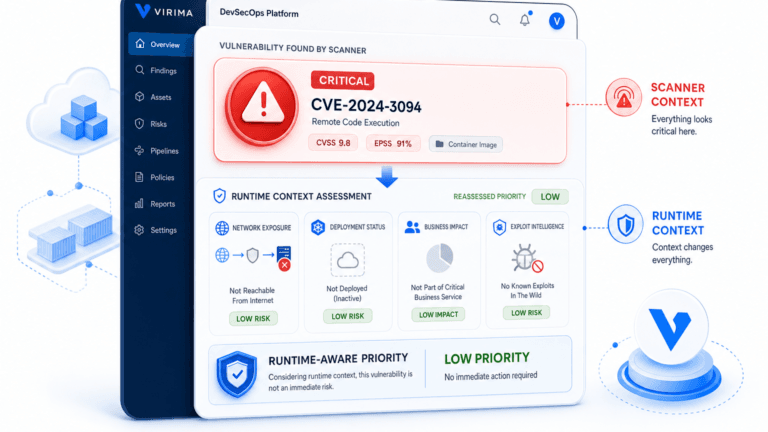
CVE and patch conversations need the same asset truth as change and resilience work: CMDB and vulnerability context.
How Virima powers hybrid cloud CMDB for London fintech and insurtech scale-ups
Virima’s role is the discovery-sourced configuration and service-context layer under the tools London scale-ups already use. It does not replace the FCA resilience programme, the ITSM platform, or cloud-native control planes. It keeps the hybrid CI record current enough for those systems to act on.
- Immediate operational impact. Agent-based, agentless, and API discovery populate CIs across on-prem and cloud accounts so onboarding does not wait on a multi-month manual build. Teams see drift on a schedule they control. That speed is Virima’s product posture for hybrid estates, not an independent third-party benchmark.
- Long-term accuracy. High-frequency scheduled discovery limits inter-audit decay. CMDB health signals help owners see staleness before a regulator sample or customer incident forces the issue. Virima maintains SOC 2 Type 2 and ISO/IEC 27001:2022 certifications as part of its security evidence posture for customers evaluating vendors that will hold estate data.
- Integration with existing workflows. Bi-directional sync with common ITSM platforms keeps the system of engagement and improves the system of record underneath it. ITOM views benefit when CI and service relationships match production: ITOM. The failure mode to avoid is the CMDB that looks complete on paper and diverges after a cleanup project: CMDB without discovery.
Discovery covers network-connected infrastructure and cloud, or SaaS accounts you connect, not browser-rendered content. Service maps require service definitions from the customer or an architecture source; Virima then builds the dependency map from discovered relationships. AWS and Azure are first-class cloud targets; the CMDB is where those resources join on-prem CIs and business services.
Moving from manual, point-in-time CMDB to a discovery-driven, always-current one
| Old way | Map-driven way |
|---|---|
| Quarterly manual reconciliation | High-frequency scheduled discovery |
| Spreadsheet and tribal-knowledge dependency maps | ViVID™ service maps built from discovery-sourced relationships |
| Siloed on-prem vs cloud inventories | Unified hybrid CI record |
| Reactive audit prep | Current evidence trail maintained across the year |
Benefits cascade
- Immediate: faster incident triage.
- Medium-term: audit and resilience evidence that matches the estate you run.
- Long-term: a configuration baseline that survives funding rounds, M&A integration, and regulatory reporting changes without a full rebuild each time.
Getting started
- Inventory your current on-prem and cloud footprint at a high level, including account and subscription boundaries.
- Identify your important business services and the dependencies you already believe they have.
- Run a non-invasive discovery pass and compare results to that assumption.
- Reconcile gaps, assign CI ownership, and mark systems that support important business services.
- Set a recurring discovery cadence and tie CMDB updates into change management so the record does not freeze between projects.
Frequently Asked Questions
What is a hybrid cloud CMDB?
A hybrid cloud CMDB stores configuration items and relationships across on-premises systems, public cloud accounts, and connected SaaS in one logical record. It supports change, incident, and resilience work with discovery-sourced inventory rather than disconnected console exports.
Why do London fintech and insurtech scale-ups need hybrid cloud CMDB visibility?
Scale-ups add cloud accounts, dual-running cores, and inherited stacks faster than quarterly spreadsheets can track. Without hybrid visibility, outage response, change risk, and resilience evidence start from incomplete inventory when boards and regulators ask what was exposed.
How does a CMDB support FCA operational resilience requirements?
A CMDB supports the infrastructure evidence layer under important-business-service mapping, impact tolerances, and third-party dependency views. It does not replace the firm’s resilience programme, scenario testing, or regulatory returns. It keeps the configuration record aligned to the estate those controls describe.
What is the difference between a CMDB and ITAM for a scale-up?
ITAM tracks assets through financial and lifecycle control. A CMDB stores CIs and relationships for operational change and service impact. Scale-ups need both lenses; discovery often feeds each from the same estate truth. See CMDB vs ITAM differences for the full split.
What does hybrid cloud CMDB look like in practice for a growth-stage fintech?
Discovery runs on a recurring schedule across on-prem and cloud accounts. CIs reconcile into one record, service maps show blast radius once services are defined, and ITSM tools consume that record for incidents and changes instead of maintaining a parallel inventory.