The Operational Context Gap That’s Slowing Down Every ITOM Team

On 18 November 2025, a permissions change on a Cloudflare database caused a Bot Management feature file to roughly double in size. That file propagated across the network, and proxy software that expected a fixed-size file failed as core traffic stalled for hours. As Cloudflare later explained, this was a routine configuration change, not an attack, and the blast radius exceeded what the change window had assumed.
The first reaction after an event like that is familiar: add another review gate, another checklist step, and another CAB signature before any config file ships. Those instincts protect careers more often than they protect delivery speed. The people in the room already had process. What they needed at the decision point was a live picture of what that file touched, which services depended on it, and who owned the downstream path.
ITOM teams hit the same wall every week on smaller stages. Incident queues stall while someone rebuilds impact by hand. Change windows slip while approvers wait for a manual write-up. Audits reopen because the inventory sample does not match the estate. The bottleneck is missing operational context at the moment a human has to decide, not a shortage of process.
What Is an Operational Context Layer in ITOM?
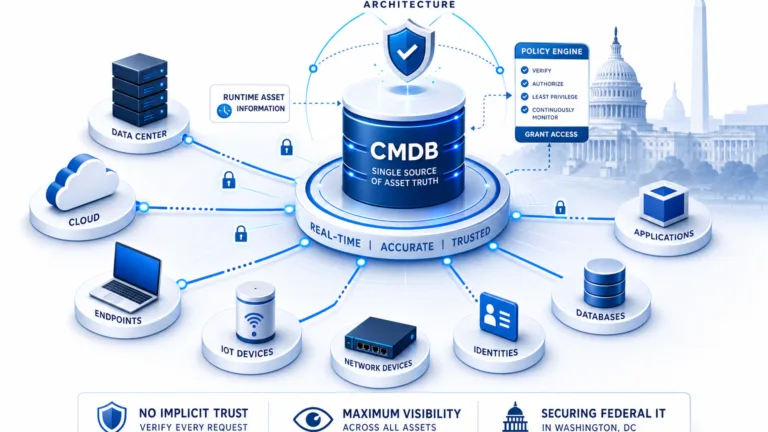
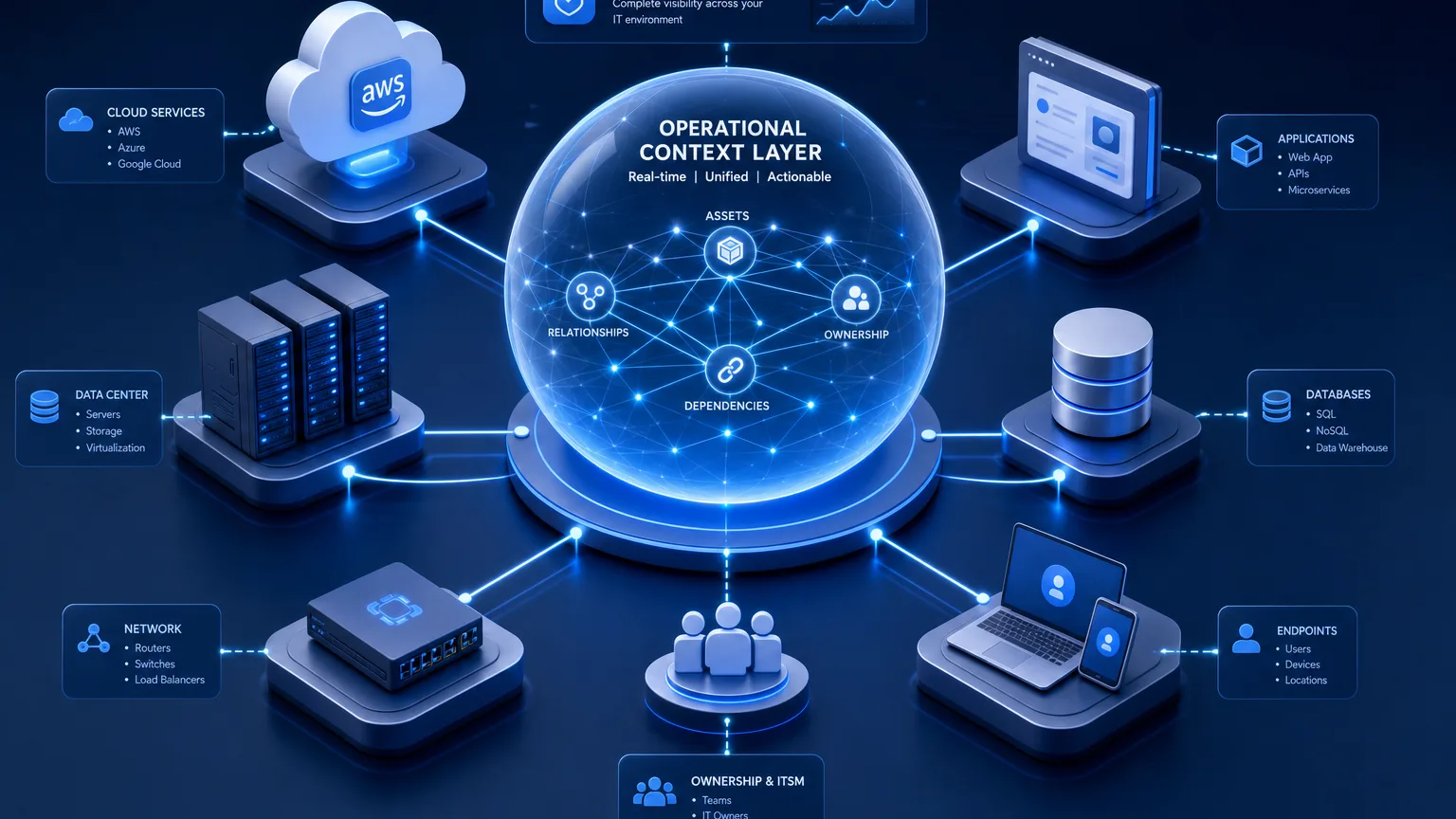
An operational context layer in ITOM is the shared picture that lets operations, change, security, and service owners answer the same four questions without a side investigation: what is this thing, what depends on it, who owns it and how critical is it, and what is its current state.
That idea sits next to ITIL 4 service configuration management. The IT Process Wiki summary of Service Asset and Configuration Management describes the practice as providing accurate configuration information so services can be delivered and supported, including CIs, relationships, and the CMDB as the information store. The operational context layer is how that practice shows up on a busy desk: not a document library, but decision-ready facts next to the ticket, the change, or the alert.
Four components make the layer usable:
- Asset and CI identity. Stable records for devices, workloads, applications, and cloud resources, with enough attributes to match reality after a redeploy.
- Relationship and dependency data. Installed-on, runs-on, exchanges-data-with, and service membership paths that show blast radius before a change runs.
- Ownership and business criticality. Named owners, support groups, and service tiers so escalation is not a chat-channel lottery.
- Current health and vulnerability state. Fresh signals for status, exposure, and patch posture joined to the same CI the ticket already names.
The Gap Between Having Data and Having Context
Most ITOM stacks already store pieces of this picture: monitoring holds metrics, the CMDB holds CIs, the ITSM tool holds tickets, and vulnerability scanners hold findings. The gap appears when those pieces never meet at the decision point.
| Situation | What happens without context |
|---|---|
| CMDB has the CI | Approver still requests a manual impact write-up because relationships and owners are missing or stale |
| Monitoring fires an alert | On-call spends the first minutes finding which service and which owner the host belongs to |
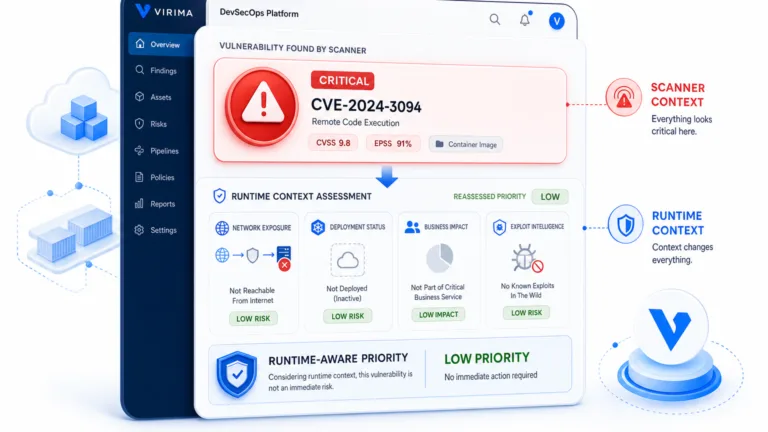
| Scanner reports a CVE | SecOps triages severity from CVSS alone because asset criticality is in another spreadsheet |
| Audit asks for an inventory sample | Team rebuilds the list from exports instead of producing a current, owned population |
A CMDB that only stores names and serials is inventory. A CMDB joined to dependencies, owners, and current state becomes the substrate of the operational context layer. The label on the database matters less than whether the desk can act without another meeting.
Why This Matters for Delivery Speed
Process overhead is expensive in any large organization. In 2016, Gary Hamel and Michele Zanini argued in Harvard Business Review that excess management was costing the U.S. economy on the order of three trillion dollars a year. The research is older, so treat the headline figure as directional, not a 2026 IT budget line. The mechanism still maps cleanly to ITOM: every extra approval that exists only to compensate for missing facts burns calendar time and attention.
Delivery speed in IT operations is the time from a clear need to a safe, completed action. That includes incident restore, change implementation, vulnerability remediation, and audit evidence. When context is thin, each of those paths grows hidden work as people chase owners, rebuild dependency diagrams, and reopen tickets because the first classification was wrong. Leaders then respond with more gates, and throughput falls further under the extra load.
Where Context Gaps Show Up
1. Stale CI relationships. The host still lists last year’s middleware tier, so the change looks local while the failure path is not.
Result: CAB approves a narrow window while production absorbs a wide blast radius.
2. No durable named owner. The CI record exists, yet support group fields are empty or point at a retired alias.
Result: Incidents bounce between queues while mean time to engage stretches as people negotiate ownership in chat.
3. Monitoring siloed from the CMDB. Alerts name hostnames the CMDB never matched, or matched under a different identity rule.
Result: Noise stays high and correlation stays manual, so the first half of the bridge call is inventory, not diagnosis.
4. Vulnerability data disconnected from asset criticality. Findings rank by score while business services rank by revenue and regulation, and the two lists never join.
Result: Teams patch loud low-impact systems first and leave quiet high-impact paths exposed.
Those four patterns show up again in change practice when the CAB works from self-declared risk instead of current estate truth. Virima’s guide on ITIL change management and CMDB accuracy walks that failure mode in detail. The same gap slows incident, audit, and vulnerability work even when change is not on the agenda.
What Missing Context Costs, By Team
CMDB Owners
Configuration managers live the hours tax first. Every incomplete relationship forces a follow-up. Every stale owner field becomes a ticket comment thread. Every import that overwrites good attributes with empty ones creates a cleanup sprint. The cost is not abstract ROI. It is hours per week spent reconciling spreadsheets, chasing application owners, and explaining why the “source of truth” still needs a side channel before CAB.
When discovery and relationship refresh lag, those hours compound. The CMDB still opens for queries, but trust does not follow the same path. Teams stop querying it and rebuild private inventories that then diverge from each other. The next audit samples the wrong population as a result.
Ops and Change Teams
On 19-20 October 2025, Amazon DynamoDB in us-east-1 suffered a multi-hour disruption. AWS’s post-event summary attributes the root cause to a latent race condition in DynamoDB’s DNS management system that left an incorrect empty DNS record the automation failed to repair. Customer impact cascaded across services that depended on that regional endpoint.
The lesson for enterprise ITOM is not “cloud never fails.” It is that dependency chains decide who feels an upstream fault, and how fast you can scope recovery. Ops and change teams without current dependency maps spend the first phase of any major event reconstructing those chains under pressure. With maps, they scope impact, route work, and communicate service status sooner. Without maps, every bridge call reinvents the estate.
CIOs and CTOs
Executives rarely ask for another CMDB feature list. They ask whether delivery dates hold, whether major incidents stay rare, and whether risk language in the board pack matches the estate. Missing operational context shows up as unpredictable lead time, repeated “unknown CI” incidents, and change calendars that slip for reasons no one can explain without a war-room transcript.
Architecture conversations should start with this gap. An operational context layer is not a second ITSM product. It is the shared runtime picture that every ITSM, observability, and security workflow already assumes exists. When it does not, process multiplies to compensate, and predictability falls.
Regulated and Audit-Heavy Environments
Auditors sample populations: in-scope hosts, change records tied to those hosts, access paths, and evidence that inventory is complete enough to trust. CISA’s Binding Operational Directive 23-01 pushes federal civilian agencies toward better asset visibility and vulnerability detection for that reason. Private-sector control frameworks make the same inventory demand under different labels.
A CMDB maps infrastructure, relationships, and ownership. It does not run the compliance program, classify data content, or replace GRC tooling. What it can do is feed accurate populations into reporting and auditing workflows so evidence collection is a query, not a three-week export project. When that feed is stale, audit cost is mostly labor and rework.
How an Operational Context Layer Replaces Process Overhead
Extra process exists to answer questions the system should already answer. Replace the missing answers and many gates become optional.
1. Discovery-sourced CMDB as the substrate
CI identity has to stay current across the estate. Agent-based, agentless, and API discovery on a high-frequency scheduled cadence keeps CI records aligned with the estate. Virima’s IT discovery approach is built for that scheduled refresh model. It is not passive continuous or event-driven discovery. The point is a trusted substrate that does not depend on humans typing every laptop and cloud workload by hand.
2. Dependency and service mapping at the decision point
Once service definitions are provided, dependency maps show installed-on, runs-on, and related paths that matter for blast radius. Service mapping moves impact analysis from a post-incident whiteboard to a pre-change view. Approvers stop requesting a separate write-up for questions the map already answers.
3. ITSM, change, and vulnerability overlays on the same map
Tickets, changes, and findings become useful when they attach to the same CIs and services the map already holds. Change management workflows then surface owners, dependencies, and prior risk signals inline. Virima integrates with ServiceNow, Jira, Ivanti, and many more through a single integrations hub, so the context layer feeds the tools desks already use instead of asking teams to abandon them.
IBM’s overview of AIOps and automation benefits stresses cutting through IT noise by correlating operations data across environments. Correlation only works when the underlying identities and relationships are trustworthy. Automation on top of conflicting inventories just accelerates bad decisions.
Process-heavy path vs. context-layer path
| Step | Process-heavy path | Context-layer path |
|---|---|---|
| Request arrives | Ticket opens with free-text impact | Ticket opens against known CI and service |
| Risk assessment | Author writes a narrative impact statement | Approver reviews current dependency and owner view |
| Review chain | Extra reviewers added “just in case” | Review depth matches criticality already on the record |
| Implementation | Team discovers missing dependents mid-window | Known dependents are staged, monitored, or deferred |
| After action | Postmortem rebuilds the map from memory | Map and change history already share the same CIs |
The second path still uses process. It uses less process that exists only to invent context.
Operational Context in Practice
- Change approver on a low-risk path. A routine middleware patch used to escalate because nobody trusted the CI relationships. With a current dependency view and named owners on the record, the same approver clears low-risk changes in minutes. Escalation remains for genuine high-blast-radius work. It stops being the default because fear filled a data hole.
- SecOps analyst running a CVE triage pass. A critical CVE lands against a large install base. Instead of sorting a flat spreadsheet by CVSS alone, the analyst filters by business service criticality and internet exposure joined to the same asset identity. Remediation order follows service risk, not scanner noise.
- Incident commander in the first fifteen minutes. An alert names a host in the monitoring stack. The context layer already holds the service path, the support group, and recent changes on related CIs. The bridge starts on diagnosis instead of a roll call for “who owns this box.”
Published results on Virima’s ServiceNow CMDB workspace overview include a Birlasoft-sourced case study citing an 85% reduction in manual CMDB maintenance and 76% of incidents auto-routed once discovery-fed accuracy and routing data were in place. Treat those figures as that engagement’s reported outcomes, not a guarantee for every estate. They show what becomes possible when desks stop hand-building context for every ticket.
Where Virima Fits Into This Layer
Virima is built as the discovery-sourced operational context layer under ITOM and ITSM work. The product set covers authoritative discovery, CMDB population and health, ViVID™ service dependency maps after service definitions are supplied, and operational views that help teams assess change risk and relate alerts to CIs and services. The goal is Trusted Runtime Truth: what exists, how it is connected, what changed, what will break, and who owns it.
Immediate impact on delivery cycles
When CI identity and relationships refresh on a reliable schedule, change and incident desks spend less time reconstructing the estate. Impact views show up before the window, not after the outage. That is the shortest path from “we need more gates” to “we need fewer guesses.”
Accuracy that holds up over time
A one-time CMDB cleanup decays. High-frequency scheduled discovery is what keeps the layer honest as cloud workloads, VMs, and network gear turn over. Virima does not claim passive real-time or continuous event streams today. It claims a disciplined refresh cadence that operations can trust and auditors can sample.
Fitting into existing ITSM workflows
Virima is not a rip-and-replace ITSM suite. It feeds and enriches the platforms teams already run for tickets, changes, and service management, including ServiceNow and peer tools reachable from the integrations hub. ITOM views sit on top of that same substrate so operations leadership sees health and risk against real CIs, not against slideware topology.
Moving From More Process to More Context
| Old default | New default |
|---|---|
| Add reviewers when trust is low | Add current context at the decision point |
| Add checklist steps after every incident | Fix the missing identity, dependency, or owner field that forced the step |
| Treat the CMDB as a quarterly project | Treat discovery cadence as an operating control |
| Rebuild impact in every ticket | Reuse service maps and CI history across tickets |
Benefits that compound
- Fewer status meetings that exist only to swap facts. When the record already holds owners and dependencies, standups move to decisions.
- Shorter safe path for low-risk work. Context lets you separate routine changes from high-blast-radius ones without inventing a new committee.
- Cleaner audit samples for the next review. Populations come from the same inventory operations use daily, which reduces last-mile spreadsheet theater.
Getting started
- Turn on discovery across on-prem, virtual, and cloud scopes your credentials allow, on a high-frequency schedule.
- Populate and reconcile the CMDB so each CI has a stable identity and surviving attributes after multi-source merge.
- Map dependencies once service definitions are supplied, then keep maps tied to discovery refresh.
- Overlay ITSM and vulnerability data so tickets, changes, and findings resolve to the same CIs and services.
- Retire redundant approval gates only after the context those gates were invented for is visible inline. Keep genuine risk gates in place, and drop the ones that existed only to compensate for empty fields.
Teams that want a structured build path can start from Virima’s build a CMDB use case and expand into service maps and ITOM views as trust returns.
Put Context at the Decision Point
ITOM delivery speed recovers when desks stop rebuilding the estate for every ticket. Put identity, dependencies, owners, and current state where approvals and incidents already run. Explore Virima ITOM when you are ready to replace guesswork gates with a discovery-sourced operational context layer your change and incident teams can trust.
FAQ
What is an operational context layer in ITOM?
It is the shared, current picture of CI identity, dependencies, ownership, criticality, and state that incident, change, and security desks use at decision time. It turns scattered tool data into answers without a side investigation.
Why does adding more process slow down IT delivery instead of speeding it up?
Extra gates often exist to invent facts the system never recorded. Each gate adds wait time, handoffs, and rework. Throughput falls even when individual steps look careful on paper.
How is an operational context layer different from a CMDB?
A CMDB is the system of record for configuration items and relationships. The operational context layer is how that record, plus ownership, criticality, and current state, is presented inside the workflows where people decide.
Does more operational context reduce the need for change approvals?
It reduces approvals that exist only because impact was unknown. High-blast-radius and regulated changes still need human judgment. Context makes that judgment faster and better scoped.
How does Virima support an operational context layer?
Virima supplies high-frequency scheduled discovery, CMDB population, ViVID™ dependency maps after services are defined, and ITSM-oriented overlays so desks see identity, relationships, and owners where work already happens.