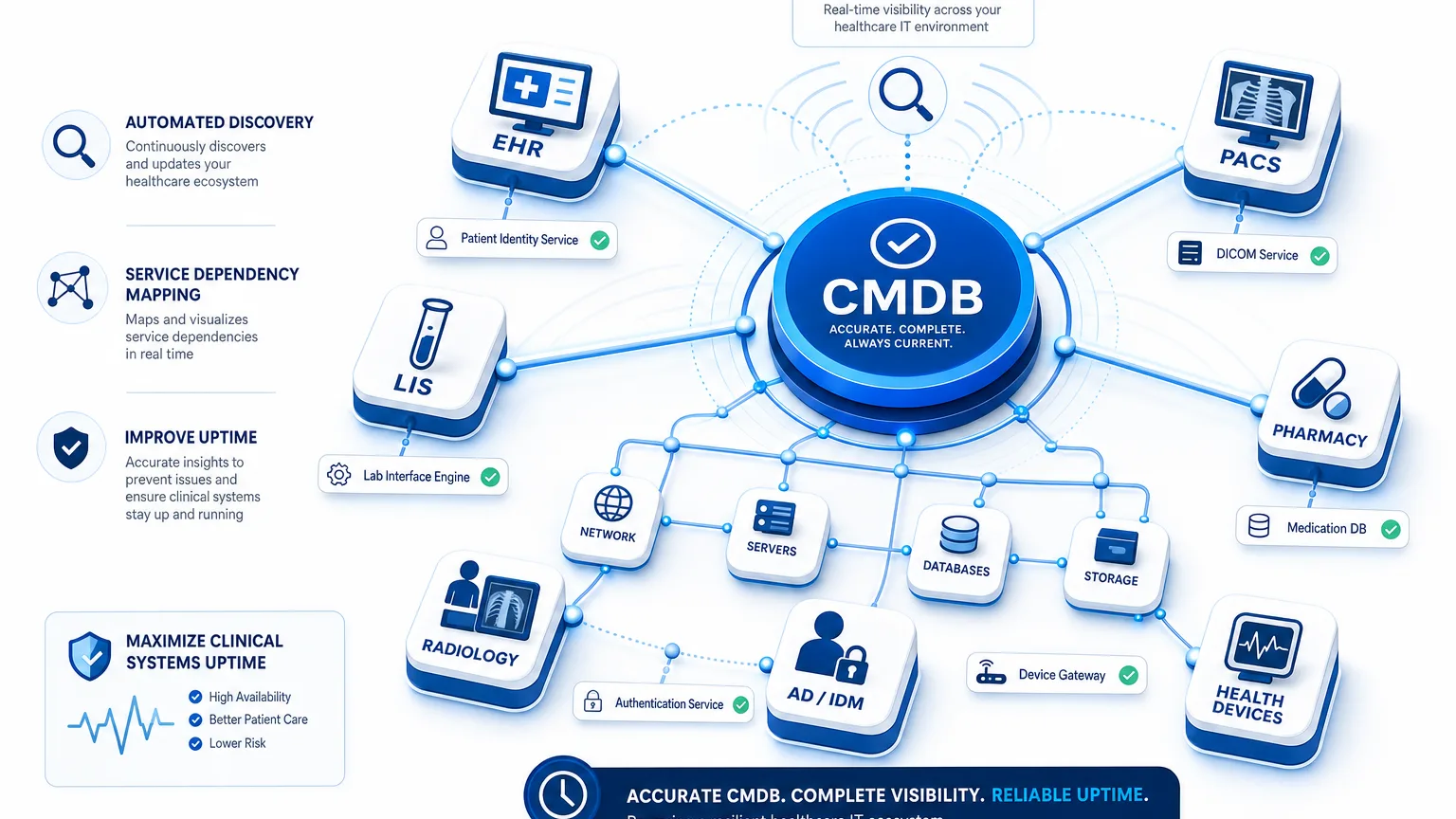
Monitoring Clinical Systems Uptime with an Accurate CMDB

When a hospital electronic health record (EHR) system or picture archiving and communication system (PACS) drops offline, the impact extends far beyond administrative frustration. Clinicians lose immediate access to patient allergy histories, diagnostic imaging feeds, and medication schedules, directly threatening patient care safety and delaying emergency treatments.
Modern hospital networks and health systems manage highly complex hybrid environments. EHR platforms like Epic or Cerner connect with laboratory information systems (LIS), biomedical telemetry devices, pharmacy dispensers, and cloud-hosted patient portals.
Healthcare IT directors and clinical infrastructure teams often rely on static asset inventories or manual spreadsheets instead of an accurate CMDB. When they do, unannounced infrastructure changes and unmapped system dependencies create severe operational vulnerabilities. Sustaining uptime for mission-critical clinical workflows requires continuous automated discovery, an always-current CMDB, and dynamic service dependency mapping. The health systems that stay online treat CMDB accuracy as a patient-safety control — the foundation of healthcare clinical systems uptime CMDB practice, not an IT bookkeeping task.
Why is maintaining uptime for mission-critical clinical systems complex in healthcare IT?
Healthcare IT environments integrate legacy clinical databases, cloud microservices, and biomedical IoT devices across strict HIPAA-compliant subnets. Without dynamic service dependency mapping, uncoordinated infrastructure changes or database patch failures trigger cascading outages across patient care applications.
The operational reality of clinical system infrastructure
Hospital IT architectures operate under continuous pressure. Unlike traditional corporate IT, clinical software interfaces must function 24/7/365 without planned maintenance downtime during peak operational hours.
Health systems run sprawling portfolios of clinical applications across hospital campuses and outpatient clinics, and every one of those applications depends on infrastructure that has to stay up. That dependency has a real price tag: a College of Healthcare Information Management Executives (CHIME) study found that a one-hour EHR outage costs a mid-sized hospital roughly $1.7 million. That figure climbs to $3.2 million for a large hospital, according to TigerConnect’s analysis of the research. This exposure creates two primary infrastructure risks:
1. Complex inter-application dependencies
A single physician order entered into an EHR interface triggers a cascade of automated network communications. The order queries patient insurance verification services, alerts the inpatient pharmacy system, transmits dosage requirements to automated dispensing cabinets, and updates billing databases.
When IT teams maintain these application connections in static spreadsheets, no single team holds complete visibility over the entire service topology. A routine patch applied to a secondary database host can silently break an interface engine feed, taking critical clinical notifications offline without triggering a primary server alert.
2. HIPAA infrastructure change management exposure and unintended outages
Hospital infrastructure teams perform dozens of software updates, network configuration changes, and security patches weekly to defend against cyber threats and meet HIPAA security standards. This is the operational core of HIPAA infrastructure change management: every one of those change tickets carries dependency risk that a static asset list can’t show.
Without clear service context, change advisory boards (CABs) evaluate change tickets in isolation. A network engineer updating a core switch configuration may not realize the switch routes primary DICOM image transfers from the radiology PACS archive to the emergency department. The result: an unexpected imaging blackout during active trauma care.
The stakes behind that patching cadence are not abstract. Ransomware hit hospitals, clinics, and other direct care providers in 445 separate incidents in 2025. When an attack takes clinical systems offline, U.S. healthcare organizations lose an average of nearly 19 days of operation at roughly $900,000 per day, per Comparitech’s 2025 healthcare ransomware roundup. Peer-reviewed research covered by Black Hat and HIMSS puts the clinical cost even higher: hospital ransomware attacks have been shown to raise patient mortality by 38 percent, according to Tech Times’ coverage of the summit findings. A CAB that can see the blast radius of a change before approving it is one of the few controls that works against both a mistaken switch update and a targeted attack.
How does automated discovery support clinical system availability across health systems?
Automated discovery continuously inventories enterprise servers, virtual host clusters, operating systems, and interface engine builds across secure clinical subnets. It eliminates manual asset drift and provides IT teams with real-time configuration visibility across hospital facilities.
Deploying EHR PACS infrastructure discovery across regulated healthcare networks
Healthcare organizations operate under strict HIPAA and HITECH security frameworks that mandate rigorous access controls and network segmentation between clinical care zones, biomedical IoT subnets, and public-facing guest Wi-Fi.
The pressure to get this right keeps climbing: healthcare data breaches now cost an average of $7.42 million per incident, the highest of any industry for the 14th consecutive year, per the same Comparitech analysis referenced above. Achieving reliable EHR PACS infrastructure discovery without compromising patient data privacy or violating network security boundaries means health systems build a secure, multi-layered discovery framework rather than relying on ad hoc scans.
Secure discovery architecture for health systems
- Zero-Footprint Agentless Probes: Situated within secure hospital datacenters, agentless probes use WMI, SSH, and SNMP protocols to discover physical servers, SAN storage arrays, and hypervisors without installing software on sensitive clinical hosts, using the same agentless and agent-based discovery methods health systems rely on across hybrid environments.
- Segmented Clinical Gateway Collectors: Placed inside isolated biomedical and PACS subnets, dedicated gateway collectors perform localized scanning tailored to the realities of connected medical device management and securely transmit configuration metadata over encrypted channels to the central CMDB.
- Cloud API Integration: Direct API connectors monitor cloud-hosted clinical analytics and telehealth workloads across AWS and Azure environments, capturing auto-scaling events and virtual appliance updates in real time.
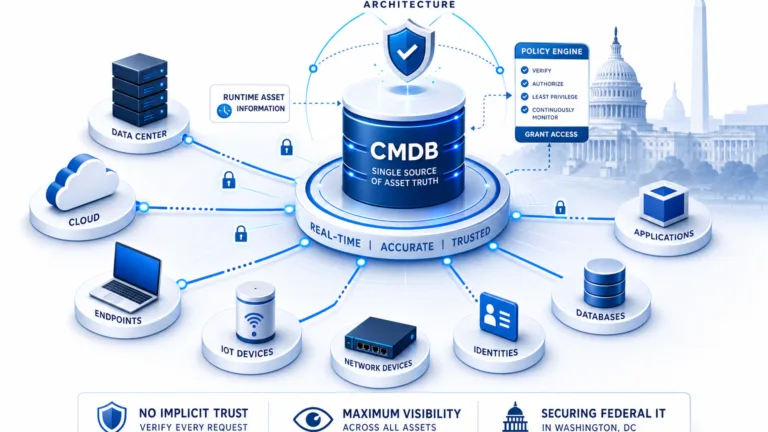
Consolidating these discovery feeds into a unified CMDB gives healthcare IT leaders reliably accurate configuration data across clinical environments. To explore how automated discovery integrates with clinical service desk platforms, visit the Virima integrations hub.
Clinical service dependency mapping: visualizing workflows and blast radius
Knowing that a database server exists in Datacenter B is insufficient; understanding that the server hosts the primary HL7 interface engine connecting the laboratory information system to the EHR is essential.
Clinical service dependency mapping — what Virima calls ViVID™ service maps — converts flat configuration item (CI) lists into interactive, real-time dependency maps. By analyzing running processes, active network connections, and configuration files, the mapping engine builds detailed clinical service topologies.
Accelerating incident triage and reducing MTTR
When a clinical application slowdown occurs, service desk technicians must quickly isolate the root cause before patient care suffers. Speed matters because every minute of manual troubleshooting compounds the cost calculated earlier — the difference between a five-minute root-cause identification and a forty-minute one is measured in tens of thousands of dollars, not just clinician frustration.
With dynamic service dependency mapping, an IT operator responding to an EHR latency alert views the full infrastructure dependency tree within seconds. If the map reveals that a degraded SAN storage controller in a secondary rack is bottlenecking database write speeds for clinical notes, technicians immediately re-route storage traffic, cutting diagnostic time and restoring system responsiveness. For more on how uptime and reliability metrics like MTTR fit into a broader IT operations strategy, see Understanding MTBF vs Service Availability.
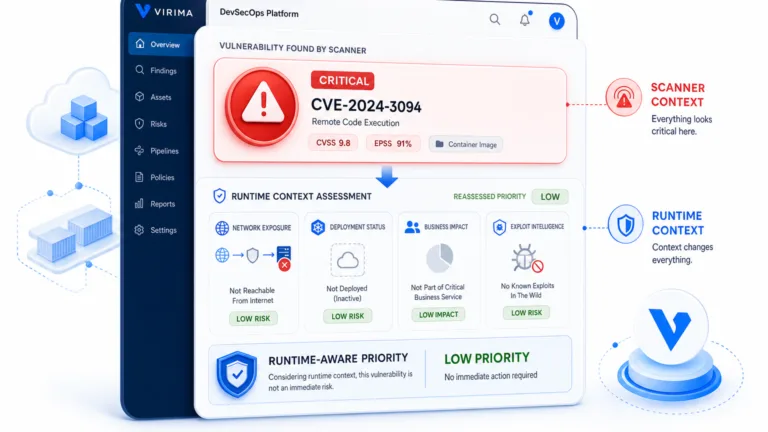
To discover how health systems reduce data decay and maintain operational clarity, explore how IT directors establish Trusted Runtime Truth.
Best practices for clinical system infrastructure governance
Maintaining continuous availability across mission-critical clinical applications requires aligning automated discovery tools with disciplined healthcare IT service management workflows. Health system IT leaders formalize this work into a repeatable framework — call it the Clinical Blast-Radius Review — built on four core operational practices:
- Prioritize Tier-1 Clinical Services: Begin service mapping initiatives by modeling core EHR, PACS, LIS, and emergency dispatch workflows before expanding to administrative systems.
- Enforce Pre-Change Blast Radius Reviews: Require CABs to review current service dependency maps before approving maintenance windows on clinical database clusters or network switches. CABs that skip this step miss hidden infrastructure connections, whether the cause is a routine change or an active attack.
- Automate HIPAA Configuration Audits: Maintain continuous tracking of server configurations, patch levels, and access controls, as part of a broader hospital IT asset management uptime practice built on IT asset management, to streamline annual HIPAA compliance reporting in line with HHS Office for Civil Rights guidance on HIPAA Security Rule risk analysis and the configuration-management controls in NIST SP 800-128. See Virima’s Complete Guide to Healthcare IT Asset Management and Hospital Asset Management Best Practices for the full picture on tracking medical devices and EHR infrastructure together.
- Integrate Discovery with Healthcare ITSM Workflows: Connect central CMDB data directly to ITSM platforms like ServiceNow, Jira Service Management, or Ivanti, providing service desk agents with instant clinical service context when handling incident tickets. For a closer look at how this plays out in practice, see how Virima Service Mapping and ViVID improve service uptime with Jira Service Management.
What are the primary financial and operational benefits of CMDB automation in healthcare?
CMDB automation prevents costly clinical system outages, accelerates incident recovery during EHR or PACS disruptions, reduces manual audit preparation costs, and lowers the risk of unbudgeted software license compliance penalties across health systems.
Securing the future of high-availability healthcare operations
As health systems expand remote patient monitoring and AI-assisted clinical decision support tools, technology dependencies will continue to grow. Relying on static spreadsheets or disconnected monitoring tools to manage mission-critical clinical infrastructure creates unacceptable patient safety risk.
By implementing continuous multi-site discovery and dynamic service dependency mapping, healthcare IT organizations close the gap between what their spreadsheets say is running and what’s actually connected to patient care. That gap is where outages start — closing it is what keeps uptime predictable as the application count and attack surface keep expanding.
Frequently Asked Questions
How does automated discovery ensure HIPAA compliance during network asset scans?
Automated discovery uses read-only, non-intrusive protocols to query infrastructure metadata without accessing protected health information (PHI). Transmitted configuration data is encrypted in transit and at rest, preserving HIPAA security standards.
Can dynamic service mapping track dependencies between cloud-hosted and on-premises clinical systems?
Yes. Advanced service mapping platforms correlate network traffic, process connections, and API endpoints across on-premises clinical datacenters, local hospital servers, and cloud-hosted microservices into a single dependency map.
How does Virima assist healthcare IT teams during emergency EHR or PACS outages?
Virima’s dynamic service mapping links technical infrastructure directly to clinical business functions. When an incident occurs, technicians can quickly pinpoint the server, storage unit, or network link causing the disruption, speeding up diagnostic and recovery workflows.