Telecom Service Dependency Mapping for Outage Diagnosis | Virima

When a tier-one telecommunications network experiences a service degradation, Network Operations Center (NOC) engineers face an immediate race against time. A single fiber cut, misconfigured router interface, or virtualized network function (VNF) memory leak triggers thousands of secondary alarms across monitoring dashboards.
Modern telecom infrastructure spans multiple technological domains: radio access networks (RAN), optical transport layers, IP packet cores, virtualized 5G core microservices, and customer-facing OSS/BSS portals.
When engineering teams rely on static network topology diagrams, siloed inventory databases, or manual spreadsheets, pinpointing the actual root cause of a subscriber outage takes hours. Achieving rapid Mean Time to Resolution (MTTR) and protecting strict service level agreements (SLAs) requires automated multi-domain discovery, core-aware configuration tracking, and dynamic service dependency mapping. Telecommunications service dependency mapping links physical network elements, virtualized functions, and logical transport paths into one live map, so outage diagnosis starts at the root cause instead of the alarm storm.
Why is outage diagnosis complex across telecommunications networks?
Telecom networks operate across deeply layered physical, transport, logical, and cloud-native domains. Lacking dynamic service dependency mapping, an incident at a low-level transport layer generates massive alarm storms across higher-level voice, data, and enterprise services, masking the true root cause.
The root cause of slow outage triage in telecommunications
Telecom service providers manage some of the most complex infrastructure environments in modern industry. As operators migrate from legacy TDM and MPLS architectures to cloud-native 5G Standalone (SA) cores, physical and virtual assets interlock across multiple network layers.
Research on Mean Time to Repair (MTTR) consistently finds that identifying the failed component, not fixing it once found, consumes the largest and least predictable share of total outage duration (Tanium, MTTR research). For a telecom NOC juggling RAN, transport, and virtualized core alarms at once, that identification phase is where hours disappear — and where telecom network outage MTTR reduction efforts pay off first. This diagnostic delay stems from two structural visibility challenges. For a closer look at how mapping tools tackle this gap, see Virima’s guide to service dependency mapping tools.
1. Alarm storms and flashing dashboard noise
When a core transport switch or optical amplifier drops offline, every upstream logical service, VPN tunnel, and customer session fails simultaneously. Monitoring platforms generate tens of thousands of event alerts within seconds.
Without automated dependency mapping linking physical transport nodes to higher-level subscriber services, NOC operators cannot distinguish between the primary failure point and secondary symptom alerts. Engineers waste critical minutes investigating healthy downstream systems that are merely reporting loss of signal.
2. Multi-vendor silos and disconnected asset repositories
Telecommunications networks combine hardware and software components from dozens of equipment vendors. Transport teams maintain optical path inventories in specialized vendor management systems; IP engineers track router topologies in separate spreadsheets; and cloud teams track containerized network functions (CNFs) inside Kubernetes dashboards.
Because these asset repositories operate as isolated silos, cross-domain dependencies remain unmapped. So when a planned firmware upgrade occurs in the IP core, engineers cannot evaluate its potential blast radius on enterprise MPLS services — and unannounced service disruptions follow.
How does service dependency mapping accelerate telecom outage diagnosis?
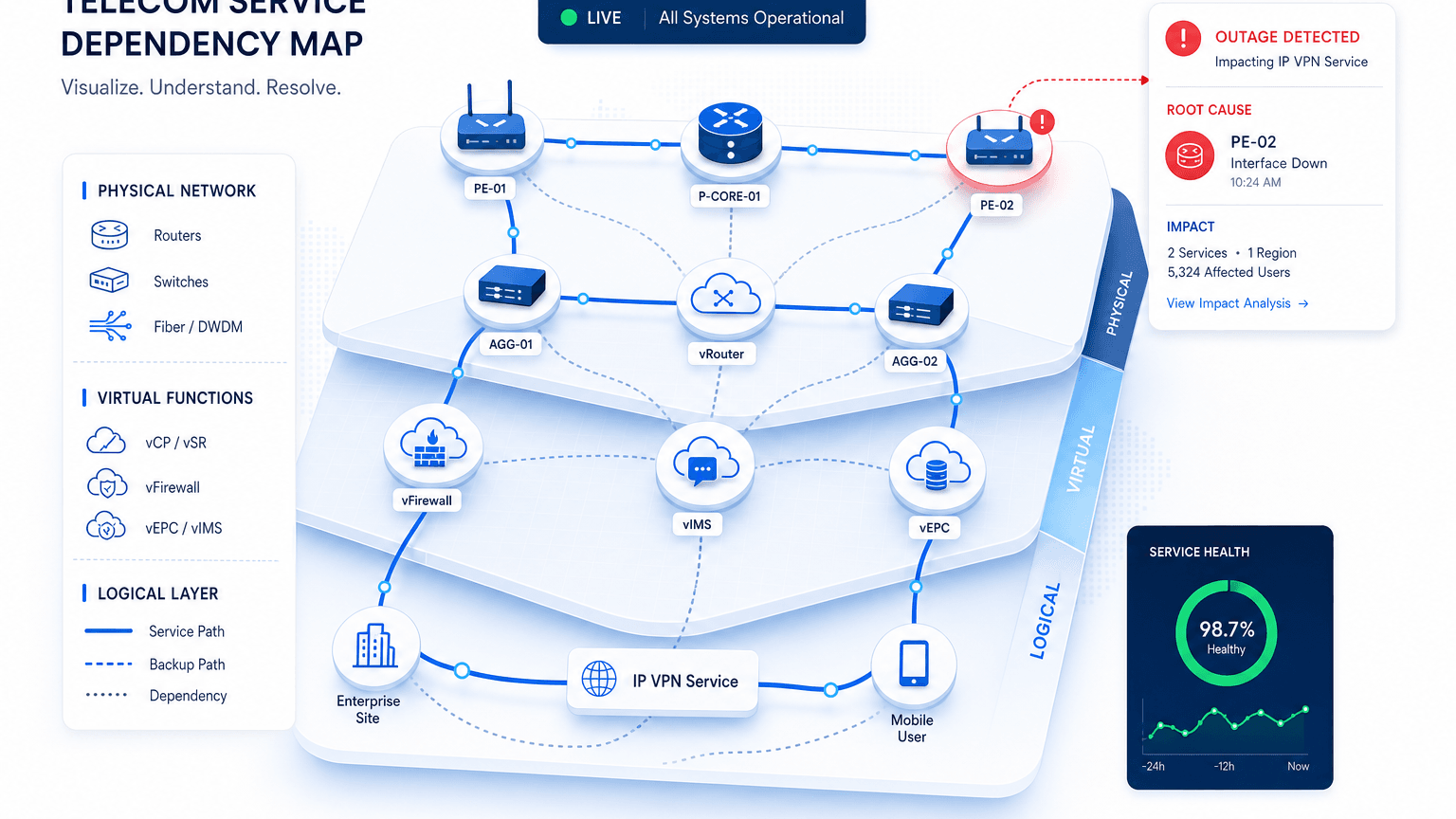
Automated discovery feeds correlate physical network elements, virtualized network functions, and logical transport paths into interactive service dependency maps. During an outage, NOC engineers trace subscriber service impacts directly to the failing physical or virtual CIs within seconds.
Deploying automated discovery across layered telecom architectures
Telecom infrastructure dependency discovery means inspecting physical, virtual, and logical network layers continuously, without generating intrusive management traffic that disrupts subscriber bandwidth — the foundation for an accurate, operational map of the network.
Telecom operators implement a multi-tiered IT discovery framework designed for high-density, distributed network architectures. A preprint on failure analysis in modern virtualized cellular infrastructure documents how the shift toward cloud-native network functions adds diagnostic layers (arXiv preprint, cellular infrastructure failure analysis). Each added layer is one more place a fault can hide before it reaches a subscriber-facing service.
Multi-domain discovery framework for telecommunications
- Physical and optical layer probes use agentless SNMP, CLI, and TL1 (Transaction Language 1) protocols to inventory core routers, optical cross-connects, DWDM transponders, and cell site gateways across regional network subnets.
- Virtual and cloud-native collectors use direct API integrations to continuously monitor NFV orchestrators, OpenStack hypervisors, and Kubernetes clusters hosting 5G User Plane Functions (UPF) and Session Management Functions (SMF).
- Logical service correlation: the discovery engine analyzes routing tables, VLAN tags, and MPLS label switched paths (LSPs) to build the telecom network element relationship mapping that connects physical interfaces to logical transport channels.
Consolidating these multi-layer discovery feeds into a unified CMDB — the foundation of telecom CMDB service mapping — gives network engineering leads one accurate configuration record instead of three disconnected ones. To explore how automated discovery integrates with enterprise service management platforms, visit the Virima integrations hub.
Dynamic service dependency mapping: from raw CIs to service context
A raw inventory listing physical switches and IP addresses cannot explain why enterprise VoIP connections are dropping across a metropolitan area. Telecom operations require dynamic service context to correlate network elements with revenue-generating subscriber services.
Visualizing the end-to-end service path
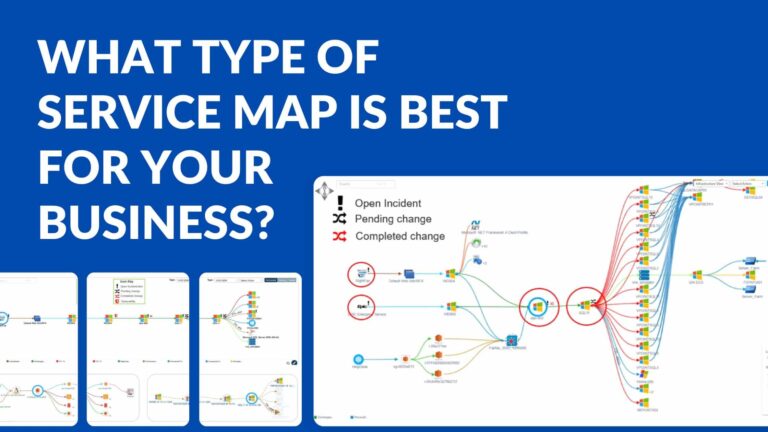
Dynamic service dependency mapping, such as Virima’s ViVID™ service maps, analyzes network traffic topologies, protocol relationships, and process configurations to construct interactive maps once operators define the services they want tracked. These maps visualize the full operational stack:
- The subscriber and business service layer: consumer 5G voice/data, enterprise SD-WAN, leased line circuits, and hosted PBX platforms.
- The logical and virtual function layer: core routing tables, VNF/CNF instances, firewall policies, and IP multimedia subsystem (IMS) components.
- The physical infrastructure layer: fiber optic cables, DWDM transport chassis, power distribution units (PDUs), and cell tower edge servers.
When an optical transponder degrades on a regional ring, the service map highlights the enterprise circuits and mobile cell sites reliant on that channel. Technicians initiate traffic rerouting before packet loss breaches subscriber SLAs.
Mitigating failed changes and pre-maintenance blast radius
Uptime Institute’s 2025 outage analysis found human error and process failures, including poor change management, behind the majority of unplanned infrastructure outages (Uptime Institute, Annual Outage Analysis Report 2025). Telecom NOCs see the same pattern when a routine maintenance window goes wrong. Before applying security patches or upgrading router OS builds, change advisory boards (CABs) must evaluate potential service impacts.
With dynamic service dependency mapping, network planners select a candidate device for maintenance and view its dependency tree in one place, instead of cross-referencing separate spreadsheets. If the map reveals that taking a core router offline will isolate a high-priority emergency services network, planners adjust maintenance windows or establish redundant transport paths prior to execution.
To learn how network engineering leaders establish operational visibility across complex infrastructure, review the architecture behind Trusted Runtime Truth.
Best practices for accelerating outage recovery in telecom operations
Achieving rapid outage diagnosis and high network availability requires combining automated discovery tools with disciplined IT service management workflows. Leading telecom operators follow four essential operational practices:
- Begin service mapping initiatives with high-revenue services first: model high-SLA enterprise circuits and core mobile voice/data paths before expanding to internal administrative IT systems.
- Enforce pre-change blast radius reviews: mandate that network operations leads inspect ViVID™ service maps before approving maintenance tickets on core transport nodes. This is exactly the discipline the same Uptime Institute research points toward — fewer unreviewed changes mean fewer surprise dependencies breaking downstream.
- Establish unified CI governance across domains by standardizing naming conventions and CI categorization across optical, IP, wireless, and cloud engineering teams, so central reporting stays consistent.
- Integrate service maps directly into NOC dashboards: connect central CMDB data to ITSM platforms like ServiceNow, Jira Service Management, or Ivanti, enriching incident tickets with live dependency maps during major network events. If your NOC already runs on ServiceNow, see how discovery and service mapping compare on that platform before deciding where dependency data should live.
When evaluating network function virtualization (NFV) upgrades or preparing for 5G core expansions, testing automated discovery capabilities ensures your organization maintains operational control over its own topology. What Is Blast Radius in IT Change Management? to turn the four practices above into a repeatable NOC process.
What are the primary business benefits of CMDB service mapping for telecom providers?
Service mapping reduces MTTR during major network outages, prevents SLA violation penalties, eliminates unbudgeted hardware replacement costs through proactive tracking, and prevents service disruptions caused by uncoordinated maintenance changes.
Securing high-availability telecommunications infrastructure
As telecom operators deploy 5G edge computing, private cellular networks, and automated network slicing, underlying infrastructure dependencies will become increasingly complex. Relying on static network diagrams or fragmented domain inventories creates severe outage risks and costly SLA penalties.
By combining automated multi-domain discovery with dynamic service dependency mapping, telecommunications providers build real operational resilience. They isolate network failures faster and protect critical subscriber services before an SLA breach. For more on structuring this kind of dependency data as networks scale toward autonomous operations, see ITIL Change Management and CMDB Accuracy: Why One Depends on the Other.
Frequently asked questions
How does automated discovery handle virtualized and containerized 5G core network functions?
Automated discovery uses direct API integrations with OpenStack, Kubernetes, and NFV orchestrators to track ephemeral 5G network functions (VNFs/CNFs) in real time. It correlates dynamic virtual instances with underlying physical hosts and network interfaces.
Can dynamic service mapping correlate physical fiber paths with logical IP services?
Yes. Advanced service mapping platforms analyze routing tables, VLAN tags, and optical cross-connect configurations to build unified cross-layer maps linking physical fiber and DWDM transport channels directly to logical IP circuits and subscriber services.
How does Virima assist NOC teams during major network alarm storms?
Virima’s dynamic service mapping links technical assets directly to business services, so when alarm storms spike, NOC operators trace impacted subscriber circuits back to the failing physical or virtual CI in seconds instead of triaging alerts one by one.