Four of Gartner’s 2027 Technology Trends Depend on an IT Estate Record: What a CMDB Supplies

IT leaders reading Gartner 2027 technology trends walk away with a long shortlist and a shorter set of decisions that still need a map of the estate underneath. On 20 October 2026, at Gartner IT Symposium/Xpo in Orlando, Gene Alvarez, Distinguished Vice President Analyst at Gartner, announced the list of top strategic technology trends for 2027: ten trends in three themes. Gartner’s accompanying article frames the year as a move from adoption to governance.
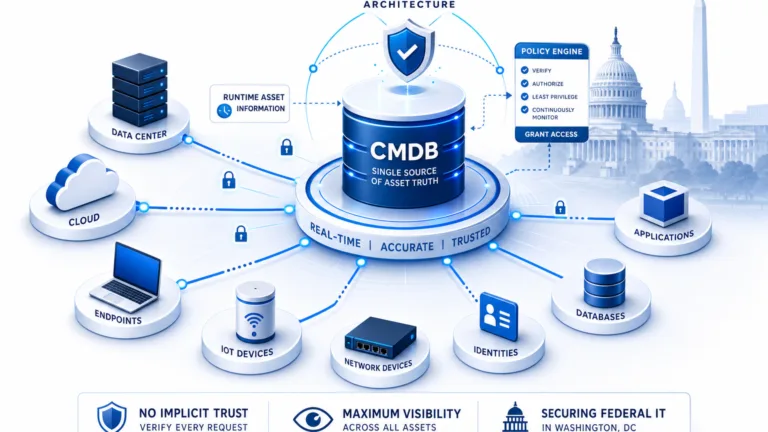
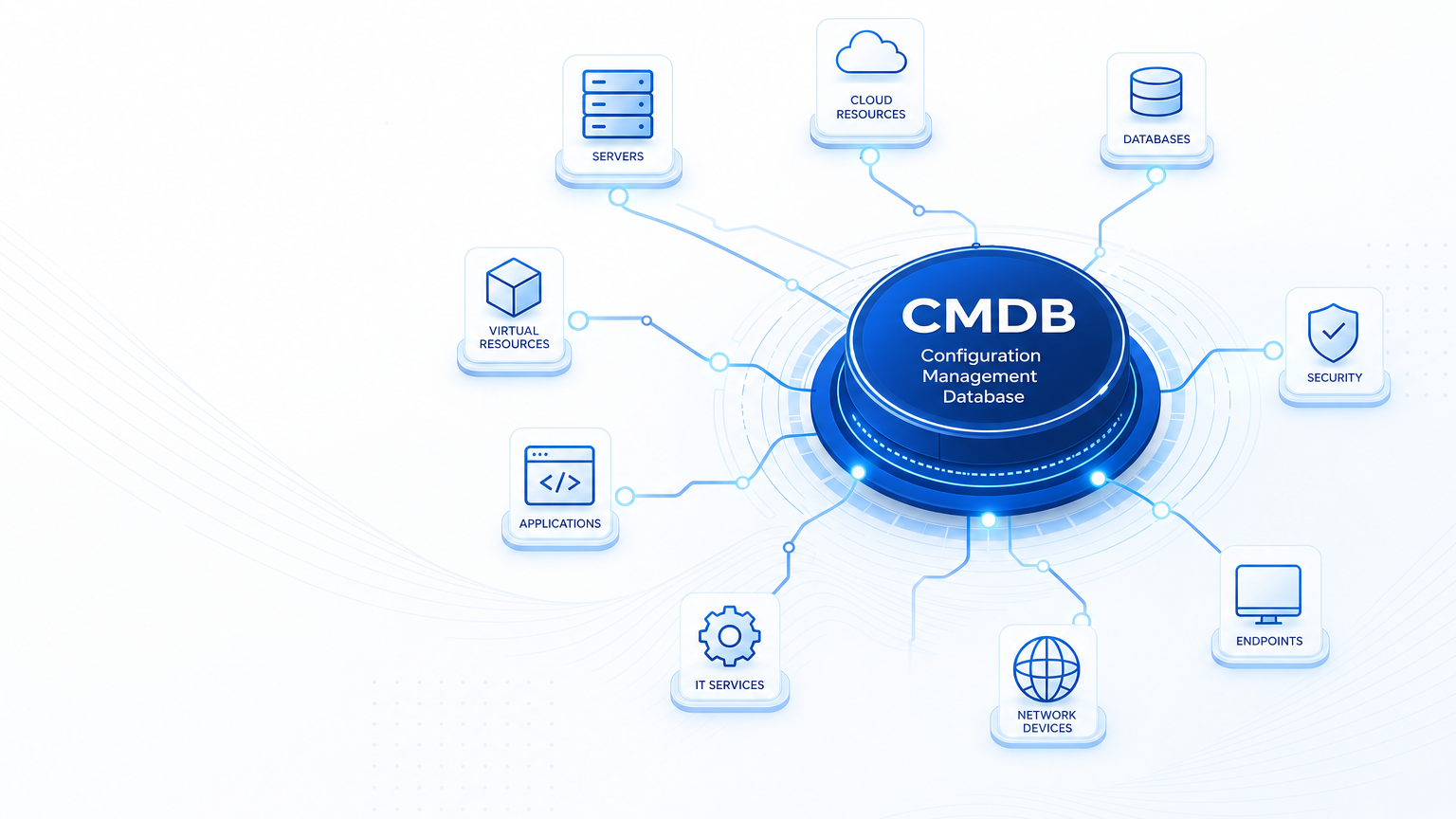
The list tells leaders what to explore. Four of the ten, on Virima’s reading, also depend on something the list does not name: a current estate record. An estate record is the recorded view of what the information technology (IT) estate contains, who owns each item, and how items connect, as far as discovery reaches. Each record carries a source and a last-seen date. It is not a claim to see everything. A configuration management database (CMDB) is the usual place that view is stored: a database of the systems a company runs, who owns each one, and how they connect. Gartner does not endorse Virima or this reading, and neither the press release nor the article names the CMDB or the estate record as a prerequisite. This post covers all ten trends in one table, then spends its depth on the four where that missing record decides whether a trend can be acted on.
All Ten Trends in One Table
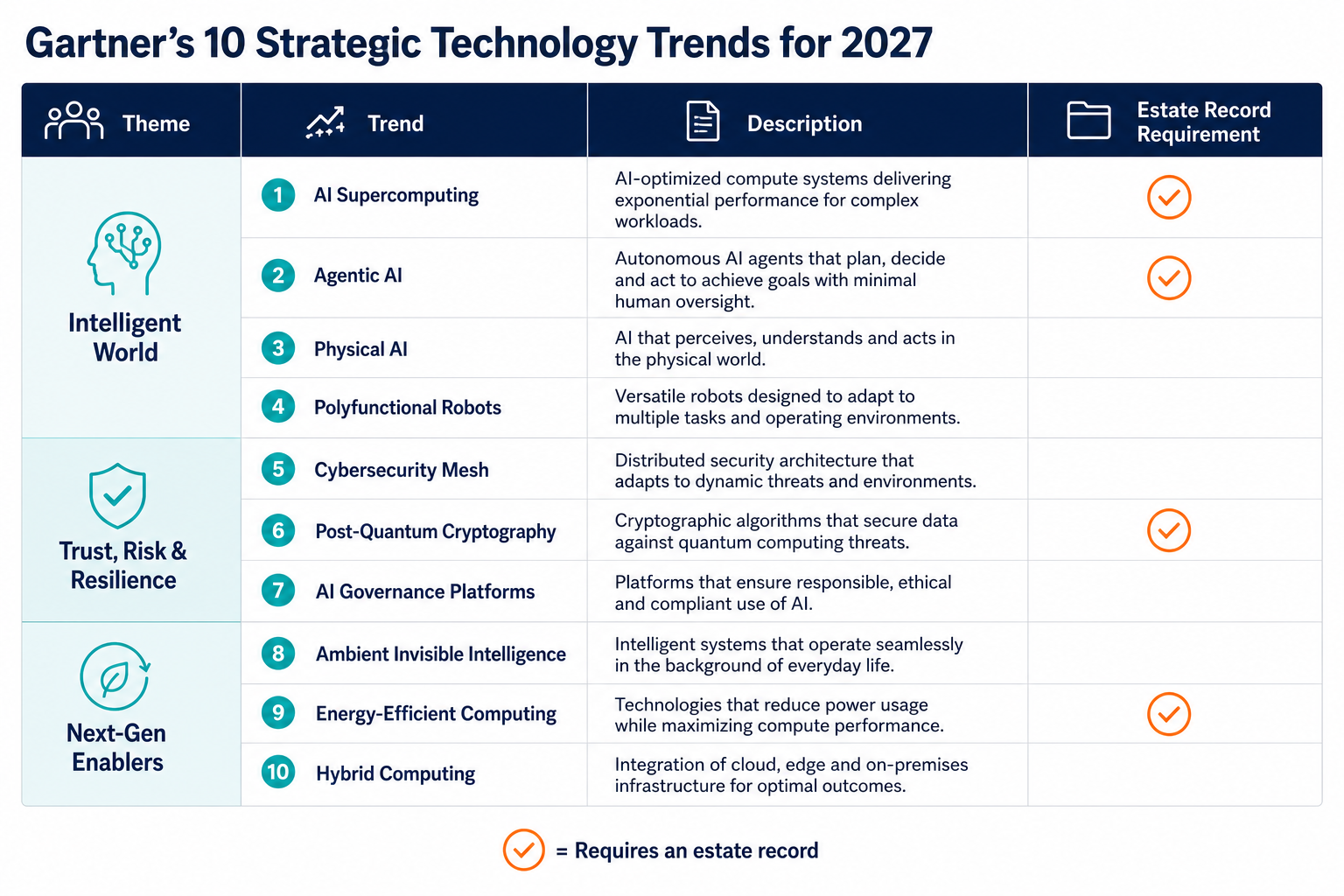
Gartner’s ten trends sit in three themes in Gartner’s article. The table below keeps Gartner’s names and one-line descriptions. The final column is Virima’s reading of where an estate record is required; Gartner does not make that claim.
| Theme (Gartner) | Trend (release name) | Gartner’s one-line description | Gartner prediction | Needs an estate record? (our reading) |
|---|---|---|---|---|
| Leverage the non-textual AI frontier | Large Quantitative Models | Modular, hybrid neural network architectures for quantitative data, shifting decisions to proactive simulation | By 2030, replace large language models in 25% of strategic forecasting and operational modeling tasks | No |
| Speech Reasoning Models | Voice artificial intelligence (AI) that reasons on audio, tracking context and intent | By 2030, over 70% of enterprise voice interactions handled autonomously | No | |
| World Models | Physics-first systems for space, time, and causality, so agents predict outcomes before acting | None given | Not directly | |
| Govern the autonomous agent platform | AI Context Platforms | Give agents the contextual knowledge to interpret inputs and act in line with business goals | By 2027, prioritizing semantics in AI-ready data raises agentic AI accuracy by up to 80% and cuts costs by up to 60% | Yes, for operational context |
| Agent Coding Harness | Closed-loop control that governs autonomous developer behavior | None given | Partly | |
| AI Agent Identity | Connects models, prompts and credentials to agent actions with dynamic, policy-controlled access | By 2028, 25% of enterprise security breaches will trace to AI agent abuse | Partly | |
| Autonomous Exposure Remediation | AI and automation to find, prioritize and fix vulnerabilities across the digital estate | None given | Yes | |
| Architect durable agility | Sovereign Tech | Technology designed to offer realistic exit strategies from critical providers | By 2030, over 75% of non-U.S. organizations adopt digital sovereignty strategies | Yes |
| Disposable Applications | Software intentionally retired once its purpose is fulfilled | None given | Yes | |
| Wetware as a Service | Remote access to living or synthetic biological systems for computation | None given | No |
Themes come from Gartner’s article; trend names follow the press release. The “up to 80% and 60%” line is Gartner’s prediction about semantics in AI-ready data. It is not an argument about estate inventory, and it stays in the table only.
What “From Adoption to Governance” Asks of the People Who Govern
Governing something starts with knowing what it touches. Gartner’s theme is governance, and independent surveys show how far governance still trails ambition.
Reporting on Alvarez’s framing describes AI operating in an “architectural vacuum” when controls and architecture lag behind deployment. A Deloitte survey of 3,235 leaders across 24 countries (24 April 2026) found that only 21% say their organization has a mature governance model for agentic AI, while 74% expect to use AI agents at least moderately by 2027. Those figures speak to policy maturity and adoption intent. They do not measure whether the organization holds a current list of the systems those agents would touch.
Controls cover what an agent may do. They do not say what an action reaches. A policy that allows a remediation job still needs an asset identity, an owner, and a path through dependent services before anyone can approve the change with confidence. The CMDB role in an agentic harness is the operational half of that problem: identity of the thing being changed, not only identity of the agent doing the changing.
Four Trends, One Missing Record
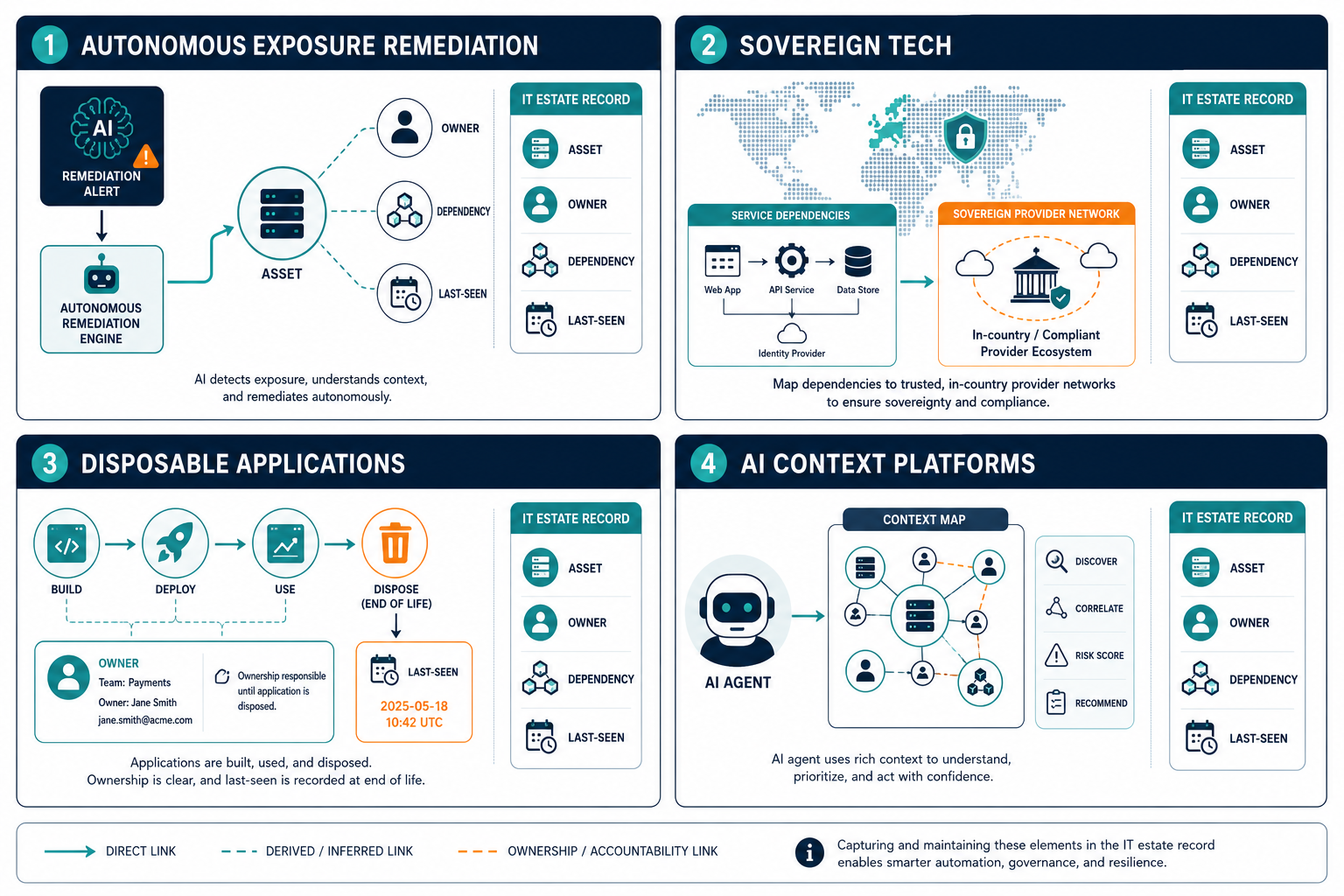
Each of the four trends below turns into the same questions about the estate. What exists, who owns it, what does it touch, and what changed.
Autonomous Exposure Remediation: a fix needs an asset, an owner, and a reach
Gartner describes Autonomous Exposure Remediation as combining AI and automation to find, prioritize, and fix vulnerabilities across the digital estate. The operational question arrives before the fix runs. Which asset is this finding on, who owns that asset, and what runs on it or depends on it?
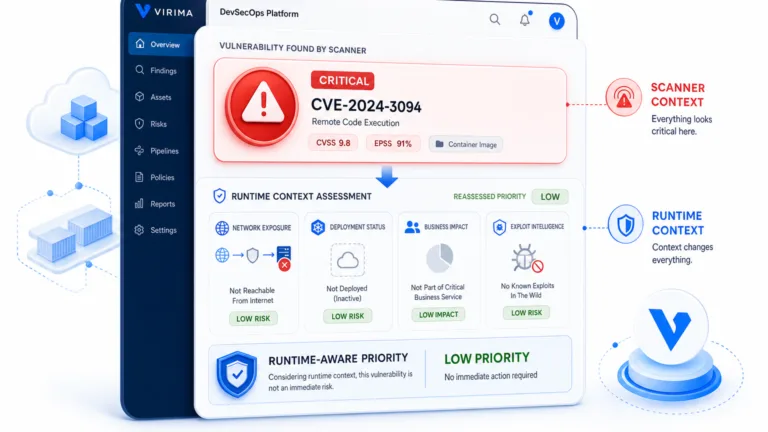
A finding attached to an asset with no durable record cannot be assigned cleanly or tracked to closure. A discovery-sourced configuration item (CI), one recorded item such as a server, an application, or a cloud account, carries an owner and last-seen date when those fields are maintained. Once your team defines a service, ViVID™ service maps can place vulnerability context on the affected assets against the service’s criticality. That placement is matching and prioritization support, not remediation.
Virima is not a vulnerability scanner and does not remediate. It supplies the estate record a scanner’s findings are matched to. For how asset visibility supports security work without replacing the scanner, see cybersecurity IT asset visibility and the CMDB.
Sovereign Tech: an exit strategy starts with a list of dependencies
Gartner frames Sovereign Tech as technology designed to offer realistic exit strategies from critical providers, and predicts that by 2030 over 75% of non-U.S. organizations will adopt digital sovereignty strategies. The estate question is which of our services depend on which provider, and which of those dependencies have no ready alternative.
Once your team defines a service, the dependency map shows which of your systems that service touches, including links that point at a provider’s platform on your side of the boundary. Exit planning then has a dated list with owners rather than a slide of assumptions.
The record shows your side of a vendor link. It does not see inside the provider’s platform, and it does not invent a second provider where none exists. Sovereignty programs still need legal, commercial, and architecture work; the map only makes the dependency list legible.
Disposable Applications: retiring software needs an owner and a list of dependents
Gartner describes Disposable Applications as software intentionally retired once its business purpose is fulfilled. The estate questions are who decides the purpose is complete, and what stops working when the application goes.
A durable record supplies lifecycle status, ownership on the CI, and timestamped history that can survive decommission when status is updated rather than deleted. Virima’s IT asset management capabilities include configurable status designations such as decommissioned, so retirement can be recorded as a state change with an accountable owner.
Retirement is a status on the record. Virima does not run an automated retirement or disposal workflow. Someone in the business still names the decision, the date, and the dependent services that must be rechecked before the lights go out.
AI Context Platforms: the operational half of context
Gartner positions AI Context Platforms as the layer that gives agents the contextual knowledge to interpret inputs and act in line with business goals. Coverage of Gartner’s context-layer framing that we reviewed lists semantics, operational data from business systems, and provenance. That coverage does not mention the IT estate or a CMDB.
The operational question stays open for any agent platform you shortlist. What does an agent read about the systems it is about to change? The CMDB and service map supply that operational half of context: what exists, how it connects, who owns it, and when it was last confirmed by discovery. Deeper treatment of that join lives in CMDB for AI agents and the agentic harness piece linked above.
A record is only as current as its last discovery scan. High-frequency scheduled discovery narrows the gap between change and confirmation; it does not freeze the estate in real time.
AI Agent Identity and the Agent Coding Harness touch the estate more lightly. Credentials map to systems, and generated code reaches infrastructure, so someone should still be able to list the assets involved. Virima does not manage identities or govern code. Those controls stay with identity platforms and engineering process.
A Question for Each Seat, Tied to a Trend
The same four trends raise different questions for different seats. Good evidence is dated, owned, and specific enough to survive a second pair of eyes.
| Seat | Trend it attaches to | The question | What good evidence looks like |
|---|---|---|---|
| Chief information officer (CIO) or vice president | Sovereign Tech | Which services depend on a provider we could not replace in a year? | A dated list with an owner per service |
| Chief technology officer (CTO) | AI Context Platforms | What does the agent read about our systems, and through which interface? | A named source with a last-seen date |
| Chief information security officer (CISO) | Autonomous Exposure Remediation | When a fix is queued, who owns the asset and what does it reach? | An owner and a dependency view on the finding |
| Information technology asset management (ITAM) leader | Disposable Applications | What is the lifecycle status of this application, and who signs off its retirement? | A status, an owner and a history |
| Compliance or governance, risk and compliance (GRC) leader | Autonomous Exposure Remediation and Disposable Applications | What shows what was fixed or retired, when, and by whom? | A timestamped record that survives decommission |
Gartner’s governance sessions have stressed making evidence building part of governance actions when things go wrong. That standard applies to any vendor you evaluate, including Virima. A CTO who asks which interface supplies system context, and how fresh the answer is, is doing the job the trends assume.
Where Virima Fits, and the Problem It Is Built to Solve
The pain is a trend list that demands decisions about assets, services, providers, and retirements, while the record behind those decisions lives in separate tools. Where discovery exports, spreadsheets, and ticketing systems do not reconcile cleanly, records go stale between scans, and ownership fields stay empty, each trend question starts as a research task. The configuration manager often carries that reconciliation without a standing executive mandate to keep one estate view current.
Virima supplies one estate record to read from. High-frequency scheduled discovery populates CIs with source and last-seen date in the CMDB. Once your team defines services, ViVID™ builds dependency maps and can overlay tickets, scheduled and recent changes, and vulnerability context on those maps from the service mapping path. Lifecycle status and ownership sit on asset records through ITAM. Two-way sync with information technology service management (ITSM) platforms such as ServiceNow, Jira Service Management, Ivanti, Halo, Xurrent, Hornbill, and TeamDynamix is available through the integrations hub. A Representational State Transfer application programming interface (REST API) exposes JSON create, read, and update paths with an API key and tenant ID issued by Virima.
At Symposium, Virima framed that package as Trusted Runtime Truth: infrastructure records joined to service dependencies, ownership, and change history so teams can move on trend work with a shared operational base. Read the category overview on Trusted Runtime Truth and the event context in the Booth 151 news release.
The record covers what discovery reaches. It does not see inside a vendor’s platform or cover operational technology such as plant or field equipment. Published cloud import paths called out here are Amazon Web Services and Microsoft Azure. Virima is not a scanner, an identity system, a compliance mechanism, or a GRC tool. Permissions and approvals stay with the teams and tools that own them.
A Short Memo to Take Back to Your Leadership Team
You can adapt a short note rather than a scorecard. Fill the brackets with your estate and calendar.
To [leadership team], from [name]. Gartner named ten strategic technology trends we should explore for 2027. [Trend A] and [Trend B] affect us first. Both depend on knowing what exists, who owns it, and what it touches, and today that record lives in [list of tools]. We will test one question on one named service by [date], with [name] as the single owner for that test. We will report whether the estate record answered the question without a side research project.
Keep the memo short enough to survive a leadership pack. One service, one question, one date, and one named owner beat a ten-trend summary that never lands.
See the Estate Record Behind These Trends
To see how Virima builds dependency maps from discovered infrastructure, use the service mapping overview already linked above. For a working session on your estate questions, request a demo.
Frequently Asked Questions
What are Gartner’s top strategic technology trends for 2027?
On 20 October 2026, Gartner named Large Quantitative Models, Speech Reasoning Models, World Models, AI Context Platforms, Agent Coding Harness, AI Agent Identity, Autonomous Exposure Remediation, Sovereign Tech, Disposable Applications, and Wetware as a Service.
Which Gartner 2027 trends need a configuration management database (CMDB)?
On Virima’s reading, Autonomous Exposure Remediation, Sovereign Tech, Disposable Applications, and AI Context Platforms need an estate record held in a configuration management database (CMDB). Gartner does not name the CMDB as a prerequisite for those trends.
What is an IT estate record in plain language?
An estate record is the dated view of what the information technology (IT) estate contains, who owns each item, and how items connect, limited to what discovery reaches. Each entry should carry a source and a last-seen date rather than an implied complete inventory.
Does Virima remediate vulnerabilities or govern AI agents?
Virima does not remediate vulnerabilities or govern artificial intelligence (AI) agents. It supplies discovery-sourced configuration items, ownership fields, and service dependency maps that scanners and agent platforms can match against. Remediation, identity control, and code governance stay with the tools and teams that own those jobs.
Where did Virima exhibit at Gartner IT Symposium/Xpo 2026?
Virima exhibited at Booth 151 during Gartner IT Symposium/Xpo 2026 in Orlando and published a news release on bringing Trusted Runtime Truth to the show floor for estate and dependency conversations.