Which Asset Management System Does IT Need: EAM, CMMS, or ITAM?

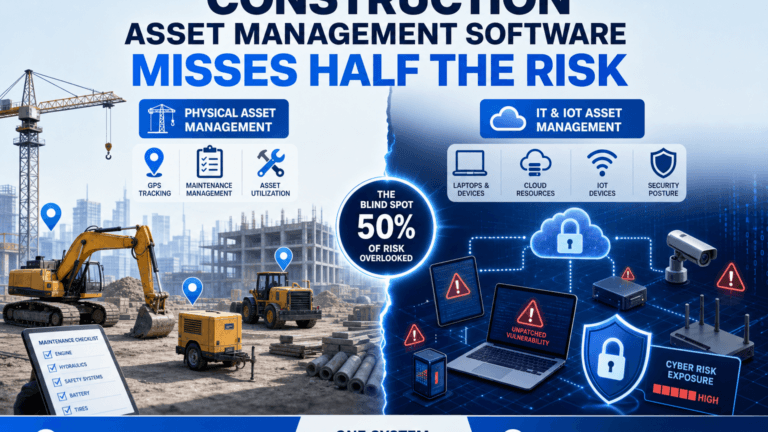
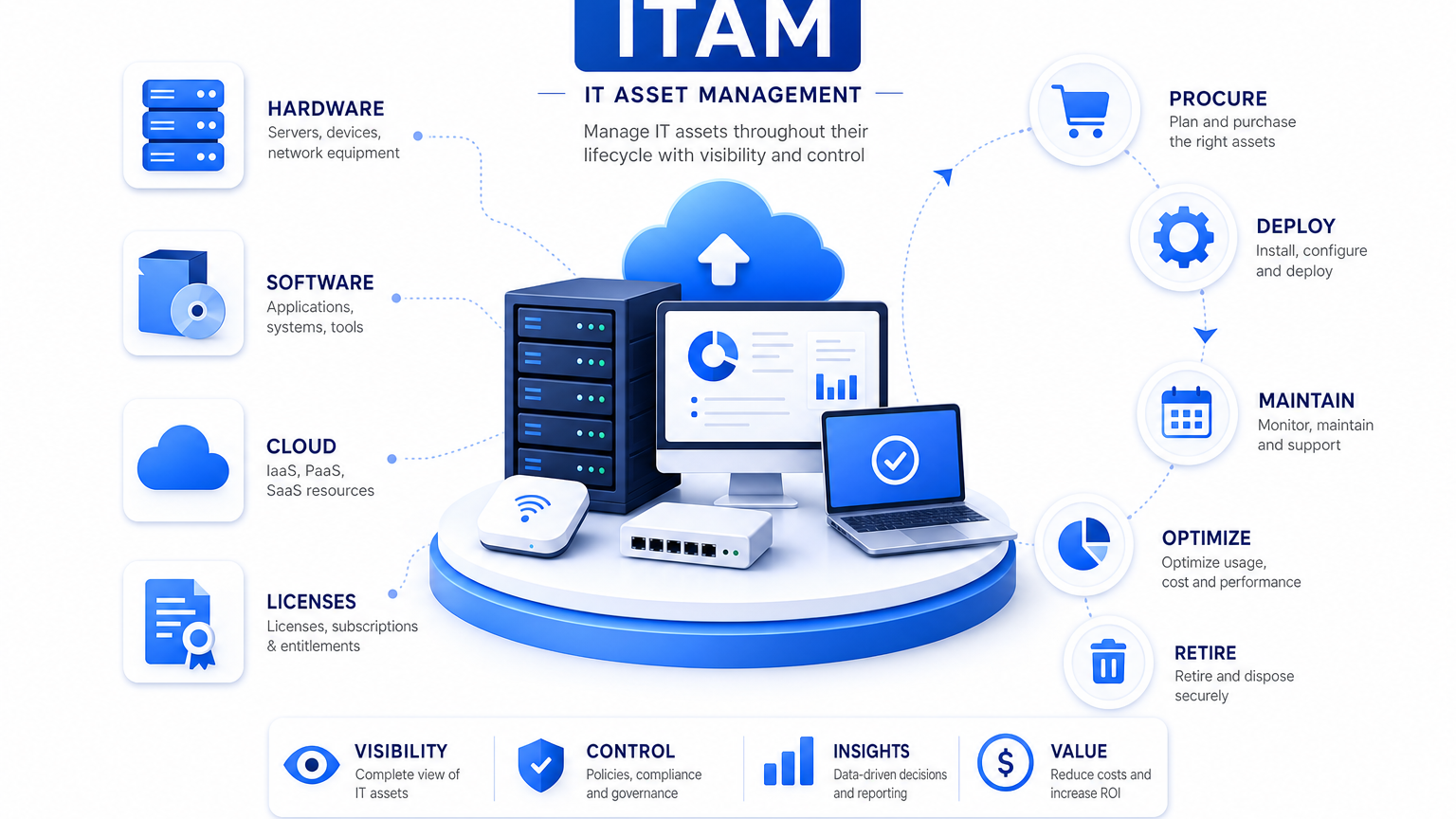
A software vendor sends an audit notice and asks for installs matched to purchased entitlements. The system holding your asset list was built to schedule pump repairs, so it holds no install data to match. That gap is the cost of picking an asset management system by acronym instead of by asset type. CMMS is maintenance-focused, covering work orders, preventive maintenance, and spare parts. EAM covers the broader lifecycle of physical assets, including planning, procurement, compliance, and retirement. ITAM covers IT assets, meaning hardware, software, cloud, and licenses, and it is what an IT team needs. This guide shows how the three differ and which stack IT should run.
One-paragraph definitions: EAM, CMMS, and ITAM
All three categories track assets, which is why buyers confuse them. Each one answers a different question for a different owner.
CMMS (computerized maintenance management system) handles work orders, preventive maintenance schedules, technician assignments, and spare-parts inventory. Maintenance teams use it to look up each machine, its service history, and the parts it needs. Its main question is what needs service next.
EAM (enterprise asset management) covers the broader lifecycle of physical assets. IBM describes EAM as the software, systems, and services that maintain and control operational assets across their lifecycle, from procurement to disposal. A CMMS often sits inside an EAM suite as the maintenance module. EAM adds planning, procurement, compliance, lifetime cost analysis, and retirement. Its main question is what each asset costs and delivers over its whole life.
ITAM (IT asset management) covers hardware, software, cloud resources, and licenses. It records what the organization owns, what it costs, and when each item reaches end of life. The guide to what ITAM is covers the practice in more depth. Its main question is whether licenses and contracts match what the company actually uses.
Why the three categories split
CMMS and EAM data models center on condition, downtime, and service intervals for machines that wear out. A software license has terms and a renewal date, and a cloud instance can disappear within a day. ITAM holds entitlements, installs, contracts, and lifecycle dates in one record.
What is the main difference between EAM, CMMS, and ITAM?
CMMS manages maintenance work such as work orders and spare parts. EAM manages the full lifecycle of physical operational assets, including planning, procurement, compliance, and retirement. ITAM manages IT hardware, software, cloud, and licenses. IT teams need ITAM because it tracks entitlements, costs, and lifecycle dates for technology assets.
Scope comparison table: EAM vs CMMS vs ITAM
This IT asset management system comparison breaks down scope, assets, owner, vendors, key data, and audit driver across the three categories.
| Attribute | CMMS | EAM | ITAM |
|---|---|---|---|
| Scope | Maintenance execution: work orders, preventive maintenance, spare parts | Full physical asset lifecycle: planning, procurement, maintenance, compliance, retirement | Full IT asset lifecycle: acquisition, deployment, licensing, renewal, disposal |
| Assets managed | Machines, vehicles, HVAC units, building equipment | Plants, fleets, production lines, facilities, energy infrastructure | Laptops, servers, network devices, software, cloud resources, licenses |
| Primary owner | Maintenance manager or facilities lead | Operations, plant, or asset management director | IT asset manager, IT operations, or procurement |
| Typical vendors | UpKeep, Fiix, Limble | IBM Maximo, Infor EAM, IFS, SAP | Virima, ServiceNow, Ivanti, Flexera |
| Key data | Service history, parts stock, technician time | Lifetime cost, utilization, compliance records | Installs, entitlements, contracts, warranty and end-of-life dates |
| Audit driver | Safety inspections and equipment certification | Regulatory and financial asset reporting | Software license compliance and vendor audits |
The audit row shows the sharpest split. A maintenance audit checks whether inspections happened on schedule. A software audit checks whether installed licenses match purchased entitlements. A system built for the first cannot evidence the second, because it collects no install data or contract terms.
The lifecycle fields overlap across all three: purchase date, cost, location, owner, and retirement date. That overlap explains why one vendor can sell all three modules. Buyers who want the lifecycle practice that sits above these systems can read the category map that adds ALM.
Overlap between ITAM and the CMDB
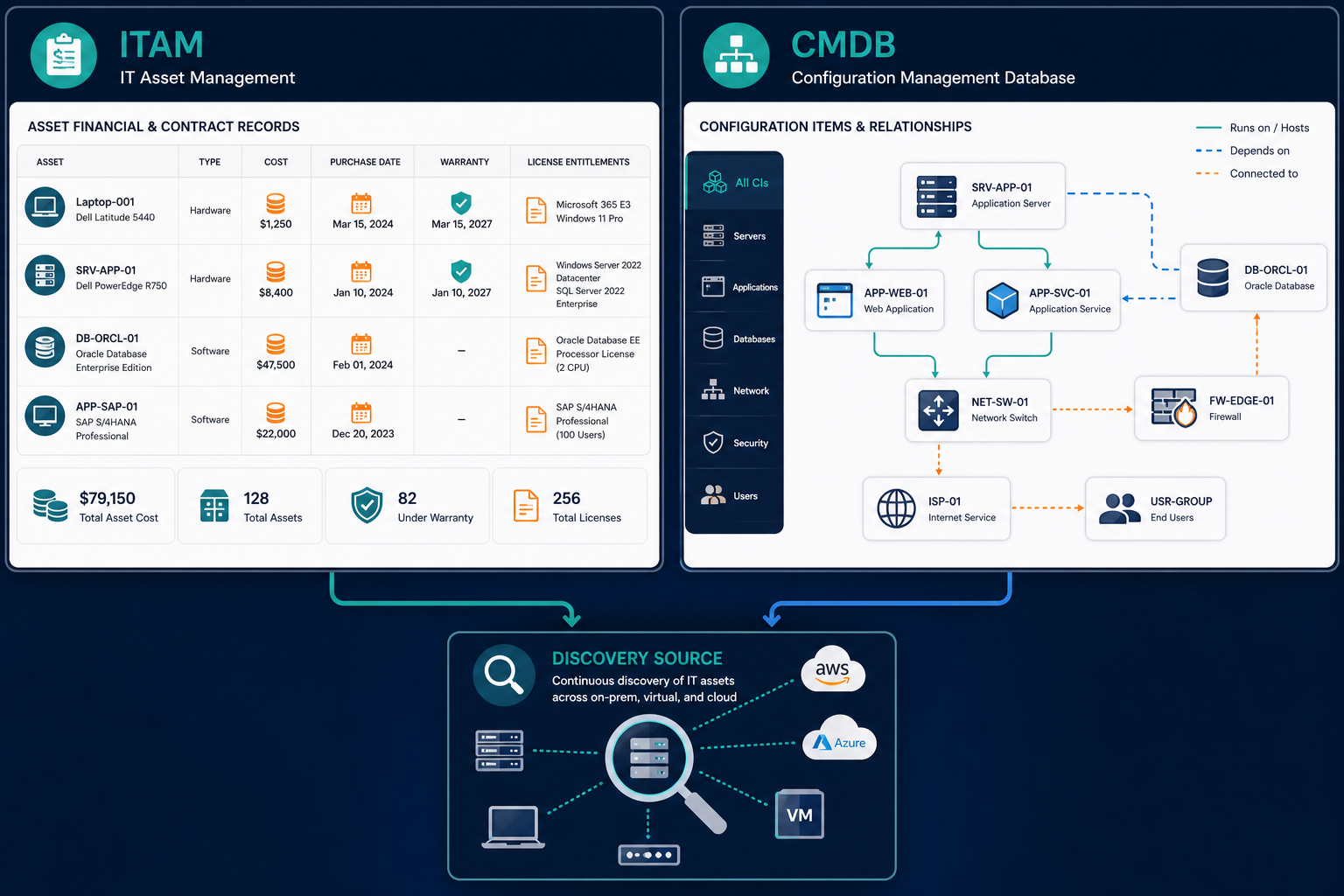
ITAM and the configuration management database (CMDB) both describe IT assets, so teams ask whether they need both. They answer different questions about one estate. ITAM records the financial and contractual side of an asset: cost, owner, purchase date, warranty, license entitlement, and disposal. The CMDB records the technical side: configuration items, their relationships, and which services depend on them.
A server shows the split clearly. ITAM holds its purchase order, warranty expiry, and depreciation schedule. The CMDB holds the applications that run on it, the database it connects to, and the business service that fails if it goes down.
ITAM vs CMDB: what’s the difference?
ITAM tracks the financial and contractual record of an IT asset, including cost, owner, warranty, and license entitlement. A CMDB tracks the technical record, including configuration items, relationships, and dependent services. Both draw on the same inventory, so they stay accurate when one discovery source feeds them.
Both records start from the same source. Discovery gathers hardware, software, and cloud data on scheduled cycles, and that data feeds both views.
When sources disagree, the records drift apart. A decommissioned host stays active in the CMDB while ITAM still counts its license. Reconciling both against one discovery source removes that gap.
How each record improves the other
ITAM fields such as asset owner, lifecycle status, and warranty end date improve CMDB records directly. A change manager reviewing a patch window can see that a server is out of warranty and nearing end of support.
CMDB relationships, visualized through Virima’s ViVID™ service maps, improve ITAM in return. They show which applications use which licensed software, so a license manager can spot a database engine running on a host from a retired project. Reclaiming that license becomes a concrete action with a named owner. Virima’s ITAM capabilities and its CMDB share discovery data for this reason.
When IT still touches EAM and CMMS territory
IT teams rarely own an EAM or CMMS, yet their assets show up in those systems more often than expected. Hospitals, manufacturers, and utilities run networked equipment that sits in both worlds. A connected infusion pump or a factory-floor sensor gateway has both a maintenance schedule and an IP address.
The facilities or biomedical team owns the maintenance record in the CMMS or EAM. IT owns the network identity, patch status, and security exposure of the same device.
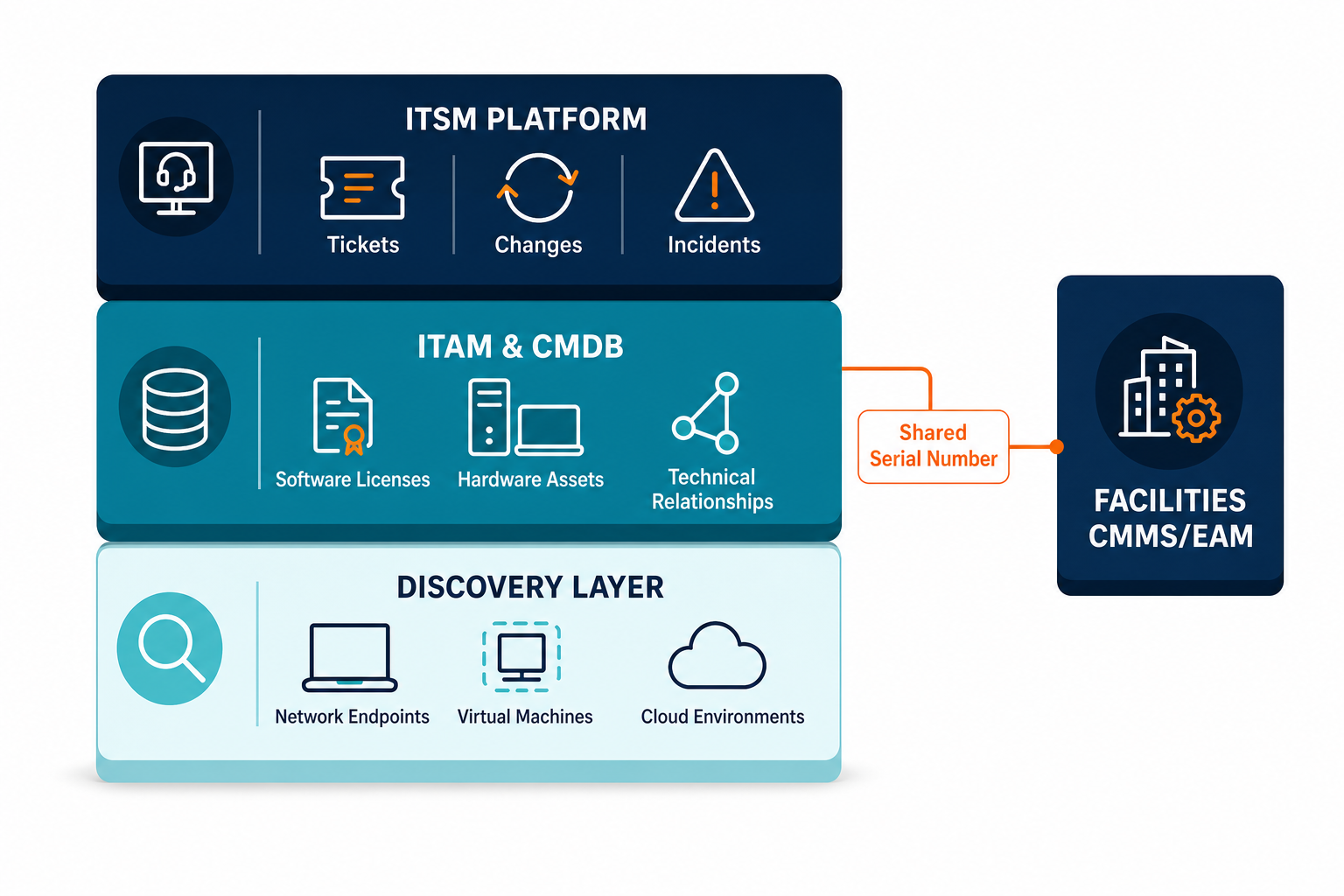
Both teams benefit from a shared asset identifier such as the serial number, so one device does not appear as two unrelated records. Hostnames change too often to serve as a reliable join key. Hospitals show this clearly, since clinical, biomedical, facilities, and IT assets coexist in one environment.
Shield your organization from audit exposure with discovery-sourced Trusted Runtime Truth for IT assets.
Explore Trusted Runtime TruthWhich tool stack IT teams actually need
Most IT teams need ITAM as the core system and a CMDB beside it, both running on a shared discovery layer. EAM and CMMS matter only when IT supports physical, maintenance-driven equipment outside the data center. For laptops, servers, network gear, software, and cloud resources, choose ITAM for the full inventory. For software audits or renewal negotiations, choose ITAM with license management. For questions about which services break when a server fails, add a CMDB with service mapping. For plants, fleets, or production equipment, operations needs EAM or CMMS, with IT connecting through a shared identifier. The same pairing holds whether IT sits inside a software company or a hospital running EAM or CMMS in parallel. For technicians scheduling preventive maintenance on machinery, operations needs a CMMS.
The core layer: ITAM, CMDB, and discovery
The foundation of an IT stack is a trustworthy list of what exists. Discovery supplies that list by scanning endpoints, networks, virtual machines, and AWS and Azure environments on a schedule. ITAM turns the list into financial and contractual records, and the CMDB turns the same list into a relationship map. Without discovery, both records depend on manual updates and fall behind the real estate.
Which asset management system does an IT team need?
An IT team needs ITAM as its core asset management system, paired with a CMDB and a discovery source. ITAM covers hardware, software, cloud, and licenses. EAM and CMMS fit physical plant and facilities equipment, and IT adds them only when it owns maintenance-driven assets such as data center power and cooling.
The workflow layer: ITSM
Tickets, changes, and incidents live in an ITSM platform. Asset and configuration data should reach that platform so analysts see ownership and dependencies while they work. Virima integrates with ServiceNow, Jira, Ivanti, HaloITSM, Xurrent, Hornbill, and TeamDynamix, and the integrations hub lists every supported partner.
The optional layer: CMMS or EAM
IT adds a CMMS or EAM only when it owns physical equipment with maintenance schedules, such as data center power and cooling. Facilities usually owns that system already, so IT typically needs read access or a shared identifier rather than its own license.
What to ask vendors before you buy
Ask each vendor which asset types it tracks by default, whether license data comes from discovery or manual entry, and how it reconciles records when two sources report the same device. A CMMS vendor answers in equipment and work-order terms, while an ITAM vendor answers in installs, entitlements, and lifecycle dates. The answer shows which category you’re actually evaluating.
Signs IT bought the wrong category
A wrong choice shows up in daily work well before the next audit. Five symptoms point to a category mismatch:
- Work-order screens sit unused. IT staff never open the maintenance modules, so only facilities benefit from the system.
- License counts live in spreadsheets. The tool holds no entitlements or installs, so renewals rely on manual tallies.
- The CMDB has no financial fields. Configuration items carry no owner, cost, or warranty, so finance cannot reconcile them.
- One device has two records. Facilities and IT track the same hardware under different identifiers.
- Audit prep needs a manual export. The system cannot match installs to entitlements without a person assembling the evidence.
Each symptom has the same fix. Move the IT estate into an ITAM system fed by discovery, and leave maintenance with the team that schedules the work.
Choose the category that matches your assets
EAM and CMMS manage physical equipment and the maintenance that keeps it running. ITAM manages the technology estate and the contracts, licenses, and lifecycle dates attached to it. IT teams get the most value from ITAM and a CMDB working from one discovery source, because that pairing answers both what the company owns and what depends on it.
Teams ready to compare their current asset records against discovered data can book a personalized demo to see how Virima correlates entitlements with live asset consumption.
Frequently Asked Questions
Is ITAM considered a subset of EAM?
ITAM is often described as a specialized branch of enterprise asset management, since both cover the asset lifecycle. In practice, they run as separate systems. EAM centers on physical operational equipment and maintenance. ITAM centers on hardware, software, cloud, and license data, which needs discovery and entitlement tracking that EAM suites rarely include.
Can a single tool handle EAM, CMMS, and ITAM?
Some large suites cover all three through separate modules. Coverage in each area varies, so a suite built around plant maintenance usually has thinner software license and discovery features. Evaluate each module against the team that will use it, and confirm the ITAM module supports discovery, license reconciliation, and lifecycle tracking.
Do IT teams ever need a CMMS?
IT teams need a CMMS when they own physical infrastructure that follows a maintenance schedule, such as data center cooling, power distribution, or UPS batteries. Most IT groups hand this work to facilities, which runs it in its own CMMS. IT then links to those records through shared asset identifiers.
How are fixed assets handled in ITAM?
ITAM records the cost, purchase date, and depreciation details for IT hardware that finance classifies as fixed assets. Virima tracks asset cost, depreciation, and value across the lifecycle. Finance keeps the official fixed asset register and general ledger. ITAM supplies the verified inventory behind it, so the register matches the devices that exist.
Does Virima replace a CMMS or EAM system?
Virima covers IT assets through discovery, ITAM, and a CMDB. It does not schedule technician work orders or manage spare-parts stock for plant equipment. Organizations with maintenance-driven assets keep their CMMS or EAM for that work and share device identifiers with the IT asset record.