Why Does Your Agent Harness Still Lack an Enterprise View? A CMDB Context Layer Fixes the Gap

The agent enterprise view is the question to carry into Gartner Symposium this week: what does an agent read about your estate before it acts? For many teams, that answer has to include a configuration management database (CMDB), and a service map for the people supervising the agent.
Gartner predicts that over 40% of agentic artificial intelligence (AI) projects will be canceled by the end of 2027 because of escalating costs, unclear business value, or inadequate risk controls. Anushree Verma, Senior Director Analyst at Gartner, framed many current efforts as early experiments driven by hype. Deloitte surveyed 3,235 information technology (IT) and business leaders across 24 countries for its 2026 State of AI in the Enterprise report and found that only 21% say their organization has a mature governance model for agentic AI.
Risk controls often sit in the agent harness as permissions and approvals. What the agent can look up about the estate it is about to touch sits somewhere else. That recorded lookup is the enterprise view in this article: the view of the estate that discovery reaches, with each record’s source and last-seen date. It is a scoped read of assets, services, owners, and changes, bounded by what your discovery coverage includes.
Gartner IT Symposium/Xpo 2026 runs 19 to 22 October in Orlando, with more than 7,000 chief information officers (CIOs) and senior leaders expected across 350-plus sessions, according to Gartner’s July 2026 announcement. The agenda includes a listed session on the Hype Cycle for Agentic AI 2026. This post is a field brief for leaders walking those halls. It explains what belongs in the harness’s estate context slot, how a CMDB and service map share that read path, and which questions each seat at the table can ask this week. Gartner, Deloitte, and the other firms cited here publish research; Virima is an exhibitor at the show. None of the citations is an endorsement of Virima or of this argument.
What an Agent Harness Holds, and the Slot Most Leave Thin
A harness gives an AI model its tools, memory, and guardrails, and a place to hold context. That context slot is often filled with data definitions and business rules. Operational context about the IT estate is frequently thin or missing.
One published definition helps set terms. Gradial’s August 2026 guide describes an agentic harness as the scaffolding around an AI model and its agents, and lists tools, integrations, context, memory, workspace, and guardrails. The term is still settling across vendors, so treat that list as one clear published frame rather than a final industry standard.
Context for agents is a wider industry topic. As reported by Mexico Business News in July 2026, Gartner has described the context layer as foundational for AI success, covering semantics such as ontologies, knowledge graphs, metadata, policies, and business rules, plus operational data from business systems and provenance for decisions. The coverage reviewed for this article does not mention a CMDB or IT operations estate map as a required component. That gap is the operational slot many harness designs still leave thin.
Adoption pressure is already visible in the same Deloitte survey. Seventy-four percent of respondents expect their companies to use AI agents at least moderately by 2027, while only 21% report a mature governance model for agentic AI. Permissions and monitoring close part of that gap. Permissions alone still leave open which servers, applications, cloud accounts, and services exist, how they connect, who owns them, and what changed on them last. Those four facts are the enterprise view scoped to discovery coverage.
If you need the longer requirements checklist for CMDB readiness, Virima’s guide on CMDB for AI agents stays on that lane. This post stays on the read path you can walk at the booth and in your next internal meeting.
CMDB for agentic harness, in five lookups
Before an agent restarts, patches, isolates, or changes anything, five lookups matter: what exists, how it connects, what changed, what could break, and who owns it. A CMDB record and a service map split that list between them.
| Lookup | Held by the CMDB record | Held by the service map (read by people and workflows) | What the agent lacks without it |
|---|---|---|---|
| What exists | Discovered configuration items (CIs) with source and last-seen date | Nodes in the map | A target it cannot identify |
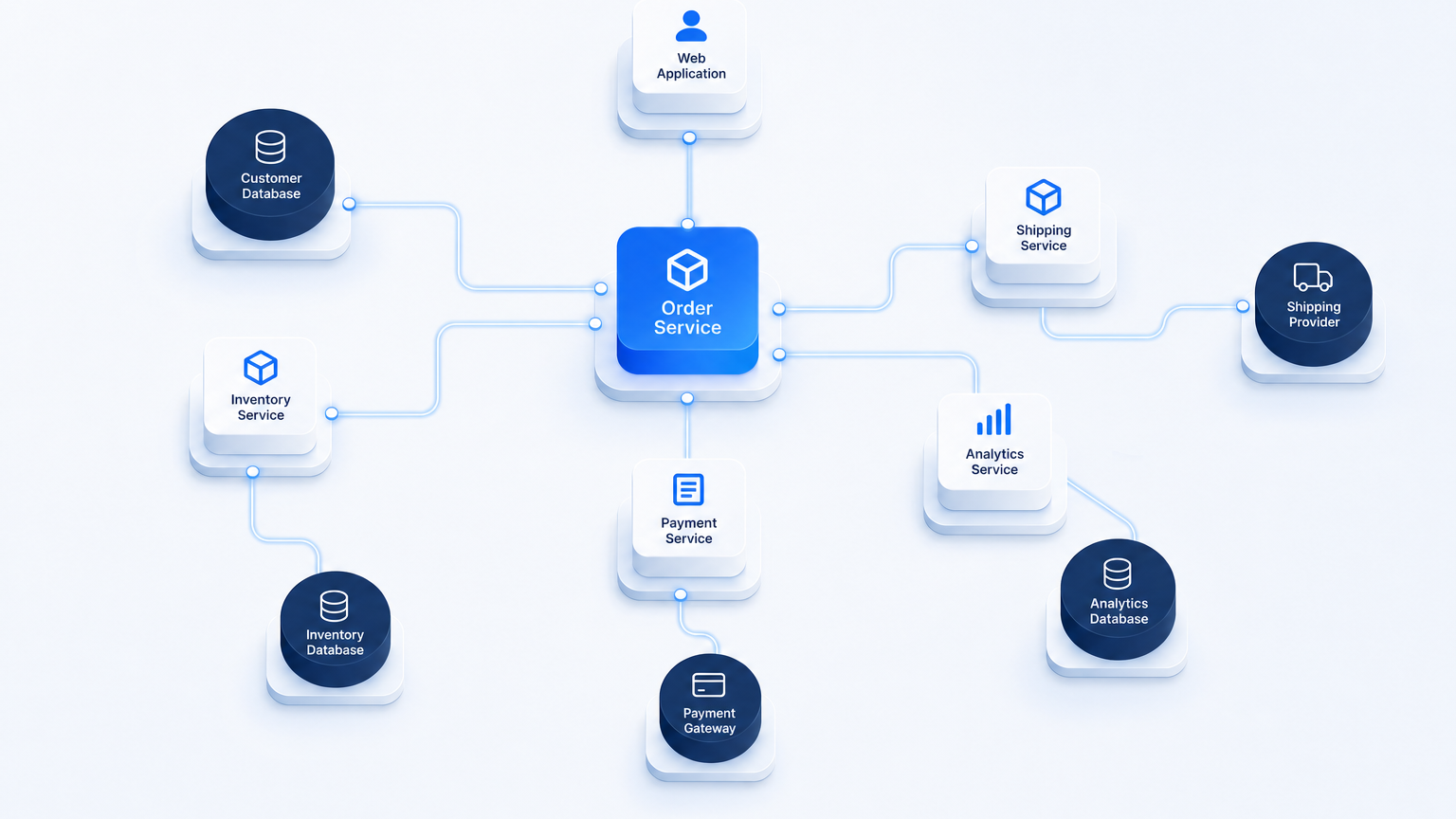
| How it connects | Relationship records | The dependency structure built from discovery data | What sits upstream and downstream |
| What changed | Timestamped history on the CI | Recent changes shown within the dependency chain | Whether the target was recently altered |
| What could break | The CI alone does not carry reach | Open tickets, scheduled changes, and vulnerabilities overlaid on the service context | The reach of an action |
| Who owns it | Owner field on the record | Owner shown in service context | Whom to ask or notify |
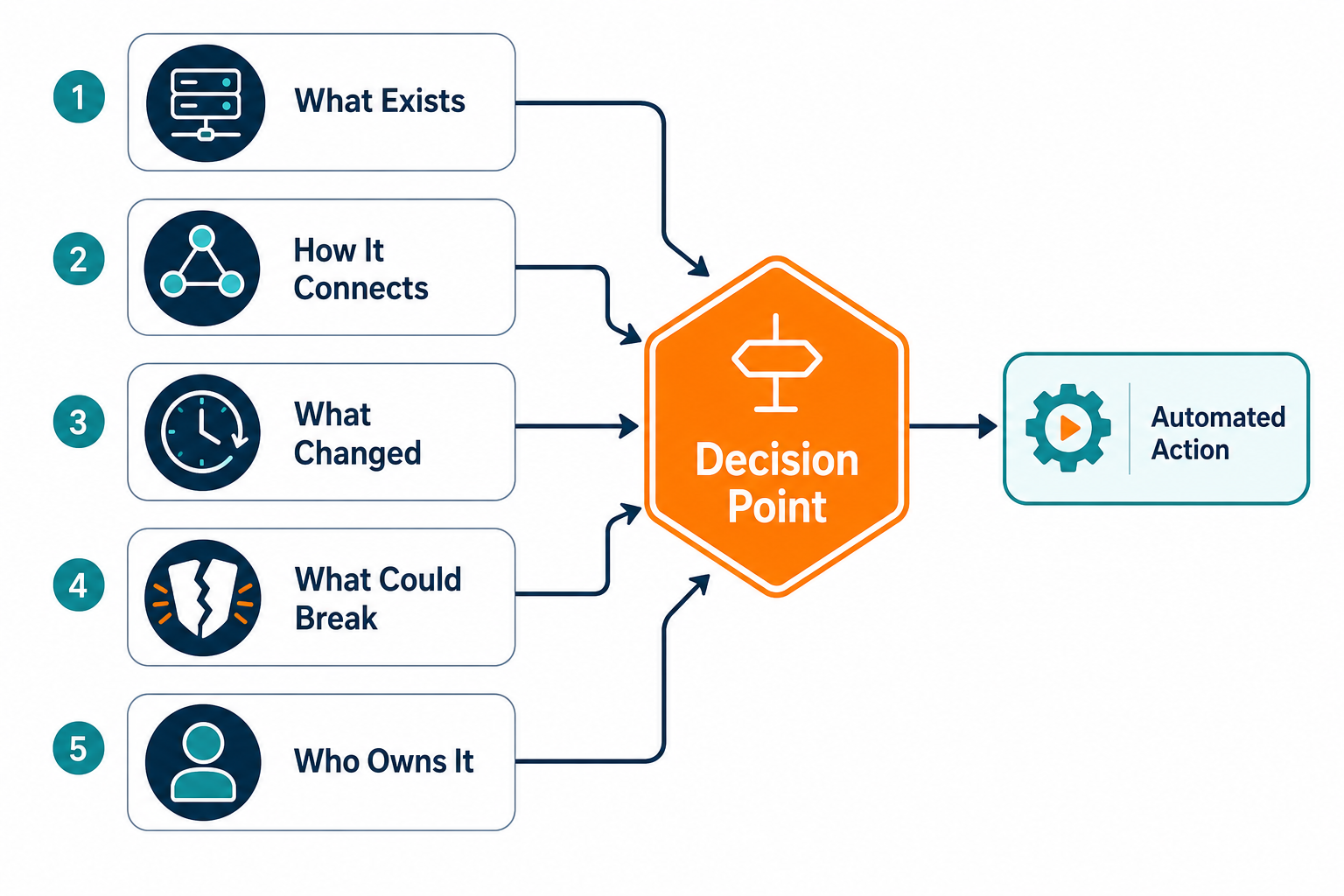
Records answer what the item is and who owns it. The map answers what the item touches. Together they form one read path, with one difference in who can read each part. CMDB records are the machine-readable layer, and the service map is a read surface for people and workflows. That split shapes what belongs in the agent harness context slot.
The read happens before the action. How any specific harness calls that read will differ by product. The design goal is the same: supply a recorded state view before a consequential step: CMDB records for the agent, and records plus the service map for the human supervisor.
Honest limits sit inside the design. Service maps depend on scheduled discovery and on service definitions your team supplies. Discovery refreshes on a schedule your operators set. Maps stay as complete as those inputs. For the product surface of each layer, see Virima’s CMDB, service mapping, and IT discovery pages.
One change, read off one map
Pick one change already on your calendar and read it from a service map in four steps. This is a reading guide for your own estate. It is a method, with no invented company and no invented outage.
- Dependency. Name the business service that matters for the change. On ViVID™, your team defines services once in the product screens or by importing a comma-separated values (CSV) file; ViVID™ then builds the dependency structure from discovery data for those definitions.
- Blast radius. Read open tickets on components inside that map. Read vulnerabilities overlaid on affected assets with the service’s criticality in view. Read approved changes already scheduled on configuration items in the same service context. Those overlays turn a static graph into a decision surface for change management.
- Change history. Read what changed on the target item and where that item sits in the dependency chain. Timestamped history on the configuration item shows changes recorded as of the last scan, so you can see whether the target moved since the last planning meeting, up to that scan.
- Owner. Read who owns the item and every related item the map shows around it. Ownership turns a technical path into an escalation path.
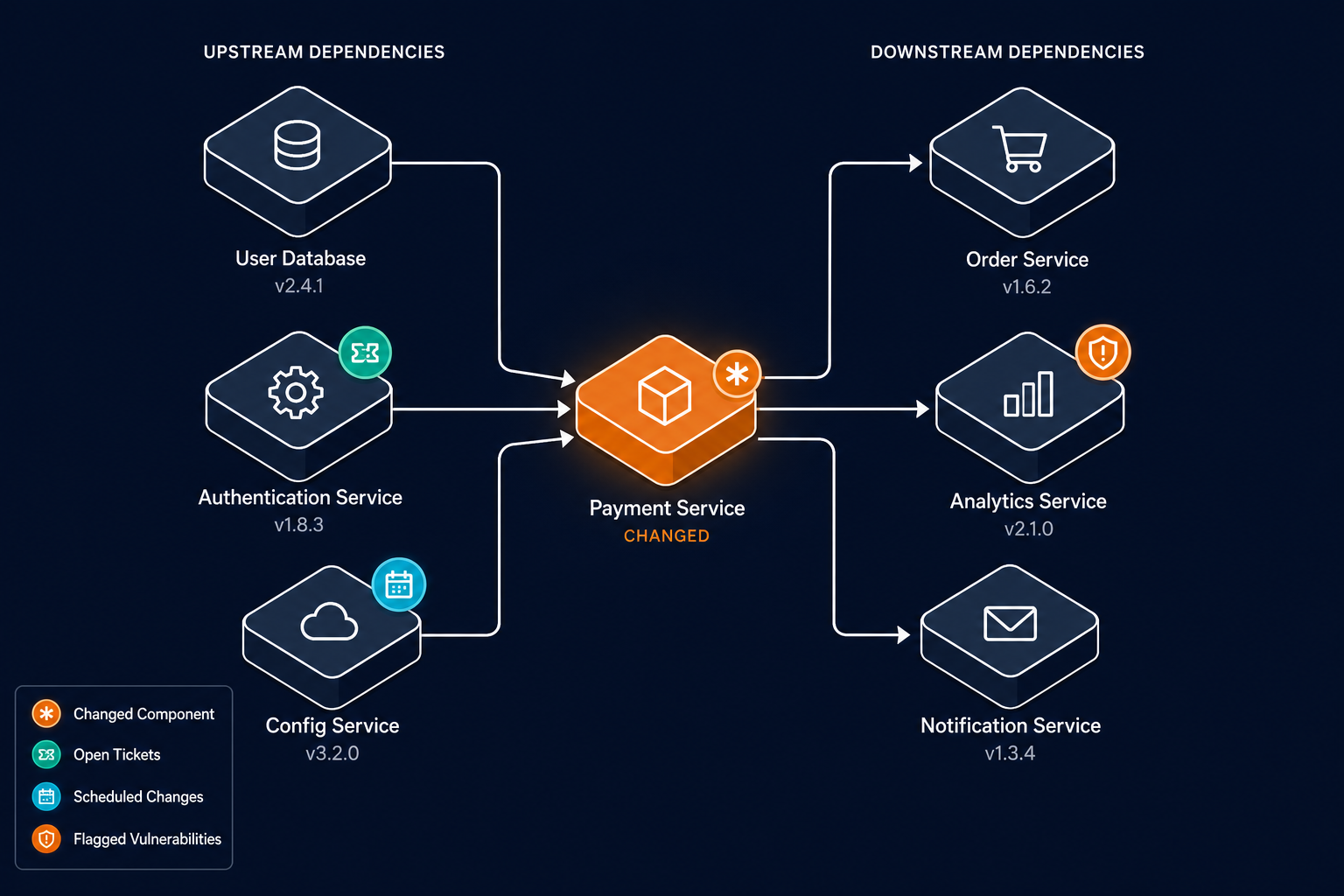
After those four reads, the booth question “What does this change actually touch?” becomes a lookup on recorded data. That is the enterprise view in use on one change.
State the limits in the same breath. The map is only as complete as the service definitions and discovery behind it. The map stops at the edge of a vendor’s closed platform. Agent permission and approval stay in the harness. The map supplies the reach and ownership context those controls should consult. If you want to run this exercise on your own estate before Orlando, CMDB for AI agents is the place to start.
Where Virima fits: what it supplies and where it stops
Virima supplies discovery-sourced records, ViVID™ service maps, and two-way sync with ticketing tools as the recorded estate an agent or operator can read. Agent control, permissions, and release authority stay outside Virima.
| Layer | Published capability |
|---|---|
| Records | Discovered CIs with source and last-seen date, multi-source reconciliation, and timestamped history, refreshed through scheduled discovery at intervals your operators set. |
| Maps | ViVID™ dependency maps built from discovery data after your team defines services, with overlays for tickets, scheduled and recent changes, and vulnerabilities. |
| Ticketing sync | Two-way sync with information technology service management (ITSM) platforms including ServiceNow, Jira Service Management, Ivanti, Halo, Xurrent, Hornbill, and TeamDynamix. |
| Programming interface | Representational State Transfer application programming interface (REST API) documented for CMDB-oriented JSON reads and writes using GET, POST, and PATCH with an API key and tenant ID issued by Virima. |
Virima’s Trusted Runtime Truth links infrastructure records to service dependencies, ownership, and change history so teams and AI-enabled workflows share a clearer, explainable view of the estate. The category page is the first place to go when you want the positioning in full. Deeper agent-data framing also lives on Virima’s post about why AI agents need trusted runtime truth.
For integration patterns beyond the ITSM list above, the published REST API overview covers how external systems read and update CMDB records. Until your product team confirms map export paths for a given harness, treat the map as a human and workflow read surface, and treat CMDB records as the documented machine-readable layer.
Virima supplies the recorded view an agent reads. Permissions and guardrails stay in the harness. The record covers what discovery reaches. The record stops at the edge of a vendor’s closed platform. Operational technology (OT) such as plant, field, or network-core equipment sits outside IT discovery scope unless you have separate coverage. Published cloud integrations for discovery focus on Amazon Web Services and Microsoft Azure. Discovery runs on schedules your operators set, so a record is as current as its last scan. Virima is an estate-truth layer for IT operations. It is separate from a full governance, risk and compliance (GRC) control suite.
One question for each seat at the table
A vendor that says its agent understands your environment can be asked where that understanding is read from. These questions are booth conversation design for Orlando.
| Seat | The question | A concrete answer sounds like | A thin answer sounds like |
|---|---|---|---|
| CIO or vice president | Which decision will this agent make, and what does it read before it makes it? | Named decision class, named data sources, named freshness rule | “It has full context on your stack” |
| Chief technology officer (CTO) | Where does that read come from, through which interface, and how old can the record be? | Named system of record, interface type, maximum age before block | “Our model is trained on enterprise data” |
| Chief information security officer (CISO) | What is missing from the agent’s view of an asset, and who finds out when an unmanaged item is touched? | Gap list, alert path, owner for unmanaged hits | “We keep risk scanning always on” |
| Information technology asset management (ITAM) leader | Does the agent’s view match the asset register, with an owner and lifecycle state for each item? | Join keys, lifecycle fields, reconciliation rule | “Assets are covered in the model” |
| Compliance or GRC leader | What evidence shows what the agent read before it acted, and who can retrieve it? | Stored read log, retention, retrieval owner | “We keep full auditability” |
Why access controls still matter
Access control and team coordination still matter besides estate view. Baker Donelson’s summary of IBM’s 2026 Cost of a Data Breach report states that among organizations with an AI-related incident, 92% lacked proper AI access controls, and only 19% reported coordination between governance and security teams. IBM publishes the underlying research program on its Cost of a Data Breach hub. Those figures concern access controls and coordination. The enterprise view is a separate lookup about estate truth. Access controls and estate truth both matter before agents scale.
Gartner’s APAC Symposium coverage on 14 September 2026 captured a governance session takeaway from Svetlana Sicular, VP Analyst: make evidence-building a key part of governance actions when things go wrong. That line is a useful prompt for the GRC seat at your table. The same APAC Day 1 notes and Gartner’s June 2025 agentic AI release also document “agent washing,” where vendors rebrand existing capabilities as agents without substantial agentic function. Hard questions stay in order on the show floor.
Bringing these questions to Booth 151
Attendees can bring questions such as what a change actually touches and which source to trust for an asset, the same prompts Virima outlined for Symposium 2026. At Booth 151, Virima will show CMDB, IT discovery, ViVID™ service mapping, and impact assessment. You can bring one change or one service to walk on a map. Plan for a walkthrough on sample or demo data rather than a live import of your production estate on the floor. The same five seat questions apply to Virima. For the CISO and GRC questions, read logging and alerting on unmanaged items sit in your harness and security tooling, not in Virima. Welcome that skepticism at the booth.
For seat-specific depth after the show, ITAM leaders can use the ITAM feature overview, security leaders can use the IT asset visibility and CMDB security angle, and GRC-minded readers can use the reporting and auditing use case.
A one-page brief to take back to your team
Leave Orlando with a one-page decision brief instead of a loose pile of session notes. Fill in each line after one booth conversation or one internal walkthrough of a single change.
| Line | What you write |
|---|---|
| The agent use case we are evaluating | |
| The change or service we tested the read path on | |
| Who owns it, and where that is recorded | |
| What the map showed us and what it missed | |
| The one lookup we cannot yet answer, and who needs it (CISO, ITAM, GRC) | |
| The owner and date of the next conversation |
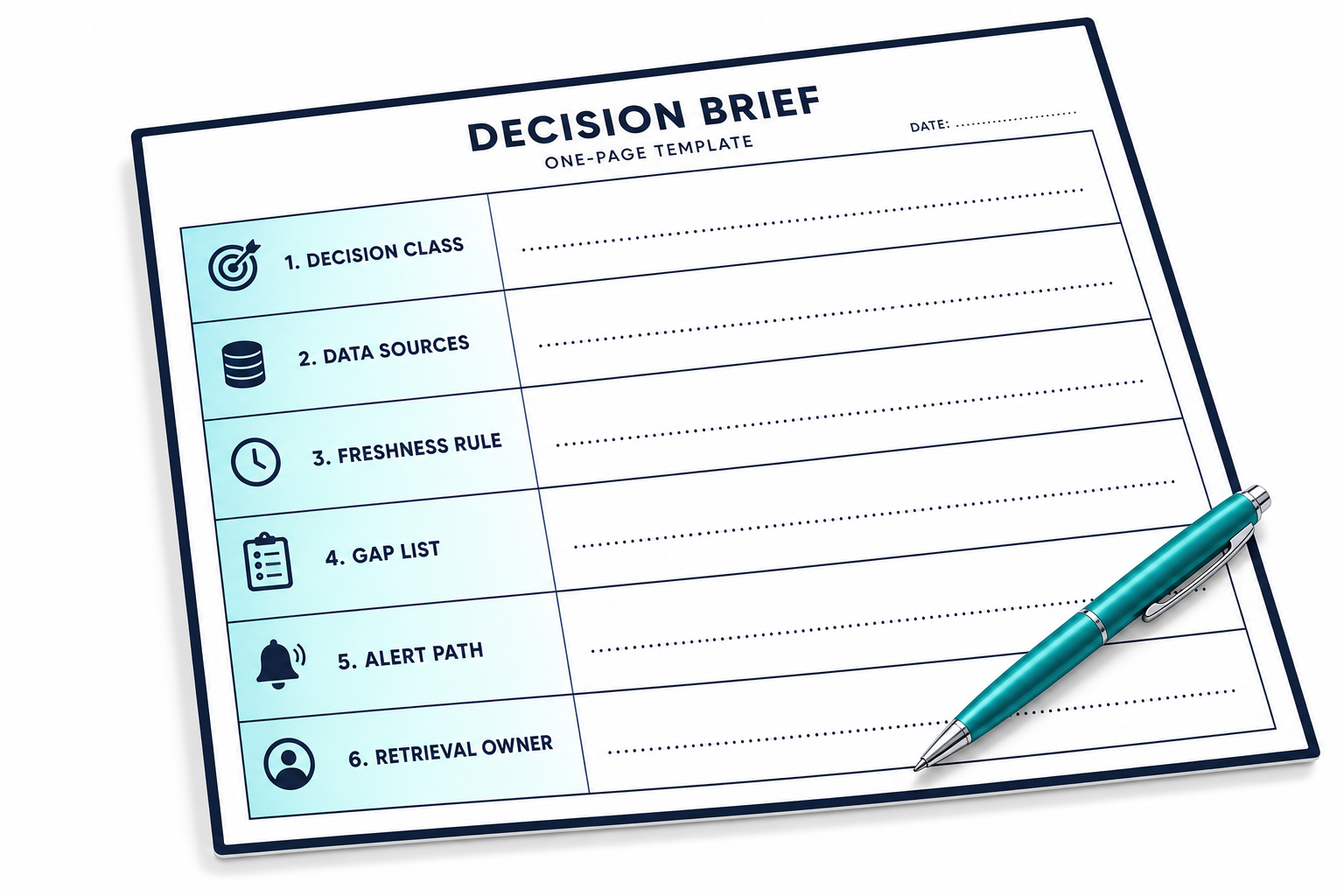
Date the brief on the day you write it. Assign one owner for the next meeting. The page is complete when every blank has a named person or a clear “unknown” with a follow-up date.
Come See Us at This Event
The show runs 19 to 22 October 2026 at the Walt Disney World Swan and Dolphin Resort in Orlando, Florida. Bring one change or one service you want to read off a map, or walk up to Booth 151 during exhibit hours.
Meet Virima at Booth 151 at Gartner IT Symposium/Xpo 2026 in Orlando. Book a walkthrough slot on the event page before you hit the floor.
View Event PageFrequently Asked Questions
What is an agent harness?
One published definition calls an agent harness the scaffolding around an artificial intelligence model with tools, integrations, context, memory, workspace, and guardrails. The term is still settling, so definitions vary by vendor and source.
Is a configuration management database the same as a context layer?
A configuration management database is one source for the operational part of a context layer. Data context such as vocabulary, lineage, and business semantics usually comes from other systems. Estate truth and semantic context work together.
Does ViVID service mapping find services on its own?
Your team defines services in the Virima screens or by importing a comma-separated values file. ViVID™ then builds the dependency structure from discovery data for those service definitions. Service composition is a team input.
Can a configuration management database make an AI agent act correctly?
A configuration management database supplies a recorded view to read before action. Permissions, approvals, and guardrails stay in the agent harness. The record is only as current as its last discovery scan cycle.
Where and when can I meet Virima at Gartner IT Symposium/Xpo 2026?
Virima is at Booth 151 from 19 to 22 October 2026 at the Walt Disney World Swan and Dolphin Resort in Orlando. Use the event page form to book time, or walk up during exhibit hours.