Fixing Endpoint Inventory for Contractor-Heavy IT Teams

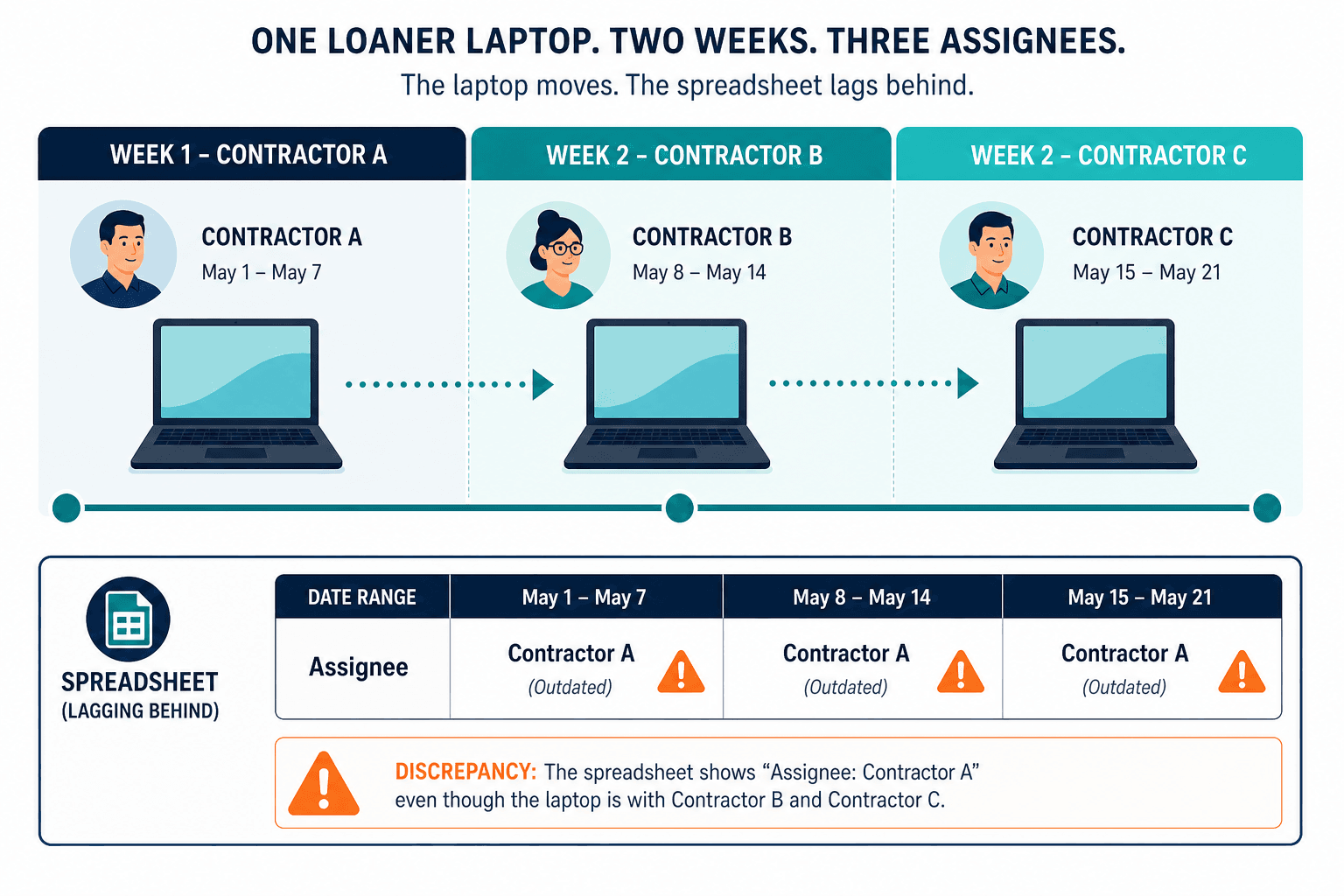
Monday morning. Three contractors finished Friday. Two new ones start with loaner laptops. The FTE headcount on the org chart barely moved. The endpoint count did.
The sheet still lists last month’s assignees. Change opens on a service that one of those loaners still holds. Nobody can prove which serial sits with which person, or whether the device that left the building is still on the network.
That is the failure mode for endpoint inventory for contractor-heavy IT teams. Staffing stays lean. Devices and temporary workers rotate faster than any manual list can keep up.
Why contractor churn breaks endpoint inventory first
Full-time fleets change on hire and exit cycles that HR and IT can schedule. Contractor endpoints change on project gates, weekend cutovers, and last-day returns that often skip the same checklist.
A 2026 Teqtivity report on device handoffs studied mid-market contractor fleets.
Permanent employees return hardware at offboarding 97% of the time. Remote, project-based contractors return it only 66% of the time. That 31-point gap is exactly what a manual sheet misses, since nobody rechecks a closed row until an audit or an incident forces the question.
The inventory problem is not “more laptops.” It is more assignment events per week against the same small ops bench. A row that was true on Tuesday is wrong by Thursday when the device moved twice and the sheet moved once.
Growing teams already feel spreadsheet drift on steady fleets. Contractor-heavy estates accelerate that drift because identity of the person and identity of the device change on different clocks. A contractor endpoint inventory built on manual updates can’t keep pace with that mismatch. For the general Excel-as-truth path, see computer inventory software for growing IT teams. This article stays on the contractor rotation path only.
What is endpoint inventory for contractor-heavy IT teams?
It is a discovery-backed record of laptops, desktops, and related endpoints used by temporary and rotating workers, joined on durable device identity such as serial number or cloud instance ID, with current assignee and last-seen so change and offboarding can trust the row.
What breaks when people move faster than the sheet
A rotating contractor laptop inventory surfaces these problems faster than a stable fleet ever would. Four failure modes show up in the first year of heavy contractor use.
Assignee lag. The person field updates after the ticket closes, if it updates at all. The device already sits with someone else.
Ghost returns. A loaner is marked returned in chat. Discovery still detects it on VPN or Wi-Fi three days later, so the sheet shows one state while the network reports another.
Duplicate rows on rebuild. A contractor laptop is reimaged between projects. Without a durable serial or cloud instance ID, the next scan creates a second CI instead of updating the first. Hostname alone is not a durable join key across rebuilds and reassignment.
Offboarding without a device close. Access is revoked in the directory. The endpoint row still shows “in use” with no retire or quarantine state. This is the single most common breakdown in contractor offboarding device inventory practice: access closes, but the device record doesn’t. Audit samples fail on devices, not on user accounts. A 2025 Oomnitza survey found that 27% of enterprises lose technology assets outright when offboarding workers. The devices that don’t disappear often sit in this same open state instead — invisible until the next audit. The same hardware-lifecycle blind spot shows up across device categories industry-wide; see Virima’s breakdown of where hardware lifecycle tracking fails.
Fixing all four comes down to the same mechanism: discovery on a scheduled cycle, reconciled against durable device identity — not who last edited a cell.
Scorecard for contractor-ready endpoint inventory
Use enterprise criteria. Lean headcount is the operating constraint, not a reason to drop fields.
| Check | Pass signal | Fail signal |
|---|---|---|
| Discovery under the list | Agent, agentless, or API discovery on high-frequency scheduled cycles | Manual row entry only after each contractor start |
| Durable device identity | Serial number or cloud instance ID survives reimage and reassignment | Hostname or “loaner-03” label as the only key |
| Assignee currency | Current holder and engagement end date on the same CI | Person name only in a chat thread or shared note |
| Last-seen and presence | Operators can see when the device last checked in | No network or agent signal after handoff |
| Offboarding close | Device state moves to returned, wiped, or retired with the engagement | User disabled, device row still active forever |
| CMDB and ticket handoff | Help desk tickets carry the same CI and owner context | Separate contractor spreadsheet the desk never reads |
Pick ten active contractor endpoints. Count how many have serial, current assignee, last-seen, and a clear end date. Gaps in that count are the inventory problem, not a staffing problem.
CISA BOD 23-01 frames complete asset visibility as a foundation for vulnerability work on networks operators run. Contractor-heavy private estates face the same limit at smaller scale: controls assume you can name the device that is online.
Why does hostname fail as the join key for contractor laptops?
Hostnames change on reimage, clone, and local rename. Serial numbers and cloud instance IDs stay with the hardware or instance across rebuilds. Contractor fleets reimage often, so hostname-only matching creates duplicate configuration items and breaks warranty and assignee history. That’s what makes a serial number endpoint inventory durable across a contractor fleet’s constant reimaging.
Custody sheets vs discovery-backed contractor inventory
A check-out log answers who signed for a device. Discovery-backed inventory answers whether that device is still present, how it is configured, and whether the assignee field matches what the network reports. The gap between those two answers is the same one Virima lays out in its broader comparison of IT discovery vs. manual inventory. Contractor churn forces the question sooner, since there is no multi-year gap between hire and exit to paper over a stale row.
| Need | Custody sheet or label app | Discovery-backed endpoint inventory |
|---|---|---|
| Source of truth | Manual entry at handoff | Scheduled discovery plus assignment fields |
| After reimage | Often a new informal name | Same CI via serial or instance ID |
| After silent keep | Sheet says returned | Last-seen still active until closed |
| Ticket context | Rarely in the help desk | CI and owner on the same path |
| Audit sample | Signature date | Serial, owner, last-seen, state |
Company-owned contractor loaners and short-term issued gear sit in this model. Personal BYOD rules and MDM policy language are a different problem. For policy coverage and personal-device controls, see Virima’s BYOD policy guide. This page does not rewrite that policy story.
How Virima holds contractor endpoint truth for lean IT
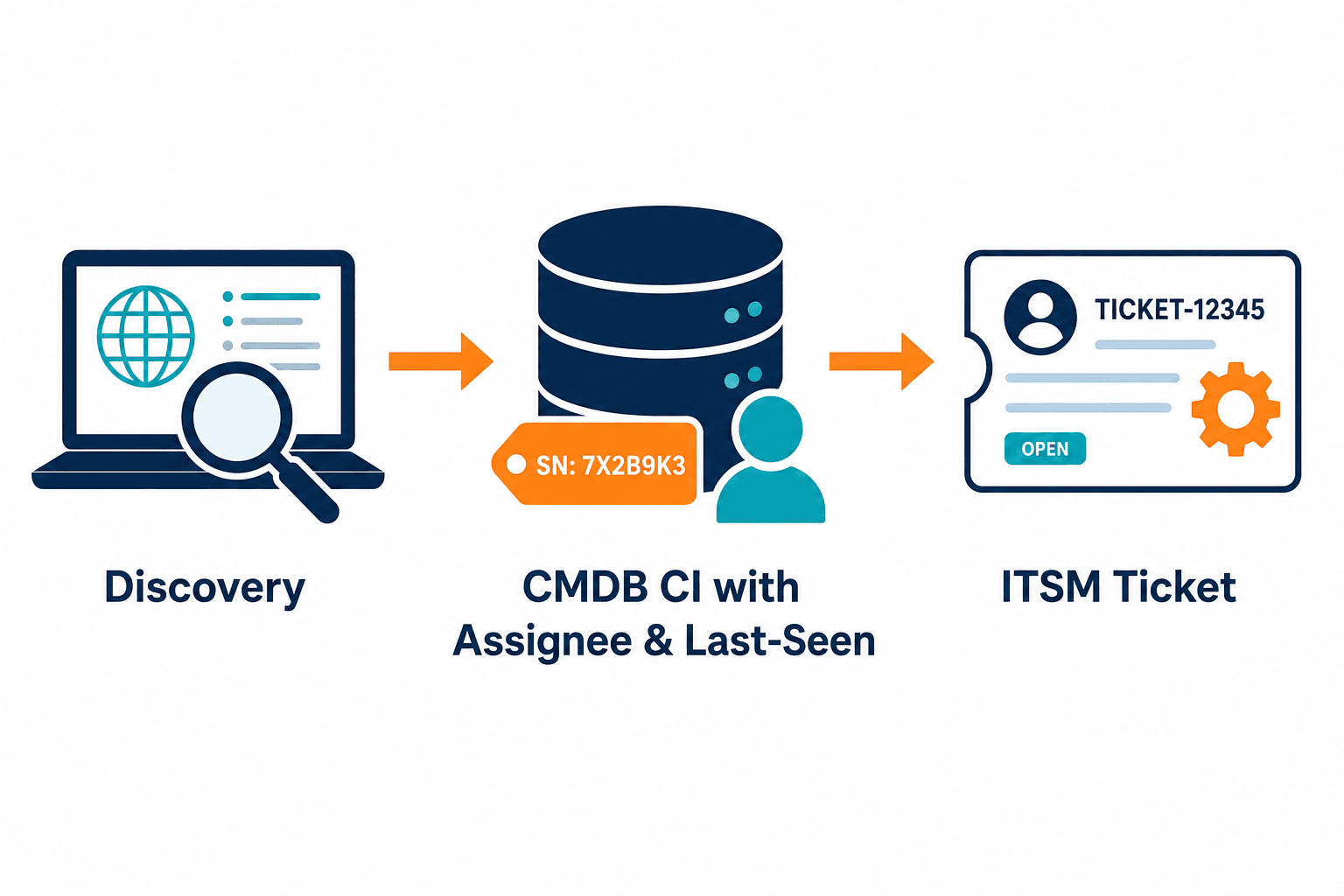
Virima runs agent, agentless, and API discovery on high-frequency scheduled cycles. Endpoint records reconcile into a CMDB on durable identity such as serial number and cloud instance ID, not hostname alone — the piece that turns a list of laptops into an actual contractor device CMDB instead of a static sheet. Owner and last-seen stay on the configuration item operators use for change and incident work.
Once the team supplies service definitions, ViVID™ service maps show which services depend on which endpoints. The CMDB feeds ITSM tools such as ServiceNow, Jira Service Management, Ivanti, HaloITSM, Xurrent, and Hornbill so tickets carry device and owner context. Partner connections are listed on Virima’s integrations hub.
That layer is Trusted Runtime Truth: what exists, how it connects, what changed, what will break, and who owns it. Directory and access tools still own account lifecycle. Virima owns governed device and relationship records that stay current on the ticket when contractors rotate.
Full discovery, CMDB, and service mapping can run under a lean bench without a multi-year platform factory. When the open question is which package fits that estate, the Business Pro option is sized for contractor-heavy teams rather than adding another shared sheet for each project wave.
Close the device when the engagement ends: the contractor offboarding checklist
Treat every contractor start and end as a device event, not only a people event.
- Issue or reclaim against serial or cloud instance ID on day one and last day.
- Keep discovery on a scheduled cycle so silent keeps and dual assignees show up as last-seen conflicts.
- Move the CI to returned, wiped, or retired when access ends, on the same day the engagement closes.
- Sample ten rows monthly: serial, assignee, last-seen, and state must match what the network reports.
Endpoint inventory for contractor-heavy IT teams holds when the record moves as fast as the people. Headcount can stay small. The sheet cannot be the only system that knows which laptop is live.
Frequently Asked Questions
Is endpoint inventory for contractors the same as computer inventory for growing teams?
They share discovery and durable identity. Contractor-heavy work adds high reassignment volume, short engagement end dates, and offboarding closes on the device row. Growing-fleet inventory covers steady expansion. This path focuses on rotation speed.
What durable ID should lean IT use for contractor laptops?
Prefer serial number on physical hardware and cloud instance ID on cloud-hosted endpoints. Hostname and friendly labels change on reimage and rename, so they fail as the only join key.
Does endpoint inventory replace HR or contractor management systems?
No. Those systems own people and engagement records. Endpoint inventory owns device presence, configuration, assignee on the CI, and last-seen. Join on clear IDs. Do not treat inventory software as an HR system of record.
How is this different from a BYOD policy article?
BYOD policy covers personal devices, eligibility, MDM or MAM rules, and offboarding of company data on hardware the employee owns. This article covers company-issued and loaner endpoints that rotate across contractors, where inventory fails when assignment outruns the sheet.
Does Virima integrate with ServiceNow or Jira Service Management for contractor tickets?
Yes. Virima feeds configuration item and dependency context into ServiceNow, Jira Service Management, Ivanti, HaloITSM, Xurrent, and Hornbill so tickets carry device and owner data from the CMDB.
Does Virima replace the contractor tracking spreadsheet with a CMDB?
Virima does not require tearing out existing contractor workflows. Discovery populates the CMDB automatically, and contractor devices reconcile on serial number or cloud instance ID instead of a maintained spreadsheet row. Engagement dates and approvals can stay in whatever system HR or procurement already uses — Virima owns device presence, configuration, and last-seen status on the same CI the help desk works from.