Can one discovery layer feed CMDB, ITAM, and ITSM without rip-and-replace?

Enterprise IT estates rarely run on a single stack. An IT Director often watches a configuration management database (CMDB) disagree with the IT asset management (ITAM) register while the service desk works from a third, different device count. A CMDB tracks configuration items and their relationships; ITAM tracks ownership, licensing, and lifecycle; ITSM runs the incident and change workflows that consume both. When each pulls from its own disconnected scanner, incident triage stalls and change approvals turn into guesswork.
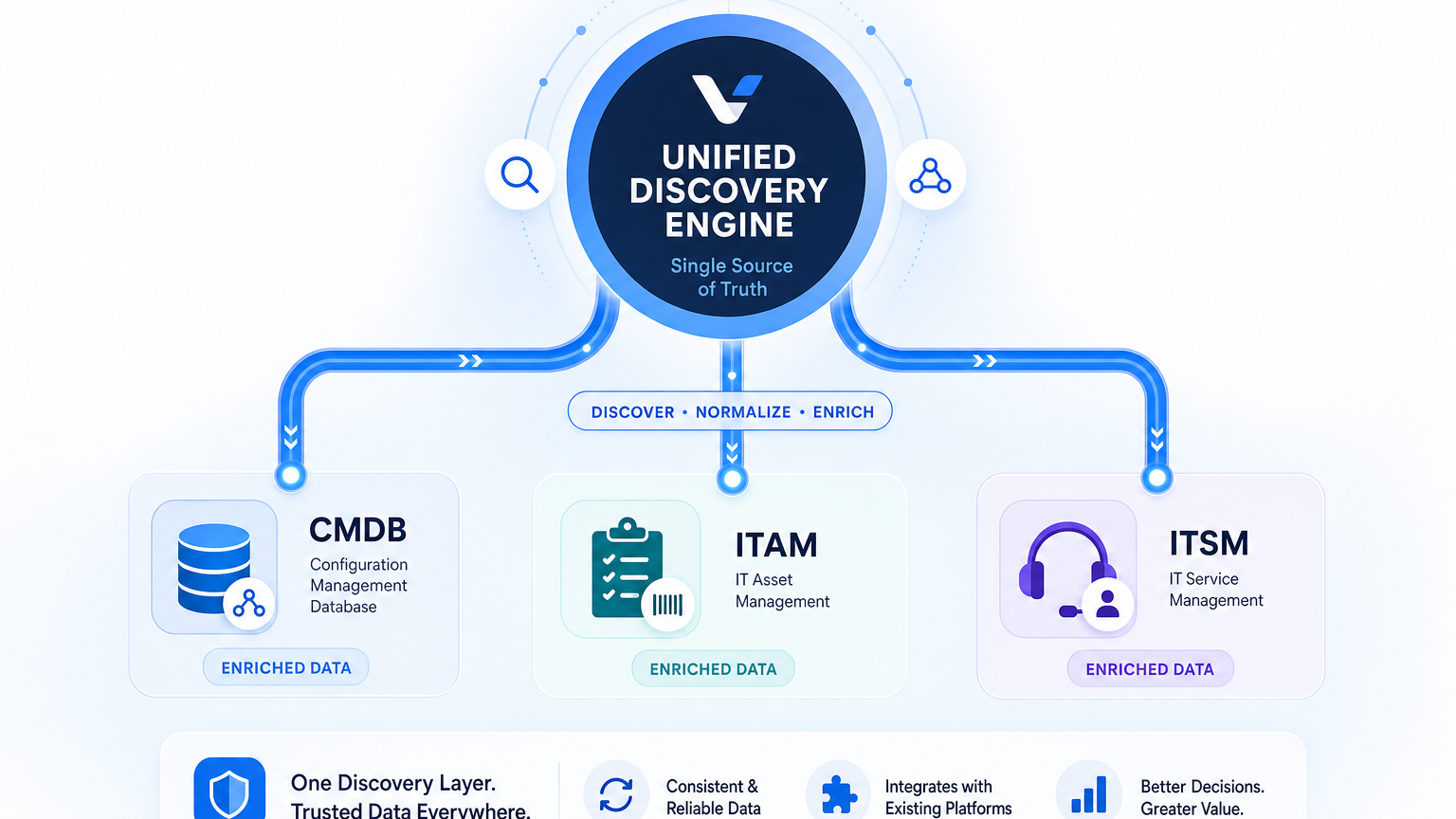
So can one discovery layer feed CMDB, ITAM, and ITSM without rip-and-replace? The short answer: yes — one discovery layer can feed all three simultaneously, without replacing any of them. The usual vendor answer is full suite consolidation, which can cost months of migration and retraining. Virima’s independent discovery layer helps IT teams avoid a rip-and-replace CMDB migration: it feeds normalized, serial-number-anchored asset data into the CMDB, ITAM, and ITSM tools already in production — no migration required.
The operational cost of point discovery sprawl
Running separate scanning tools for service management and asset governance creates permanent data conflict. Desktop scanning agents report physical laptops that network SNMP sweeps miss. Cloud management APIs track ephemeral compute instances that never enter the fixed asset register. Meanwhile, storage subnets go unmonitored because no single team claims administrative responsibility for them. A CMDB can look complete and still disagree with live discovery. Virima’s analysis of CMDB data quality metrics and its comparison of ServiceNow health scores against discovery findings detail this gap.
When configuration data disagrees across core platforms, operational processes break down in three ways. Incident response stalls as service desk agents spend critical triage minutes verifying whether an affected IP address belongs to an active production database or a decommissioned staging server. Unauthorized changes slip through as change advisory boards approve infrastructure modifications without visibility into upstream application dependencies or downstream consumers — the blast radius of the change, the set of services and assets affected if it goes wrong, stays invisible until something breaks. And audit penalties escalate when software license managers defend compliance audits using incomplete deployment numbers, risking unbudgeted true-up fines like those detailed in Virima’s CMDB inaccuracy cost analysis.
Federal architecture standards back this up. NIST SP 800-128 names an accurate inventory of interconnected information system components as the core prerequisite for configuration control and enterprise security governance. Relying on disconnected point discovery tools makes satisfying this baseline standard almost impossible.
Why does discovery point tool sprawl degrade IT service delivery?
Fragmented discovery scanners collect unsynchronized configuration data across siloed repositories. This mismatch forces engineering teams into manual reconciliation, obscures cross-system infrastructure dependencies, and increases change failure rates across production environments.
The rip-and-replace trap: why suite consolidation fails
When faced with fractured operational records, enterprise software sales teams routinely advise standardizing on a single monolithic platform. They promise that buying one proprietary suite for discovery, asset tracking, and service delivery will automatically resolve all reconciliation pain.
For an IT Director accountable for delivery uptime and operational expenditure, suite consolidation carries four distinct risks. Switching costs run high: migrating multi-tiered change approvals, service catalogs, and custom orchestration logic demands thousands of engineering hours. Time to value is slow — vendors commonly cite 12 to 24 months for complex enterprise suite migrations before operational teams see basic configuration parity, and that estimate assumes the migration stays on schedule. Edge discovery tends to be weak, since workflow suites excel at process governance but their bundled discovery tools frequently struggle to scan unmanaged subnets, legacy operational technology, or complex hybrid networks. And vendor lock-in sets in once discovery is fastened directly to a specific ticketing interface, preventing IT leadership from adopting best-of-breed operations tools as corporate requirements evolve.
Replacing existing ITSM platforms to solve a discovery defect addresses the wrong operational layer. Service desks, asset registers, and configuration databases are consumer systems. The defect lies in data capture and relationship modeling, not in workflow execution. To solve this problem at the foundation, engineering teams need trusted runtime truth before data ever reaches operational queues. That means verified hardware ownership, active software components, and inter-service relationships established at the source, not reconciled after the fact.
The unified discovery layer architecture: ingest, join, and feed
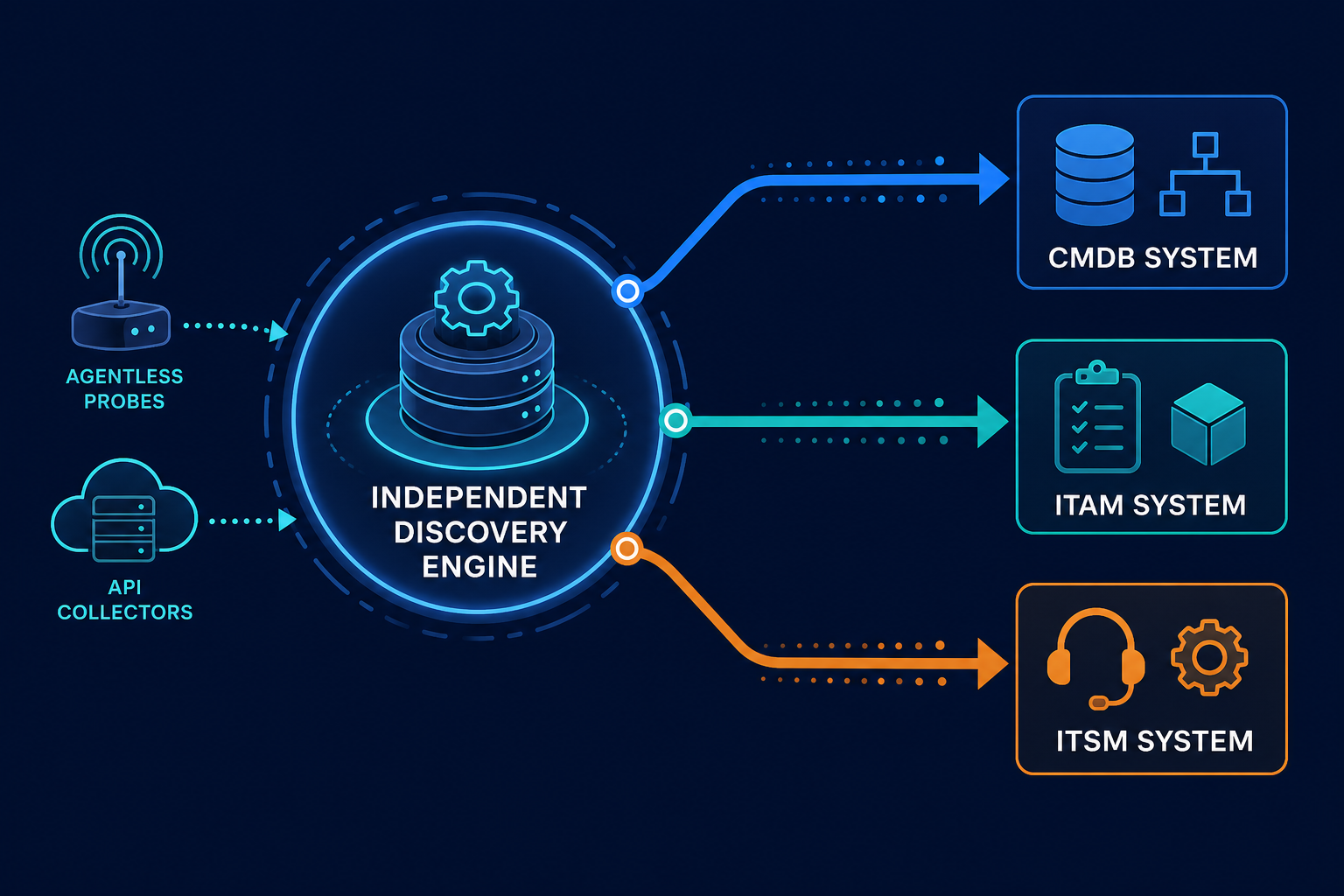
An independent discovery layer treats enterprise infrastructure as one reconciled source of data rather than a platform-specific record store. Instead of forcing teams into one administrative console, it executes wide-ranging scans across physical, virtual, and cloud environments during scheduled discovery cycles.
+-----------------------------------------------------------------------+
|                      Unified Discovery Engine                         |
|  (Agentless Probes, API Collectors, Scheduled Discovery Cycles)       |
+------------------------------------+----------------------------------+
                                     |
                                     v
+-----------------------------------------------------------------------+
|                    Normalization & Durable Identity                   |
|   (Join Keys: Hardware Serial Numbers & Cloud System Instance IDs)    |
+-------------------+-----------------+---------------------------------+
                    |                 |
         +----------+                 +----------+
         v                                       v
+-----------------------+              +-----------------------+
|       ITAM Feeds      |              |   CMDB & ViVID™ Maps  |
| - Serial Numbers      |              | - Relational Topology |
| - Installed Software  |              | - Service Dependencies|
| - Lifecycle Dates     |              | - Blast Radius Context|
+-----------+-----------+              +-----------+-----------+
            |                                      |
            +------------------+-------------------+
                               |
                               v
+-----------------------------------------------------------------------+
|                       Consuming Platforms                             |
| (ServiceNow, Jira Service Management, Freshservice, Ivanti,           |
|  TeamDynamix)                                                         |
+-----------------------------------------------------------------------+
1. Reliable component identification
Effective cross-platform reconciliation requires durable join keys. Hostnames change across migration windows, and IP addresses shift across dynamic DHCP pools. Virima’s independent discovery engine binds identity to immutable attributes instead — hardware serial numbers, chassis identifiers, and cloud system instance IDs — so the same asset resolves to one record across the CMDB, ITAM, and ITSM views.
2. Tailored operational feeds
Different business functions require different subsets of configuration data across daily workflows. Virima routes one reconciled dataset into three purpose-built feeds:
- The ITAM Stream: Ingests normalized hardware serial numbers, processor specifications, storage tiers, and verified software installation instances to balance license entitlements against actual consumption.
- The CMDB Stream: Maps active network connections, process-level relationships, and host-to-storage topologies to preserve structural configuration records.
- The ITSM Stream: Injects contextual dependency maps directly into incident and change ticket views, enabling engineers to assess blast radius before modifying infrastructure.
3. Preserving established workflows
Through Virima’s certified connectors, normalized infrastructure data synchronizes into target systems without requiring custom database schema modifications. Incident response teams continue managing tickets inside ServiceNow, Jira Service Management, Freshservice, or TeamDynamix, while service desks receive verified asset records that eliminate manual cross-referencing during outages.
Architectural approaches compared
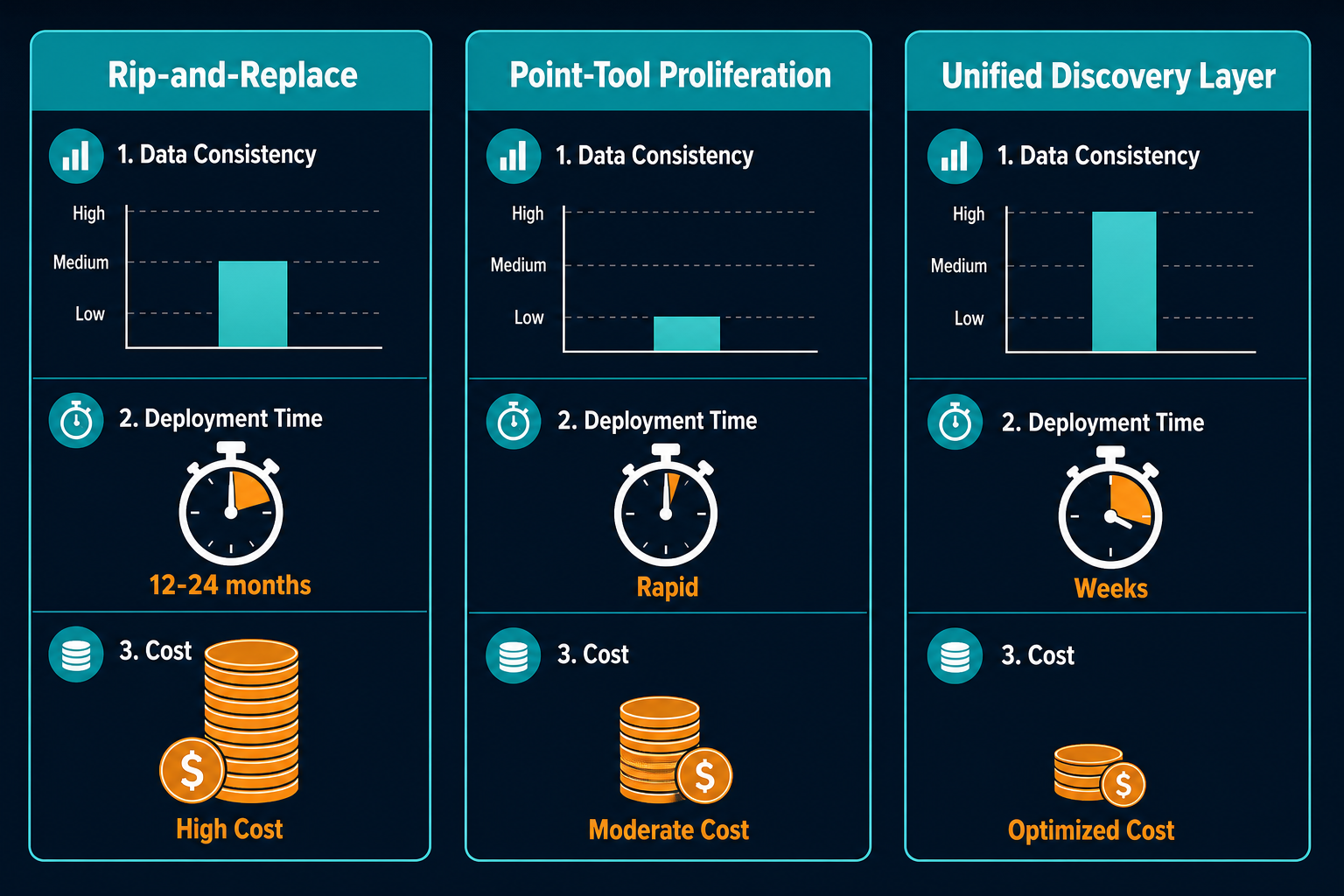
| Architectural Factor | Point-Tool Proliferation | Monolithic Rip-and-Replace | Unified Discovery Layer |
|---|---|---|---|
| Data Consistency | Low; unaligned scans produce persistent record duplication | Moderate; limited to areas covered by native scanners | High; unified reconciliation engine produces single dataset |
| Deployment Time | Rapid per tool, but permanent maintenance burden | 12 to 24 months across whole enterprise | Weeks; connects directly into operational platforms |
| Workflow Disruption | Low impact initially; high administrative overhead | Severe; requires retraining staff and rebuilding workflows | Minimal; preserves existing ITSM and ITAM user interfaces |
| Cross-Platform Support | Siloed; requires manual spreadsheet transfers | Restricted to vendor’s own platform | Native; multi-directional data feeds across partner tools |
| Capital Expenditure | Fragmented subscription and maintenance fees | Substantial migration and implementation costs | Optimized; preserves capital already invested in existing suites |
Feeding actionable context to consuming platforms
An independent discovery layer does more than export flat inventory tables. It structures relational context so operational teams can visualize dependencies without switching applications.
When service definitions are provided by application owners, automated relationship discovery populates dynamic ViVID™ service maps. These dependency visualizations link server hardware, container nodes, microservices, and network interfaces directly to business services.
Rather than maintaining separate point solutions, organizations route this contextual data into established service desks through certified integrations supporting platforms like ServiceNow, Jira Service Management, Ivanti, and TeamDynamix — delivering CMDB, ITAM, and ITSM integration without adding another console for support teams to learn. Support teams triage incidents with clear visibility into component ownership and service criticality, while asset managers maintain reliable audit logs across hardware and software lifecycles.
Establishing infrastructure visibility without disruption
Consolidating enterprise IT tools does not require decommissioning your operational software stack. An independent discovery engine lets IT leaders eliminate configuration blind spots, satisfy regulatory standards, and deliver reliable asset context to incident managers — all without replacing the service management platforms already in place. That’s the real answer to whether one discovery layer can feed CMDB, ITAM, and ITSM without rip-and-replace: yes, as long as the layer is built to stay independent of all three.
Frequently Asked Questions
How does an independent discovery engine avoid duplicate asset records across CMDB and ITAM?
The discovery engine normalizes collected data and assigns identity using durable hardware join keys, such as equipment serial numbers and cloud system instance IDs, rather than mutable hostnames or dynamic IP addresses. This consistent identification links physical asset ledgers and configuration items to the same verified physical or virtual component.
Can an external discovery layer feed relationship data into existing ServiceNow or Jira CMDB tables?
An independent discovery layer connects directly into target schemas using certified API integrations. Hardware attributes, software instances, and upstream dependencies populate native platform tables directly, eliminating manual data entry while preserving existing change management processes.
How does Virima handle network discovery without disrupting production environments?
Virima executes discovery during scheduled discovery cycles using non-disruptive agentless protocols and lightweight agents where required. By combining credentialed WMI, SSH, SNMP, and cloud management API queries, it discovers connected systems and maps dependencies without overloading network infrastructure.