ServiceNow CMDB Health Score vs. Discovery Findings: Why Completeness Isn’t Accuracy

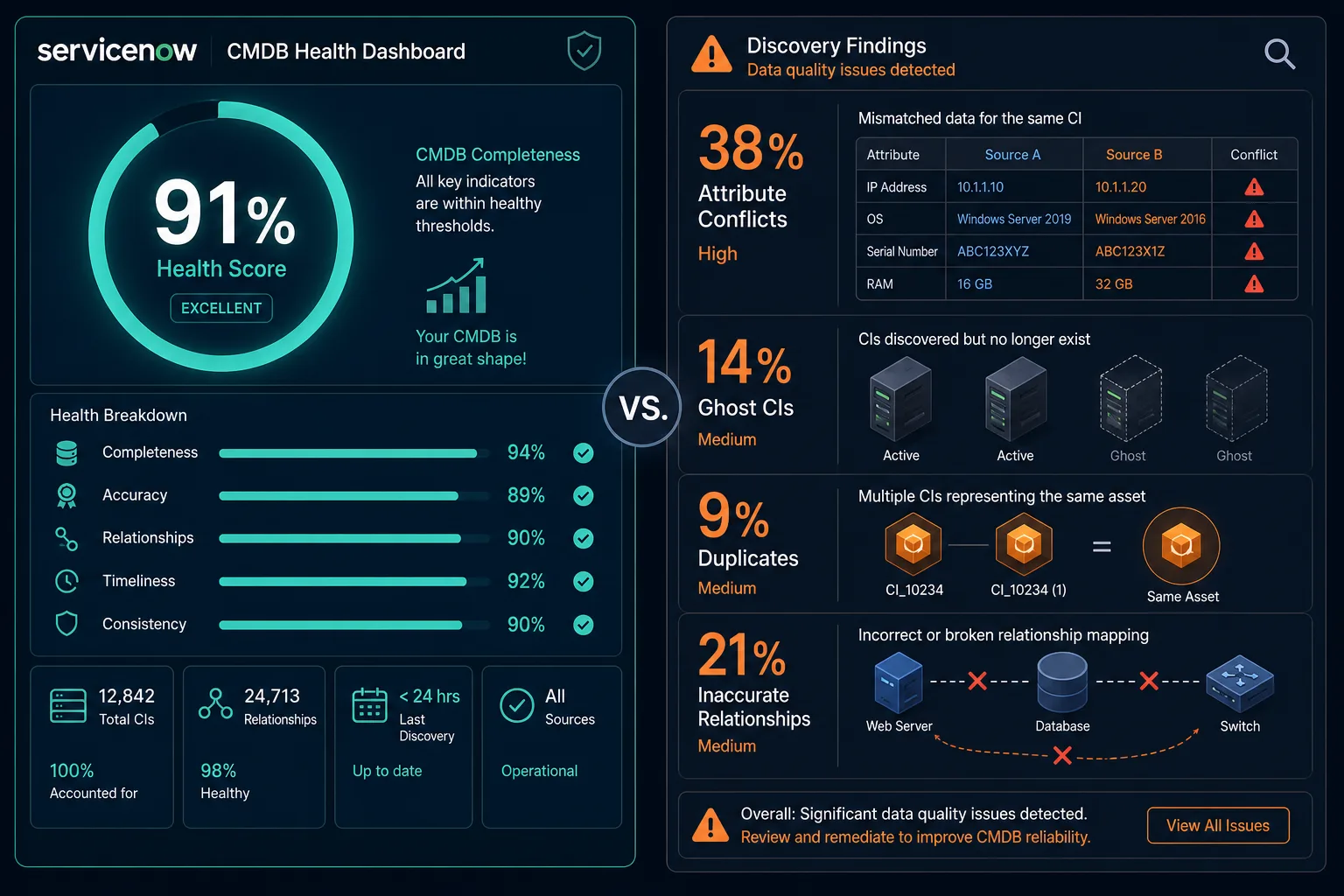
ServiceNow CMDB health score accuracy is a common point of confusion: the Health Dashboard measures field completeness — whether required fields are populated — not whether the values in those fields are correct. An organization can have a 91% completeness score while 38% of CI records contain attribute conflicts with the live environment. Completeness and accuracy are two different measurements, and conflating them leads to misplaced trust in CMDB data.
If you’re a ServiceNow admin or IT Operations Manager responsible for CMDB accuracy, this gap matters directly to your change management risk. Here’s what one organization found when they ran their first discovery scan against a CMDB that had been manually maintained for five years.
The environment: five years of manual CI maintenance
One ServiceNow customer had managed their CMDB manually for five years across four full-time staff, with two complete team turnover cycles. No agentless or agent-based IT discovery had ever run against the environment. All CI data came from manual entry: devices added at procurement, systems provisioned through change tickets, and occasional manual audits that covered portions of the CI estate but never the whole environment at once. These are the risks of CMDB manual maintenance at scale — not isolated data entry errors, but compounding drift that no periodic audit fully catches.
The CMDB Health Dashboard showed a score of 91%. By the metric the health dashboard tracks — whether required fields on CI records are populated and whether relationships exist — that was an accurate measurement. On paper, the CMDB looked well-maintained.
When IT leadership decided to run their first discovery scan against the live environment, the results revealed something very different.
What ServiceNow’s CMDB Health Dashboard actually measures
The ServiceNow CMDB Health Dashboard calculates one thing: completeness. It measures what percentage of CI records have required fields populated and what percentage have at least one relationship attached. A Gartner 2024 report on ITAM and CMDB maturity found that 68% of organizations rely primarily on completeness metrics to assess CMDB health. Fewer than 20% validate whether the populated fields contain accurate values.
Here’s the critical limitation: the health dashboard has no mechanism to verify whether a populated field contains a correct value. A CI record with hostname “app-srv-04” satisfies the completeness check regardless of whether a device with that hostname actually exists in the current environment. The field is populated; the metric is satisfied. A CI relationship that points to a device decommissioned three years ago still counts as a relationship present.
This is a CMDB data quality problem, not a maintenance effort problem. The health dashboard tracks build-out progress — “Have we filled in the required fields?” — not whether the values in those fields are correct.
Most teams hit this gap when discovery runs for the first time — and the number of conflicts surprises everyone who thought the ServiceNow CMDB health score was enough.
What the first discovery scan found about CMDB data quality
When discovery ran across this environment for the first time, it compared the live infrastructure state against the CI records in ServiceNow. The results fell into four categories:
Attribute conflicts: 38% of CIs
CI records where at least one field value differed from what discovery returned from the live device. Outdated hostnames, IP addresses that had been reassigned, OS versions that didn’t match the actual system — 38% of CIs had at least one such conflict.
Ghost CIs: 14% of records
Ghost CIs — records for devices that no longer exist in the environment — included decommissioned servers, replatformed systems, and deleted virtual machines. 14% of CIs were ghost records. These looked active in ServiceNow, had populated fields, and contributed positively to the health score.
Duplicate records: 9%
The same physical or virtual device appearing under two CI records, due to manual procurement import errors or provisioning workflows that created overlaps. 9% of CIs had duplicates.
Inaccurate relationship data: 21%
Relationship records that were partially or entirely wrong: server-to-application mappings where the application no longer ran on that server, relationships pointing to ghost CIs. 21% of CIs had at least partially inaccurate relationship data.
Wondering what a first scan would surface in your environment? See how Virima’s ServiceNow CMDB reconciliation works →
All these records — ghost CIs, duplicates, records with stale values — had populated required fields. That’s why the score was 91%, not despite the problems but because of them. The health dashboard had no way to know that 14% of them represented devices gone from the environment for years, or that 38% of field values no longer matched reality.
CMDB remediation: what 14 weeks of cleanup reveals
The discovery findings triggered a structured remediation. Over 14 weeks:
- 7,200 CIs were revised — field values updated to match what discovery returned from live devices
- 1,900 ghost CIs were retired — records moved to inactive status
- 640 duplicate records were merged — pairs consolidated with discovery data verifying the authoritative record
This remediation was not hypothetical overhead. It required prioritization calls, change windows, and coordination across IT operations. A Forrester 2025 study on CMDB remediation found that organizations that remediate stale CIs report a 40% reduction in change-related incidents. The reason: teams can finally trust the blast-radius data in their CMDB.
The 14-week effort required significant coordination time. The alternative — continuing to approve changes against a CMDB with 21% inaccurate relationship data — carries a harder-to-quantify but higher risk. That 40% incident reduction reflects the cost of operating on stale data, made visible only after remediation.
One counter-intuitive finding: after remediation, the ServiceNow CMDB health score dropped from 91% to 88%. The CMDB was in meaningfully better shape — more accurate, no ghost records inflating counts, duplicates consolidated. The score was lower. This happens because ghost CIs, before they were retired, counted positively toward completeness. When 1,900 ghost records were removed, the CI set shrank, and the 88% score applied to a cleaner estate.
A score on clean data is more useful than a higher score on dirty data.
Why discovery-sourced data matters for CMDB trust
The gap between completeness and accuracy is the reason many organizations now use IT discovery to source CMDB updates rather than relying on manual maintenance alone. Discovery tools compare live device telemetry against the CMDB, flag discrepancies, and provide the authoritative state to reconcile against.
For teams running ServiceNow, Virima integrates directly with ServiceNow to surface reconciliation data:
- which CIs conflict with the live environment
- which records correspond to devices that no longer exist
- which attributes need updating
Unlike tools that write directly to CI records, Virima’s integration routes all updates through ServiceNow’s standard change workflow — giving IT operations teams the control and audit trail that direct writes bypass.
The distinction between completeness and accuracy also shapes how to interpret other CMDB metrics. Relationship count, CI count, field coverage — all measure breadth, not depth. They answer “Is the data filled in?” not “Is the data correct?” CMDB best practices now explicitly separate these concerns.
Building trustworthy CMDBs with Virima’s discovery-sourced approach
Organizations moving away from manual-only CMDB maintenance typically follow a similar pattern: run a baseline discovery scan, identify conflicts and ghost records, remediate using discovery as the ground truth source, then establish a regular discovery cycle to keep the CMDB synchronized with the live environment.
Virima’s discovery platform uses agentless, agent-based, and API scanning to build a complete, current view of hybrid IT environments. That data feeds both CMDB reconciliation in ServiceNow and Virima’s ViVID™ service maps, which layer relationship accuracy on top of CI accuracy — showing which services depend on which infrastructure components at any point in time. The result is a CMDB that stays accurate without requiring manual maintenance across team cycles.
Frequently Asked Questions
What does ServiceNow’s CMDB Health Dashboard actually measure?
Why did my CMDB health score drop after remediation?
What causes CMDB data to go stale in a manually maintained environment?
How does Virima integrate with ServiceNow to improve CMDB accuracy?
If your CMDB health score is above 85% but your last manual audit is more than six months old, you may be operating in the same gap this organization discovered. The gap between your ServiceNow CMDB health score and the accuracy of the underlying data is the gap that discovery closes. See how Virima’s discovery-sourced CMDB reconciliation works in a production ServiceNow environment, or Schedule a demo to walk through what remediation looks like for your specific environment.