CMDB data quality metrics: why completeness is the wrong metric

CMDB data quality metrics are the operational signals that tell you whether your configuration data is reliable enough to drive incident response, change approvals, and audit decisions — not just whether required fields are populated. Completeness, the metric most CMDB teams optimize for, measures presence rather than accuracy. When a configuration item is unconfirmed by discovery for 90 days and has no relationship records, it can still score as complete — and still fail you during a P1 outage. This article makes the case for replacing completeness as your primary CMDB health signal and introduces four metrics that measure what completeness cannot: whether your data is current, connected, and confirmed.
The CMDB completeness trap
Completeness has one job in CMDB reporting: confirm that required fields are populated. A CI with a hostname, OS version, and owner field filled in is technically complete. It may also be unconfirmed by discovery for 90 days, have no relationship records linking it to the application it supports, and carry the name of an owner who left the organization last quarter.
That CI passes your completeness check. It tells you nothing about whether you can rely on it.
This is the trap: completeness measures presence, not accuracy. When IT ops teams optimize for it, the incentive structure pulls in the wrong direction. Adding CIs — even unconfirmed, unlinked ones — improves the score. Validating existing CIs, building out relationships, and cleaning up stale records does not. So teams do what their metrics reward. One illustrative example: a team that imports 400 CIs from a spreadsheet with no discovery confirmation, no relationship records, and no ownership validation improves its completeness from 91% to 97%. Operationally, it has made its CMDB less trustworthy — more data to maintain, none of it verified.
The root causes of CMDB data degradation follow a consistent pattern: manual data entry without discovery validation, bulk imports from spreadsheets or ITSM integrations that add CI records but no relationship data, and decommissioned asset records that are never cleaned up after hardware or software is retired. When completeness is the primary metric, none of these root causes surface — because all three can improve a completeness score while degrading the operational reliability of the data.
A 2025 IBM study found that organizations lose more than $5 million annually on average due to poor data quality. Even when data appears well-structured, 67% say they don’t fully trust it for decision-making. CMDB teams face the same problem at the CI level — completeness creates the appearance of readiness without the substance.
For teams responsible for CMDB health, that distinction matters. Incident response, change approval, and audit compliance all depend on data you can act on — not data that merely exists.
Four CMDB data quality metrics that actually predict reliability
These four metrics don’t replace your existing CMDB health reporting framework. They replace completeness as the primary indicator you optimize for. Together they tell you what completeness cannot: whether your CMDB data is current enough, connected enough, and confirmed enough to support the operations that depend on it.
1. CI confidence score distribution
CI confidence score distribution is the percentage of your configuration items that fall above or below a threshold of operational reliability — measured by how recently each CI was confirmed by discovery, how many authoritative sources agree on its attributes, and whether its relationships have been validated.
The metric that matters is not the average confidence score across all CIs; it’s the distribution. The operational questions: What percentage of your business-critical CIs score above your action threshold? How many fall below the confidence floor where a change approval or automated ITSM enrichment should require a manual review step?
A practical target for production infrastructure: 90% or more of CIs in critical CI classes confirmed by discovery within 30 days. For cloud and virtual assets, that freshness window should compress to seven days — the pace at which ephemeral environments change makes 30-day staleness operationally dangerous. Gartner (2025) has flagged this explicitly, noting that ephemeral and hybrid multicloud assets make traditional asset detection approaches obsolete without near-real-time discovery to back them up.
CI confidence score distribution turns your CMDB from a presence record into an operational signal. When an agent or change manager acts on a low-confidence CI, that flag is meaningful — not because the CI doesn’t exist, but because the data currency can’t be confirmed. Learn how Virima’s automated discovery keeps CI confidence scores current across agentless, agent-based, and API discovery methods: Ansible CMDB: How is Virima’s automated CMDB better?
2. CMDB relationship coverage rate
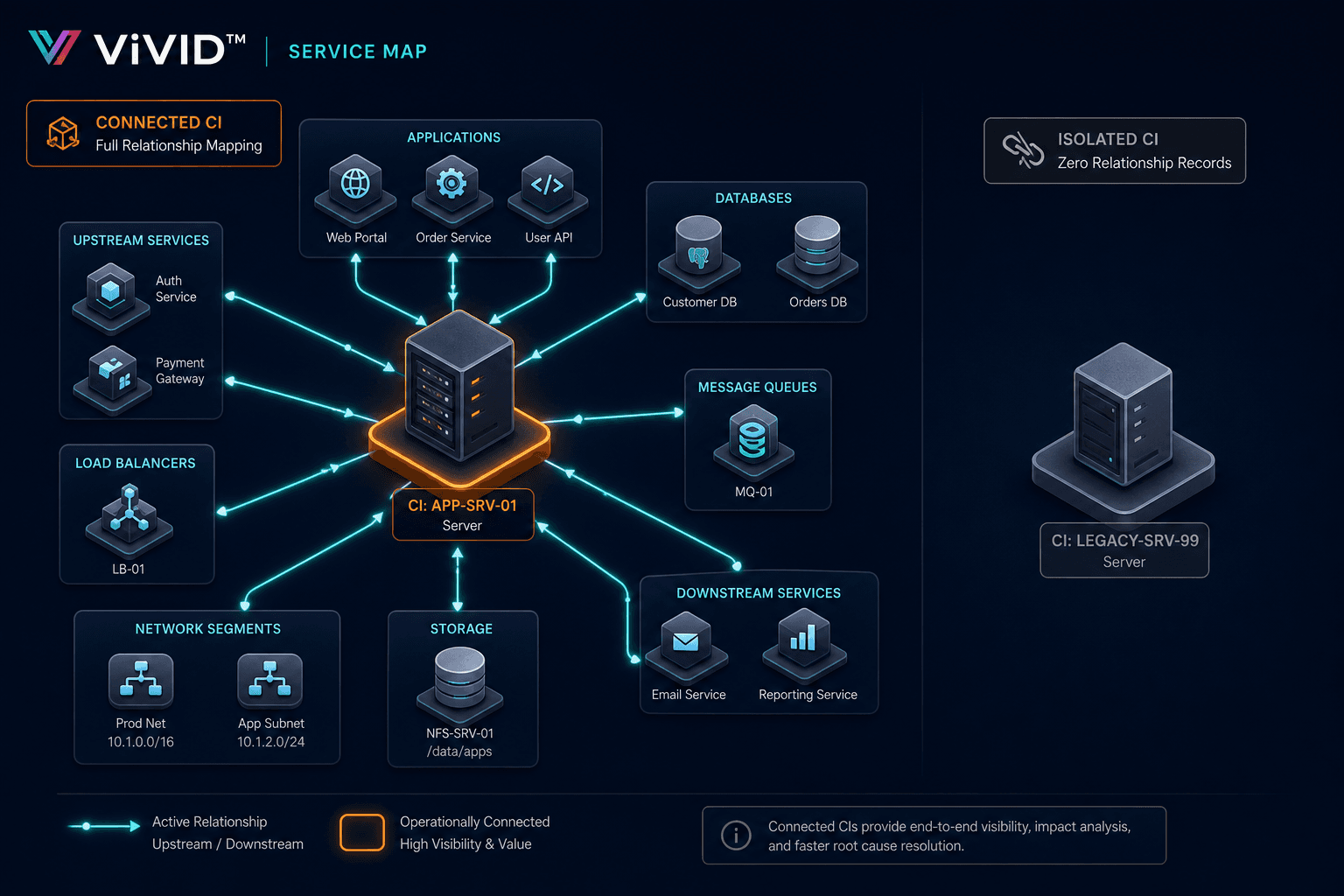
CMDB relationship coverage rate is the percentage of configuration items that have at least one confirmed upstream or downstream relationship in the CMDB. It’s a sharper metric than completeness because connectivity, not presence, is what drives operational value.
You may know exactly what a server’s hostname and OS version are. Without knowing what applications it serves, what network segments it connects to, and what downstream services depend on it — you can’t assess blast radius before a change or isolate root cause during an incident.
A realistic benchmark: IT teams that have invested in continuous automated discovery typically achieve 80–85% relationship coverage on production infrastructure. Below 70%, your CMDB struggles during incident triage — your engineers spend the first 20 minutes of a P1 outage manually tracing dependencies that should already be mapped and current. Forrester (2025) has noted that CMDB platforms are evolving toward intelligent knowledge graphs with real-time holistic views precisely because relationship data is what separates operational intelligence from inventory tracking.
Virima’s ViVID™ service maps display the relationship layer in a visual dependency map that updates as discovery runs — so blast radius and service ownership are visible at the CI level, not reconstructed manually during an incident. Introducing ViVID Service Maps
3. Authoritative source agreement rate
Authoritative source agreement rate is the percentage of CI attributes where all contributing data sources agree. A high agreement rate means your discovery and ITSM workflows are in sync. A low agreement rate means you have competing truths, and neither can be trusted without manual verification. Source agreement is, in practice, a direct measure of CMDB accuracy — when it falls, decisions made on CMDB data carry unverified risk.
Most CMDBs are populated from multiple sources: discovery tools, ITSM imports, manual entry, API integrations, and bulk CSV uploads. When two sources disagree on the same attribute — say, a discovery run returns one IP address while an ITSM import carries a stale value — the CMDB has a conflict it cannot self-resolve.
This is where automated discovery earns its value over manual CMDB maintenance. When discovery runs continuously against your infrastructure, conflicts surface immediately — rather than accumulating silently over months until an incident or audit exposes them. Every CI traces back to its discovery source, so when an attribute is in dispute, you know which source last confirmed it and when. Ansible CMDB: How is Virima’s automated CMDB better?
Target: 95% or higher agreement across required attributes for production CIs. Below 85%, your CMDB is actively conflicted — change managers and service owners are looking at data they cannot verify, and the decisions they make on that data carry hidden risk.
4. Orphaned CI rate
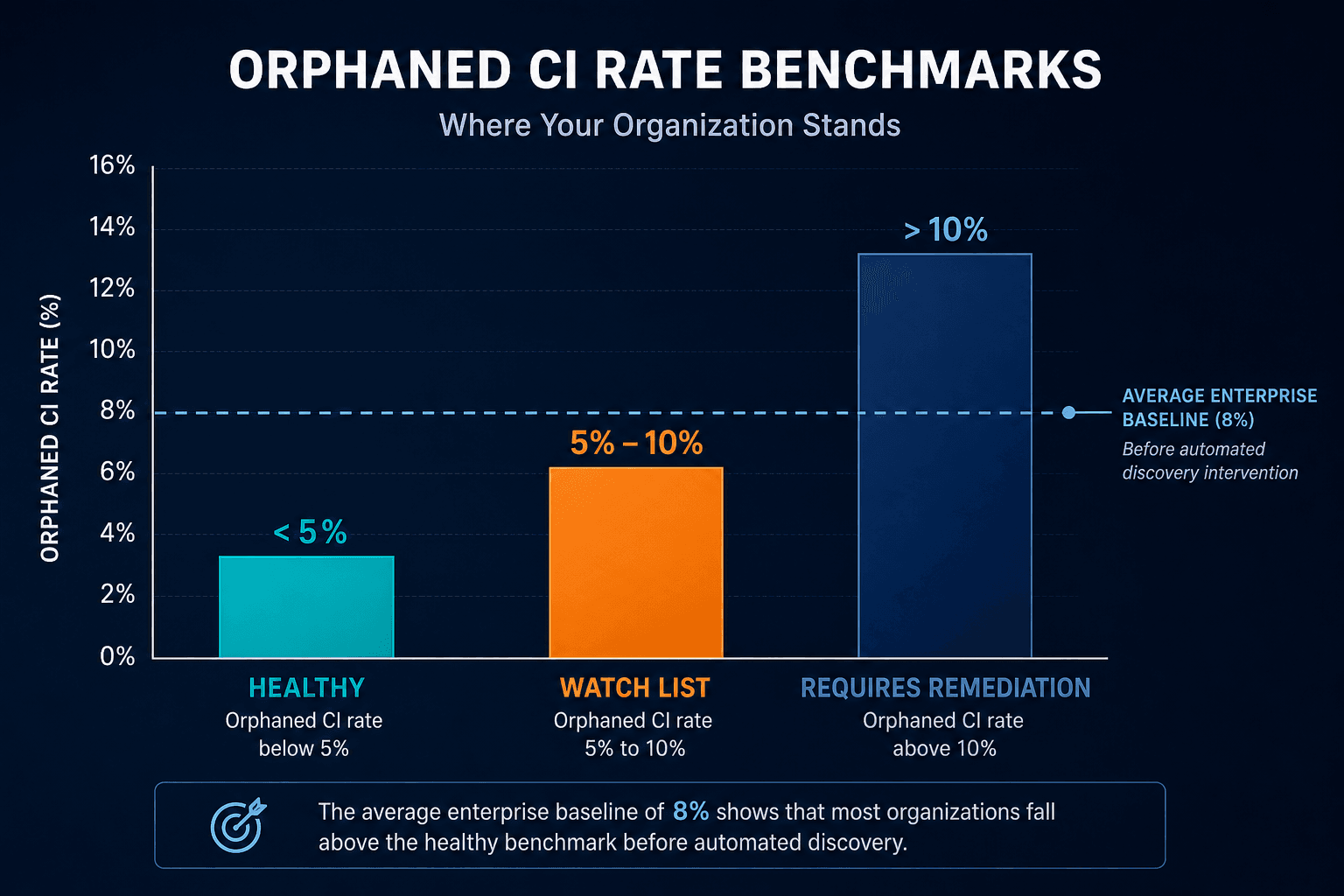
Orphaned CI rate is the percentage of your total CI population with no confirmed discovery match, no active relationships, and no recent owner validation. It’s a direct measure of CMDB pollution — the weight of unconfirmed, unconnected data your team is maintaining without operational return.
An orphaned CI may represent a decommissioned asset that was never cleaned up, a CI entered manually and never confirmed by discovery, or a duplicate record that drifted from the original entry.
The scale of the problem surprises most teams until they look. A 2025 RapDev case study found that a national healthcare provider resolved more than 55,000 CMDB quality issues in a single remediation engagement. Orphaned and duplicate CIs were among the top contributors. Most organizations don’t surface the volume until they run a discovery tool that cross-references existing CIs against confirmed infrastructure and flags the gaps.
Target: Orphaned CI rate below 5% for enterprise CMDBs. Above 10%, the CMDB requires active remediation before it can serve as a reliable data foundation for ITSM enrichment, change governance, or agentic IT workflows. CMDB with Automated Discovery for Hybrid and Cloud Environments
Two scenarios where completeness gave a false pass
These scenarios are illustrative, drawn from patterns common in CMDB health reviews and audit preparation cycles.
Scenario 1 — The CMDB health review
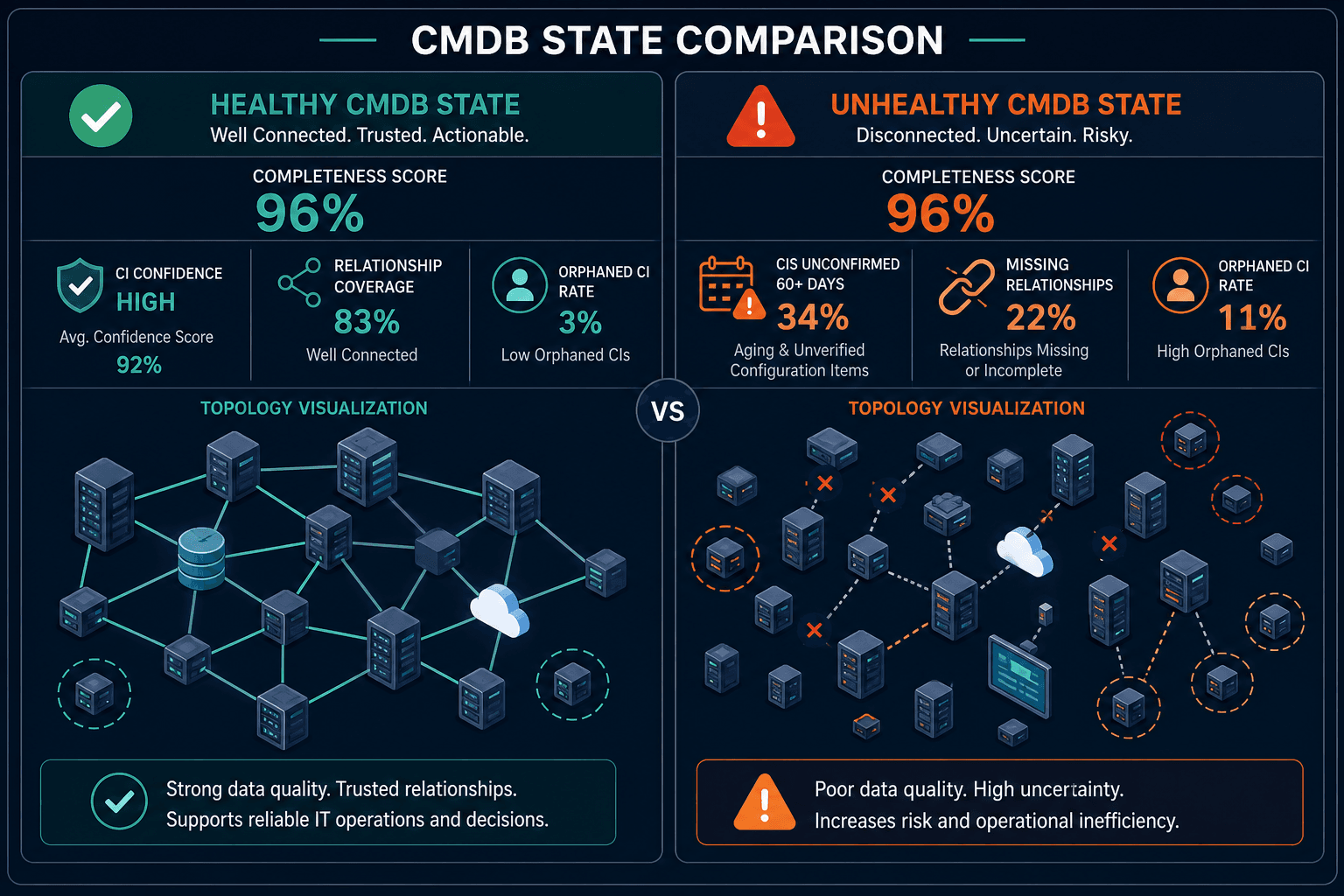
An IT ops team runs a quarterly CMDB health review. Completeness score: 96%. By every dashboard measure, the CMDB is in good shape. The team then applies the four CMDB data quality metrics and the picture changes: 34% of CIs have not been confirmed by discovery in 60 or more days, 22% have no relationship records, and the orphaned CI rate sits at 11%.
The team had spent two quarters improving completeness — importing records, filling required fields, updating owner assignments in bulk. None of that activity addressed CI confirmation, relationship mapping, or orphaned record cleanup. The CMDB looked healthy by one measure and was operationally unreliable by four others. The incident team already knew it. The CMDB dashboard had not caught up.
Scenario 2 — SOC 2 audit preparation
An enterprise preparing for SOC 2 Type II review confirms 100% completeness across 340 in-scope CIs. When auditors request relationship records and ownership confirmation on each CI, the actual state surfaces: 47 CIs carry outdated owner assignments, 81 have no relationship records linking them to in-scope systems, and 23 have CI confidence scores more than 90 days old.
The completeness score passed the initial audit screening. The operational metrics surfaced gaps that required remediation before the formal audit period opened. Catching those gaps before the auditors did meant the difference between a clean audit and a findings-heavy result that required a corrective action plan.
Shifting your CMDB health metrics framework
Adopting these four metrics doesn’t require scrapping your existing completeness reporting. Completeness remains a useful baseline — it just should not be the primary signal you optimize for or present to leadership as a proxy for CMDB health.
Tie confidence scores to change approval gates
Change approval workflows should check CI confidence score, not just CI existence. A CI below your confidence threshold should trigger a manual review step before changes are approved — particularly for production or business-critical systems.
Report relationship coverage by CI class
Not all CIs carry the same dependency risk. Report relationship coverage separately for servers, applications, network devices, and cloud instances, and set different targets for each. A standalone workstation carries different relationship expectations than a production database.
Automate source agreement monitoring
Manual reviews will always lag. Continuous discovery surfaces source conflicts in near real time, allowing teams to resolve disagreements before they compound into broader data trust problems.
Move from annual to monthly orphaned CI reviews
Smaller batches are faster to triage. Monthly review cycles keep CMDB pollution below the threshold where it starts affecting incident response, change governance, or compliance outcomes. For enterprise CMDBs, a monthly orphaned CI review cycle and quarterly relationship coverage audit — backed by continuous automated discovery — is the baseline cadence for maintaining operational reliability.
CI confidence, relationship coverage, and source agreement are also the data foundation that agentic IT workflows depend on — automated remediation, change orchestration, and event correlation all require CMDB records that are current and confirmed.
Virima’s automated discovery — agentless, agent-based, and API-based — feeds all four of these CMDB health metrics continuously. When discovery runs against your infrastructure, it updates CI confidence scores, validates and populates relationships, surfaces source conflicts, and flags CIs with no confirmed match. The ViVID™ service maps surface that relationship context — blast radius and service dependencies at the CI level. Change managers and incident responders can act on data they trust.
If your CMDB governance strategy still centers on completeness, you are optimizing for the metric that tells you the least about operational readiness. The four CMDB data quality metrics above — CI confidence, relationship coverage, source agreement, and orphaned CI rate — are where real CMDB health lives.
CMDB governance best practices
Frequently Asked Questions
What are the most important CMDB data quality metrics beyond completeness?
What is a good CI confidence score for production infrastructure?
What percentage of CIs should have relationship records in a CMDB?
How does Virima help improve CMDB data quality?
Can Virima detect orphaned CIs automatically?
If your team is ready to move beyond completeness scores and measure CMDB health by CI confidence, relationship coverage, source agreement, and orphaned CI rate, Virima’s automated discovery tracks all four CMDB data quality metrics continuously — updated in near real time without manual audits. CMDB in 2023: 4 important CMDB trends to watch out for