Data Center Capacity Planning Is a Visibility Problem, Not a Forecasting Problem

Data center teams keep buying ahead of demand curves that miss the floor. The forecasting workbook looks rigorous. Power, cooling, rack units, and port counts all trend toward a ceiling. Capex moves. Then a walk-down finds idle blades still drawing load, orphaned VMs still pinned to hosts, and three appliances that never entered the inventory the model trusted.
Data center capacity planning is usually sold as a forecasting and modeling discipline. Measure consumption, project growth, expand before the wall. That math only works when the baseline still matches the estate. When the asset inventory is stale, the model forecasts against fiction. Visibility into what exists, what still runs workloads, and what already left the floor is the binding constraint.
What data center capacity planning means, and where the standard model breaks
Data center capacity planning projects and manages the physical and logical resources that host enterprise workloads. Most frameworks balance four pillars:
- Space: rack units, floor plate, and weight limits.
- Power: utility feed, UPS headroom, and PDU breaker capacity.
- Cooling: CRAH capacity, airflow, and thermal envelope.
- Network: ports, patch density, and fabric bandwidth.
The default process is linear: capture current use, apply a business growth curve, and trigger procurement near a utilization threshold. Facility teams invest heavily in telemetry and DCIM platforms to tighten those measurements. Category definitions and tool shortlists live on companion posts such as best DCIM software. This article stays on capacity planning as a discipline and on the data center asset inventory those models inherit.
Nearly one-third of vendors name forecasting future capacity requirements as their customers’ single biggest issue — up from 23% in 2024. That’s per Sunbird’s summary of Uptime Institute’s 2025 Global Data Center Survey, and the Uptime Institute 2025 Global Data Center Survey results page anchors the same research program. Teams already collect power and cooling signals. The tell is that forecasting concern climbed anyway. Inputs drift faster than models improve.

What is data center capacity planning and why does it matter?
Data center capacity planning projects space, power, cooling, and network headroom for IT workloads. It matters because under-building risks outages and delays, while over-building locks capital into unused floor and power. Forecast quality depends on a current asset inventory, not only on better growth curves.
The visibility gap inside facilities that look full
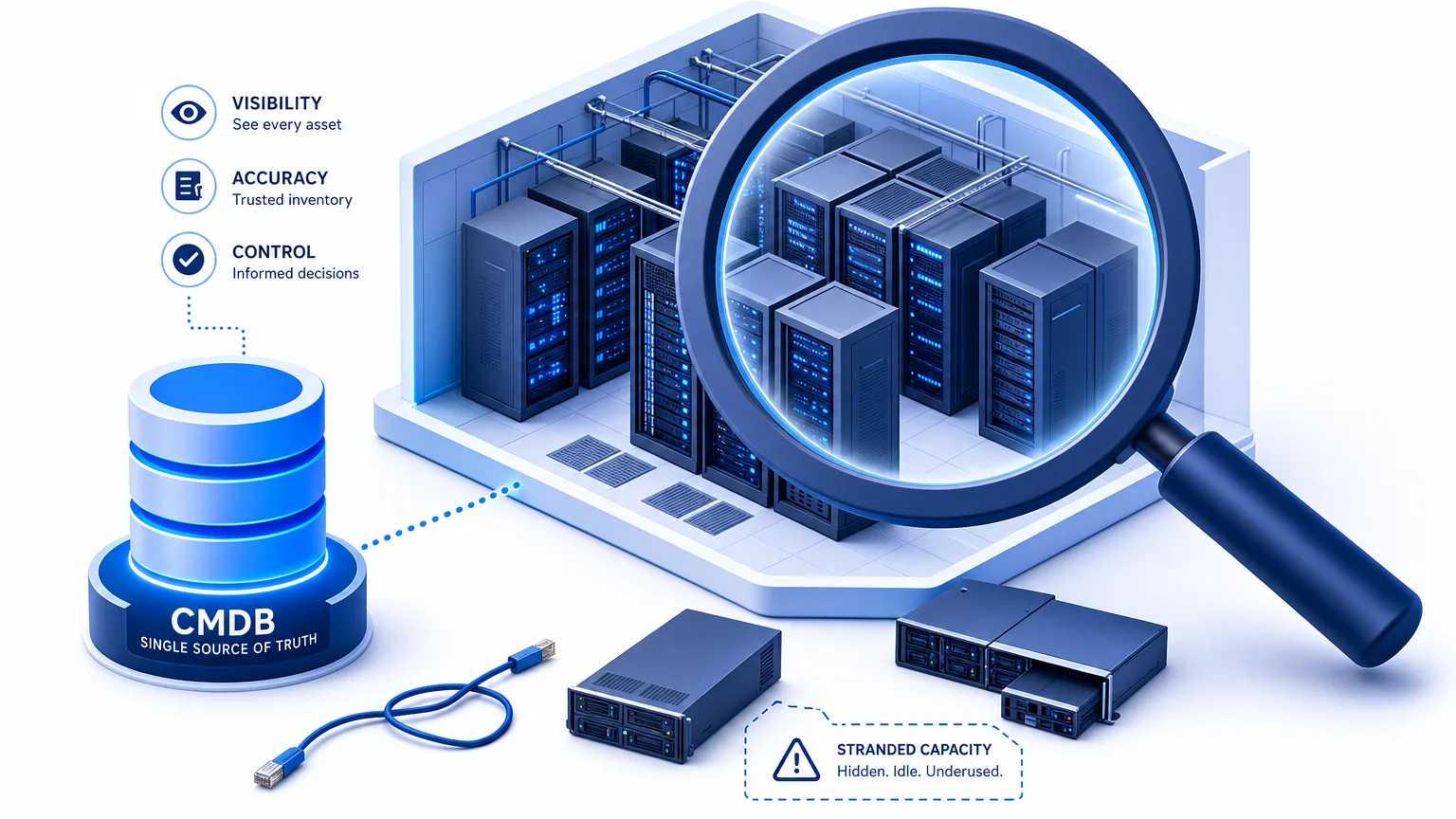
When a model shows a hall near power or rack limits, leadership often treats the facility as full. Audits regularly find stranded capacity data center patterns: resources still consuming space and power while delivering little or no business work.
Zombie hosts after project end
Applications move or retire. Physical servers stay powered because nobody closed the decommission path in inventory. The capacity model still counts their draw as legitimate demand.
Orphaned VMs and storage drift
Virtualization makes deploy cheap and cleanup optional. Abandoned test rings, forgotten staging guests, and unmapped volumes keep consuming host cycles and array capacity.
Undocumented rack changes
Emergency swaps and temporary appliances land during incidents. Elevations diverge from the spreadsheet or CMDB row. The next install fails on delivery day because free U space only existed on paper.
Sunbird’s customer stories on the same capacity-planning page describe operators reclaiming large amounts of rack footprint once inventory and planning data lined up. One university consolidation reduced rack count by 42% after clearer capacity visibility. The directional lesson holds without treating every vendor case study as universal math: shortfalls often sit beside reclaimable, untracked capacity.
Left alone, stranded capacity data center risk compounds every quarter reclaim gets deferred. Buying more floor or power while idle silicon still occupies racks is an expensive visibility failure. Reclaim decisions belong before the next expansion vote.
Why forecasting models inherit accuracy from asset data
Capacity software extrapolates from baselines and allocation records. Bad inventory compounds through every projection cycle.
| Asset condition | Inventory record | Model assumption | Facility outcome |
|---|---|---|---|
| Idle host still powered | Active production | Draw is real demand | Extra power bought for dead work |
| Hardware never removed | Marked decommissioned | Space shown free | Install fails against a full rack |
| Unmapped hypervisor cluster | Missing from inventory | Compute understated | Unnecessary host or cloud spend |
| Workload already moved to cloud | Still listed on-prem | Local growth projected | Floor reserved for traffic that left |
Manual audits and quarterly sheets age in days. Decommissions, migrations, shadow provisioning, and hybrid shifts rewrite the estate between planning meetings. Data center capacity planning that treats inventory as an annual project inherits that lag as forecast error.
CISA Binding Operational Directive 23-01 pushed federal civilian agencies toward complete asset visibility on a defined cadence. Commercial capacity programs that expand facilities without comparable inventory hygiene inherit the same class of blind spot: decisions made on partial presence data.
What causes stranded capacity in a data center?
Stranded capacity appears when inventory no longer matches the floor: idle servers still powered, orphaned VMs, and unrecorded rack changes. Power and space look consumed while reclaimable capacity sits unused. Discovery-sourced asset records reduce that gap before the next expansion purchase.
Where discovery and CMDB accuracy fit the capacity process
Separate facility telemetry from asset truth.
What DCIM tracks, and what discovery finds
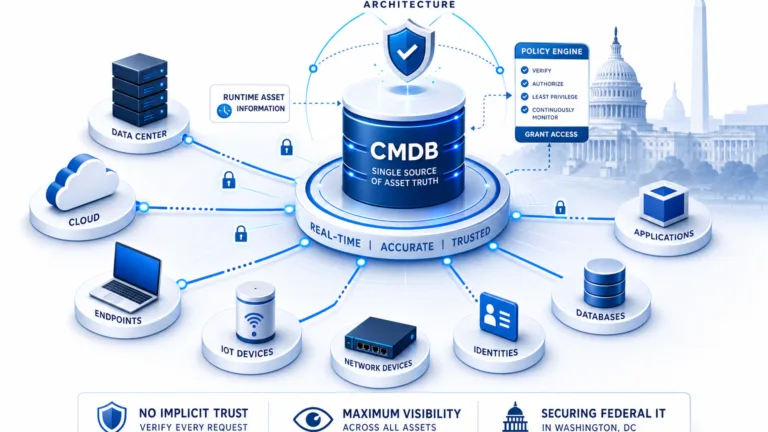
DCIM tools track PDU draw, thermal envelopes, and generator loads. They answer how much power and cooling the room uses. They still need an accurate asset and software inventory to explain which devices draw that load, which workloads still run, and which owners can authorize reclaim. That inventory layer is Virima’s lane.
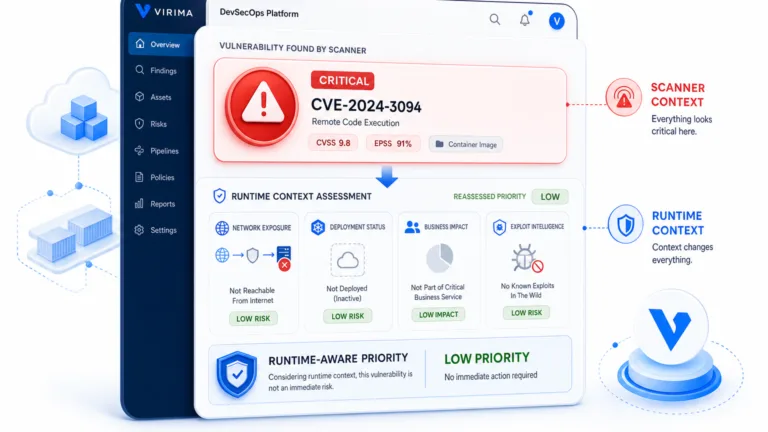
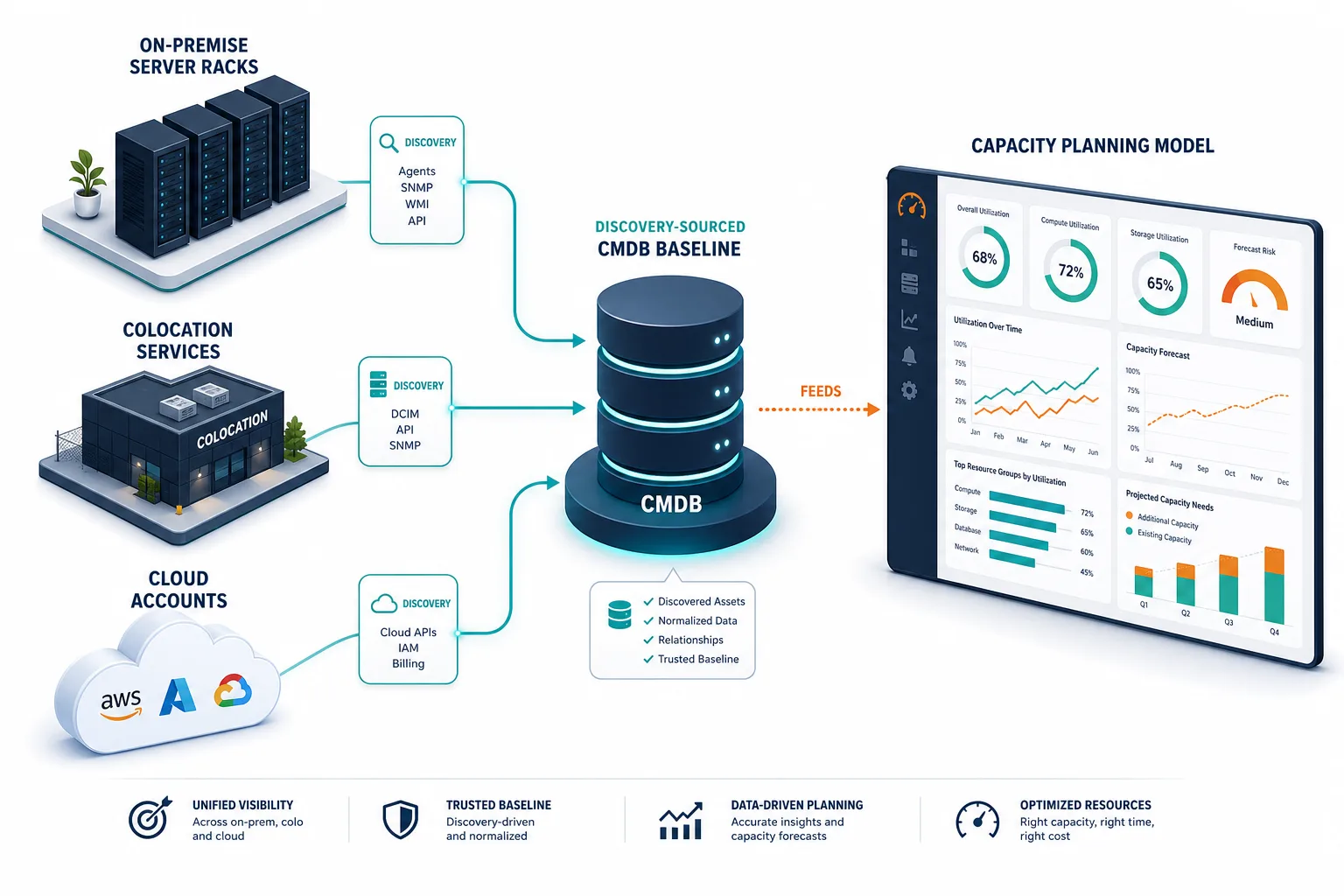
Multi-method IT discovery on a high-frequency scheduled cadence (agent, agentless, and API-based methods) refreshes physical hosts, network gear, hypervisors, and cloud instances into a governed CMDB. Software and workload signals help show whether a powered machine still does useful work. When service definitions exist, ViVID™ service maps tie racks and hosts to business paths so a reclaim decision follows which service actually depends on a rack, not just which rack draws the most power.
Where Virima’s role stops
Virima does not replace DCIM, thermal modeling, or capacity-planning solvers. It supplies discovery-sourced presence, attributes, and relationships those tools and planners model against. Event-driven streaming discovery remains roadmap territory rather than the current product surface. For how multi-method discovery approaches fit hybrid estates, see the four major approaches of IT asset discovery.
Trusted Runtime Truth for this use case means knowing what exists on the floor and in connected clouds. It also means knowing what still runs, what changed since the last plan, and who owns reclaim. Start with Trusted Runtime Truth.
How is data center capacity planning different from DCIM?
Data center capacity planning is the discipline of forecasting space, power, cooling, and network needs. DCIM software supplies facility telemetry such as power and thermal monitoring. Accurate plans need both facility signals and discovery-sourced asset inventory so models do not forecast against stale host and VM lists.
Virima integrates with ServiceNow, Jira, Ivanti, and many more through the Virima integrations hub. Capacity and facilities teams keep DCIM and ITSM tools they already run while discovery-fed CMDB rows keep the baseline honest.
Your capacity model may still rely on last quarter’s host list while the floor moved last week. See how high-frequency discovery keeps a CMDB current enough to model against before the next expansion vote.
Hybrid and multi-cloud stretch the same inventory problem
Hybrid cloud capacity planning rarely stops inside one building. On-prem halls, colo cages, and public cloud accounts now share workloads, but the capacity spreadsheet still often stops at the raised floor.
Repatriation can land unexpected compute on local racks overnight. Burst targets sit idle when routing never uses them. A project that “finished” in cloud leaves on-prem hosts powered because nobody closed the local row. Spreadsheet on-prem lists plus separate cloud consoles produce two half-stories of headroom. Hybrid cloud capacity planning needs discovery that spans physical, virtual, and cloud tiers so movements show up in one baseline the model can read.
Operations leaders feel this as surprise U-space and power pressure after a cloud program “completed.” Architecture leaders feel it as double-counting: reserved on-prem headroom for workloads that already run elsewhere. Both failures trace to split inventory, not to a weak growth formula.
For estate-wide patterns, see hybrid cloud asset discovery and hybrid discovery across on-prem, VMware, and cloud. Cloud configuration records that stay current, including patterns in how to build an AWS configuration management database, reduce shadow instances that distort enterprise-wide forecasts. Name AWS and Azure as the primary public clouds in scope; treat other providers as the same inventory problem, not a separate product claim.
A practical starting checklist for visibility-led planning
Scoped actions beat absolute promises. None of these steps claims that discovery alone finishes data center capacity planning best practices. They put inventory truth ahead of the next purchase order.
- Run multi-method discovery on a defined cadence. Agent, agentless, and API scans should refresh the estate before each major planning cycle, not once a year.
- Reconcile DCIM telemetry to CMDB rows. High power on a rack with weak software presence is a reclaim and walk-down candidate.
- Audit low-utilization hosts and orphaned VMs monthly. Confirm owners before decommission so reclaim is controlled, not accidental.
- Join capacity headroom to service context when definitions exist. Expand for critical service growth, not only for anonymous spikes.
- Track inventory freshness as a planning KPI. Last-seen age on critical racks belongs next to utilization charts.
- Document hybrid moves in the same system of record. Cloud and on-prem shifts should update one baseline the model reads.
A short pilot on one hall is enough to prove the pattern. Compare the live discovery set to the capacity workbook, list mismatches, reclaim what owners approve, then re-run the forecast. Most teams find the workbook was wrong in both directions, overstating some rows and missing others.
How often should data center capacity plans be updated?
Update capacity plans as often as inventory can be re-verified, typically monthly or on a fixed high-frequency discovery cadence rather than only annual reviews. Hardware changes, VM sprawl, and cloud moves alter utilization faster than quarterly spreadsheets can track.
Model capacity against the estate you actually run
Data center capacity planning fails when teams treat it as pure forecasting craft. No growth curve repairs a baseline that still lists dead hosts and misses live ones.
Ground models in discovery-sourced CMDB data. Reduce stranded capacity before the next hall expansion. Keep DCIM for facility telemetry and keep Virima in the inventory lane underneath. That split is how operations and architecture leaders spend capital on real demand instead of inventory fiction.
If your last expansion started from a spreadsheet nobody trusts after a rack walk, fix the baseline first. Schedule a demo to see how Virima keeps asset and software inventory current enough for capacity models to use.
Frequently Asked Questions
What role does asset inventory play in capacity forecasting?
A current data center asset inventory is the baseline every capacity model extrapolates from. Stale hosts, missing VMs, and false decommissions skew utilization trends and push teams to expand early or miss real shortfalls. Discovery-fed CMDB rows keep that baseline closer to the floor and to hybrid estates.
How does Virima’s discovery fit alongside DCIM in a capacity planning process?
Virima’s multi-method discovery (agent, agentless, and API-based) feeds a governed CMDB that DCIM tools and capacity models read from. DCIM keeps owning power and thermal monitoring; Virima’s job is confirming which racked assets are still doing real work before that power gets counted as demand.
What is a practical data center capacity planning process when inventory drifts?
Refresh discovery on a defined schedule, reconcile DCIM power and space views to CMDB presence, reclaim confirmed idle capacity, then run the growth model. Treat inventory freshness as an input gate, not an afterthought after the forecast is done.
Which data center capacity planning best practices matter most for hybrid estates?
Use one inventory baseline across on-prem, colo, and cloud, schedule discovery often enough to catch moves, and join capacity decisions to service context when definitions exist. Separate cloud consoles and floor spreadsheets hide headroom and double-count demand.
Does Virima perform data center capacity planning or DCIM monitoring?
No. Virima provides multi-method IT discovery and a governed CMDB so planners and DCIM tools work from current asset and software inventory. It does not replace thermal modeling, power chain design, or dedicated capacity-planning solvers.